
服务消费

Search documents
时报观察|电商渗透率见顶 消费结构迎来深刻转型
证券时报· 2025-11-11 23:56
Group 1 - The core viewpoint of the article highlights that the stagnation of e-commerce penetration rate does not indicate a decline in consumption but rather reflects a significant transformation in China's consumption structure from goods to services [1][2] - E-commerce penetration rate reached a peak of 27.6% in 2023 but is projected to decline to 26.8% in 2024, with the current rate around 25% [1] - The increase in service consumption, particularly in education, culture, and entertainment, shows a growth of 10.3% in per capita spending, outpacing the growth in physical goods [1][2] Group 2 - The rise of experiential and personalized service consumption indicates a shift in consumer spending patterns, leading to a ceiling for e-commerce penetration [2] - Major e-commerce platforms are integrating online and offline consumption experiences through "instant retail" to adapt to the rapid rise of service consumption [2] - Online service consumption grew by 20.2% and instant e-commerce sales increased by 24.3% in the first nine months of the year, highlighting the shift towards digital and service-oriented retail [2] Group 3 - The growth and competitiveness of both e-commerce and offline malls depend on accurately understanding consumer experiences and trust [3]


哑铃策略应对风格再平衡 机构建议布局“周期+科技”
Shang Hai Zheng Quan Bao· 2025-11-09 17:28
Group 1 - The core viewpoint is that the A-share market is experiencing a phase of style rebalancing, with a focus on "cyclical + technology" strategies due to significant performance improvements in cyclical sectors and the need for technology stocks to digest previous gains [1][2] - Institutions suggest that while cyclical sectors show strong performance, the long-term trend remains in favor of technology growth, particularly driven by AI narratives [1][2] - The current market environment indicates that the stability of the corporate overseas environment and AI industry trends are crucial variables influencing various sectors, including TMT, non-ferrous metals, chemicals, and electric new energy [1] Group 2 - Analysts emphasize the importance of recognizing the cyclical sectors' performance improvements as seen in Q3 reports, while also noting that technology growth remains the market's main focus [2][3] - The recommendation for investors is to adopt a "barbell strategy" that balances risks and returns by investing in both cyclical and technology sectors [2] - There is a suggestion to explore investment opportunities in cyclical sectors like steel, chemicals, and new consumption, alongside technology applications in AI and innovative pharmaceuticals [3]
市场风格切换是否进入博弈期?|每周研选
Shang Hai Zheng Quan Bao· 2025-11-09 15:41
Market Overview - A-shares experienced narrow fluctuations this week, with a clear sign of style rebalancing as cyclical sectors like chemicals, lithium batteries, and photovoltaics strengthened, while previously leading tech growth stocks continued to consolidate [1] - The market is expected to maintain a rapid rotation of hotspots, reflecting the gradual establishment of the "anti-involution" theme [21] Investment Strategies - Investors should focus on the phase rebalancing between technology and cyclical styles, as cyclical sectors show significant performance improvement in Q3 reports, while tech growth stocks need to digest their previous gains [1][13] - Two main strategies are suggested for next year's economic direction: one focusing on cyclical sectors like steel, chemicals, and agriculture, and the other on strong industry trends represented by AI computing [7] Sector Insights - The technology sector's development has shifted from reliance on overseas computing infrastructure to leveraging China's advantages in electricity, manufacturing, and infrastructure, indicating a revaluation of Chinese assets [5] - The cyclical sector is currently in a rebound phase, with potential opportunities in power equipment and chemicals, while the tech sector remains a long-term market focus despite current high-level consolidation [9][13] Future Market Trends - The market is likely to enter a major upward phase from November to December, with a stronger than usual style change expected in Q4 [17] - The upcoming spring market may start as early as December this year, driven by a rebalancing of positions in high-deviation sectors [19]
A股分析师前瞻:年末为什么会出现仓位与风格的再平衡?
Xuan Gu Bao· 2025-11-09 13:15
Group 1 - The focus of brokerage strategy analysts this week is on year-end style rebalancing, with historical patterns indicating that sectors with high deviation in holdings during the third quarter, such as new energy, pharmaceuticals, and food and beverage, tend to show weaker performance around November [1][3] - The fourth quarter is expected to face profit-taking pressure in main sectors, as previous main lines have accumulated significant gains, leading to high levels of capital crowding [1][3] - The structure of institutional holdings in the first three quarters of this year is evident, suggesting a high probability of position rebalancing before the spring market rally, which will create favorable conditions for better market performance [1][3] Group 2 - The strategy team from Guojin highlights the fragility of financial cycles among overseas tech giants, leading to a focus on high-certainty varieties, with A-shares also beginning a process of style rebalancing [2][4] - The transition of the tech industry's development from U.S.-led computing infrastructure to China's advantages in electricity, manufacturing, and general infrastructure represents a repricing of Chinese assets [2][4] - In the diffusion market, opportunities in specific sub-sectors within the electric equipment and chemical sectors are worth attention, including electrical instruments, titanium dioxide, organic silicon, and specialty plastics [2][4] Group 3 - The strategy team from Dongwu notes that the spring market rally is likely to experience a position rebalancing before its initiation, with a focus on sectors that have independent logic beyond AI narratives and are experiencing upward trends in ROE from long-term lows [1][3] - The analysis indicates that the small-cap style has a higher probability of rising compared to large-cap style in November, attributed to A-shares being in a performance and macro event "vacuum period," leading to active theme investments based on next year's performance expectations [1][3] Group 4 - The strategy team from Huaxi reviews the past decade, noting that November is favorable for "small-cap value + theme investment," with the market entering an active phase based on performance expectations and industry trends [1][3] - The current investment focus in A-shares may further concentrate on upstream industries and technology applications under the "anti-involution" strategy, with short-term attention on policies promoting consumption [1][3]
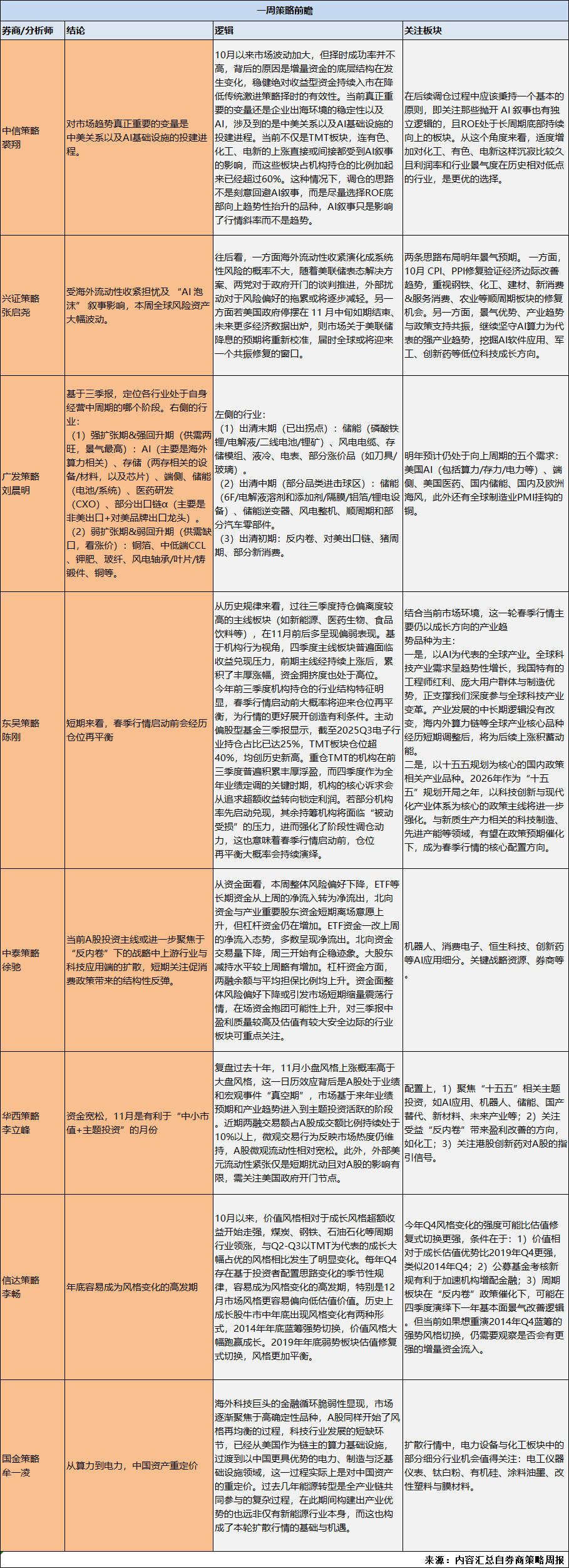
兴业证券:海外扰动下的布局思路
智通财经网· 2025-11-09 08:23
Core Viewpoint - The report from Industrial Securities highlights significant volatility in global risk assets due to concerns over tightening overseas liquidity and discussions surrounding an "AI bubble" [1] Group 1: Market Conditions - Global risk assets have experienced substantial fluctuations this week, influenced by a lack of economic data, frequent hawkish statements from the Federal Reserve, and rising liquidity pressures in the money market due to government shutdown and fiscal constraints [1] - The strong dollar has suppressed global stock markets and commodity prices, with technology-heavy indices like Nikkei 225, Korean stock index, and Nasdaq leading the decline [1] Group 2: Future Outlook - The probability of overseas liquidity tightening evolving into systemic risk is low, as solutions from the Federal Reserve and bipartisan negotiations to reopen the government are progressing, which may gradually alleviate external disturbances on risk appetite [2] - If the U.S. government shutdown ends as expected in mid-November and more economic data is released, market expectations for Federal Reserve rate cuts will be recalibrated, potentially creating a window for global recovery [3] Group 3: AI Industry Analysis - The current discussions around the "AI bubble" have caused some disturbances in the domestic AI industry chain, but Industrial Securities believes that AI's empowerment of traditional industries is still in its early stages, making it incomparable to the internet bubble of 1999-2000 [4] - The development logic of the AI industry is clear, with major global tech companies continuously defining their AI strategies, and the fundamentals of leading companies in the U.S. stock market remain strong due to ongoing R&D investments and capital expenditures [4] Group 4: Investment Strategies - The "14th Five-Year Plan" emphasizes AI as a key driver for national competition and technological innovation, indicating that the AI industry chain will be a focus area with favorable prospects next year [5] - The year-end market is seen as an important window for positioning in sectors expected to perform well in the coming year, with a focus on cyclical sectors such as steel, chemicals, construction materials, and new consumption [6][7] - High-growth sectors expected to see net profit growth of over 30% next year include AI hardware, new energy, and military industries, while sectors with expected growth of 10%-30% include pharmaceuticals and AI downstream applications [7][8]

购在中国 | “购在中国·2025精品消费月”启动
Sou Hu Cai Jing· 2025-11-06 07:19
Core Viewpoint - The "Shopping in China · 2025 Boutique Consumption Month" initiative was launched in Shanghai, aiming to enhance consumer spending and showcase premium products and services across over 100 cities in China [2] Group 1: Event Overview - The event was attended by key officials including the Vice Minister of Commerce and various city vice mayors, highlighting its national significance [2] - The initiative is part of the efforts to implement the spirit of the 20th Central Committee's Fourth Plenary Session and the decisions of the Central Government [2] Group 2: Focus Areas - The activities will focus on four main areas: boutique shopping, exquisite dining, exciting tourism, and fine performances, aimed at expanding quality consumption [2] - The initiative seeks to create new consumption scenarios that are widely impactful and highly visible, thereby continuously releasing consumer potential [2] Group 3: Participation and Promotion - At the launch, the eighth China International Import Expo featured country-specific products, and major domestic trade enterprises announced their intentions for importing goods [2] - New consumption and time-honored brand representatives showcased their latest products, while service sector companies outlined their activity plans [2]

十五五规划,提振消费将是系统性大工程
2025-11-03 02:35
Summary of Key Points from Conference Call Records Industry Overview - The conference call discusses the **Chinese consumer market** and various sectors including **home appliances**, **textiles and apparel**, **food and beverage**, and **high-end consumption** [1][2][3][4][5][6][7][8][9][10][11][12][13][14][15][16][17][18][19][20][21][22][23][24][25][26][27][28][29][30][31][32][33][34][35][36][37][38][39]. Core Insights and Arguments Government Initiatives - The **15th Five-Year Plan** emphasizes enhancing consumer spending through measures such as promoting employment, increasing wage income, stabilizing expectations, and improving the social security system [1][4][6]. - Short-term measures include a **central subsidy** of **300 billion** in 2025, with expectations for continued large-scale subsidies in 2026, albeit with a broader scope to avoid over-reliance on subsidies [1][5][6]. Consumer Market Trends - The consumer market has shifted from a bull market post-2020 to a prolonged bear market starting in 2021, primarily due to weakened purchasing power and consumption downgrade [2]. - The **A-share** consumer sector has lagged, while the **Hong Kong stock market** saw a rise in new consumption sectors in late 2024 and early 2025 [2]. Sector-Specific Insights - **Home Appliances**: Companies like **Midea** and **Haier** are expected to grow due to international competitiveness and channel reforms, despite concerns over subsidy reductions [1][13]. - **Television Industry**: **Hisense** and **TCL** are positioned to benefit from increased Mini LED penetration, enhancing brand positioning and average pricing [1][14]. - **Textiles and Apparel**: The sector is undergoing structural upgrades with rising demand for health-oriented and fashionable clothing. Despite fluctuations in overseas demand, international expansion is expected to improve order situations by 2026 [1][22][24][25]. - **Food and Beverage**: Investment opportunities lie in new consumption channels and health-oriented products, with policy support expected to stimulate demand [3][37][38]. Long-term Market Outlook - The overall market outlook for 2026 is cautious, with expectations of improved overseas business due to China's efficiency in the supply chain and technological advancements [12]. - The **high-end consumption market** is anticipated to benefit from wealth improvements and policy optimizations, particularly in sectors like luxury goods and entertainment [32]. Additional Important Insights - The **service consumption sector** is highlighted as a crucial employment channel, with increased supply in events like concerts and sports benefiting from policy optimizations [3][31]. - The **internationalization of Chinese consumer industries** is progressing, with significant competitiveness in technology and manufacturing sectors, although challenges remain in textiles and apparel [11][24][27]. - The **outdoor apparel market** is emerging as a growth area, with traditional brands expanding their product lines [26]. - The **packaging industry** is experiencing consolidation, with major players like **Aoruijin** and **Baosteel** capturing significant market share [18]. This summary encapsulates the key points discussed in the conference call, providing a comprehensive overview of the current state and future outlook of the Chinese consumer market and related industries.
国泰海通|批零社服:服务产业迎政策利好,新消费景气持续
国泰海通证券研究· 2025-10-31 10:39
Group 1: Service Consumption Catalysts - The promotion of service consumption has a higher marginal increment, with the Ministry of Commerce and nine departments recently releasing policies to expand service consumption, highlighting structural focus [1] - Historically, the structural proportion of service consumption has increased, with the ability to sustain price increases; enhancing vacation markets and flexibility will lead to higher demand elasticity [1] - In service consumption, the education sector shows rigid demand with volume and price still benefiting; policies have expanded high school education, while leading tea and coffee brands have significant expansion space and competitive advantages [1] Group 2: Symbolic Consumption and Emotional Value - Emotional value and experiential consumption address demand pain points and are rapidly realizing commercial value; industries like IP toys essentially consume symbolic and content value [2] - Interesting retail has become a clear trend in offline business development; the Chinese IP toy industry is still in a high growth phase, with leading IPs breaking through demographics, regions, and scenarios [2] - The craftsmanship of gold products is enhancing their added value, driven by consumer attributes, with innovations like ancient gold meeting young consumers' aesthetic and preservation needs [2] Group 3: New Channels Reshaping the Industry Chain - The trend in China's distribution system transformation is shifting from manufacturer-led deep distribution to consumer-driven efficient retail, with core retail capabilities evolving from site selection to product selection [3] - Retail in China is diversifying across categories and scenarios, with positive competition expected among discount snacks, community retail, and hypermarket remodels [3] - Competition in food delivery and instant retail is ongoing, with changes in fulfillment systems and differing demand attributes leading to significant shifts in competitive dynamics [3] - AI technology is being applied to new physical devices, with advancements in efficiency and commercialization in sectors like human resources, e-commerce, and education [3]

消费行业:“十五五”消费再定位,供给升级、服务扩容、需求松绑
Dongxing Securities· 2025-10-30 03:42
Investment Rating - The industry investment rating is "Positive" [4] Core Insights - Consumption will continue to be the core driver of China's economic growth during the 14th Five-Year Plan, with a focus on traditional industries, service sectors, consumption, and cultural industries as key investment areas [1][2][3] - The report emphasizes the importance of enhancing traditional industries through technological upgrades and digital transformation, particularly in sectors like textiles, light industry, and consumer goods [1] - The service sector is expected to expand with a focus on high-quality, diversified, and convenient services, benefiting areas such as elderly care, childcare, and community services [2] - The report highlights the need to stimulate consumer demand by addressing employment, income, and public service spending, which will positively impact sectors like automotive and real estate [2] - Cultural industries are seen as a means to empower consumption, with initiatives aimed at enhancing cultural enterprises and promoting international tourism [3] Summary by Sections Traditional Industries - Focus on upgrading traditional industries to enhance global competitiveness, particularly in mining, metallurgy, and textiles [1] - The report anticipates a new product cycle driven by AI and green technologies in consumer goods [1] Service Sector - Implementation of actions to enhance service quality and expand service sector capabilities [2] - The integration of modern services with advanced manufacturing is expected to create new consumption opportunities [2] Consumer Demand - The report outlines strategies to boost consumer spending, including the removal of unreasonable restrictions in automotive and housing markets [2] - Initiatives like paid staggered vacations are expected to expand consumption in tourism and leisure sectors [2] Cultural Industry - The establishment of a robust cultural industry system is crucial for attracting younger consumers and enhancing the conversion rates of cultural experiences in commercial settings [3] - The report suggests that improving the convenience of inbound tourism will benefit high-end retail and duty-free sectors [3] Investment Recommendations - Traditional consumer goods manufacturers that embrace digital and green transformations are likely to benefit from policy support and market share growth [3] - Leading companies in service sectors such as education, healthcare, and tourism are expected to gain from policy backing and expanding demand [3]
解码中国消费新趋势
Shang Hai Zheng Quan Bao· 2025-10-28 19:37
Core Insights - The article highlights the transformation of China's consumption landscape, emphasizing the shift towards quality, cultural identity, and technological innovation as key drivers of market dynamics [1][2][3] Group 1: Consumer Trends - The Chinese market is witnessing a significant upgrade in consumer goods, with a focus on quality and smart technology, as evidenced by the rise in sales of high-end appliances [2] - Data from Taobao and Tmall indicates that during this year's "Double 11" shopping festival, 80 brands achieved over 100 million yuan in sales within the first hour, showcasing the demand for premium products [2] - The trend is shifting from basic functionality to enhanced user experience, with consumers increasingly favoring high-quality and branded products [2][3] Group 2: Service Consumption - Service retail sales in China grew by 5.2% year-on-year in the first nine months of the year, outpacing the growth of goods retail sales, indicating a shift towards service-oriented consumption [3] - The growth in service consumption is driven by demographic changes and technological advancements, with sectors like elderly care and experiential services gaining traction [3][4] Group 3: Emotional and Cultural Consumption - New consumption scenarios centered around emotional connections and cultural identity are emerging, reflecting a shift in younger consumers' motivations from functional satisfaction to emotional resonance [5][6] - Products that incorporate unique designs and humor are gaining popularity, as they provide emotional comfort and reflect the identity and expression of the younger generation [5][6] - The integration of traditional aesthetics with modern design is enhancing product differentiation and driving the growth of domestic brands, showcasing a blend of cultural confidence and commercial value [6]