
金融

Search documents
美国GDP公布后,美元、美债走低,黄金收涨!
Jin Rong Shi Bao· 2025-12-24 08:00
Group 1 - The core viewpoint of the articles indicates that the U.S. GDP grew at an annualized rate of 4.3% in Q3, surpassing the 3.8% growth rate of Q2, driven by increased consumer spending, exports, and government spending [1][2] - Consumer spending, which accounts for about 70% of the U.S. economy, increased by 3.5% in Q3, up from 2.5% in Q2, contributing 2.39 percentage points to GDP growth [2] - Exports rose by 8.8%, contributing 1.59 percentage points to GDP growth, while government consumption and investment added 0.39 percentage points [2] Group 2 - Non-residential fixed investment grew by only 2.8% in Q3, significantly lower than the 7.3% growth in the previous quarter, indicating potential concerns regarding business investment [1] - Despite the strong GDP growth figures, financial markets reacted calmly, with the U.S. dollar index falling by 0.35% and U.S. Treasury yields showing mixed movements [1] - Economists suggest that while the economy maintained growth momentum in Q3, potential pressures from a federal government "shutdown" could lead to a slowdown in Q4, with projections for 2025 GDP growth possibly dropping to 2% or lower [2]
鼓励外商投资目录迎扩容,先进制造、现代服务业是重点
Xin Lang Cai Jing· 2025-12-24 07:56
Core Viewpoint - The release of the "Encouragement Directory for Foreign Investment Industries (2025 Edition)" aims to attract and utilize foreign investment more effectively, with new regulations set to take effect on February 1, 2026 [1][5]. Summary by Categories Changes in the Encouragement Directory - The new directory includes a total of 1,679 entries, with a net increase of 205 entries and 303 modifications compared to the 2022 version [1][5]. - The national directory for encouraging foreign investment now has 619 entries, an increase of 100, while the directory for advantageous industries in central and western regions has 1,060 entries, with an increase of 105 [1][5]. Focus Areas for Foreign Investment - The directory emphasizes three main areas for foreign investment: 1. **Advanced Manufacturing**: New or expanded entries in terminal products, components, and raw materials to enhance the development of industrial and supply chains [2][6]. 2. **Modern Services**: New or expanded entries in business services, technical services, scientific research, and service consumption to promote high-quality development in the service sector [2][6]. 3. **Regional Investment**: Encouragement for foreign investment in central and western regions, northeastern regions, and Hainan Province, tailored to local resources and industrial development [3][7]. Foreign Investment Trends - From January to November 2025, China utilized 693.18 billion RMB in foreign investment, a year-on-year decrease of 7.5%, but with a significant monthly increase of 26.1% in November [3][7]. - The number of newly established foreign-invested enterprises reached 61,207, marking a growth of 16.9% [3][7]. Future Strategies for Attracting Foreign Investment - The National Development and Reform Commission (NDRC) plans to enhance foreign investment through three strategies: 1. **Expanding Foreign Capital Inflow**: Utilizing major foreign investment projects to create a green channel for project construction and addressing national-level issues related to land, sea use, environmental assessments, and energy consumption [3][7]. 2. **Improving Satisfaction of Foreign Enterprises**: Conducting special actions to understand and resolve issues faced by foreign enterprises in investment and operations, while enhancing communication with foreign investors [3][7]. 3. **Building Investment Cooperation Platforms**: Organizing international investment cooperation activities to facilitate project negotiations and signings [4][8].
华创张瑜:2026年将是中国股市配置价值觉醒元年,中游制造是最确定方向 | Alpha峰会
Hua Er Jie Jian Wen· 2025-12-24 07:16
Core Viewpoint - The year 2026 is anticipated to be a pivotal year for the awakening of value in China's capital market, moving towards a low-volatility and high-Sharpe ratio investment phase [1][6][26]. Economic Outlook - China's economy is expected to emerge from its low point and enter a recovery phase, with exports remaining a key support for macroeconomic performance in 2026 [1][30]. - Despite overall external demand pressure, China's manufacturing competitiveness remains intact, particularly in the midstream sector, which is expected to show resilience in exports [1][30]. - CPI is likely to trend positively, with a high certainty of turning positive, reflecting the ongoing recovery in domestic demand [1][30][33]. - PPI is expected to show an upward trend, but its year-on-year positive growth needs to be verified in the second quarter [1][30][37]. Policy Perspective - Macro policies are shifting away from "extraordinary" measures, focusing instead on stabilizing expectations and supporting economic operations [2][26]. - The emphasis will be on sustainable policy adjustments rather than large-scale stimulus, with a focus on balancing short-term and long-term goals [2][27]. Asset Allocation Insights - In 2026, a "dual bull market" in stocks and bonds is unlikely; the focus will be on asymmetric volatility between the two asset classes [2][5]. - Investors are encouraged to consider undervalued, high-dividend sectors for allocation, while speculative funds should target industries with high capacity utilization and limited capital expenditure [2][5]. Sector-Specific Analysis - The midstream manufacturing sector is identified as the most certain area of prosperity for 2026, supported by enhanced export competitiveness and the implementation of anti-involution policies [5][30]. - The return on equity (ROE) in midstream manufacturing is expected to stabilize and improve, with PPI year-on-year growth anticipated to stop declining in the first half of the year [5][30]. Market Dynamics - The trend of residents moving their savings into financial assets is expected to continue, although risk appetite may not rise rapidly [2][5]. - The stock market's trading volume is projected to remain high but may not see significant increases compared to previous years [2][5]. Price Trends - The housing market's recovery is contingent on mortgage rates being lower than rental yields, which is a critical condition for stabilizing property prices [5][40]. - The relationship between mortgage rates and rental yields is highlighted as a key indicator for predicting housing price stabilization [5][40].


美对台军售闯下大祸,中方怒抛118亿美债!解放军40架次军机围台
Sou Hu Cai Jing· 2025-12-24 06:36
Group 1 - The U.S. recently approved a record $11.1 billion arms sale to Taiwan, including offensive weapons such as M109A7 self-propelled howitzers and HIMARS long-range strike systems, aimed at enhancing Taiwan's military capabilities and complicating China's efforts for reunification [1] - The arms sale is seen as a political tool by U.S. politicians, particularly as the midterm elections approach, with Trump leveraging it to appeal to conservative factions and the military-industrial complex while diverting attention from domestic issues [1] - Taiwan's defense budget is expected to exceed 3% of its GDP due to the costly arms acquisition, leading to a potential cycle of debt and economic strain, as funds are diverted from social welfare to military spending [9] Group 2 - China has significantly reduced its holdings of U.S. Treasury bonds to $688.7 billion, the lowest since 2008, signaling a strategic decision to lower risk and reduce dependence on dollar assets amid rising U.S. debt and fiscal instability [3] - The Chinese military has demonstrated its capabilities with increased activity around Taiwan, including the deployment of aircraft and naval vessels, indicating a strong military response to perceived provocations [5] - The disparity in military capabilities between China and Taiwan is stark, with Taiwan's military relying heavily on imports and facing challenges in self-production, while China's military strength continues to grow, complicating the security landscape in the region [7] Group 3 - The U.S. strategy of arming Taiwan and rallying allies like Japan and Australia is becoming less effective as American hegemony declines, with concerns over the credibility of the dollar increasing due to China's actions [9] - The arms sale is unlikely to resolve the U.S. economic challenges or support Taiwan's independence aspirations, as the military assets acquired may not enhance security but rather hinder Taiwan's economic development [9] - Historically, the process of national reunification is viewed as irreversible, with external interventions and internal resistance unable to alter the eventual outcome of Taiwan's return to China [10]

港股提前收市,核电股大涨,中广核矿业涨超5%
21世纪经济报道· 2025-12-24 05:37
Group 1 - The Hong Kong stock market closed early on December 24 due to the holiday, with the Hang Seng Index rising by 0.17% and the Hang Seng Tech Index increasing by 0.19% [1] - Nuclear power stocks led the gains, with China General Nuclear Power Corporation rising over 5% [1] - Semiconductor stocks also performed well, with SMIC and Jingmen Semiconductor both increasing by over 3%, while Huahong Semiconductor and Shanghai Fudan rose by over 1% [1] Group 2 - The article highlights a strong performance in the optical communication sector, with Cambridge Technology rising over 5% [1] - Other sectors that saw gains include dairy products, electric equipment, food, non-ferrous metals, building materials, cement, and gold [1] - Conversely, sectors such as film, lithium batteries, home appliances, domestic banks, port transportation, and innovative pharmaceuticals experienced declines [1] Group 3 - The semiconductor sector showed slight fluctuations, with major companies like Alibaba, Meituan, Xiaomi, JD.com, and Baidu experiencing declines of less than 1% [2] - Individual stock movements included a significant rise of 22.23% for Baidu's stock after being included in the Hong Kong Stock Connect, while Youjia saw a drop of over 7% [4] - The article notes that over 3,800 stocks rose, with commercial aerospace and chip concepts experiencing a surge, and Zhongjin Resources rising over 6% [6]

美国2025年三季度GDP数据点评:25Q3美国GDP:过时的数据,过度的反应
Soochow Securities· 2025-12-24 04:05
Economic Performance - Q3 2025 US GDP grew at an annualized rate of +4.3%, significantly exceeding Bloomberg analysts' consensus of +3.3% and Atlanta Fed's GDPNow estimate of +3.5%[1] - The GDP price index increased by +3.8%, compared to an expected +2.7% and a previous value of +2.1%[1] Consumption and Inventory - Strong consumer spending contributed +2.39% to GDP growth, with a quarterly increase of +3.5%, up from +1.68% in the previous quarter[1] - Inventory changes had a marginal contribution of -0.22%, improving from -3.44% in the previous quarter, indicating a reduction in inventory drag[1] Investment Trends - Fixed asset investment growth slowed to +1% in Q3, down from +4.4% in Q2, with non-residential fixed asset investment decreasing to +2.8%[1] - AI-related industry investment growth decelerated, with contributions to GDP from computer information equipment and software dropping significantly[1] Market Reactions - Initial market reactions to the strong GDP data indicated fears of economic overheating, leading to a rise in the dollar index and US Treasury yields, while equities and commodities fell[1] - Following the initial reaction, asset prices reversed, with US Treasury yields and the dollar declining, while equities rebounded[1] Future Outlook - Q4 2025 GDP growth is expected to significantly cool due to government shutdown impacts, with consumer spending showing signs of decline[2] - The Congressional Budget Office estimated a potential -1.5% impact on Q4 GDP due to the government shutdown, alongside high base effects from Q3[2] Core Economic Indicators - The Private Domestic Final Purchases (PDFP) annualized growth rate remained stable at +3.0%, only slightly up from +2.9% in the previous quarter, indicating resilient core economic growth[1] - Daily consumer spending growth has recently dropped to +0.156% year-on-year, suggesting a potential drag on Q4 GDP[2]
美银调查:基金经理几乎“满仓”跨年!现金水平降至3.3%历史新低
华尔街见闻· 2025-12-24 04:01
投资者正以极度乐观的姿态步入新的一年,尽管心中仍对2026年可能面临的挑战存有顾虑,但当下的做多热情已占据主导地位。 据美国银行(Bank of America)最新的基金经理调查显示, 基金经理们的现金水平已大幅降至资产管理规模的3.3%,创下历史新低 。与此同时,投资者对经 济增长、股票和大宗商品的信心爆棚,这两类通常在经济扩张期表现良好的资产, 其合计敞口已达到2022年2月以来的最高水平 。 12月23日,彭博市场策略师Michael Msika发文称,这种近乎"满仓"的激进仓位反映出, 市场对进一步反弹的预期压倒了对高估值、人工智能(AI)巨额资本 支出以及盈利预期的担忧 。尽管科技股仍是主要驱动力,但 投资者在过去两个月已开始进行板块轮动,随着更有吸引力的投资机会出现,这种轮动正在拓宽 市场的上涨广度。 文章也指出,有策略师们警告称,在这股乐观情绪背后,经济前景并非没有阴云。 通胀的粘性、劳动力市场的动态变化以及美联储微妙的平衡术,仍是投资者 需要警惕的结构性风险。 极度乐观的仓位配置 根据美国银行的基金经理调查数据,随着新年的临近,仓位情况显得相当拥挤。投资者大幅削减现金持有量,转而押注于风险资 ...


连续16天净流入!A500ETF基金(512050)冲击4连涨,最新规模超300亿元
Xin Lang Cai Jing· 2025-12-24 03:26
A500ETF基金紧密跟踪中证A500指数,中证A500指数从各行业选取市值较大、流动性较好的500只证券 作为指数样本,以反映各行业最具代表性上市公司证券的整体表现。 数据显示,截至2025年11月28日,中证A500指数(000510)前十大权重股分别为宁德时代(300750)、贵州 茅台(600519)、中国平安(601318)、招商银行(600036)、紫金矿业(601899)、中际旭创(300308)、美的集 团(000333)、兴业银行(601166)、新易盛(300502)、长江电力(600900),前十大权重股合计占比20.04%。 A500ETF基金(512050),场外联接(华夏中证A500ETF联接A:022430;华夏中证A500ETF联接C: 022431;华夏中证A500ETF联接Y:022979),相关指数基金(华夏中证A500指数增强A:023619;华夏 中证A500指数增强C:023620), A500增强ETF基金(512370) 从资金净流入方面来看,A500ETF基金(512050)近16天获得连续资金净流入,最高单日获得28.78亿元净 流入,合计"吸金"137.8 ...
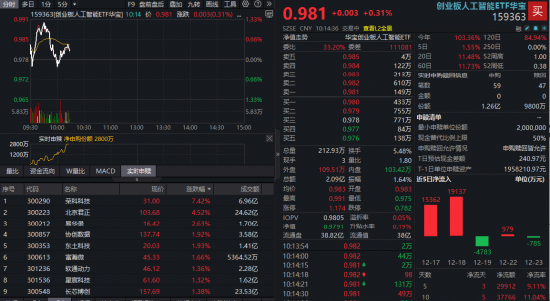
中际旭创股价再刷新高!创业板人工智能ETF(159363)获资金净流入!英伟达H200或在春节前交付中国客户
Xin Lang Cai Jing· 2025-12-24 02:38
Core Viewpoint - The market for AI computing power continues to thrive, with significant activity in optical modules and related hardware, indicating strong demand and investment opportunities in the sector [1][3]. Group 1: Market Performance - Optical module CPO and other computing hardware showed active performance, with Zhongji Xuchuang's stock rising nearly 3% to a new high and Beijing Junzheng increasing over 5% [1][6]. - The largest and most liquid AI ETF on the ChiNext board (159363) saw an intraday increase of over 1%, with active buying reflected in a net subscription of 28 million shares [1][6]. Group 2: AI Chip Supply - NVIDIA plans to deliver its second-ranked AI chip, the H200, to Chinese customers by mid-February 2024, with an expected shipment of 5,000 to 10,000 chip modules, equating to approximately 40,000 to 80,000 H200 chips [2][8]. Group 3: Investment Recommendations - Longjiang Securities emphasizes the importance of AI computing power and suggests focusing on the first AI ETF on the ChiNext board (159363) and its associated funds, which have a significant allocation to optical modules [3][8]. - The ETF has a recent scale exceeding 3.8 billion CNY, with an average daily trading volume of over 600 million CNY, ranking first among seven ETFs tracking the ChiNext AI index [3][8].


巩固“稳”的基底 开拓“进”的新局——聚焦省委经济工作会议①
Da Zhong Ri Bao· 2025-12-24 01:15
Group 1 - The core viewpoint emphasizes the steady growth and positive trajectory of Shandong's economy, with key indicators showing resilience and improvement [1][2] - In the first eleven months, the province's industrial added value increased by 7.7%, retail sales of consumer goods grew by 5.2%, and foreign trade rose by 4.6% [1] - Shandong is set to become the third province in China and the first in the north to surpass a GDP of 10 trillion yuan, marking significant economic milestones [1] Group 2 - The "six musts" outlined in the Central Economic Work Conference are crucial for guiding Shandong's economic development, focusing on policy support, innovation, and leveraging local advantages [2][3] - The province aims to enhance its economic structure by addressing long-standing issues while also adapting to new challenges, indicating a dual focus on stability and progress [3][4] - The emphasis on "stability" includes maintaining employment, businesses, markets, and expectations, while "progress" involves implementing key industrial projects and fostering new growth drivers [4][5] Group 3 - The service sector is identified as a key engine for economic growth and job creation, with a reported 5.3% increase in revenue from the service industry in the first ten months of the year [5][6] - Despite the growth in the service sector, challenges remain regarding its overall size and quality, prompting calls for targeted strategies to enhance its development [6] - The focus on specific industries, such as wholesale and retail, finance, and transportation, highlights the need for tailored policies to boost service sector performance [6]