债券

Search documents
信用债“补涨”可持续吗?
Changjiang Securities· 2025-10-22 11:41
1. Report Industry Investment Rating - Not provided in the given content 2. Core Viewpoints of the Report - From October 13th to 17th, the "catch - up" market in the credit bond market was mainly due to valuation restoration brought by loose capital, but its sustainability is under test. The current market relies more on capital gains rather than fundamental drivers and is vulnerable to fluctuations in the fund's liability side and potential policy implementation [1][6]. - Credit bond valuation restoration still has some sustainability as the market is in a transition stage where negative factors are being digested and positive factors are not fully priced. However, the fund's liability side is relatively fragile, and the inflow of wealth - management funds is prudent [6]. - In mid - to late October, the credit bond investment strategy should focus on the allocation opportunities of 3 - 5Y varieties, with a core principle of being stable and structured. It is necessary to balance risk control and return certainty [7]. 3. Summary by Relevant Catalogs 3.1 Yield and Spread Overview 3.1.1 Yields and Changes of Each Maturity - Yields of various bonds such as treasury bonds, local government bonds, and corporate bonds at different maturities (0.5Y, 1Y, 2Y, 3Y, 5Y) showed different degrees of change compared to the previous week, with historical quantiles ranging from single - digit percentages to around 50% [14]. 3.1.2 Spreads and Changes of Each Maturity - Credit spreads of different bonds also changed compared to the previous week, and historical quantiles varied widely, from less than 1% to over 70% [16]. 3.2 Credit Bond Yields and Spreads Classified by Category (Hermite Algorithm) 3.2.1 Yields and Spreads of Urban Investment Bonds by Region - Yields and spreads of urban investment bonds in different provinces showed different trends. For example, in Anhui, yields at various maturities decreased compared to the previous week, and credit spreads also showed corresponding changes [20][23]. 3.2.2 Yields and Spreads of Industrial Bonds by Industry - Not provided in the current content 3.2.3 Yields and Spreads of Financial Bonds by Issuer - Not provided in the current content 3.2.4 Yields and Spreads of Credit Bonds Classified by Category (Balance Average Algorithm) - Not provided in the current content 3.3 Key Indicator Tracking of the Credit Bond Market 3.3.1 Performance of Major Bond Indexes - Not provided in the current content 3.3.2 Wealth - Management Scale and Break - Even Rate - Not provided in the current content 3.3.3 Capital and Market Sentiment Index - Not provided in the current content
利率专题:2025,债券资产重估之年
Tianfeng Securities· 2025-10-22 08:13
1. Report Industry Investment Rating No relevant content provided. 2. Core View of the Report In 2025, the bond market has shifted from a unilateral bull market in 2024 to a continuous wide - range oscillation pattern. Since the third quarter, due to factors such as the "anti - involution" policy, the stock - bond "see - saw" effect, and the fund fee rate new - rule solicitation, the bond market has experienced overall value re - evaluation. Looking forward to the fourth quarter, there are both positive and negative factors in the bond market, and it is expected to show an oscillatory pattern with limited trend - based market opportunities [1][9]. 3. Summary According to the Directory 3.1 Macro - narrative Changes and the Re - evaluation of Bond Assets - **Overall Market Change**: The bond market has shifted from a unilateral bull market in 2024 to a wide - range oscillation pattern. Since the third quarter, influenced by factors like the "anti - involution" policy and the fund fee rate new - rule solicitation, bond market interest rates have fluctuated upwards, and bond assets have undergone comprehensive value re - evaluation. As of October 20, 2025, the yields of 1 - year, 10 - year, and 30 - year treasury bonds have all increased compared to the beginning of the year [9]. - **Deviation from Fundamental and Liquidity**: In the third quarter, the weak fundamentals and loose liquidity could not explain the bond market's fluctuations. The bond market was mainly driven by the "asset re - allocation" logic and the "re - inflation" expectation under the "anti - involution" policy. Regulatory policies also had an impact on the bond market [11]. - **Investor Behavior Change**: Since the third quarter, both residents and institutions have adjusted their asset allocation, reducing the proportion of bond assets and increasing the allocation of equity assets. This has had an impact on the bond market's capital supply [12]. 3.2 "Triple" Re - evaluation of Interest - rate Bonds - **Obvious Interest Rate Callback**: Since the third quarter, affected by policies and regulatory changes, the bond market sentiment has been under pressure, and the yields of long - term and ultra - long - term bonds have increased significantly. As of October 20, 2025, the 10 - year and 30 - year treasury bond yields are at relatively high levels in 2025 [17]. - **Widening of Term Spreads**: The term spreads of 10 - year - 1 - year and 30 - year - 10 - year treasury bonds have widened, and the yield curve has evolved towards a bear - steep state [18]. - **Increase in Variety Spreads**: The 10 - year China Development Bank bond - treasury bond spread has been re - evaluated. Under the influence of the fund fee rate new - rule solicitation, the redemption pressure of bond funds may increase, and the spread between China Development Bank bonds and treasury bonds may widen [23]. 3.3 Differentiation and Remodeling of Credit Spreads - **Relatively Resistant Short - term Credit**: Short - term credit bonds are relatively resistant to decline. The yield increase of medium - and short - term general credit bonds is mostly within 10BP, and the credit spread has slightly narrowed [25]. - **Re - emergence of the "Interest Rate Amplifier" Attribute of Tier 2 and Perpetual Bonds**: The yields of long - term Tier 2 and perpetual bonds have increased significantly, and the current credit spread quantile is above 90% [25]. - **Value Remodeling of Long - term General Credit Bonds**: Under the influence of the fund fee rate new - rule solicitation, the demand for long - term general credit bonds is weak, and the adjustment range of ultra - long - term credit bonds is relatively large [25]. 3.4 High Premium Rate in the Convertible Bond Market - **Overall High Value in the Third Quarter**: In the context of the overall re - evaluation of the bond market, the valuation system of convertible bonds is also being remodeled, and their value in the third quarter is at a relatively high historical level [27]. - **Stable Average Pure Bond Value and Rising Pure Bond Premium Rate**: The pure bond value of the convertible bond market in the third quarter has remained stable, while the pure bond premium rate has risen, indicating that the equity nature of convertible bonds is stronger than the bond nature [27]. - **Increased Average Conversion Value and Relatively High Conversion Premium Rate**: The average conversion value of the whole market has increased, and the conversion premium rate is at a relatively high historical level [28]. 3.5 Tariff Hedging vs. Macro - narrative: Which Will Prevail? - **Fourth - quarter Bond Market Review**: In October, the bond market usually fluctuates greatly, and it is an important window for the introduction of fourth - quarter growth - stabilization and credit - easing policies. From November to December, the bond market usually enters a repair period [38]. - **Positive Factors for the Bond Market**: Tariff disturbances may bring hedging sentiment and easing expectations; the policy effect in the fourth quarter may weaken, and economic growth may slow down; the capital market is balanced and stable, and the central bank's supportive attitude remains; the bond market odds have improved, and the attractiveness to allocation - type funds may increase [3][41]. - **Negative Factors for the Bond Market**: The implementation of the fund sales fee rate reform may trigger redemption and position - adjustment behaviors; the "re - inflation" expectation and macro - narrative changes under the "anti - involution" policy may have a long - term impact on the bond market [3]. - **Outlook for the Bond Market**: In the fourth quarter, the bond market is expected to show an oscillatory pattern with a trading range for the 10 - year treasury bond yield between 1.7% - 1.9%. However, due to various factors, it is difficult to have a trend - based market [48].
中抛美债停不下来!不是瞎操作,是防美国冻资产的后手
Sou Hu Cai Jing· 2025-10-22 04:58
Group 1 - The core point of the article highlights a significant decline in foreign holdings of U.S. Treasury bonds, particularly by China, which has dropped to $730.7 billion, the lowest level since 2008, indicating a directional withdrawal from U.S. debt [1][3][11] - The U.S. fiscal report for the first half of fiscal year 2025 shows a deficit of $1.307 trillion and net interest payments of $582 billion, reflecting increasing debt costs and raising concerns about fiscal sustainability [5][17][34] - The trend of decreasing U.S. Treasury holdings is accompanied by a simultaneous increase in gold reserves, with central banks globally net buying over 400 tons of gold, indicating a shift towards physical assets as a hedge against risks [9][21][28] Group 2 - The European Union's decision to use frozen Russian central bank assets for loans to Ukraine marks a significant shift in international financial practices, suggesting that political factors are increasingly influencing financial security [7][15][34] - The overall structure of foreign holdings in U.S. Treasury bonds is changing, with countries like Japan and the UK showing fluctuating positions while China continues to reduce its holdings [9][19][30] - The rising gold prices, which have surpassed $2,400 per ounce, contrast with the declining U.S. Treasury bond prices, indicating a market preference for gold as a safer asset amid increasing geopolitical tensions and financial uncertainties [24][26][36]


上交所:N应流转盘中临时停牌
Mei Ri Jing Ji Xin Wen· 2025-10-22 02:30
每经AI快讯,10月22日,上交所公告,N应流转(113697)今日上午交易出现异常波动。根据《上海证券 交易所可转换公司债券交易实施细则》的有关规定,本所决定,自2025年10月22日9时25分开始暂停N 应流转(113697)交易,自2025年10月22日14时57分起恢复交易。 ...
Global investors like the new-look Japan government, for now
Reuters· 2025-10-21 15:39
Core Viewpoint - Global money managers are increasingly interested in Japan's stock and debt markets due to the new reflationist government's policies and the need to diversify from more expensive U.S. and European markets [1] Group 1 - Japan's stock and debt markets are becoming attractive to global investors [1] - The new government's reflationist approach is a significant factor in drawing investors back to Japan [1] - There is a growing desire among investors to diversify their portfolios away from pricier markets in the U.S. and Europe [1]

固定收益周报:四季度债市或将维持震荡格局-20251021
Shanghai Aijian Securities· 2025-10-21 11:43
1. Report Industry Investment Rating No relevant content provided. 2. Core Viewpoints of the Report - The bond market is expected to show a warming trend in the fourth quarter compared to the third quarter, but it is still a relatively weak asset and is likely to be dominated by a volatile market. Investors are advised to be cautiously optimistic and flexibly seize trading opportunities [5][58]. - In the short term, the resurgence of trade frictions provides some support for the bond market, but the conflict may still fluctuate. Attention should also be paid to the potential short - term disturbances caused by the reform of public fund sales fees and the potential selling pressure from banks [5][58]. - It is recommended to prioritize the layout of medium - and short - term bond varieties, such as 5 - 6 - year policy financial bonds and local bonds, and 7 - year and 10 - year China Development Bank bonds, which have sufficient spread protection [5][58]. 3. Summary by Directory 3.1 Bond Market Weekly Review - From October 13th to 17th, the bond market showed a volatile pattern under the influence of multiple factors such as tariff disturbances, fundamental data, policy signals, and market sentiment, with the yield curve shifting downward overall. The yield of the 10 - year Treasury active bond decreased by about 0.5bp to 1.7475% [2][8]. - Treasury yield performance was differentiated, and most of the key - term spreads of Treasury bonds narrowed [10][14]. 3.2 Bond Market Data Tracking 3.2.1 Funding Situation - From October 13th to 17th, the central bank's open - market operations had a net withdrawal of 49.79 billion yuan. The next week's reverse - repurchase maturity is 67.31 billion yuan, less than the previous week. The funding rate has increased, and the funding situation remains in a tight balance [16][17]. - The SHIBOR rate showed a differentiated performance, with the overnight, 1 - week, 2 - week, 1 - month, and 3 - month rates changing by 0.40bp, 1.20bp, - 2.10bp, 0.10bp, and - 0.10bp respectively as of October 17th compared to October 11th [28]. 3.2.2 Supply Side - From October 13th to 17th, the total issuance of interest - rate bonds increased, with the net financing amount also increasing. The government bond issuance scale increased month - on - month, while the net financing amount decreased month - on - month. The issuance scale of inter - bank certificates of deposit increased, with the net financing amount increasing month - on - month and the issuance rate rising [34][35][43]. 3.3 Next Week's Outlook - The supply pressure of Treasury bonds will increase next week. The planned issuance of Treasury bonds is 633 billion yuan, and the planned issuance of local government bonds is 196.7 billion yuan [3][56]. - The funding situation is likely to remain relatively loose. Before the tax - payment period disturbance, the funding situation is expected to maintain a relatively loose state [4][57]. 3.4 Bond Market Strategy - The bond market is expected to remain in a volatile pattern in the fourth quarter. It is recommended to prioritize the layout of medium - and short - term varieties and look for varieties with similar maturities and wider spreads [5][58]. 3.5 Global Asset Classes - The U.S. Treasury yield curve steepened. The 10Y - 2Y term spread widened by 3bp to 56bp [59]. - The U.S. dollar index declined slightly, and the central parity rate of the U.S. dollar against the RMB was lowered. The prices of gold and silver rose significantly, while the price of crude oil declined slightly [59][60][63].
华尔街先知Yardeni:油价下跌将推动10年期美债收益率降至3.75%
Hua Er Jie Jian Wen· 2025-10-21 07:38

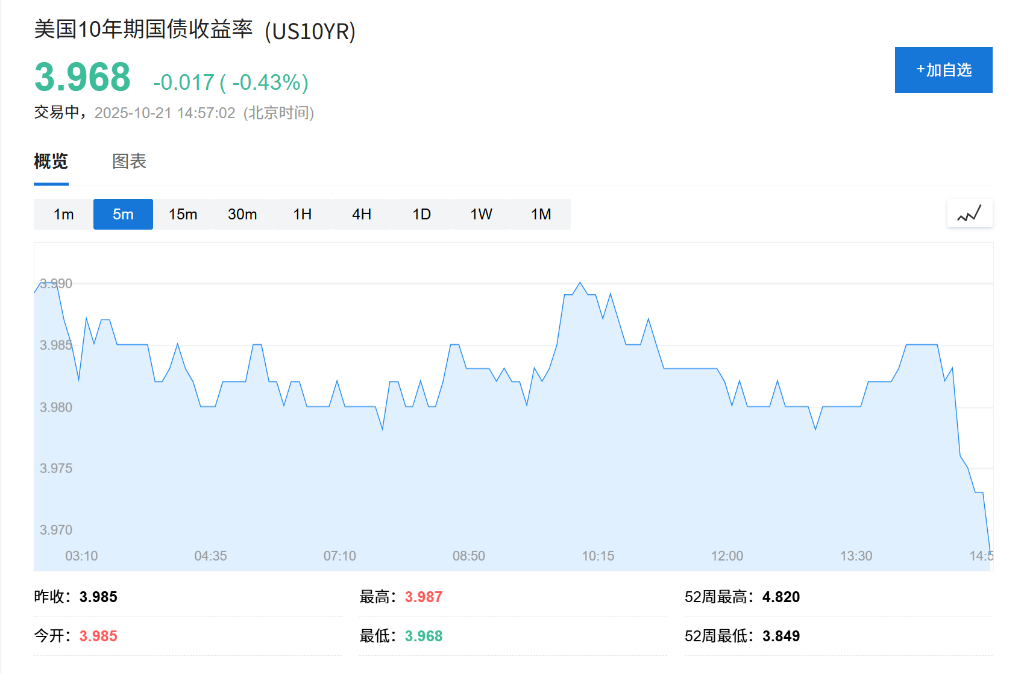
Group 1 - Ed Yardeni predicts that declining oil prices may push the benchmark 10-year U.S. Treasury yield back to levels not seen in over a year, potentially reaching 3.75% if the Federal Reserve lowers interest rates next week [1] - The prediction is based on the long-term correlation between oil prices and Treasury yields, where oil prices influence inflation, which in turn affects the interest rate market [1] - The recent rally in U.S. Treasuries has been supported by expectations of Fed rate cuts and concerns over regional bank risks, with the 10-year Treasury yield hovering around 3.96% and a cumulative decline of approximately 17 basis points this month [1] Group 2 - The simultaneous rise of U.S. Treasuries and equities is noted as a "rare" market moment, indicating traders are betting on a "Goldilocks" scenario where economic growth slows enough to curb inflation without leading to a recession [3][7] - The decline in oil prices, attributed to a worsening oil surplus and concerns over a global economic slowdown, has pushed WTI crude oil prices down to below $57 from a high of $80 per barrel earlier this year [4] - Lower energy prices are expected to further support Treasury performance, creating a favorable market environment for investors [7]
固收深度报告20251021:如何挖掘科创债ETF成分券套利机会?
Soochow Securities· 2025-10-21 06:31
1. Report Industry Investment Rating No information provided in the report. 2. Core View of the Report - The Sci - tech Bond ETF has expanded again, and the adjustment of its component bonds implies opportunities. When a sci - tech bond is included in the ETF, passive funds' concentrated buying may drive up its price in the short term, creating arbitrage opportunities. In the long - run, it may benefit from liquidity optimization and credit endorsement, forming a price spill - over effect [1][8][9]. - By analyzing the rules of Sci - tech Bond ETF's component bond adjustment from September 10 to September 30, 2025, a set of forward - looking prediction frameworks can be constructed to help investors find potential component bonds and capture capital gains [12]. 3. Summary by Related Catalogs 3.1 Sci - tech Bond ETF Expansion and Component Bond Adjustment Opportunities - The sci - tech bond market has expanded rapidly, and the Sci - tech Bond ETF products have emerged and developed. In 2025, the first batch of 10 Sci - tech Bond ETFs had an initial scale of 76.499 billion yuan, reaching 139.151 billion yuan by October 9, with an increase of 81.90%. The second batch of 14 Sci - tech Bond ETFs, listed on September 24, had an initial scale of 104.566 billion yuan, reaching 113.441 billion yuan by October 9, with an increase of 8.49% [8]. - When a sci - tech bond is included in the ETF, passive funds' concentrated buying can push up its price and create arbitrage opportunities. In the long - run, it may benefit from liquidity and credit, forming a "component bond rush" market [1][9]. 3.2 Bond Nature - related Indicators 3.2.1 Implied Rating - The Sci - tech Bond ETF shows a clear rating preference, with AA+ as an important dividing line. Bonds with an implied rating below AA+ have a low probability of being included, while those with AAA and AAA - ratings have a low probability of being removed. AAA - rated bonds are preferred, and AA+ - rated bonds can also be considered [1][14][15]. 3.2.2 Bond Scale - The Sci - tech Bond ETF uses 40 billion yuan as an important dividing line for bond scale. Small - and medium - scale bonds (within 40 billion yuan) are more likely to be included, especially those within 20 billion yuan. Larger - scale bonds have a lower inclusion probability but a lower removal probability after inclusion [1][16][17]. 3.2.3 Bond Type - The Sci - tech Bond ETF only includes public - issued corporate bonds and financial bonds, no sub - bonds. This helps ensure the ETF's circulation in the exchange market, guarantees information transparency and liquidity, and controls credit risks [1][19]. 3.2.4 Issuer's Enterprise Nature - The Sci - tech Bond ETF tends to include bonds issued by central and local state - owned enterprises. Central - state - owned - enterprise - issued bonds are preferred, and high - quality private - enterprise - issued bonds also have a chance of inclusion. Local - state - owned - enterprise - issued bonds are the main ones to be removed [1][23][24]. 3.2.5 Issuer's Industry - The Sci - tech Bond ETF prefers traditional industries such as industry, finance, and public utilities, which provide a stable value and liquidity foundation. It also actively adjusts and selectively includes emerging industries like energy and materials to balance traditional and emerging sectors [1][28][29]. 3.2.6 Bond Issuance and Remaining Terms - The Sci - tech Bond ETF mainly includes and removes medium - and short - term bonds with issuance terms of 3 - year and 5 - year and remaining terms of about 2 - 5 years. It prefers newly - issued or recently - listed bonds to ensure liquidity [1][32][33]. 3.3 Market Performance - related Indicators 3.3.1 Trading Liquidity - The Sci - tech Bond ETF prefers bonds that have been traded recently (within about two weeks) with high trading volume. Bonds with a trading turnover rate of over 3% are more likely to be included. However, non - traded bonds that meet other criteria can also be considered due to the lack of high - turnover bonds [1][2][47]. 3.3.2 Average Daily Tracking Index Deviation - Bonds with an average daily tracking index deviation of less than 0.04% are more likely to be included, and those with a deviation of less than 0.1% can also be considered. Bonds with a deviation of more than 0.08% are more likely to be removed [1][2][53]. 3.4 Summary - In terms of bond nature, the Sci - tech Bond ETF prefers bonds with an implied rating of AA+ or above (especially AAA), small - and medium - scale (within 40 billion yuan, especially within 20 billion yuan), public - issued corporate and financial bonds, issued by central and local state - owned enterprises (especially central ones), from traditional industries, and with medium - and short - term issuance and remaining terms [55][56]. - In terms of market performance, it prefers bonds that are newly traded within 15 days with a high turnover rate and those with an average daily tracking index deviation of less than 0.1% (especially less than 0.04%) [57].
美国国债:长端领涨收益率曲线趋平,10年期近3.98%
Sou Hu Cai Jing· 2025-10-20 23:57
本文由 AI 算法生成,仅作参考,不涉投资建议,使用风险自担 【周一美国国债小幅上涨,长端领涨致收益率曲线趋平】周一,美国国债小幅上扬,上午涨幅延续至下 午收盘,长端国债领涨使收益率曲线趋平。油价突跌提供上涨动力,随后10年期国债期货大宗交易买入 推动涨势。受上市公司业绩及贸易局势降温提振,股市走高。 纽约时间下午3点后不久,长端收益率下 行约3个基点,短端变化小,2s10s曲线趋平超2个基点、5s30s走平超1个基点。 10年期收益率接近 3.98%,是一周内第二次收于4%下方。 美国上午时段,WTI原油期货接近56美元/桶,距年内低点不足2 美元,国债获买盘,一笔33.5万美元/DV01的10年期国债期货大额买盘推动涨势。 午盘左右,一笔78万 美元/DV01的长期国债期货大宗卖盘阻碍涨势,下午3点,期货成交量约为20日均值的70%。 美东时间 下午3:25左右,2年期国债收益率报3.4614%;5年期报3.576%;10年期报3.9838%;30年期报 4.5749%;5年和30年期收益率差报99.72个基点;2年和10年期收益率差报52.03个基点。 ...
投资者权衡美国经济状况 美债周一小幅波动
Xin Hua Cai Jing· 2025-10-20 16:32
Core Points - US Treasury yields experienced slight declines as investors focused on the economic situation amid the ongoing government shutdown, which has entered its fourth week [1][3] - The US federal debt is projected to reach $38 trillion by October 24, with the current total exceeding $37.96 trillion, increasing by $102.49 billion since the beginning of the month [4] - The UK government is committed to reducing borrowing costs and debt while ensuring economic growth, as stated by the Chancellor of the Exchequer [5] Group 1: US Treasury Market - The 2-year Treasury yield fell by 0.9 basis points to 3.455%, the 10-year yield decreased by 1.8 basis points to 3.991%, and the 30-year yield dropped by 2.1 basis points to 4.582% [1] - The government shutdown has halted the release of key economic data, including weekly jobless claims, which may impact investor sentiment [3] - The Treasury Department issued $163 billion in two bond offerings, including $86 billion in 13-week and $77 billion in 26-week bills [7] Group 2: Economic Outlook - Economists express concerns that the prolonged government shutdown could affect quarterly GDP growth, although a temporary slowdown is anticipated [3] - The upcoming release of the delayed September CPI data is expected to provide insights into the economic health before the Federal Reserve's FOMC meeting [3] - The US budget deficit for fiscal year 2025 is projected to be $1.775 trillion, a decrease of $410 billion, marking the first annual decline since 2022 [3] Group 3: International Markets - In Europe, bond yields showed mixed trends, with German and French bonds primarily declining, while Italian bonds experienced slight fluctuations [4] - The UK Chancellor emphasized the need for transparency regarding current fiscal challenges while reaffirming commitment to fiscal rules [5] - In the Asia-Pacific region, the Japanese market reacted positively to political stability, with the Nikkei index reaching a historical high [5][6]