
建材

Search documents
光大证券晨会速递-20250930
EBSCN· 2025-09-30 01:00
Group 1: Market Overview - The domestic equity market indices generally rose, while the Hong Kong stock market experienced a pullback. The new fund market remains active with 61 new funds launched, totaling 36.607 billion shares issued [2] - In terms of thematic fund performance, new energy and TMT thematic funds showed superior net value growth, while pharmaceutical thematic funds continued to decline. The semiconductor thematic products performed notably well [2] Group 2: Construction and Building Materials - The Ministry of Industry and Information Technology issued the "Construction Materials Industry Steady Growth Work Plan (2025-2026)", focusing on coordinated efforts on both supply and demand sides. The report suggests attention to new materials and construction-related companies such as China Jushi, Guoen Co., Puyang Huachang, and others [3] - Key companies to watch include China Construction, Dongfang Yuhong, and Anhui Conch Cement, which are positioned well within the infrastructure and real estate supply chain [3] Group 3: Pharmaceutical Industry - Pfizer's acquisition of Metsera and its next-generation weight loss product portfolio marks a significant endorsement of the GLP-1 market potential, following similar moves by Eli Lilly and Novo Nordisk. This highlights the industry's urgent demand for next-generation therapies [4] - The global GLP-1 research competition has entered a critical phase, where depth of the supply chain, technological iteration capabilities, and cost control will be key to success. The report expresses strong optimism regarding the rise of China's weight loss drug supply chain [4] Group 4: Steel Industry - The asphalt operating rate is at its highest level in five years, with ductile iron pipe prices and processing fees at year-to-date highs. The steel sector's profitability is expected to recover to historical average levels, supported by government policies aimed at phasing out outdated capacity [5] - The report indicates that the steel sector's price-to-book ratio (PB) is likely to recover alongside profitability improvements [5]
【光大研究每日速递】20250930
光大证券研究· 2025-09-29 23:06
Group 1 - The "15th Five-Year Plan" will focus on three core themes: technology leadership, boosting domestic demand, and security development. Key policy measures include stabilizing economic growth, enhancing total factor productivity, accelerating AI application, stabilizing manufacturing share, and investing more resources in human capital [4] - The pure bond fund analysis will examine approximately 1,000 pure bond funds, focusing on investor structure, bond types, duration, and leverage to accurately characterize each fund's duration style [4] - In the equity market, the new energy and TMT-themed funds showed superior net value growth, while the pharmaceutical sector continued to decline. There was significant net inflow into domestic stock ETFs, particularly in TMT and large-cap broad-based ETFs [4][5] Group 2 - Freeport has reduced its production guidance for 2025 and 2026 by 20,000 and 27,000 tons respectively, which accounts for 0.9% and 1.2% of global copper production in 2024. There is an expectation for copper prices to rise due to improved air conditioning production in the last quarter of the year [6] - The asphalt operating rate is at its highest level in five years, and the prices of ductile iron pipes and processing fees are at their annual peaks. The steel sector's profitability is expected to recover to historical average levels, with potential PB recovery for steel stocks [6] - The construction materials industry has released a growth stabilization plan that emphasizes quality and efficiency, prohibiting new capacity additions. This plan aims to enhance profitability through coordinated efforts on both supply and demand sides [6] Group 3 - Pfizer's acquisition of Metsera and its next-generation weight loss product portfolio highlights the significant potential and long-term viability of the weight loss drug market. This move underscores the industry's urgent need for next-generation therapies and the competitive landscape in the GLP-1 sector [7]


地产首席看好物业机器人 建材首席推荐AI产业链 传统行业分析师转型成“刚需”?
Mei Ri Jing Ji Xin Wen· 2025-09-29 21:17
Group 1 - The core viewpoint of the articles highlights the increasing necessity for traditional industry analysts to adapt and incorporate emerging technologies like AI and robotics into their research, driven by the ongoing "technology bull market" since September 24, 2024 [1][2][3] - Analysts from traditional sectors such as real estate and building materials are actively promoting emerging technology themes, indicating a shift in focus towards high-growth areas [2][3] - The performance of emerging technology sectors has significantly outpaced traditional industries, with the average trading volume of top technology sectors being 19 times greater than that of the lowest-performing sectors since the "9·24" market event [3][4] Group 2 - There is a notable trend of cross-industry transformation among analysts, with many recognizing the need to expand their research boundaries to remain relevant in a changing market landscape [4][5] - Analysts from traditional sectors are increasingly reacting to technology news with the same speed as their counterparts in tech industries, showcasing a shift in research dynamics [2][5] - Despite the push towards technology, traditional industries still hold investment value, particularly in high-dividend sectors like coal and utilities, which are seen as attractive in a low-interest-rate environment [6][7]

地产首席看好物业机器人 建材首席推荐AI产业链……“科技牛”特征明显 传统行业分析师转型成“刚需”?
Mei Ri Jing Ji Xin Wen· 2025-09-29 14:05
Core Insights - The trend of traditional industry analysts shifting towards emerging technologies like AI and robotics has become a necessity for career development in the current market environment [1][3][5] - Since the "9·24" market event, emerging technology themes have dominated the market, while traditional cyclical industries have been neglected [2][3] Group 1: Market Trends - Emerging technology sectors, including electronics, computers, and medical biology, have seen significant trading volumes, with the average trading amount of the top five sectors being 19 times that of the bottom five sectors [3] - The average increase in share prices for the top five sectors since "9·24" is 80%, surpassing the average increase of nearly 40 percentage points for the bottom five sectors [3] Group 2: Analyst Behavior - Analysts from traditional sectors are increasingly incorporating emerging technologies into their research, with some even organizing field research on robotics applications in property management [2][5] - The speed at which traditional industry analysts respond to technology news has improved, matching that of their counterparts in the tech sector [2][3] Group 3: Cross-Industry Trends - The trend of analysts crossing into new fields is seen as a necessary adaptation, with some analysts stating that without this shift, they would struggle to remain relevant [5][6] - The historical context shows that traditional industries can still hold investment value, as evidenced by past performance in sectors like coal and cement during market recoveries [6] Group 4: Future Outlook - Despite the shift towards technology, there remains a demand for in-depth research in traditional sectors, as some analysts continue to produce well-received reports [6] - The overall trend indicates a decline in the number of analysts focused on traditional industries, as newer firms concentrate on technology and biotech sectors [6][7]
地产首席看好物业机器人,建材首席推荐AI产业链……“科技牛”特征明显 传统行业分析师转型成“刚需”?
Mei Ri Jing Ji Xin Wen· 2025-09-29 13:59
Core Insights - Emerging technologies have become the main theme in the market, overshadowing traditional cyclical industries since the "9·24" market event [2][3] - Analysts from traditional sectors are increasingly incorporating AI and robotics into their research, reflecting a necessary shift in their professional development [1][5] Group 1: Market Trends - Since "9·24", the average increase in technology-heavy sectors such as electronics, computers, and medical biology has been around 80%, significantly outperforming traditional sectors like coal and steel, which lagged behind by nearly 40 percentage points [3] - The top five sectors by transaction volume are all technology-oriented, with an average transaction amount 19 times greater than the bottom five sectors [3] Group 2: Analyst Behavior - Analysts from traditional industries are adapting to the new market dynamics by focusing on emerging technologies, with some even organizing field research on robotics applications in property management [2][5] - The trend of traditional analysts crossing into tech research is becoming a necessity for career survival, as indicated by a notable shift in their focus areas [5][6] Group 3: Industry Dynamics - The historical performance of traditional industries like coal and cement shows that they still hold investment value, especially in a low-interest-rate environment where dividend-paying assets are in demand [7] - Despite the rise of new research forces focusing on technology and biotech, there remains a market for in-depth studies from seasoned analysts in cyclical industries [7][8]
东兴证券晨报-20250929
Dongxing Securities· 2025-09-29 10:01
Economic News - The central bank proposed to implement a moderately loose monetary policy to strengthen counter-cyclical adjustments and maintain ample liquidity, aligning social financing and M2 growth with economic growth and price expectations [2] - The State-owned Assets Supervision and Administration Commission emphasized resisting "involution-style" competition and optimizing investment structure while accelerating digital and green equipment updates [2] - The National Development and Reform Commission initiated the "East Data West Calculation" project to build a national integrated computing network, encouraging low-cost and reliable computing services for innovative digital economy enterprises [2] - From January to August, the total profit of industrial enterprises above designated size reached 46,929.7 billion yuan, a year-on-year increase of 0.9%, reversing the profit decline trend since May [2] - The Ministry of Commerce announced that starting January 1, 2026, export licensing management will be implemented for pure electric passenger vehicles to promote healthy development of new energy vehicle trade [2] Company Recommendations - Jiangfeng Electronics (300666.SZ): Stable growth in target material business, with component business expected to ramp up [4] - Jingzhida (688627.SH): Rapid growth in semiconductor testing business, with multiple R&D projects receiving orders [4] - Guoli Electronics (688103.SH): Leading vacuum device company with broad space in downstream semiconductor and new energy sectors [4] - Kingsoft Office (688111.SH): WPS365 shows impressive growth, with continuous AI empowerment [4] - Gotion High-tech (002074.SZ): Steady growth in installed capacity share, with solid-state battery progress on track [4] - China Jushi (600176.SH): New demand driving continuous improvement in profitability [4] Cesium and Rubidium Industry Insights - Cesium and rubidium resources are rare, with unique physical and chemical properties leading to wide applications in electronics, catalysts, special glass, and medical diagnostics [5][18] - Global cesium consumption in 2020 was 2,400 tons, with the US (960 tons, 40%) and China (800 tons, 33%) being the largest consumers [6] - The demand for cesium and rubidium is expected to grow significantly, driven by upgrades in consumption structure and emerging applications in high-tech fields [7][9] - The global cesium and rubidium salt demand is projected to increase from 2,466 tons in 2025 to 4,600 tons in 2027, with a compound annual growth rate of 36.6% [8][9] - Major companies in the cesium and rubidium market include Zhongkuang Resources and Jinyuan Galaxy, which are expected to benefit from supply expansion and demand growth [10][25] Construction Materials Industry Insights - The new "Construction Materials Industry Stabilization Growth Work Plan (2025-2026)" emphasizes digitalization, green transformation, and high standards while reducing investment focus [11][12] - The plan aims to optimize supply-side capabilities, promote advanced inorganic non-metallic materials, and enhance the application of high-end materials [13][14] - The demand for green building materials is expected to expand, with policies supporting the promotion of green materials and high-end applications [14][15] - The construction materials industry is transitioning towards high-quality development, focusing on new materials and applications in response to declining traditional real estate demand [16]
北新建材发生3笔大宗交易 合计成交5201.28万元
Zheng Quan Shi Bao Wang· 2025-09-29 09:53
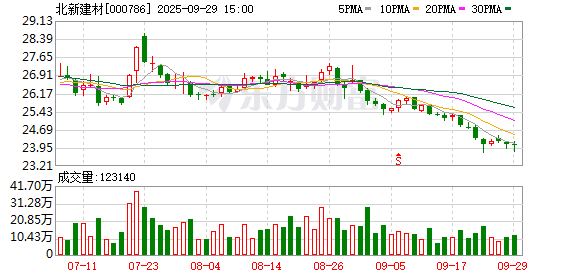
Core Viewpoint - On September 29, Beixin Building Materials conducted three block trades totaling 2.16 million shares, with a transaction value of 52.01 million yuan, at a price of 24.08 yuan per share [2] Trading Summary - The total transaction volume for the three block trades was 216,000 shares, with a total transaction amount of 52.01 million yuan, all at a price of 24.08 yuan [2] - Institutional proprietary seats participated in all three trades, resulting in a net purchase of 52.01 million yuan [2] - The closing price of Beixin Building Materials on the same day was 24.08 yuan, reflecting a slight decrease of 0.08% [2] - The daily turnover rate was 0.75%, with a total trading volume of 296 million yuan and a net inflow of main funds amounting to 12.23 million yuan [2] - Over the past five days, the stock has seen a cumulative decline of 1.11%, with a total net inflow of 130,800 yuan [2] Margin Trading Data - The latest margin financing balance for Beixin Building Materials is 624 million yuan, with a decrease of 7.41 million yuan over the past five days, representing a decline of 1.17% [2]

如何看待节前的市场变化?:投资要点:
Huafu Securities· 2025-09-29 08:38
Group 1 - The market experienced fluctuations with a slight increase of 0.25% in the overall A-share market during the week of September 22-26, 2025, with the Sci-Tech 50 and ChiNext indices leading the gains, while the CSI Red Chip and CSI 1000 indices lagged behind [2][9] - The technology and advanced manufacturing sectors showed strong performance, while the pharmaceutical, medical, and consumer sectors faced declines [2][9] - The report indicates a decrease in the stock-bond yield spread to 0.5%, which is below the +1 standard deviation, suggesting a potential market peak in the near future [3][18] Group 2 - The gaming industry saw the approval of 156 new game titles in September, enhancing supply within the sector, with major companies like Tencent and NetEase receiving approvals for several key games [4][38] - The construction materials industry is set to benefit from the "Stabilizing Growth Work Plan (2025-2026)", which aims to promote the elimination of outdated production capacity and improve the supply-demand balance [4][39] - Nvidia announced a significant investment of $100 billion into OpenAI, indicating ongoing expansion in AI infrastructure, which presents investment opportunities in AI-related sectors [4][40] Group 3 - The report suggests a favorable outlook for the "Red October" market trend following the National Day holiday, with expectations of a market rally based on historical patterns [5][14] - The focus remains on sectors such as Hang Seng Technology, energy storage, satellite connectivity, and commercial aerospace, with recommendations for internal expansion within growth sectors [5][41] - The report highlights the potential for external rotation into consumer and large-cap blue-chip stocks for investors seeking lower volatility [5][41]
有色金属行业稳增长方案出炉!材料ETF(159944)收涨近3%,价格创年内新高,实现4连阳
Xin Lang Cai Jing· 2025-09-29 08:06
该基金紧密跟踪中证全指原材料指数,旨在反映A股市场原材料行业代表性公司的整体表现。中证全指 原材料指数精准聚焦"反内卷"赛道,覆盖有色金属、基础化工、钢铁、建材等7个核心板块,"反内 卷"含量超90%。前十大权重股包括紫金矿业、万华化学等各细分行业龙头。指数样本每半年调整一 次,采用自由流通市值加权,为投资者提供了跟踪原材料板块的投资工具。 截至9月26日,该指数当前市净率仅为2.04倍,低于中证细分化工产业主题指数、中证申万有色金属指 数等其他同类指数,契合周期行业"买在低估值"的逻辑。 信达证券分析指出,第一,"反内卷"有望推动产能过剩下行拐点出现;第二,随着产能过剩化解进程加 快,PPI也有望迎来上行拐点。不过需要注意的是,"反内卷"过程中可能出现制造业增长动能阶段性衰 减的情况,要同时实现稳增长目标,还需同步配套需求侧政策工具。若能辅以有效的扩大需求举措,本 轮"反内卷"政策的持续落地有望为资本市场带来牛市支撑。 华泰证券研报称,PPI同比及工业企业利润有望延续修复态势。今年8月工业企业盈利同比较7月的-1.5% 大幅上行至20.4%,或主要受到去年同期低基数的提振,其中营收同比增速较7月的1.1%温 ...
2025世界粤商大会9月29日在广州开幕
Nan Fang Ri Bao Wang Luo Ban· 2025-09-29 08:00
Core Insights - The 2025 World Cantonese Business Conference aims to unite global Cantonese business forces and promote high-quality development in the Guangdong-Hong Kong-Macao Greater Bay Area [1][2] - The conference will feature a format of "1+5+N," including one opening ceremony, five thematic sessions, and numerous supporting activities [1] - Participants express hope for collaboration and investment opportunities, emphasizing the importance of innovation and long-term strategies in a rapidly changing world [2][3] Group 1: Conference Objectives and Structure - The conference serves as a platform to showcase Guangdong's achievements in reform and economic development, promote its business environment, and enhance cooperation among Cantonese businesses [3][4] - The event is expected to facilitate the integration of various industry chains, supply chains, and innovation chains, particularly in fields like artificial intelligence and digital economy [3][5] Group 2: Business Responsibilities and Opportunities - Guangdong's strategic position as a leader in reform and opening-up presents significant opportunities for businesses to contribute to high-quality development [4] - Business leaders emphasize the need to focus on technological self-reliance, modern industrial systems, and social responsibility, particularly in initiatives like "Ten Thousand Enterprises Revitalizing Ten Thousand Villages" [4][5] Group 3: Collaboration and Innovation - There is a call for strengthening cross-regional collaboration and resource integration within the Greater Bay Area to enhance traditional manufacturing and emerging industries [5] - Companies are encouraged to leverage the global Cantonese business network to create efficient platforms for information sharing and resource complementarity, while also investing in strategic emerging industries [5]