家用电器

Search documents
【16日资金路线图】两市主力资金净流出近240亿元 电子等行业实现净流入
Zheng Quan Shi Bao· 2026-01-16 10:38
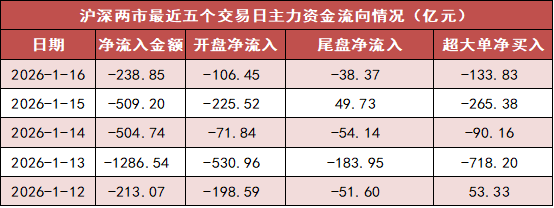
1月16日,A股市场整体下跌。截至收盘,上证指数收报4101.91点,下跌0.26%;深证成指收报14281.08点,下跌 0.18%;创业板指收报3361.02点,下跌0.2%。两市合计成交30262.32亿元,较上一交易日增加1207.36亿元。 1.两市主力资金净流出近240亿元 今日沪深两市主力资金开盘净流出106.45亿元,尾盘净流出38.37亿元,全天净流出238.85亿元。 | | | 沪深两市最近五个交易日主力资金流向情况(亿元) | | | | --- | --- | --- | --- | --- | | 日期 | | 净流入金额 开盘净流入 | 尾盘净流入 | 超大单净买入 | | 2026-1-16 | -238.85 | -106. 45 | -38. 37 | -133. 83 | | 2026-1-15 | -509.20 | -225.52 | 49.73 | -265. 38 | | 2026-1-14 | -504.74 | -71.84 | -54. 14 | -90. 16 | | 2026-1-13 | -1286.54 | -530. 96 | -183. 95 | ...

中国消费品牌出海迈向「新周期」:把爆款做成体系,把增长做成复利
36氪· 2026-01-16 10:36
Core Insights - The article highlights the rising cost structure faced by outbound consumer brands, with Google Ads CPC increasing by 10% and Meta CPL soaring by 20%, indicating a shift from a growth model reliant on spending to one focused on brand value [1][3][4] - The "2025 MeetBrands Top 50" list reflects a structural upgrade in the outbound industry, where brands are evolving not just through competition but also due to changing market rules [3][4] Brand Evolution - Sixteen brands have graduated from "emerging" to "benchmark" status, achieving annual overseas revenues of $500 million and establishing a global presence in over ten countries [6][7] - The new entrants on the list exhibit characteristics of "category leaders," with revenues transitioning from millions to billions, driven by technological and situational advantages [9][10] Market Dynamics - The Pearl River Delta remains a key player, contributing 62% of the listed brands, while the Yangtze River Delta has become a hub for brand operations, accounting for 26% [13][14] - The competition landscape is shifting from a focus on low-cost and traffic-driven strategies to a more sustainable model emphasizing long-term operations and brand value [36][39] Capability Challenges - Many mid-tier outbound brands face "invisible capability thresholds" that hinder growth, such as over-reliance on low prices and traffic, lack of localization, and digital disconnection [16][17] - The D-MES evaluation model has been upgraded to better assess brands' long-term capabilities, focusing on digitalization, consumer influence, product innovation, and commercial conversion [19][21] Digitalization and Consumer Trust - Digital capabilities are becoming a crucial competitive advantage, with brands like Anker leading in integrating AI into their core operations [22][23] - Building consumer trust through deep localization and addressing the "high awareness, low trust" gap is essential for brands to succeed in overseas markets [24][25] Product Innovation and Market Expansion - Successful brands are focusing on solving real consumer pain points rather than competing on superficial features, as demonstrated by Rest's innovative product development [28][29] - The emphasis is shifting towards multi-channel operations and expansion into emerging markets, with brands diversifying their strategies beyond traditional mature markets [31][33] Long-term Strategy - The future of outbound brands lies in a "steady, precise, and strong" approach, prioritizing profit margins and customer loyalty over rapid growth [36][40] - Brands must transition from a focus on traffic to enhancing conversion efficiency across the sales process, addressing key friction points in customer experience [37][38]

【16日资金路线图】两市主力资金净流出近240亿元 电子等行业实现净流入
证券时报· 2026-01-16 10:33
1月16日,A股市场整体下跌。截至收盘,上证指数收报4101.91点,下跌0.26%;深证成指收报14281.08 点,下跌0.18%;创业板指收报3361.02点,下跌0.2%。两市合计成交30262.32亿元,较上一交易日增加 1207.36亿元。 1. 两市主力资金净流出近240亿元 今日沪深两市主力资金开盘净流出106.45亿元,尾盘净流出38.37亿元,全天净流出238.85亿元。 | | | 沪深两市最近五个交易日主力资金流向情况(亿元) | | | | --- | --- | --- | --- | --- | | 日期 | | 净流入金额 开盘净流入 | 尾盘净流入 | 超大单净买入 | | 2026-1-16 | -238.85 | -106. 45 | -38. 37 | -133. 83 | | 2026-1-15 | -509.20 | -225. 52 | 49.73 | -265. 38 | | 2026-1-14 | -504.74 | -71.84 | -54. 14 | -90. 16 | | 2026-1-13 | -1286.54 | -530. 96 | -183. 9 ...

【招银研究|权益策论】2026全球股市展望:核心线索与中国机遇(2026年1月)
招商银行研究· 2026-01-16 09:22
Market Overview - In 2025, global stock markets experienced a broad rally, with emerging markets significantly outperforming developed markets. The MSCI Emerging Markets Index rose by 31%, while the MSCI Developed Markets Index increased by 19%. US stocks lagged behind globally [4][10] - The technology sector led the market, driven by the AI wave, followed by cyclical stocks, while energy and consumer sectors underperformed due to weak global demand [4][10] Core Themes - The three key investment themes for 2026 that will impact global and A-share markets are: 1. Continued liquidity easing globally, providing funding support for market investments 2. Sustained AI investment as a core driver for the technology sector 3. A potential recovery in global manufacturing, boosting high-end manufacturing sectors [15][16] A-share Market Analysis - The bull market is expected to continue, with the Shanghai Composite Index surpassing 4000 points. Valuations are not in bubble territory, and as long as earnings materialize and liquidity narratives remain unchanged, the market trend is likely to persist [28] - Focus on three main directions for industry selection: "AI + manufacturing overseas + related raw materials." Traditional industry allocations are shifting from high dividend yields to high free cash flow assets [28][39] Industry Insights - The AI investment trend is expected to continue, supported by industry, funding, and policy factors. Despite a shift from infrastructure competition to application value realization, demand for computational power will persist [21][22] - Global manufacturing is anticipated to maintain a recovery trend, aided by liquidity support from interest rate cuts and a restructuring of supply chains in response to security concerns [23][24] Investment Strategy - The focus is shifting from high dividend assets to high free cash flow assets, as the market environment changes. High free cash flow companies can provide both safety through dividends and growth through capital expenditures in key sectors like AI and manufacturing [48][49] - Growth-oriented stocks, particularly in the ChiNext board, are expected to outperform value stocks like the CSI 300, driven by strong earnings growth and favorable liquidity conditions [56][66] International Market Outlook - The Hong Kong stock market is projected to experience a slow bull run, with the Hang Seng Index potentially rising to 29,000 points, driven by earnings recovery and liquidity easing [71] - The US stock market is expected to see slower growth, with high valuations and strong earnings providing key support, but entering a phase of fragile balance with increased volatility [76]
家电ETF(159996)涨超1%,中国大家电市场已进入成熟期
Mei Ri Jing Ji Xin Wen· 2026-01-16 06:39
(文章来源:每日经济新闻) 家电ETF(159996)跟踪的是家用电器指数(930697),该指数从沪深市场中选取涉及家用电器制造、 销售及相关服务业务的上市公司证券作为指数样本,以反映家用电器相关上市公司证券的整体表现。 1月16日,家电ETF(159996)涨超1%,中国大家电市场已进入成熟期。 银河证券指出,全球家电市场规模广阔,各品类稳健增长。中国大家电市场已进入成熟期,以更新需求 为主。2024年9月以来,家电行业充分受益于国补;2026年国补政策持续,但力度有所减弱。在海外大 型消费电器市场,中国企业海外品牌份额稳步提升。中国品牌在数字经济升级趋势下,全球竞争优势不 再局限于成本优势,已转换为全面的产业链优势、产品优势。 ...
兆驰股份股价涨5.17%,嘉实基金旗下1只基金重仓,持有4.89万股浮盈赚取2.2万元
Xin Lang Cai Jing· 2026-01-16 06:26
Core Viewpoint - Zhaochi Co., Ltd. experienced a stock price increase of 5.17% on January 16, reaching 9.15 CNY per share, with a trading volume of 1.576 billion CNY and a turnover rate of 3.92%, resulting in a total market capitalization of 41.422 billion CNY [1] Group 1: Company Overview - Zhaochi Co., Ltd. is located at 128 B Building, Zhaochi Group, Bulan Road, Longgang District, Shenzhen, Guangdong Province, and was established on April 4, 2005, with its listing date on June 10, 2010 [1] - The company's main business involves the research, development, manufacturing, sales, and service of home audio-visual and electronic products [1] - The revenue composition of the company is as follows: multimedia audio-visual products and operation services account for 66.90%, while the LED industry chain constitutes 33.10% [1] Group 2: Fund Holdings - According to data, one fund under Jiashi Fund has a significant holding in Zhaochi Co., Ltd. The Jiashi CSI Home Appliance Index Initiated A Fund (018564) held 48,900 shares in the third quarter, representing 1.7% of the fund's net value, ranking as the tenth largest holding [2] - The Jiashi CSI Home Appliance Index Initiated A Fund was established on June 1, 2023, with a latest scale of 14.944 million CNY. Year-to-date, it has achieved a return of 2.24%, ranking 4569 out of 5531 in its category; over the past year, it has returned 17.42%, ranking 3550 out of 4215; and since inception, it has returned 38.02% [2] - The fund manager, Liu Jiayin, has a tenure of 9 years and 301 days, with the total asset scale of the fund currently at 225.744 billion CNY. The best fund return during Liu's tenure is 156.57%, while the worst is -31.37% [2]

四川长虹股价跌5.42%,国泰基金旗下1只基金重仓,持有736.26万股浮亏损失427.03万元
Xin Lang Cai Jing· 2026-01-16 01:52
国泰中证全指家用电器ETF(159996)基金经理为苗梦羽。 截至发稿,苗梦羽累计任职时间4年112天,现任基金资产总规模72.68亿元,任职期间最佳基金回报 72.11%, 任职期间最差基金回报-37.06%。 数据显示,国泰基金旗下1只基金位居四川长虹十大流通股东。国泰中证全指家用电器ETF(159996) 三季度新进十大流通股东,持有股数736.26万股,占流通股的比例为0.16%。根据测算,今日浮亏损失 约427.03万元。 国泰中证全指家用电器ETF(159996)成立日期2020年2月27日,最新规模16.57亿。今年以来收益 2.33%,同类排名4504/5531;近一年收益18.77%,同类排名3479/4215;成立以来收益59.28%。 从基金十大重仓股角度 1月16日,四川长虹跌5.42%,截至发稿,报10.12元/股,成交2.68亿元,换手率0.57%,总市值467.16亿 元。 资料显示,四川长虹电器股份有限公司位于四川省绵阳市高新区绵兴东路35号,成立日期1993年4月8 日,上市日期1994年3月11日,公司主营业务涉及主营"以电视、冰箱(柜)、家用空调、洗衣机、扫地机 器人、智 ...

穿透消费分化迷雾:CBI品牌榜中的“真增长”挖掘
Ge Long Hui· 2026-01-15 11:25
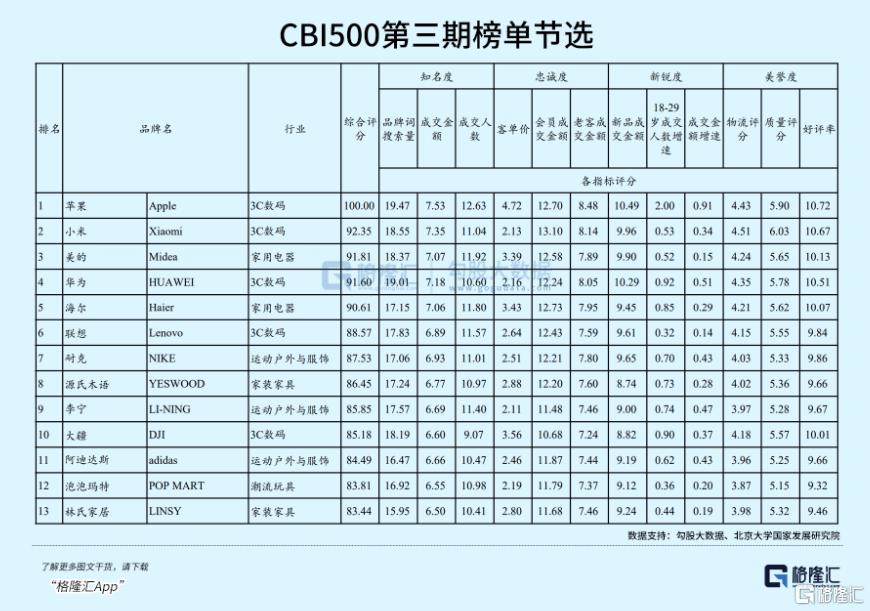
Group 1 - The Chinese consumer market has shown a steady recovery since 2025, with a year-on-year growth of 6.8% in retail sales of consumer goods in the first three quarters, contributing 53.5% to economic growth [1] - The recovery trend in the consumer sector is not uniform, with traditional brands struggling due to lack of innovation, while new brands are breaking through with technological advancements and innovative models [1] - The need for a quantitative evaluation tool to identify structural opportunities in the market has led to the development of the "China Online Consumption Brand Index (CBI)" and the "Global Brand China Online Top 500 List (CBI500)" by Peking University [2] Group 2 - The CBI500 list is based on real consumer data from Taobao and Tmall, utilizing a comprehensive brand quality indicator that includes new product capability, user reviews, and search popularity [2][5] - The top five brands in the CBI500 list—Apple, Xiaomi, Midea, Huawei, and Haier—demonstrate a "stronger gets stronger" logic, maintaining competitive advantages through balanced performance across various dimensions [6][8] - DJI has achieved significant growth, moving from a score of 78.53 to 85.18, entering the top ten for the first time, driven by continuous technological innovation and market expansion [9][12] Group 3 - Pop Mart has shown strong resilience in the collectible toy sector, climbing from 31st to 12th place in the CBI500 list, with leading scores in loyalty and customer spending [14][17] - The growth logic of Pop Mart is based on deep insights into emotional consumption needs, utilizing an IP matrix and a robust membership system to create a strong emotional connection with consumers [17] - The differentiation in the consumer market has created opportunities for brands that adapt to trends, as seen with Fenjiu's rise in rankings due to its "youthful" strategy targeting younger consumers [22][23] Group 4 - The CBI list serves as a data-driven tool for observing the consumer market, helping investors identify brands that capture product innovation opportunities and possess anti-cyclical potential [27][29] - The evaluation logic of the CBI list helps to avoid misleading short-term sales data, focusing instead on loyalty and reputation metrics to identify brands that achieve sustainable growth [27][29] - The current economic recovery phase presents a critical window for brand restructuring and value selection, emphasizing the importance of understanding consumer behavior changes [26][29]






穿透消费分化迷雾:CBI品牌榜中的“真增长”挖掘
格隆汇APP· 2026-01-15 11:15
Core Insights - The article highlights the steady recovery of China's consumer market since 2025, with a year-on-year growth of 6.8% in retail sales of consumer goods in the first three quarters, contributing 53.5% to economic growth [2] - However, the consumer sector faces challenges with increasing internal differentiation, where traditional brands struggle due to lack of innovation while new brands succeed through technological breakthroughs and innovative models [2][3] Group 1: Consumer Brand Landscape - The CBI500 ranking reflects a stable top tier of brands, emphasizing the "stronger get stronger" logic in the consumer market [7] - Leading brands like Apple, Xiaomi, Midea, Huawei, and Haier maintain competitive barriers through balanced performance across four dimensions: brand awareness, innovation, loyalty, and reputation [8][10] - DJI and Pop Mart have shown significant growth, with DJI entering the top ten for the first time, driven by continuous technological innovation and market expansion [11][16] Group 2: Brand Performance and Growth Strategies - DJI's growth is attributed to its focus on technology innovation and creating benchmark products, leading to a 66% market share in the global action camera market as of Q3 2025 [11][14] - Pop Mart's rise in the rankings is due to its strong loyalty metrics and effective IP matrix operation, which resonates with emotional consumer needs [19][20] - The brand's strategy includes a robust membership system that enhances customer loyalty through emotional engagement [19] Group 3: Market Differentiation and Opportunities - The differentiation in the consumer market presents challenges for traditional brands while creating opportunities for those that adapt to trends [21][22] - Brands like Fenjiu have successfully capitalized on changing consumer preferences, with a notable increase in their ranking due to a focus on younger consumers [26] - The article emphasizes the importance of aligning with policy support and consumer trends to identify quality brands that can thrive in a competitive landscape [27][28] Group 4: CBI Index and Its Value - The CBI index serves as a data-driven tool for observing the consumer market, helping investors identify brands that capture product innovation opportunities and possess resilience against economic cycles [30][31] - The index's multidimensional evaluation framework allows for a deeper understanding of consumer demand and brand performance, aiding in long-term investment decisions [32]

【广发金工】周期与先进制造业绩预告增速领先
广发金融工程研究· 2026-01-15 08:25
Core Viewpoint - The overall performance forecast for 2025 shows a cumulative disclosure rate of approximately 3.99% and a cumulative positive performance rate of about 40.83% among the disclosed companies [10][11]. Group 1: Overall Performance Forecast - Among the 218 companies that disclosed performance forecasts, 53 companies (24.31%) expect an increase in performance, 26 companies (11.93%) expect slight increases, 9 companies (4.13%) expect to turn losses into profits, and 1 company (0.46%) expects to maintain profitability [10]. - Conversely, 129 companies (59.17%) anticipate performance reductions, losses, or have uncertain forecasts [10]. Group 2: Performance by Sector - In the advanced manufacturing sector, the defense and military industry index has risen by 12.70%, correlating with a 26.50% growth in net profit attributable to the parent company [24]. - The machinery equipment sector shows a net profit growth of 39.63%, with an index increase of 6.06% [24]. - The pharmaceutical and medical sector has seen a significant decline, with net profit down by 36.59%, yet the index has increased by 9.85% [25]. - In the cyclical sector, upstream and midstream raw material industries have shown substantial improvement, with net profit growth exceeding 160% in construction materials, steel, and basic chemicals, although market reactions have been relatively stable [25]. - The consumer sector shows mixed results, with light industry manufacturing and agriculture experiencing net profit declines of -45.13% and -27.40%, respectively, while the automotive and home appliance sectors have seen net profit growth of 42.43% and 30.49% [25]. - The technology sector, particularly in media, has shown a significant divergence, with net profit down by 163.49% but an index increase of 24.65% [25]. - The real estate sector remains weak, with a net profit decline of 74.57%, while the banking sector has recorded a 5.98% profit growth but a 2.83% decline in the index [25]. Group 3: Performance Disclosure by Market Capitalization - The disclosure rate increases with market capitalization, with large-cap companies (over 100 billion) showing a disclosure rate of 7.95% and a positive performance rate of 64.29% [11][20]. - Mid-cap companies (500-1000 billion) have a disclosure rate of 8.70% and a positive performance rate of 56.25% [11][20]. - Small-cap companies (under 50 billion) have the lowest disclosure rate at 2.16% and a positive performance rate of 28.89% [11][20].