医药

Search documents
陆家嘴财经早餐2025年11月13日星期四
Wind万得· 2025-11-12 22:32
Group 1 - The China Photovoltaic Industry Association refuted rumors about the collapse of the polysilicon storage platform, emphasizing the industry's commitment to combating unhealthy competition [2] - President Xi Jinping expressed China's willingness to import more high-quality products from Spain and explore cooperation in emerging fields such as renewable energy and artificial intelligence [3] - The Shanghai Stock Exchange International Investors Conference highlighted the increase in foreign investment in A-shares, with the market value held by foreign investors rising from over 3 trillion yuan at the end of 2020 to over 3.5 trillion yuan currently [4] Group 2 - The A-share market experienced fluctuations, with the photovoltaic industry chain declining due to external influences, while the banking and insurance sectors showed strength [5] - The number of newly launched funds in the market reached 1,371 this year, the highest in nearly three years, although the average fundraising scale was only 782 million yuan [6] - The Hong Kong-listed company Baillie Gifford announced a delay in its global offering, indicating a shift in market conditions [6] Group 3 - The Ministry of Education and other departments issued guidelines to strengthen science and technology education in primary and secondary schools, focusing on STEM fields [8] - The National Energy Administration released guidelines to promote the integrated development of renewable energy, supporting the establishment of 100% renewable energy bases in suitable regions [8] - The 2025 World Power Battery Conference signed 180 projects with a total amount of 861.3 billion yuan, covering key areas in green energy [9]

港股定价权增强 市场正循环显现
Zheng Quan Shi Bao· 2025-11-12 22:28
Core Viewpoint - The Hong Kong stock market has reached a new milestone with southbound capital inflows exceeding 1.3 trillion HKD this year, marking a significant increase in liquidity and activity, driven by strategic allocations from mainland investors seeking undervalued assets and high-quality stocks [1][2][3]. Group 1: Market Performance - As of November 10, 2023, the southbound capital through the Stock Connect has net inflows of 66.54 billion HKD, bringing the total for the year to 13,053.49 billion HKD, surpassing the 1.3 trillion HKD mark [2]. - Major indices in the Hong Kong market, including the Hang Seng Index, Hang Seng Tech Index, and Hang Seng China Enterprises Index, have all seen year-to-date increases of over 30%, ranking among the top global markets [2]. Group 2: Factors Driving Inflows - The influx of southbound capital is attributed to five main factors: valuation discounts compared to A-shares, a declining domestic interest rate environment, continuous optimization of the Stock Connect mechanism, inherent demand from long-term domestic funds, and global expectations of liquidity easing [3][4]. - The phenomenon of "asset scarcity" is also noted, where domestic funds are seeking effective allocation opportunities in the Hong Kong market due to limited high-return assets available domestically [4]. Group 3: Market Dynamics and Trends - The continuous inflow of southbound capital has improved liquidity in the Hong Kong market and enhanced the pricing power of mainland investors [5]. - In 2024, southbound capital is expected to account for approximately 34.64% of the total trading volume in the Hong Kong market, a significant increase from previous years [6]. - The composition of southbound capital is primarily driven by insurance funds and public funds, with public funds showing a compound annual growth rate of 23.5% in their holdings from 2020 to 2025 [6]. Group 4: Future Outlook - The Hong Kong market is anticipated to benefit from a "positive cycle" as more mainland companies list in Hong Kong, attracting further capital inflows and enhancing liquidity [8]. - Despite significant gains in the Hong Kong market this year, its valuation remains attractive compared to other global markets, providing further incentive for mainland investors to allocate capital southward [9].
解码南向资金累计净买入首破5万亿港元 港股定价权增强 市场正循环显现
Zheng Quan Shi Bao· 2025-11-12 18:58
Core Viewpoint - The continuous inflow of southbound funds into the Hong Kong stock market has reached a record high, indicating a significant transformation in market liquidity and activity, driven by strategic allocation needs from mainland investors seeking undervalued assets and high-quality stocks [1][2][4]. Group 1: Market Performance - As of November 10, southbound funds have net inflows of 66.54 billion HKD, bringing the total for the year to 1.305 trillion HKD, and cumulative inflows since the launch of the Hong Kong Stock Connect have surpassed 5 trillion HKD [2][3]. - Major indices in the Hong Kong market, including the Hang Seng Index, Hang Seng Tech Index, and Hang Seng China Enterprises Index, have all seen year-to-date increases of over 30%, ranking among the top global markets [2]. Group 2: Factors Driving Inflows - The influx of southbound funds is driven by five key factors: valuation discounts compared to A-shares, demand for technology leaders and high-dividend assets in a declining domestic interest rate environment, improved connectivity mechanisms, long-term investment needs from insurance and public funds, and global liquidity easing expectations [3][4]. - The phenomenon of "asset scarcity" is also noted, where abundant funds are seeking quality assets, leading to increased southbound investments in the Hong Kong market [4]. Group 3: Market Dynamics and Trends - Southbound funds accounted for approximately 34.64% of the total trading volume in the Hong Kong market in 2024, a significant increase from previous years [5]. - The market capitalization held by southbound funds is around 6.21 trillion HKD, representing 12.93% of the total market, with insurance and public funds making up over 40% of this capital [6]. Group 4: Future Outlook - The Hong Kong market is expected to benefit from a "positive cycle" as more mainland companies list in Hong Kong, attracting further capital inflows and enhancing liquidity [7]. - Despite significant gains this year, the valuation of the Hong Kong market remains attractive compared to global peers, providing further incentives for mainland investors to allocate capital southward [8].
公募基金港股持仓聚焦高成长性资产
Zheng Quan Ri Bao· 2025-11-12 16:15
Group 1 - Public funds have significantly increased their allocation to Hong Kong stocks, with the investment market value reaching 1.362211 trillion yuan by the end of Q3 2025, a 43.09% increase from the end of Q2 2025 [1] - The market value of equity and index funds in Hong Kong stocks reached 1.231653 trillion yuan and 701.284 billion yuan, reflecting increases of 45.02% and 73.07% respectively [1] - The surge in public fund holdings indicates a structural transformation in asset allocation, driven by the enhanced attractiveness of Hong Kong stocks, particularly in the technology and banking sectors [1][2] Group 2 - The influx of funds into Hong Kong ETFs is attributed to three main factors: valuation advantages compared to A-shares, trading convenience and low fees of ETFs, and risk diversification benefits [2] - The most favored Hong Kong stocks by public funds include SenseTime-W, Alibaba Health, China Biologic Products, and others, primarily in the information technology and healthcare sectors, aligning with the constituents of the Hang Seng Technology Index and the Hong Kong Pharmaceutical Index [2] - A total of 38 cross-border ETFs attracted a net inflow of 49.561 billion yuan in Q3, with a year-to-date net inflow of 72.642 billion yuan as of November 12 [3] Group 3 - The acceleration of fund flows into ETFs is expected to enhance market liquidity and pricing efficiency, supporting the stable development of the Hong Kong stock market [4]



港股公告掘金 | 荣利营造:拟携手宁德时代共同开发高效储能系统及解决方案
Zhi Tong Cai Jing· 2025-11-12 15:19
Major Events - Hong Kong Stock Exchange (00388) plans to make a strategic investment in Xunqing Settlement Holdings Limited [1] - Lai Kai Pharmaceutical-B (02105) signs an exclusive licensing agreement with Qilu Pharmaceutical for LAE 002 (AFURESERTIB) in China [1] - TECHSTARACQ-Z (07855) is expected to inherit the company Tuda Tong's listing on the main board of the Stock Exchange on December 10 [1] - Superstar Legend (06683) intends to establish a joint venture with Yushu Technology to develop consumer-grade IP robots and IP derivative products [1] - Beijing Enterprises Holdings (00392) plans to acquire 100% equity of Beijing Beiran Special Equipment Inspection and Testing Co., Ltd. for 54.6 million yuan [1] - CSPC Pharmaceutical Group (01093) has its application for the marketing of Pertuzumab Injection accepted by the National Medical Products Administration [1] - Rongli Construction (09639) plans to collaborate with CATL to develop efficient energy storage systems and solutions [1] Operating Performance - BeiGene (06160) reports a net profit attributable to shareholders of 1.139 billion yuan for the first three quarters, turning from loss to profit year-on-year [1] - Tencent Music-SW (01698) reports a net profit attributable to equity holders of 2.15 billion yuan in the third quarter, a year-on-year increase of 36.0% [1] - Zhou Li Fu (06168) sees a 32% year-on-year increase in e-commerce revenue for the first ten months, with net profit rising 71% year-on-year [1] - China Resources Land (01109) reports a cumulative contract sales amount of approximately 169.6 billion yuan for the first ten months, a year-on-year decrease of 16.6% [1]


美国最高法关税辩论分析:如果“对等关税”被判违法?
Shenwan Hongyuan Securities· 2025-11-12 12:12
Legal Analysis - The U.S. Supreme Court's debate on the legality of "reciprocal tariffs" shows a 3:6 ratio in favor of declaring them illegal, indicating a high probability of a ruling against them[2] - The main arguments for declaring the tariffs illegal include the assertion that tariff authority belongs to Congress and that the IEEPA was intended to limit presidential power, not expand it[2][11] - Three potential outcomes of the ruling are identified: a likely illegal ruling with delayed effect (45%-55% probability), partial illegality with possible allowance for fentanyl tariffs (20%-30% probability), and a low probability (10%-20%) of upholding the legality of reciprocal tariffs[17][18] Economic Implications - If reciprocal tariffs are deemed illegal, the U.S. tariff structure may decline by approximately 25%, with total tariff revenue potentially dropping from $1,959 billion to $1,554 billion[4][26][37] - Current tariff revenue composition shows reciprocal tariffs account for 45%, Section 301 tariffs for 18%, and Section 232 tariffs for 17%[4][26] - The effective tariff rate for the U.S. is currently 9.75%, with the highest rate on Chinese imports at 40.4%[4][32] Political Response - In response to a potential ruling against reciprocal tariffs, Trump may resort to existing tariff laws such as Sections 232, 301, and 338, but the likelihood of broad tax refunds is low due to legal constraints[3][22] - The probability of universal tax refunds is low, with refunds likely limited to specific plaintiffs rather than a blanket return to all importers[3][25] - Trump's proposal to distribute tariff revenues to citizens faces significant legislative hurdles, requiring Congressional approval[3][25]
创新药ETF领涨;年内上市ETF同比大增丨ETF晚报
2 1 Shi Ji Jing Ji Bao Dao· 2025-11-12 10:25
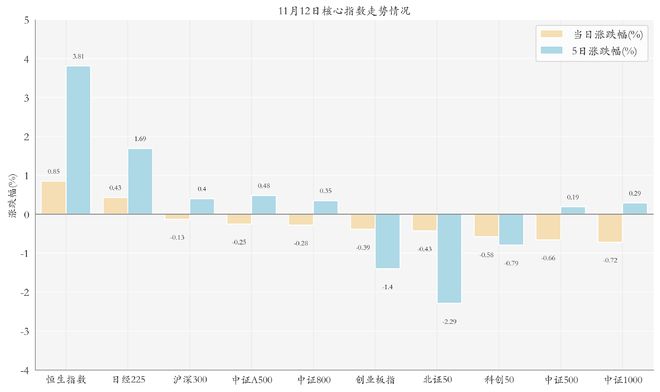
Group 1: ETF Market Overview - The three major indices experienced fluctuations and declines, with the Shanghai Composite Index down by 0.07%, the Shenzhen Component Index down by 0.36%, and the ChiNext Index down by 0.39. Notably, several pharmaceutical ETFs, particularly the innovative drug ETFs, saw gains, with the Fortune Innovative Drug ETF rising by 1.89% and the Guotai Innovative Drug ETF increasing by 1.85% [1] - As of November 11, 2023, a total of 317 ETFs have been launched this year, with a combined scale of 541.17 billion yuan. This marks a significant increase compared to 163 and 156 ETFs launched in 2024 and 2023, respectively, indicating a rapid expansion in the ETF market [2] - The number of newly issued funds this year has reached 1,371, the highest in nearly three years. However, the average fundraising scale for new funds is only 78.2 million yuan, reflecting a shift in the public fund issuance market towards a more diversified and institutionalized approach [3] Group 2: Regulatory Insights - The Vice Chairman of the China Securities Regulatory Commission, Li Ming, emphasized the importance of preventing significant market fluctuations and maintaining stability. He highlighted the strong fundamentals of the Chinese economy and the need for long-term investment strategies to enhance market stability [4] Group 3: ETF Performance - The overall performance of ETFs varied, with cross-border ETFs showing the best average return of 1.18%, while thematic stock index ETFs had the worst average return of -0.58% [10] - The top-performing ETFs today included the Sci-Tech Innovative Drug ETF from Huatai, which rose by 1.99%, followed by the Fortune Innovative Drug ETF and the Guotai Innovative Drug ETF, both increasing by 1.89% [12][13] - In terms of trading volume, the top three stock ETFs were the CSI A500 ETF, with a trading volume of 4.965 billion yuan, followed by the A500 ETF Fund and the A500 ETF from E Fund, with trading volumes of 4.944 billion yuan and 4.552 billion yuan, respectively [15]
数据看盘实力游资、量化大笔甩卖福龙马 多家机构激烈博弈天际股份
Sou Hu Cai Jing· 2025-11-12 09:59
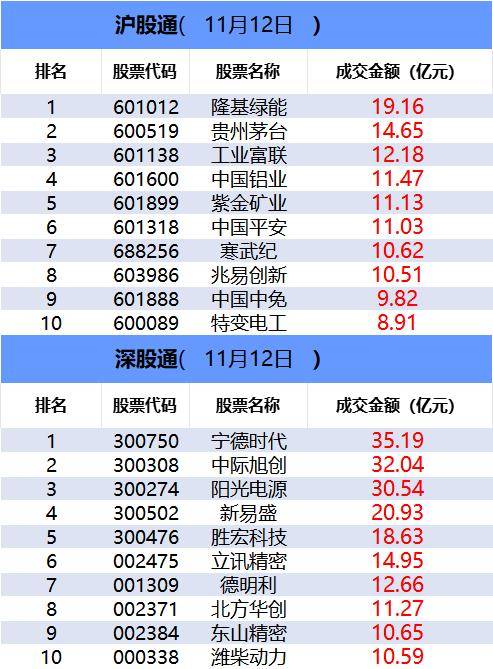
Trading Volume Summary - The total trading volume of the Shanghai and Shenzhen Stock Connect today reached 2260.65 billion, with Longi Green Energy and CATL leading in trading volume for the Shanghai and Shenzhen markets respectively [1] - The Shanghai Stock Connect had a total trading amount of 1071.76 billion, while the Shenzhen Stock Connect totaled 1188.89 billion [2] Top Stocks by Trading Volume - Longi Green Energy (601012) topped the Shanghai Stock Connect with a trading volume of 19.16 billion, followed by Kweichow Moutai (600519) at 14.65 billion and Industrial Fulian (601138) at 12.18 billion [3] - In the Shenzhen Stock Connect, CATL (300750) led with a trading volume of 35.19 billion, followed by Zhongji Xuchuang (300308) at 32.04 billion and Sunshine Power (300274) at 30.54 billion [3] Sector Performance - The pharmaceutical sector saw the highest net inflow of main funds, amounting to 26.07 billion, with a net inflow rate of 2.01% [5] - Other sectors with significant net inflows included banking (18.88 billion, 5.48%) and industrial metals (14.33 billion, 2.79%) [5] - Conversely, the new energy sector experienced the largest net outflow, totaling -178.93 billion, with a net outflow rate of -5.86% [6] ETF Trading Activity - The Hong Kong Pharmaceutical ETF (513700) recorded a remarkable trading volume increase of 167% compared to the previous trading day, reaching 2.96 billion [11] - The top ETF by trading volume was the Hong Kong Securities ETF (513090) with 94.31 billion, followed by the Hong Kong Innovative Drug ETF (513120) at 90.81 billion [9][10] Futures Positioning - In the futures market, the IC main contract saw a significant increase in short positions, with over 11,000 contracts added, while long positions increased by over 1,500 contracts [12] Stock Market Activity - Tianji Co. (300759) experienced a notable trading activity with four institutions selling 1.43 billion while one institution bought 661.2 million [15] - Fu Long Ma (300220) faced selling pressure from two quantitative trading desks, totaling 1.86 billion, while also receiving a buy from another desk for 541.4 million [18]





市场分析:金融医疗行业领涨,A股小幅整理
Zhongyuan Securities· 2025-11-12 09:17
Market Overview - On November 12, the A-share market experienced slight fluctuations, with the Shanghai Composite Index facing resistance around 4019 points[2] - The Shanghai Composite Index closed at 4000.14 points, down 0.07%, while the Shenzhen Component Index fell 0.36% to 13420.62 points[7] - Total trading volume for the day was 19,649 billion yuan, slightly lower than the previous trading day[7] Sector Performance - Banking, insurance, pharmaceuticals, and mining sectors performed well, while photovoltaic, wind power, and power grid equipment sectors lagged[3] - Over 60% of stocks in the two markets declined, with mining, insurance, and medical sectors showing the highest gains[7] Valuation Metrics - The average price-to-earnings (P/E) ratios for the Shanghai Composite and ChiNext indices are 16.40 times and 49.44 times, respectively, above the median levels of the past three years[3] - The current market is at a significant transition point, with the Shanghai Composite Index likely to consolidate around the 4000-point mark[3] Investment Strategy - Investors are advised to adopt a balanced allocation strategy focusing on "cyclical + technology growth" to capture structural opportunities[3] - Short-term recommendations include monitoring banking, insurance, medical devices, and non-ferrous metals sectors for investment opportunities[3] Risk Factors - Potential risks include unexpected overseas economic downturns, domestic policy changes, and macroeconomic disturbances[4]

刚刚!深“V”逆转!恶意做空,紧急回应!
中国基金报· 2025-11-12 07:54
Market Overview - On November 12, A-shares experienced a "V" shaped recovery, with the Shanghai Composite Index down by 0.07%, the Shenzhen Component Index down by 0.36%, and the ChiNext Index down by 0.39% [2][3] - A total of 1,758 stocks rose, while 3,563 stocks fell, with a total trading volume of 19,648.13 billion and a total trading amount of 132,600.4 million [5] Sector Performance - The pharmaceutical sector saw a collective surge, particularly in cell immunotherapy, with stocks like Kaineng Health and Jimin Health hitting the daily limit [5][6] - Oil and gas stocks remained strong, with companies like Sinopec Oilfield Service and Zhun Oil Co. reaching their daily limits [6] Solar Industry Impact - A circulating article regarding "anti-involution" in the photovoltaic sector negatively impacted market sentiment, leading to significant declines in solar and energy storage stocks [9] - Notable declines included Tongwei Co. hitting the daily limit down, and other companies like Canadian Solar and Aiko Energy dropping over 10% [9][10] Industry Response - The China Photovoltaic Industry Association (CPIA) issued a statement to counter the circulating rumors, emphasizing their commitment to industry self-regulation and the importance of maintaining national and industry interests [11][12] - Following the CPIA's clarification, the main contract for polysilicon futures rebounded strongly after previously declining nearly 4% [14]