农业

Search documents
主动量化周报:主线切换:涨价逻辑首选化工-20251116
ZHESHANG SECURITIES· 2025-11-16 10:40
- The report discusses the microstructure rebalancing in the A-share market, highlighting the increased concentration of stock price movements driven by speculative capital inflows since June 2025, which has impacted quantitative products' portfolio construction and risk exposure adjustments[13][23][24] - Quantitative products have adjusted their exposure to micro-cap stocks, initially reducing their holdings to mitigate nonlinear market cap risks, and later increasing allocations to amplify excess returns as speculative capital inflows weakened post-October 2025[13][23][24] - The report emphasizes the Barra style factor performance, noting that fundamental factors such as BP value and investment quality have shown positive returns, while transaction-related factors like short-term momentum have also delivered strong excess returns during the market's recent fluctuations[23][24][25]

金融赋能:强农兴农“智慧”先行
Zheng Quan Ri Bao Zhi Sheng· 2025-11-16 10:09
Core Insights - The core focus of the article is on the development of smart agriculture in China, emphasizing the establishment of a standard system to enhance the industry and the role of financial institutions in supporting this growth [1][2]. Industry Overview - The Ministry of Agriculture and Rural Affairs has released a guide to build a smart agriculture standard system, aiming to promote the industry's development and improve standardization efforts [1]. - China's smart agriculture market is projected to reach approximately 105 billion yuan in 2024, with a year-on-year growth of 11.7%, and is expected to grow to 120 billion yuan by 2025 [1]. Financial Support Mechanisms - Financial institutions, including policy banks and commercial banks, are actively creating a multi-layered financial service system to support smart agriculture, providing traditional credit support and innovative products [1]. - The People's Bank of China in Heilongjiang has introduced a combination of services to support the development of smart agriculture, enhancing the mechanization rate of crop farming to 99.07%, which is 26 percentage points higher than the national average [3][4]. Technological Integration - The integration of technology and finance is transforming traditional agriculture, with smart farming equipment like intelligent corn fertilization machines being utilized to enhance efficiency and productivity [4][5]. - Financial institutions are developing tailored financial services for technology-driven agricultural enterprises, facilitating the growth of smart agriculture [4][6]. Product Innovations - Various banks in Heilongjiang are launching innovative financial products to support smart agriculture, such as "Dragon Grain Financing" and "Agricultural Socialized Service Loans," aimed at enhancing the agricultural value chain [6][7]. - The Industrial and Commercial Bank of China is utilizing satellite remote sensing technology to monitor agricultural loan clients' crop conditions, enabling efficient loan management [7]. Impact on Agricultural Modernization - The comprehensive financial support aligns with Heilongjiang's agricultural modernization strategy, promoting the adoption of advanced technologies like Beidou navigation and drones in smart agriculture [8].
宏观周报:国内经济稳增长,海外风险再上升-20251116
Yin He Zheng Quan· 2025-11-16 07:54
Domestic Economic Overview - In October, China's economic data showed contractions in both supply and demand, but structural highlights remain in consumption upgrades and new productivity[1] - The retail sales of passenger cars in the first week of November dropped by 18.8% year-on-year, while metro passenger volume increased by 4.0% year-on-year[2] - Fixed asset investment from January to October decreased by 1.7% year-on-year, indicating a need for increased investment to support economic growth[7] Production and Pricing Trends - As of November 16, the operating rate of blast furnaces was 82.79%, down 0.36 percentage points from the previous month, indicating a seasonal decline in production[3] - The Consumer Price Index (CPI) showed a 0.19% week-on-week drop in pork prices, while vegetable prices stabilized with a 0.14% increase[4] - The Producer Price Index (PPI) reflected mixed performance in black commodities, with coking coal prices down by 3.86% and iron ore prices up by 0.53%[7] Fiscal and Monetary Policy - The issuance of special refinancing bonds has been completed, with general government bonds issued amounting to 3093.2 billion yuan, achieving 89.5% of the issuance target[7] - The People's Bank of China conducted a 800 billion yuan reverse repurchase operation, indicating a policy intent to maintain liquidity in the banking system[7] - The yield curve for government bonds has flattened, with the 10-year yield at 1.8140% and the 30-year yield at 2.1481%[7] International Economic Context - The U.S. government ended a 43-day shutdown, with potential losses estimated at 1.5 trillion USD, impacting economic data releases[8] - New tariffs have been signed by Trump, adjusting the scope of "reciprocal tariffs" and affecting trade relations with multiple countries[8] - The Federal Reserve faces uncertainty regarding inflation data due to the risk of missing October's CPI release, complicating monetary policy decisions[8]
今日特朗普要闻
Xin Lang Cai Jing· 2025-11-15 05:08
Group 1 - Nuclear Testing Statement: The U.S. plans to conduct nuclear weapons tests, but it is unclear if this includes nuclear warhead detonations; the Energy Secretary previously stated that the tests would not involve nuclear explosions [1] - Tariff Policy Adjustment: An executive order has been signed to remove certain agricultural products from the "reciprocal tariff" list, with new policies already in effect; there are plans to sign an order to lower tariffs on beef, tomatoes, and other grocery items to alleviate price pressures on consumer goods [1] - Soybean Export Forecast Downgrade: The U.S. Department of Agriculture, under the Trump administration's directive, predicts a 13% year-on-year decline in U.S. soybean exports for the 2025/26 marketing year due to rising U.S. soybean prices making South American supplies more competitive [1] Group 2 - Air Traffic Controller Salary Back Pay: On November 14, air traffic controllers who worked during the shutdown received 70% of their back pay, with the remaining amount to be disbursed gradually; there is a proposal for a $10,000 bonus for fully present air traffic controllers [1] - Epstein Case Response: The Trump administration is calling for a Justice Department investigation into the connections between Epstein and figures such as Clinton, Summers, and JPMorgan, while accusing Democrats of using the issue to divert attention from government shutdown concerns [1] - Ukraine Conflict Statement: The administration expresses a desire for a swift resolution to the Ukraine conflict [1] Group 3 - Evaluation of Europe: In an interview, it was stated that Europe is "no longer the Europe it used to be" due to the impacts of immigration and fiscal policies [1] - BBC Dispute Progress: Trump's legal team demands that the BBC retract a "spliced content documentary" and issue an apology with compensation, threatening to sue for at least $1 billion if not addressed; as of the morning of the 15th, the BBC has not publicly responded [1]
2025年第四季度市场展望报告:从贸易战到降息与刺激政策-瀚亚投资
Sou Hu Cai Jing· 2025-11-15 02:09
Core Insights - The report by Hanya Investment focuses on the evolution of global trade patterns, central bank interest rate cuts, and policy stimulus, reviewing market performance in Q3 2025 and predicting trends for Q4 2025 and 2026 [1] Market Performance Overview - Global markets experienced a broad rally in Q3 2025, driven by the extension of the US-China trade truce, optimism surrounding AI, and expectations of Federal Reserve interest rate cuts [7] - The S&P 500 index rose by 7.8%, while the Nasdaq index increased by 11.2%. Emerging markets outperformed developed markets with a 10.9% rise, led by China's A-shares (+20.8%) and Taiwan (+14.7%), while India saw a decline of 6.6% [7][8] - Fixed income markets showed volatility, with US Treasury yields declining across the board, and the 10-year Treasury yield falling to 4.16%. Emerging market dollar bonds led with a 4.8% increase [10] - In the foreign exchange market, the US dollar index rose by 0.9% but was down 9.9% year-to-date. The Chinese yuan and Hong Kong dollar performed well, while the New Taiwan dollar and South Korean won depreciated significantly [11] Macroeconomic Outlook - The macroeconomic outlook indicates differentiated growth, with the US and East Asian economies expected to slow down in Q4 2025 and into H1 2026. The Federal Reserve is anticipated to cut rates by 25 basis points in October and December [2][16] - China's economic growth may decline due to a slowdown in credit growth, with GDP growth targets for 2026 set between 4.5% and 5%. New stimulus policies will focus on consumer subsidies and technology investments [17] - India's economy is showing signs of recovery, supported by fiscal and monetary stimulus, while ASEAN economies are relying on domestic demand and policy easing to counteract growth slowdowns [2][16] Monetary Policy and Currency Outlook - The monetary policy environment is entering a loosening phase, with the Federal Reserve expected to continue rate cuts and end quantitative tightening. Other Asian central banks, including those in China and India, are also expected to lower rates [21] - The US dollar is projected to depreciate by 3%-5% in 2026, while the Chinese yuan may appreciate moderately. Other Asian currencies are expected to remain weak until a clear trend of dollar depreciation emerges [2][21] Asset Allocation Strategy - The report suggests a short-term optimistic stance on risk assets, particularly in emerging and Asian markets, while maintaining a neutral long-term outlook. In fixed income, US Treasuries are favored, along with emerging market dollar bonds and Asian credit bonds [3][29] - The report highlights ongoing policy stimulus in Asia, with countries like China, India, and Indonesia implementing measures such as fiscal transfers, tax cuts, and credit support to boost economic recovery [3][17]


湖南新五丰股份有限公司变更会计师事务所公告
Shang Hai Zheng Quan Bao· 2025-11-14 20:42
Core Viewpoint - The company, Hunan Xinwufeng Co., Ltd., is changing its accounting firm from Tianjian Accounting Firm to Shanghui Accounting Firm for the 2025 fiscal year due to the former's prolonged service exceeding the regulatory limit [2][8]. Group 1: Change of Accounting Firm - The new accounting firm to be appointed is Shanghui Accounting Firm (Special General Partnership) [2]. - The previous accounting firm was Tianjian Accounting Firm (Special General Partnership) [2]. - The change is necessitated by the regulatory requirement that limits the tenure of accounting firms for state-owned enterprises and listed companies [8]. - The company has communicated with both the outgoing and incoming firms, confirming that there are no objections to the change [9]. Group 2: Details of the New Accounting Firm - Shanghui Accounting Firm has accumulated a professional risk fund of 0 billion RMB and has a total insurance compensation limit exceeding 1 billion RMB [3]. - In the past three years, Shanghui Accounting Firm has not been found liable for any civil lawsuits due to its professional conduct [3]. - The firm has received one administrative penalty and seven supervisory measures in the last three years, with no criminal penalties [4]. Group 3: Audit Fees - The audit fee for the 2025 fiscal year is set at 1.18 million RMB (including tax), which is a reduction of 170,000 RMB (12.59%) from the previous year's fee of 1.35 million RMB [6]. Group 4: Board and Committee Approvals - The Audit Committee approved the proposal to change the accounting firm with a unanimous vote of 3 in favor and none against [10]. - The Board of Directors also approved the proposal with a unanimous vote of 7 in favor [11]. - The change will take effect upon approval by the company's first extraordinary general meeting in 2025 [12].

中美政商人士呼吁两国携手共创未来
Xin Hua She· 2025-11-14 14:59
Core Viewpoint - The annual meeting of the Chicago chapter of the American Chinese Chamber of Commerce was held on November 13, 2023, focusing on cooperation opportunities between China and the U.S. in agriculture and artificial intelligence under the theme "Working Together to Create the Future" [1] Group 1 - The meeting brought together political and business figures from both China and the U.S. to discuss collaboration in key sectors [1]
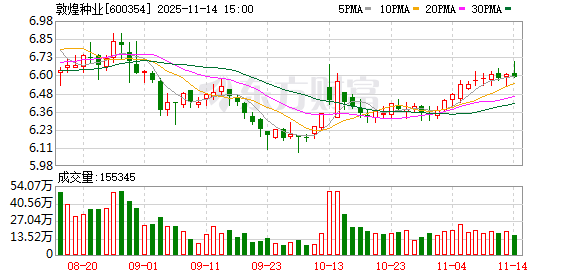
敦煌种业:关于5%以上股东签署《股份转让协议》暨权益变动的提示性公告
Zheng Quan Ri Bao· 2025-11-14 13:38
Core Viewpoint - Dunhuang Seed Industry announced a share transfer agreement where its shareholder, Dunhuang Supply and Marketing Cooperative, will transfer 26,500,000 shares to Shazhou Energy, representing 5.0208% of the total share capital [2] Group 1: Shareholder Changes - Dunhuang Supply and Marketing Cooperative currently holds 29,568,876 shares, accounting for 5.6022% of the total share capital [2] - The share transfer agreement requires compliance confirmation from the Shanghai Stock Exchange and registration with the China Securities Depository and Clearing Corporation [2] Group 2: Voting Rights - The voting rights associated with the transferred shares will continue to be exercised by Jiuquan Steel Group until the transfer is completed [2] - Shazhou Energy intends to delegate the voting rights of the shares it acquires to Jiuquan Steel Group after the transfer is finalized [2]

韩美敲定贸易协议!向美投资3500亿美元,分期付款稳汇率
Guo Ji Jin Rong Bao· 2025-11-14 12:05
韩国总统李在明11月14日宣布,韩美两国确定就关税及安保协商达成一致。 根据协议,韩国将向美国进行总计3500亿美元的投资,韩美一致同意推进韩国建造核潜艇,美国同 意将对韩汽车关税从25%降低至15%。 值得关注的是,这笔巨额投资将采取分期付款方式执行,以避免对本就疲软的韩元汇率造成进一步 冲击。 协议重点 根据韩美双方发布的联合事实清单文件,这项协议基于今年7月发布的"韩国战略贸易及投资协 议"框架。 韩国对美投资构成协议的核心,总额达3500亿美元。其中包括1500亿美元的造船业投资,另外2000 亿美元将依据《战略投资谅解备忘录》投入美国的先进产业。 在关税方面,协议规定韩国输美产品税率已达15%或以上的商品不再加征"附加关税",税率低于 15%的产品则提高至15%。美国对应承诺将韩国产汽车、汽车零部件、木材等产品依照《贸易扩展法》 第232条款征收的关税降至15%。 在半导体领域,韩国也已确保关税水平不会削弱竞争力。 分期付款稳汇率 协议细节还显示,韩国承诺的3500亿美元对美投资计划分"两步走",其中的2000亿美元为现金投 资,类似于日本的安排,每年投资上限为200亿美元,投资承诺将在2029年1 ...
关于商品配置的思考:择时、品种与仓位
对冲研投· 2025-11-14 12:03
Core Viewpoint - The article emphasizes the strategic role of commodities in hedging against inflation and diversifying risks in the context of increasing global macroeconomic uncertainty. It highlights the need for balanced asset allocation among stocks, bonds, and commodities, focusing on timing, selection, and position sizing [4][5]. Group 1: Timing and Economic Cycles - The Merrill Lynch Investment Clock is a classic framework for timing asset allocation, categorizing the economy into four phases: recovery, overheating, stagflation, and recession [6]. - Commodity performance varies across different economic cycles: during recovery, commodity prices remain low due to slow demand recovery; in overheating, strong demand leads to significant price increases; stagflation sees rising inflation with stagnant growth; and recession results in declining economic growth and rising bond prices [9][10]. - The relationship between risk assets and economic cycles indicates that stocks tend to lead economic changes, while commodities respond more synchronously or with a slight lag [11]. Group 2: Selection of Commodity Types - Commodities play a crucial role in combating inflation, as upstream raw material price fluctuations often exceed those of downstream products, providing a buffer against price increases [29]. - The article notes that inflation is often driven by significant price volatility in energy products, which can impact costs across various industries [30]. - Understanding the causes of inflation is essential: monetary phenomena can lead to nominal price increases, while supply-demand imbalances often result from constrained supply [32]. Group 3: Position Sizing and Risk Control - The volatility characteristics of stocks, bonds, and commodities differ, with commodities generally exhibiting higher volatility. In stable macro environments, these assets often move in different directions, allowing for risk mitigation through diversification [36]. - The article discusses the risks associated with inflationary changes, where rising inflation expectations can lead to a positive correlation between equity and commodity markets, complicating risk management strategies [39]. - It suggests that during periods of high volatility, conservative strategies may involve increasing bond allocations to stabilize the portfolio, while aggressive strategies might increase risk asset positions for higher returns [41]. Group 4: Reflection on Commodity Allocation - The article highlights the challenges of timing in the current economic environment, where traditional indicators may not accurately reflect the economic cycle due to structural changes [46]. - It points out that the demand for real estate-related commodities is being suppressed by high household leverage, and the economy is shifting towards a multi-faceted growth model driven by exports and consumption [48]. - The disparity in wealth distribution is noted as a factor that limits total demand for commodities, as lower-income households have less purchasing power compared to higher-income households [54][55].