
有色金属

Search documents
化工板块,集体走强
财联社· 2026-02-06 03:48
Market Overview - The A-share market showed a rebound in early trading, with all three major indices turning positive after previously dropping over 1% [1] - The half-day trading volume in the Shanghai and Shenzhen markets was 1.38 trillion, a decrease of 63.3 billion compared to the previous trading day [1] - Over 3,800 stocks in the market experienced an increase [1] Sector Performance - The chemical sector saw a collective rise, with stocks such as Cangzhou Dahua, Jinniu Chemical, Baichuan Co., and Baihehua hitting the daily limit [3] - The humanoid robot concept performed actively, with stocks like Wuzhou Xinchun, Liancheng Precision, and Tianqi Co. also reaching the daily limit [3] - The non-ferrous metals sector rebounded, with Hunan Gold and Xianglu Tungsten hitting the daily limit [3] - The optical communication concept experienced a volatile recovery, with Hangdian Co. achieving five consecutive daily limits in six days [3] - The traditional Chinese medicine sector opened actively, with Te Yi Pharmaceutical hitting the daily limit [3] - Conversely, the consumer sector faced a collective decline, particularly in the liquor and tourism hotel sectors, with Huangtai Liquor and Dalian Shengya hitting the daily limit [3] - By the end of trading, the Shanghai Composite Index rose by 0.11%, the Shenzhen Component Index increased by 0.65%, and the ChiNext Index also rose by 0.65% [3]


沃什鹰派预期或被夸大,铜价有望修复,有色金属ETF基金(516650)涨超1%
Sou Hu Cai Jing· 2026-02-06 03:35
Core Viewpoint - The COMEX prices of gold, silver, and copper are rising, with expectations of a copper shortage by 2026 due to supply constraints and geopolitical factors [1] Group 1: Market Performance - As of February 6, 2026, the COMEX prices for gold, silver, and copper are strengthening, with the non-ferrous metal ETF (516650) increasing by 1.19% [1] - Notable stock performances include Hunan Gold hitting the upper limit, Guocheng Mining rising by 5.98%, and other companies like Yahua Group and Xiamen Tungsten also seeing gains [1] Group 2: Supply and Demand Dynamics - The copper market is expected to face a widening gap, with a projected global refined copper surplus shrinking to 170,000 tons [1] - If China engages in stockpiling similar to 2020, alongside continuous inflow of U.S. copper inventories, a shift to a global refined copper shortage is anticipated, which would drive copper prices up [1] Group 3: Economic and Policy Influences - Recent declines in copper prices are attributed to the nomination of Kevin Walsh, a "hawkish" candidate for the Federal Reserve chair by Trump, although market reactions may be exaggerated [1] - The feasibility of the Fed's balance sheet reduction is questioned due to insufficient bank reserves and the need for fiscal expansion, with expectations of two rate cuts in 2026 [1] - Geopolitical tensions are influencing the demand for critical minerals, leading to an increase in the global copper gap and a potential rise in copper prices due to "security premiums" [1] Group 4: ETF Focus - The non-ferrous metal ETF (516650) tracks the CSI sub-index for the non-ferrous metal industry, focusing on gold, copper, aluminum, rare earths, and tungsten, with a combined gold, copper, and aluminum content of 61.29%, the highest in the market [2]
黄金持续震荡 还能涨吗?中信证券敖翀:金价上涨趋势并没有完结
2 1 Shi Ji Jing Ji Bao Dao· 2026-02-06 03:20
2026年伊始,黄金行情持续牵动全球投资者的神经。 暴涨——新高——暴跌——回暖——震荡,剧烈的波动之下,市场情绪在狂热与恐慌之间反复切换。有 人止损离场,也有人逢低抄底;也有投资者跑步进场,而后在行情震荡中饱受煎熬…… 截至2月6日11时,国际黄金现货价格约在4850美元/盎司上下,较年初上涨约12%,表现虽超过多数主 流市场指数。然而,与1月29日创下的历史高点相比,金价仍回调超过700美元/盎司。 市场分歧正在加剧。"黄金还能买吗?""该选积存金还是黄金ETF?""这一轮上涨究竟能走多远?"投资 者的疑问纷至沓来。与此同时,已有部分投资者将目光悄然转向其他小金属,试图在金银狂潮之外,提 前捕捉下一个可能起飞的市场。 近日,针对当前黄金市场的剧烈波动与后续走向,21世纪经济报道记者特别对话了中信证券有色金属行 业首席分析师敖翀,试图厘清本轮行情的核心驱动,探寻价格剧烈波动的背后逻辑。 在交流中,敖翀明确指出,当前黄金的上涨趋势尚未完结,流动性预期是当下驱动黄金价格走势的核心 力量。此外,持续的地缘政治冲突也为黄金提供了阶段性的避险动力。 敖翀进一步分析称,随着流动性的持续释放,中国和全球经济有望在未来6- ...

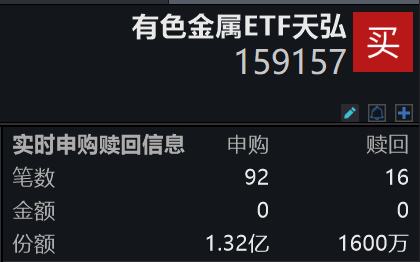
抢占工业有色周期上行先机,有色金属ETF天弘(159157)实时净申购1.16亿份深市同标的第一
Sou Hu Cai Jing· 2026-02-06 03:08
Core Viewpoint - The industrial non-ferrous metals sector is experiencing a favorable investment environment, driven by supply constraints and increasing demand from the AI industry, which is expected to enhance the long-term performance of upstream resources [2][3]. Group 1: Market Performance - As of February 6, 2026, the Tianhong Non-Ferrous Metals ETF (159157) recorded a turnover of 9.91% with a transaction volume of 99.59 million yuan, and the underlying index, the CSI Industrial Non-Ferrous Metals Theme Index (H11059), increased by 0.37% [1]. - The Tianhong Non-Ferrous Metals ETF has seen a net subscription of 116 million shares, ranking first among similar products in the Shenzhen market [1]. Group 2: Industry Insights - The industrial non-ferrous metals sector is concentrated, with the top three industries being copper (31.1%), aluminum (21.9%), and rare earths (16.1%), collectively accounting for approximately 70% of the index [2]. - The rapid development of the AI industry is expected to drive up electricity demand, which will ultimately benefit the industrial non-ferrous metals sector, especially given the anticipated limited supply growth in the coming years [2]. Group 3: Price Trends - The commodity price index in China reached a three-and-a-half-year high in January 2026, with the non-ferrous metals price index rising by 9.9% month-on-month and 26.6% year-on-year [4]. - Among 50 monitored commodities, 33 saw price increases in January, with lithium carbonate, refined tin, and refined nickel leading the gains at 48.4%, 20.2%, and 19.5% respectively [4]. Group 4: Institutional Perspectives - CITIC Securities indicates that after a significant price increase in 2025, the momentum for non-ferrous metal prices and stocks remains strong, supported by supply disruptions and high demand in certain sectors [4]. - The firm expresses optimism regarding the investment value in precious metals, industrial metals, battery metals, and strategic metals due to favorable market conditions [4].
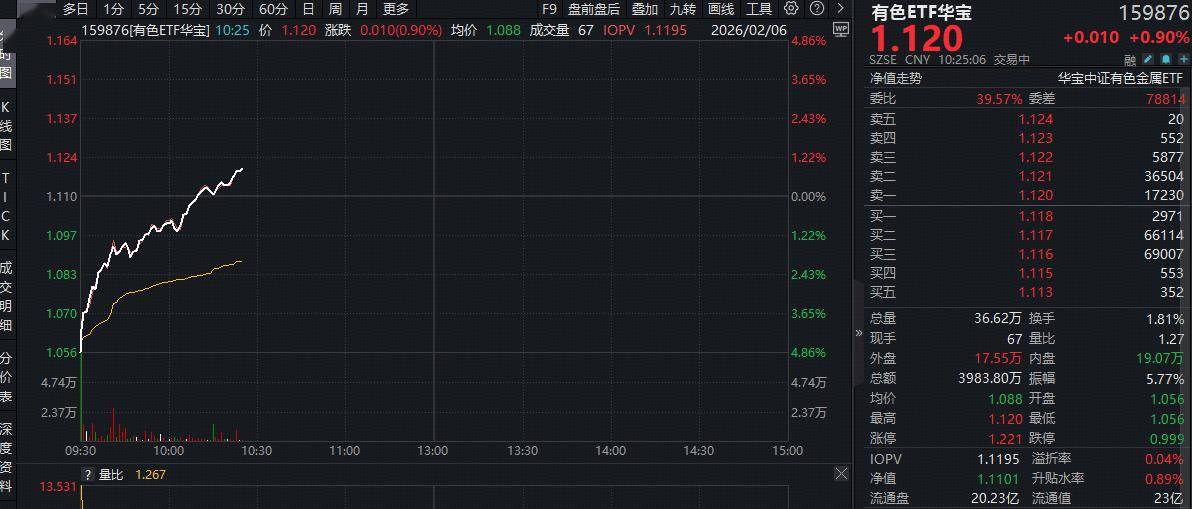
ETF盘中资讯|拔地而起!有色ETF(159876)逆市摸高0.9%,此前两日连续吸金超4000万元!中美同步推进铜资源战略储备建设
Sou Hu Cai Jing· 2026-02-06 03:08
Group 1 - The core viewpoint of the news highlights a strong performance in the non-ferrous metals sector, particularly with the Huabao ETF, which saw a 0.9% increase despite market fluctuations, indicating positive investor sentiment towards the sector [1] - Major stocks in the sector, such as Guocheng Mining and Hunan Gold, led gains of over 5%, while other companies like Shengxin Lithium Energy and Xiamen Tungsten also saw significant increases [1] - The recent influx of capital into the sector, amounting to 40.93 million yuan over two days, reflects a growing confidence in the future performance of non-ferrous metals [1] Group 2 - The strategic importance of copper is underscored by simultaneous initiatives from China and the U.S. to enhance copper resource reserves, with China exploring the inclusion of copper concentrate in its national strategic reserves to address a 75% import dependency [3] - The global copper market is facing a supply-demand imbalance, with declining ore grades and insufficient capital expenditure leading to a predicted long-term supply gap, driven by increasing demand from sectors like AI data centers and electric vehicles [3][4] - Analysts predict that copper prices will rise due to a "safety premium" as countries prioritize resource security amid geopolitical tensions, with domestic initiatives in China aimed at strengthening the copper supply chain [4] Group 3 - The domestic push for a copper resource reserve system aims to enhance the resilience and security of the copper supply chain, with expectations of an expanding global copper deficit leading to upward pressure on prices [4] - The current market conditions suggest that the "non-ferrous feast" will not be a short-term phenomenon, with high profitability expected to persist for 3-5 years due to a combination of supply-demand mismatches and macroeconomic factors [4] - Some analysts caution about potential volatility in the market due to speculative profit-taking, advising a balanced allocation of 10-20% in non-ferrous metals within investment portfolios to capture upside while managing risk [4]
有色ETF鹏华(159880)红盘向上,机构看好铜基本面,铜价有望持续上行
Xin Lang Cai Jing· 2026-02-06 02:57
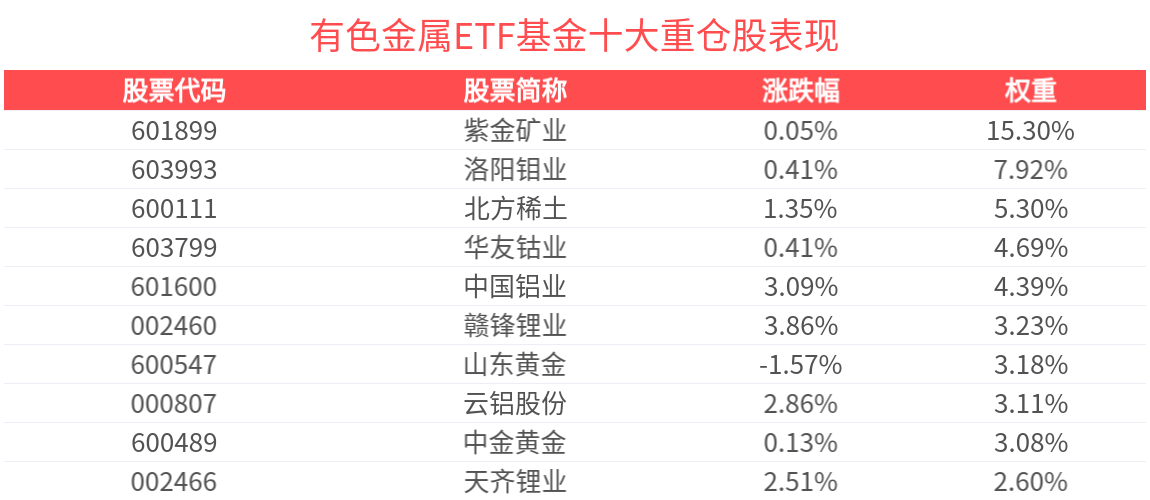
Group 1 - The core viewpoint is that the non-ferrous metals sector is experiencing a strong rally, with specific mention of Hunan Gold hitting the daily limit, and industrial metals continuing to rise. Morgan Stanley indicates a significant likelihood of intensified bullish trends in the copper market in the coming months due to mismatches in supply and demand [1] - China Galaxy Securities highlights the domestic initiative to build a copper resource reserve system aimed at enhancing the resilience and security of the domestic copper supply chain. The ongoing global geopolitical shifts are expected to widen the global copper supply gap, leading to an increase in copper prices driven by a "safety premium" [1] - Short-term copper prices are influenced by market expectations regarding the Federal Reserve's policies, but there is potential for recovery as downstream demand improves, solidifying the fundamental support. Current valuations of key copper mining stocks in the A-share market show a high margin of safety for 2026, indicating significant investment value [1] Group 2 - As of February 6, 2026, the National Securities Non-Ferrous Metals Industry Index (399395) rose by 0.83%, with notable increases in component stocks such as Hunan Gold (+10.00%), Zhongtung High-tech (+5.13%), and Xiamen Tungsten (+4.70%) [1] - The Penghua Non-Ferrous ETF closely tracks the National Securities Non-Ferrous Metals Industry Index, which selects 50 prominent securities in the non-ferrous metals sector based on size and liquidity, reflecting the overall performance of listed companies in this industry [2] - As of January 30, 2026, the top ten weighted stocks in the National Securities Non-Ferrous Metals Industry Index include Zijin Mining, Luoyang Molybdenum, and Northern Rare Earth, collectively accounting for 49.87% of the index [2]
有色金属ETF天弘(159157)今日重磅上市,一键布局三重逻辑驱动下的工业有色板块
Ge Long Hui· 2026-02-06 02:46
Group 1 - The core viewpoint of the news is the launch of the Tianhong Industrial Metal ETF (159157), which focuses on industrial non-ferrous metals and has seen a cumulative increase of 123.19% since last year [1] - The ETF's core advantages include a precise focus on key industrial metals such as copper (34.7%), aluminum (20.2%), rare earths (12.5%), and lead-zinc (7%), which together account for over 70% of its holdings, directly linked to the upstream demand from emerging industries like new energy and AI [1] - The AI-driven demand surge is expected to significantly increase the need for industrial non-ferrous metals, particularly copper, while supply constraints due to insufficient capital expenditure and declining ore grades over the past decade will support long-term price increases [1] Group 2 - Rare earth metals have become crucial national strategic resources, with China's dominance in reserves, production, and smelting technology highlighting their strategic value amid US-China trade tensions [1] - The resource sector is entering an upward cycle, characterized by tight supply conditions and increasing global emphasis on resource security, making it likely for metal prices to rise in the long term [1] - The Tianhong ETF tracks the CSI Industrial Non-Ferrous Metal Theme Index, covering 30 leading companies in the sector, providing a convenient way to capitalize on investment opportunities driven by AI, strategic resources, and cyclical uptrends [2]
国投期货综合晨报-20260206
Guo Tou Qi Huo· 2026-02-06 02:38
Group 1: Energy and Metals Crude Oil - Night session oil prices gave back previous gains. Geopolitical news has a phased and intermittent impact on oil prices. Global oil market inventory accumulation pressure remains significant, and oil price volatility is expected to continue [1]. Precious Metals - Overnight, precious metals continued to decline. CME raised margin requirements for gold and silver futures. Short - term precious metals are in a volatile stage, and it is advisable to wait for volatility to decline [2]. Copper - Overnight, Shanghai copper's open interest dropped below 600,000 lots. The market is volatile in the short - term. The market focuses on potential reserves and supply - demand changes around the Spring Festival. It is more concerned about inter - period reverse arbitrage and waiting to go long at low prices [3]. Aluminum - Overnight, Shanghai aluminum rebounded slightly. Short - term macro sentiment is unstable, and the fundamentals are weak. There is still adjustment pressure around the Spring Festival [4]. Cast Aluminum Alloy - Cast aluminum alloy follows the fluctuations of Shanghai aluminum, with low market activity. It has difficulty rising with aluminum prices and its seasonal spread with Shanghai aluminum will be weaker than in previous years [5]. Alumina - Domestic alumina operating capacity has slightly decreased, but long - term large - scale production cuts have not occurred. The alumina market remains in surplus [6]. Zinc - Before the Spring Festival, Shanghai zinc's fluctuations have increased. The downstream purchasing sentiment is weak. In the short - term, zinc prices lack the momentum to rebound, but attention should be paid to potential rebounds after volatility declines [7]. Lead - The domestic lead market has weak supply and demand. Consumption support for prices is insufficient in the short - term. Cost support is relatively strong, and the market is in a state of divergence. It is advisable to wait and see before the Spring Festival [8]. Nickel and Stainless Steel - Shanghai nickel declined, and market trading was active. Stainless steel downstream buyers are cautious. The market sentiment is panicked, and caution is recommended [9]. Tin - Overnight, tin prices fluctuated. Wait for the changes in social inventory after the decline in tin prices this week. It is advisable to hold a small number of short positions or wait and see [10]. Lithium Carbonate - Lithium carbonate hit the daily limit down during the session. The market participation is affected by exchange policies. The futures price is in high - level oscillation, with high short - term uncertainty [11]. Industrial Silicon - Industrial silicon was dragged down by the precious metal market sentiment. In February, production is expected to decline significantly. The downstream demand is weak. The market may rebound after a sharp decline and will generally maintain an oscillating trend [12]. Polysilicon - The polysilicon market sentiment was affected by the decline in precious metals. In February, production is expected to decline. The market may go through inventory reduction. After an emotional correction, the market will maintain an oscillating trend [13]. Rebar and Hot - Rolled Coil - Night session steel prices oscillated weakly. Rebar demand and production declined, and inventory continued to accumulate. Hot - rolled coil demand decreased, and inventory slightly increased. The market atmosphere is pessimistic, and the price is under short - term pressure [14]. Iron Ore - The iron ore market oscillated overnight. Supply is seasonally low, and demand is weak in the off - season. The overall supply - demand is relatively loose, and the short - term trend will be mainly oscillating [15]. Coke - The coke price oscillated downward during the day. Coking profit is average, and inventory slightly increased. The price will probably oscillate within a range [16]. Coking Coal - The coking coal price oscillated downward during the day. The total inventory has increased significantly. The price is difficult to decline significantly and will mainly oscillate within a range [17]. Ferromanganese Silicon - The price oscillated during the day. The supply is in surplus, and the price is affected by the "anti - involution" policy [18]. Ferrosilicon - The price oscillated during the day. The demand has some resilience, and the supply has little change. The price is affected by the "anti - involution" policy [19]. Group 2: Shipping and Related Products Container Freight Index (European Line) - Shipping companies are raising post - holiday quotes, but the actual implementation may be limited. The market is in a quiet period before the Spring Festival, and the freight rate is generally stable [20]. Fuel Oil and Low - Sulfur Fuel Oil - High - sulfur fuel oil is supported by geopolitical factors and tight supply - demand in the spot market. Low - sulfur fuel oil is under pressure due to supply increases and weakening demand [21]. Asphalt - Shandong and southern refineries have reduced production. Consumption has improved year - on - year. The price will continue to be strong, and the cracking spread is expected to rise [22]. Group 3: Chemical Products Urea - The spot price of urea has increased slightly. Production is rising, and demand is mainly for reserve. The market will oscillate within a range [23]. Methanol - Overseas methanol plant operation has declined, and domestic production has increased. The coastal demand is weak, and the short - term fundamentals are still weak [24]. Pure Benzene - Geopolitical risks have decreased, and the price has fallen. Domestic production has increased slightly, and imports are still high. The downstream demand is expected to improve, but the fundamentals may weaken as supply increases [25]. Styrene - Domestic production has increased. The price is affected by crude oil price fluctuations and will oscillate widely [26]. Polypropylene, Plastic, and Propylene - The supply of the two - olefin market has no obvious pressure. The downstream demand is weak, and the market will oscillate [27]. PVC and Caustic Soda - PVC is expected to oscillate strongly due to cost support and export demand. Caustic soda is running weakly, and its price is determined by the price of liquid chlorine [28]. PX and PTA - PX and PTA are oscillating at a low level. There is a risk of inventory accumulation around the Spring Festival. Consider long - position opportunities in the second quarter based on PX maintenance and polyester load - increasing expectations [29]. Ethylene Glycol - The inventory is increasing, and the short - term trend is oscillating. The supply - demand may improve in the second quarter, but the long - term is still under pressure [30]. Short - Fiber and Bottle Chip - Short - fiber has a good supply - demand pattern, but downstream orders are weak. Bottle - chip processing margin has improved, but there is long - term capacity pressure. Both follow raw material price fluctuations [31]. Group 4: Building Materials Glass - Glass prices are weakening. There is pressure for inventory accumulation during the Spring Festival. The price will oscillate widely due to the game between low valuation and weak reality [32]. 20 - Number Rubber, Natural Rubber, and Butadiene Rubber - The international crude oil price has fallen, and the natural rubber supply is in the reduction period. The demand is average, and the market sentiment is weak. It is advisable to wait and see [33]. Soda Ash - Soda ash is running weakly. Inventory is rising, and the market is under supply - demand pressure. Consider short - selling on rebounds [34]. Group 5: Agricultural Products Soybean and Soybean Meal - After the Sino - US leaders' communication, the US soybean futures rose, but the domestic market followed weakly. The short - term trend of domestic soybean meal will be bottom - oscillating [35]. Soybean Oil and Palm Oil - CBOT soybeans are strong. The US soybean oil is expected to oscillate strongly. Pay attention to the impact of macro factors in 2026 [36]. Rapeseed and Rapeseed Oil - The import of oilseeds is expected to improve. The rapeseed market will oscillate in the short - term [37]. Soybean No. 1 - Soybean No. 1 oscillates. The policy is promoting domestic soybean production. Pay attention to policy and market sentiment [38]. Corn - The spot price of corn in the northeast and northern ports is slightly stronger. The futures price will oscillate weakly in the short - term [39]. Live Pig - The live pig futures are declining. The short - term supply pressure is large, and the long - term price may have a low point in the first half of next year [40]. Egg - The egg futures have fallen significantly. The egg price may rise in the first half of 2026. Consider long - position strategies after the Spring Festival [41]. Cotton - Zhengzhou cotton is slightly declining. The short - term trend will be oscillating. Pay attention to import changes [42]. Sugar - International sugar production varies by country. Domestic sugar production in Guangxi is slow, but there is an expectation of an increase in the 25/26 season. The short - term price is under pressure [43]. Apple - The apple futures price oscillates. The market focuses on demand. The poor quality and high price may affect inventory reduction [44]. Wood - The wood futures price is at a low level. Low inventory supports the price. It is advisable to wait and see [45]. Pulp - The pulp futures price has fallen. The port inventory is accumulating. The short - term fundamentals are weak, and the price will oscillate. Wait and see and pay attention to support levels [46]. Group 6: Financial Products Stock Index - A - shares adjusted with reduced volume, and stock index futures fell. The short - term risk assets will probably oscillate at a high level, and it is better to focus on performance - certain sectors [47]. Treasury Bond - On February 5, 2026, TL2603 led the rise. Other varieties are strong under the influence of loose funds and central bank bond - buying [48].
黄金:资产再配置,金价走向何方?
HTSC· 2026-02-06 02:30
Investment Rating - The industry rating for precious metals is "Overweight" (Maintain) [7] Core Insights - The report highlights that the long-term increase in gold holdings by central banks is driven by concerns over the creditworthiness of dollar assets, the need for stable exchange rates in extreme scenarios, and geopolitical risks. It is projected that central banks will continue to increase their gold reserves, stabilizing at around 800 tons per year from 2026 to 2030 [2] - The report anticipates that the average gold price could rise to between $5,400 and $6,800 per ounce from 2026 to 2028, driven by a potential increase in the investment allocation of gold in global financial assets [6] Summary by Sections Section 1: Gold Price Projections - The average gold price is expected to reach $6,800 per ounce by 2028, with projections for 2026 and 2027 being $5,463 and $6,059 per ounce respectively. This is based on historical distribution of gold allocation and structural shifts due to de-dollarization and geopolitical factors [6][12] Section 2: Central Bank Demand - Central banks are expected to maintain a long-term increase in gold holdings, with the proportion of gold in reserves projected to rise to 21.4% by mid-2025. If this proportion reaches the historical median of 34% by 2035, the demand for gold could continue to grow [2] Section 3: Non-Investment Demand - Non-investment demand for gold, primarily from jewelry and industrial uses, is expected to stabilize. Jewelry demand is projected to average around 1,951 tons per year, while industrial demand is expected to remain steady at approximately 332 tons per year [3] Section 4: Investment Demand - The report estimates that the stock of gold allocated for personal and institutional investment will gradually increase, with projections for 2026, 2027, and 2028 being 85,713 tons, 86,642 tons, and 87,953 tons respectively [4] Section 5: Financial Asset Allocation - There is still room for increased allocation of gold in global financial assets, with the expected market value of investable gold reaching approximately $15.1 trillion, $16.9 trillion, and $19.3 trillion in 2026, 2027, and 2028 respectively [5][16]
大越期货沪镍、不锈钢早报-20260206
Da Yue Qi Huo· 2026-02-06 02:12
交易咨询业务资格:证监许可【2012】1091号 沪镍&不锈钢早报—2026年2月6日 大越期货投资咨询部 祝森林 从业资:F3023048 投资咨询证:Z0013626 联系方式:0575-85226759 不锈钢 每日观点 1、基本面:现货不锈钢价格持平,短期镍矿价格上涨,看涨情绪浓重,镍铁价格继续上涨,成本线上升, 不锈钢库存有一定回升。中性偏强 2、基差:不锈钢平均价格14987.5,基差1177.5,偏多 3、库存:期货仓单:45970,+1531,中性 4、盘面:收盘价在20均线以下,20均线向上,中性 5、结论:不锈钢2603:少量空头持有,站回20均线止损。 沪镍 每日观点 1、基本面:外盘有所回落。供应方面,前期减产的产能开始恢复生产,进口货源陆续到货,印尼寒锐 镍板也有大量提供,市场供应充足。产业链上,镍矿看涨情绪较浓重,菲律宾与印尼都有强支撑。镍 铁价格继续上涨,成本线上升。不锈钢库存开始回升,要注意库存回升之后不锈钢价格或有反转。精 炼镍库存持续高位,过剩格局不变。新能源汽车产销数据良好,但总体镍需求提振有限。偏空 2、基差:现货139850,基差5420,偏多 3、库存:LME库存2 ...