
国防军工

Search documents
浙商早知道-20251016
ZHESHANG SECURITIES· 2025-10-15 23:30
Market Overview - The Shanghai Composite Index rose by 1.2%, the CSI 300 increased by 1.5%, the STAR 50 gained 1.4%, the CSI 1000 was up by 1.5%, the ChiNext Index surged by 2.4%, and the Hang Seng Index climbed by 1.8% [5][4] - The best-performing sectors included power equipment (+2.7%), automotive (+2.4%), electronics (+2.3%), pharmaceutical and biotechnology (+2.1%), and retail (+1.9%). The worst-performing sectors were steel (-0.2%), oil and petrochemicals (-0.1%), agriculture, forestry, animal husbandry, and fishery (+0.0%), real estate (+0.1%), and defense and military industry (+0.2%) [5][4] - The total trading volume in the Shanghai and Shenzhen markets was 20,729 billion, with a net outflow of 5.44 billion HKD from southbound funds [5][4] Automotive Industry Insights - The automotive sector report emphasizes three main investment opportunities: robotics, bus exports, and intelligent driving [6] - The market perception of technological advancements and potential profit growth in the automotive sector is considered insufficient [6] - Key drivers include significant changes in the robotics industry, strong bus export volumes, and rapid advancements in applications for autonomous vehicles [6] Agriculture, Forestry, Animal Husbandry, and Fishery Insights - The core viewpoint is that pig farming and cattle breeding remain the main focus, with an emphasis on capturing post-cycle opportunities [7] - The report notes a continuous decline in pig prices, a gradual reversal in the beef cycle, and persistent low milk prices [7] - Key drivers include rising pig prices due to policy shifts towards "anti-involution" and increasing beef prices as traditional demand peaks in Q4 [7] Macro Economic Insights - The macroeconomic report highlights a significant increase in exports to Africa, driven by Chinese companies seeking new markets amid US trade tensions [8] - The report suggests that the high growth in exports may be a result of "export grabbing" [8] - The potential for industrial layout in African economies is noted as a key differentiator from market expectations [8] Fixed Income and Credit Bond Insights - The fixed income report indicates that the positive spread between rental yields and risk-free rates could provide guidance for housing prices, with 2027 expected to be a critical year for identifying the bottom of the real estate market [9] - The report anticipates a "L-shaped" bottoming out of the real estate market rather than a V-shaped rebound, highlighting significant structural differentiation [9] - Key drivers include the rental return rate as a critical reference for when housing prices may bottom out, with expectations for rental yields to reach near a decade-high by the end of 2027 [9]
晨会纪要:开源晨会1016-20251015
KAIYUAN SECURITIES· 2025-10-15 15:40
Group 1: Macroeconomic Insights - The report discusses the potential for PPI to turn positive, with September CPI at -0.3%, PPI at -2.3%, and expectations for both being slightly negative [5][9][12] - Core CPI has shown a seasonal decline, with September's core CPI remaining at 0%, marking the first time since April 2025 that it fell below seasonal expectations [10][11] - The report anticipates that if PPI remains at 0% from October 2025 onward, the average PPI for 2026 could be around -0.7% [14] Group 2: Electronic Industry Insights - The report highlights the acceleration of commercialization in domestic AI hardware, focusing on the synergy of computing power, storage, and operational capacity [18][19] - The demand for Scaleup and Scaleout hardware is expected to grow significantly, with the global market for Scaleup exchange chips projected to reach nearly $18 billion by 2030, with a CAGR of approximately 28% from 2022 to 2030 [19] - The report identifies a low domestic production rate for operational hardware, indicating a significant opportunity for domestic replacements in the market [21] Group 3: Robotics Industry Insights - The report introduces Figure03, a humanoid robot designed for mass production, emphasizing safety and comfort in home environments [23][24] - Figure03 features advanced capabilities such as tactile sensors for stable operation in limited visibility environments and supports wireless charging for continuous operation [24][25] - The report notes that Figure aims to produce over 100,000 units within four years, with a projected valuation of nearly $40 billion, supported by significant investments from major tech companies [24][26]
每日复盘-20251015
Guoyuan Securities· 2025-10-15 13:50
Market Performance - On October 15, 2025, the Shanghai Composite Index rose by 1.22% to 3,912.21 points, while the Shenzhen Component Index increased by 1.73% to 13,118.75 points, and the ChiNext Index surged by 2.36% to 3,025.87 points[2][14][18] - The total market turnover was 20,903.87 billion yuan, a decrease of 5,062.00 billion yuan compared to the previous trading day[2][14] Sector and Style Analysis - Among the 30 major sectors, the top performers were Electric Equipment and New Energy (up 2.87%), Automotive (up 2.32%), and Electronics (up 2.12%)[2][21] - The overall market style performance ranked as follows: Growth > Cyclical > Consumer > Financial > Stable[2][21] Fund Flow - On October 15, 2025, the net outflow of main funds was 8.53 billion yuan, with large orders seeing a net outflow of 61.36 billion yuan and small orders experiencing a net inflow of 185.43 billion yuan[3][26] - Major ETFs such as the Huaxia SSE 50 ETF and the Huatai-PB CSI 300 ETF saw significant decreases in turnover, with changes of -10.24 billion yuan and -7.96 billion yuan respectively[3][32] Global Market Trends - On the same day, major Asia-Pacific indices closed higher, with the Hang Seng Index up 1.84% and the Nikkei 225 Index up 1.76%[4][36] - In contrast, European indices showed mixed results, with the German DAX Index down 0.62% and the UK FTSE 100 Index up 0.10%[5][37]
A股定增市场持续升温,前三季度累计募资超7700亿
Cai Jing Wang· 2025-10-15 11:05
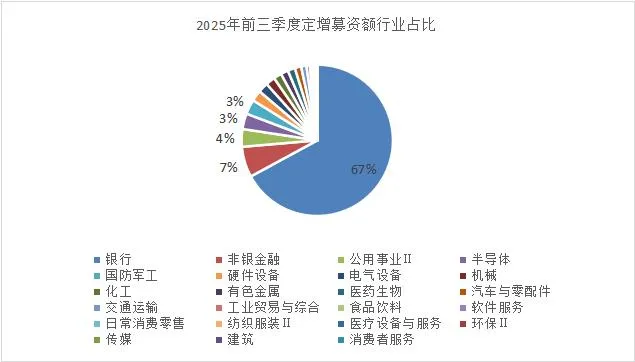
Core Insights - The A-share private placement market is experiencing a strong recovery in 2025, with total fundraising reaching 775.1 billion yuan in the first three quarters, a year-on-year increase of 548.7% [1][2][10] - Key sectors attracting investment include non-bank financials, defense and military, semiconductors, and hardware equipment [1][3] Fundraising Overview - In the first three quarters of 2025, 119 companies conducted private placements, raising a total of 775.1 billion yuan, marking a 15.53% increase in the number of placements compared to the previous year [2] - The total fundraising amount significantly exceeds the annual totals from the previous three years, which were 721.9 billion yuan in 2022, 578.9 billion yuan in 2023, and 173.1 billion yuan in 2024 [2] Sector Analysis - The banking sector accounted for nearly 70% of the total fundraising, primarily due to major banks like China Bank and Postal Savings Bank raising a combined 520 billion yuan [2][3] - Non-bank financials and public utilities ranked second and third in fundraising, with amounts of 50.7 billion yuan and 29.3 billion yuan, respectively [3] - The semiconductor and defense sectors also saw significant fundraising, with amounts of 25.9 billion yuan and 24.3 billion yuan, respectively [3] Average Fundraising Amount - The average fundraising amount per project has increased, with the average for 115 companies (excluding four state-owned banks) being 22.2 million yuan, compared to 11.9 million yuan in the same period last year [3] - Eleven companies raised over 5 billion yuan each, compared to only four in the previous year [3] Notable Projects - Major projects include Guolian Minsheng's 29.5 billion yuan for asset acquisition, AVIC Chengfei's 17.4 billion yuan for asset acquisition, and China Nuclear Power's 14 billion yuan for project financing [4][6] - Other significant projects include Fulede's 6.19 billion yuan for acquiring 100% of Fulehua and ChipLink's 5.31 billion yuan for acquiring 72.33% of ChipLink Yuezhou [4][6] Regional Distribution - Beijing leads in fundraising with 42.9 billion yuan from 11 projects, accounting for 55.34% of the total [7] - Shanghai and Jiangsu follow with 15.0 billion yuan and 4.3 billion yuan, respectively [7] - Shaanxi has seen a notable increase in fundraising, reaching 19.2 billion yuan, largely due to AVIC Chengfei's successful issuance [8] Market Trends - The recovery in the private placement market is attributed to policy guidance, active mergers and acquisitions, and improved market profitability [12] - The technology sector, particularly in high-end manufacturing and AI, is seeing increased investment, with several companies planning significant fundraising for related projects [12]





天风·固收 | 对比4月,转债TACO交易再现?
Xin Lang Cai Jing· 2025-10-15 10:10
Core Viewpoint - The short-term upward elasticity of equities is limited, making it difficult for the inflow of funds to continue boosting convertible bond valuations. It is recommended to maintain a neutral to low position and wait for opportunities, focusing on low-priced convertible bonds that resonate with terms, especially those in the export chain that may be affected by tariff policies, which could present numerous TACO trading opportunities [1][8]. Summary by Sections Tariff Impact and Market Reactions - In early April, the market experienced panic selling due to the announcement of tariffs by the U.S. government, leading to significant declines in A-shares, with the Shanghai Composite Index dropping 7.34% on April 7. Convertible bonds followed suit, with the weighted index of convertible bonds falling over 12% [2]. - Following the initial panic, the market began to recover on April 8, driven by a focus on expanding domestic demand and self-sufficiency, with the convertible bond index rebounding by 2.45% from April 8 to April 11 [2][3]. Sector Performance in Convertible Bonds - The performance of convertible bonds varied significantly across sectors during April. Industries with high external demand, such as advanced manufacturing and electronics, saw deeper declines and weaker rebounds compared to others. For instance, the electronics and home appliances sectors experienced over a 15% drop, followed by a mere 5% rebound [4]. - Conversely, sectors with balanced internal and external demand, such as defense, computing, and pharmaceuticals, showed strong rebounds after the initial declines [4]. Export Chain Convertible Bonds - The performance of export chain convertible bonds also varied, with some, like those in the chemical and textile sectors, showing resilience and good rebound performance despite earlier declines. For example, the Li Min and Su Li convertible bonds in the chemical sector had lower declines and performed well in the subsequent rebound [6]. - However, sectors like consumer electronics and medical outsourcing saw deeper initial declines and weaker recovery in the rebound phase [6]. Market Trends and Future Outlook - The TACO trading opportunities re-emerged in April due to unexpected changes in tariff policies, leading to high volatility in asset prices. As of late September, the market saw a decrease in convertible bond holdings by insurance institutions and other major holders, but public funds increased their positions, keeping convertible bond valuations relatively high [7]. - Looking ahead, the consensus is forming around a recovery in micro-enterprise performance, with a focus on high-priced equity strategies and small-cap growth convertible bonds in sectors like AI, semiconductors, and military electronics [8].

10月15日深证国企ESGR(470055)指数涨0.82%,成份股东方电子(000682)领涨
Sou Hu Cai Jing· 2025-10-15 09:47
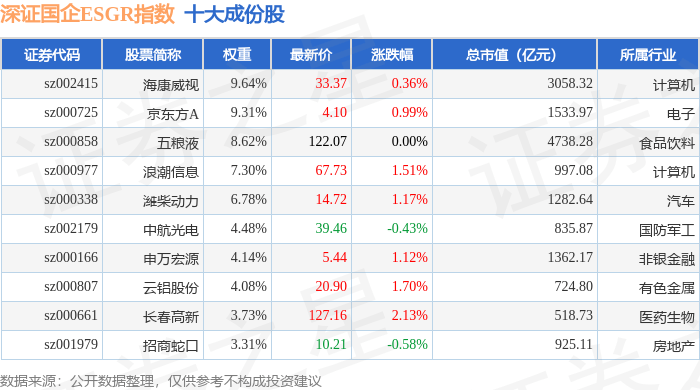
Core Points - The Shenzhen State-Owned Enterprises ESGR Index (470055) closed at 1616.23 points, up 0.82%, with a trading volume of 37.146 billion yuan and a turnover rate of 1.29% [1] - Among the index constituents, 38 stocks rose while 11 fell, with Dongfang Electronics leading the gainers at 4.46% and Dongfang Tantalum leading the decliners at 3.83% [1] Index Constituents Summary - The top ten constituents of the Shenzhen State-Owned Enterprises ESGR Index are as follows: - Hikvision (sz002415) has a weight of 9.64%, latest price at 33.37 yuan, with a market cap of 305.832 billion yuan [1] - BOE Technology Group (sz000725) has a weight of 9.31%, latest price at 4.10 yuan, with a market cap of 153.397 billion yuan [1] - Wuliangye Yibin (sz000858) has a weight of 8.62%, latest price at 122.07 yuan, with a market cap of 473.828 billion yuan [1] - Inspur Information (sz000977) has a weight of 7.30%, latest price at 67.73 yuan, with a market cap of 99.708 billion yuan [1] - Weichai Power (sz000338) has a weight of 6.78%, latest price at 14.72 yuan, with a market cap of 128.264 billion yuan [1] - AVIC Optoelectronics (sz002179) has a weight of 4.48%, latest price at 39.46 yuan, with a market cap of 83.587 billion yuan [1] - Shenwan Hongyuan (sz000166) has a weight of 4.14%, latest price at 5.44 yuan, with a market cap of 136.217 billion yuan [1] - Yunnan Aluminum (sz000807) has a weight of 4.08%, latest price at 20.90 yuan, with a market cap of 72.480 billion yuan [1] - Changchun High & New Technology (sz000661) has a weight of 3.73%, latest price at 127.16 yuan, with a market cap of 51.873 billion yuan [1] - China Merchants Shekou (sz001979) has a weight of 3.31%, latest price at 10.21 yuan, with a market cap of 92.511 billion yuan [1] Capital Flow Analysis - The net inflow of main funds into the ESGR index constituents totaled 454 million yuan, while retail funds saw a net outflow of 114 million yuan [1] - The detailed capital flow for key stocks includes: - BOE Technology Group saw a net inflow of 221 million yuan from main funds [2] - Wuliangye Yibin had a net inflow of 108 million yuan from main funds [2] - Inspur Information experienced a net inflow of 102 million yuan from main funds [2] - Yunnan Aluminum had a net inflow of 74 million yuan from main funds [2] - Changchun High & New Technology saw a net inflow of 66 million yuan from main funds [2]

国防军工行业10月15日资金流向日报
Zheng Quan Shi Bao Wang· 2025-10-15 09:24
Core Points - The Shanghai Composite Index rose by 1.22% on October 15, with 29 out of 31 sectors experiencing gains, particularly in the power equipment and automotive sectors, which increased by 2.72% and 2.37% respectively [1] - The defense and military industry saw a slight increase of 0.20%, despite a net outflow of 2.35 billion yuan in main funds [2] - Overall, the main funds in the two markets experienced a net outflow of 853 million yuan, with 16 sectors seeing net inflows, led by the pharmaceutical and biological industry with a net inflow of 3.845 billion yuan [1] Industry Summary Defense and Military Industry - The defense and military sector had 138 stocks, with 90 rising and 44 falling; one stock hit the daily limit up while another hit the limit down [2] - The top three stocks with the highest net inflow were China Satellite (77.31 million yuan), Feilihua (54.54 million yuan), and Hongda Electronics (46.43 million yuan) [2] - The sector's stocks with the largest net outflows included Changcheng Military Industry (488.36 million yuan), Western Superconducting (327.96 million yuan), and AVIC Shenfei (158.24 million yuan) [3] Fund Flow Analysis - The defense industry saw a total of 39 stocks with net inflows, while 7 stocks experienced outflows exceeding 100 million yuan [2][3] - The stocks with the highest net inflow percentages included China Satellite (1.72%), Feilihua (2.51%), and Hongda Electronics (5.69%) [2] - Conversely, the stocks with the largest outflows included Changcheng Military Industry (-7.36%), Western Superconducting (-4.36%), and AVIC Shenfei (-1.68%) [3]
10月15日主力资金流向日报
Sou Hu Cai Jing· 2025-10-15 09:18
今日各行业资金流向 | 行业 | 日涨跌幅(%) | 资金流向(亿元) | 行业 | 日涨跌幅(%) | 资金流向(亿元) | | --- | --- | --- | --- | --- | --- | | 医药生物 | 2.08 | 38.45 | 社会服务 | 1.43 | -0.25 | | 电力设备 | 2.72 | 17.04 | 石油石化 | -0.14 | -0.31 | | 家用电器 | 1.40 | 17.04 | 交通运输 | 0.72 | -0.76 | | 汽车 | 2.37 | 12.86 | 综合 | 0.79 | -1.13 | | 非银金融 | 1.48 | 11.48 | 环保 | 0.57 | -1.31 | | 食品饮料 | 0.77 | 10.00 | 公用事业 | 0.44 | -1.44 | | 计算机 | 1.52 | 9.68 | 农林牧渔 | 0.01 | -2.12 | | 建筑装饰 | 1.10 | 5.23 | 房地产 | 0.11 | -2.79 | | 建筑材料 | 1.55 | 3.60 | 煤炭 | 0.44 | -3.55 | | 商贸零售 | ...




今日沪指涨0.10% 美容护理行业涨幅最大
Zheng Quan Shi Bao Wang· 2025-10-15 05:56
Core Points - The Shanghai Composite Index rose by 0.10% today, with a trading volume of 827.71 million shares and a total transaction value of 1,280.495 billion yuan, a decrease of 23.83% compared to the previous trading day [1][2] - A total of 3,296 stocks increased in value, with 51 hitting the daily limit up, while 1,952 stocks declined, including 6 hitting the daily limit down [1][2] Industry Performance - The top-performing sectors included: - Beauty and Personal Care: Increased by 2.50%, with a transaction value of 45.93 billion yuan, up 57.56% from the previous day, led by Shanghai Jahwa, which rose by 10.00% [1] - Retail: Increased by 1.69%, with a transaction value of 203.51 billion yuan, up 33.09%, led by Guoguang Chain, which rose by 10.00% [1] - Pharmaceutical and Biological: Increased by 1.49%, with a transaction value of 698.26 billion yuan, up 14.92%, led by Guangsheng Tang, which rose by 20.00% [1] - The sectors with the largest declines included: - Defense and Military: Decreased by 1.49%, with a transaction value of 342.54 billion yuan, down 35.37%, led by Beifang Changlong, which fell by 10.39% [2] - Non-ferrous Metals: Decreased by 1.23%, with a transaction value of 1,244.15 billion yuan, down 24.08%, led by Shandong Gold, which fell by 6.67% [2] - Steel: Decreased by 0.74%, with a transaction value of 131.04 billion yuan, down 34.92%, led by Guangdong Mingzhu, which fell by 7.73% [2]
ETF融券榜 | 军工ETF(512660)融券净卖出365.46万元,居可比基金首位-20251014
Xin Lang Cai Jing· 2025-10-15 04:53
Group 1 - The military industry ETF (512660.SH) experienced a decline of 1.28% on October 14, 2025, with a trading volume of 1.072 billion yuan [1] - The ETF saw a short selling of 4.033 million yuan and a repayment of 378,400 yuan, resulting in a net short selling of 3.6546 million yuan, ranking first among comparable funds [1] - Over the past two days, leveraged funds have accelerated their selling, totaling 4.7412 million yuan, also ranking first among comparable funds [1]