
油脂

Search documents
建信期货油脂日报-20251114
Jian Xin Qi Huo· 2025-11-14 06:48
Report Information - Report Date: November 14, 2025 [2] - Industry: Oil and Fat [1] - Research Team: Agricultural Products Research Team [4] - Researchers: Yu Lanlan, Lin Zhenlei, Wang Haifeng, Hong Chenliang, Liu Youran [3] Investment Rating - Not provided Core Views - The oil and fat sector rebounded from a low level, and the strategy is mainly to go long in bands [7] Section Summaries 1. Market Review and Operation Suggestions - **Price Quotes**: Dongguan rapeseed oil traders quoted prices with Dongguan factories' third - grade rapeseed oil at 01 + 620 and first - grade rapeseed oil at 01 + 720. In the East China market, the basis price of first - grade soybean oil was 01 + 270 in November and 01 + 280 from December to January. Guangdong traders' palm oil quotes were stable [7] - **Market Analysis**: Rapeseed oil continuously increased positions and rose, showing the strongest trend. Due to the interruption of imported rapeseed supply, domestic coastal oil mills' rapeseed crushing has not recovered, and rapeseed oil inventory has been continuously depleted. The domestic spot basis is stable with a slight upward trend. Soybean oil has limited downward price space based on import cost calculations and has buying value but is currently suppressed by high inventory. Palm oil is expected to see a decrease in production and inventory starting from November after the high - production reality in October was confirmed by the MPOB report [7] 2. Industry News - **Production Forecast**: Driven by favorable weather, improved labor supply, and high - yield new plantations, Malaysia's crude palm oil production in 2025 is expected to exceed 20 million tons for the first time, which may lead to higher - than - expected inventory and put pressure on the benchmark futures price [8] - **Export Data**: From November 1 - 10, 2025, Malaysia's palm oil exports were 190,533 tons, a 49.5% decrease compared to the same period in October. Exports to China were 0.57 million tons, a decrease of 48,000 tons compared to the previous month [8] - **Price Spread**: On November 12, 2025, the price of Indonesian crude palm oil was $1,070, and that of Malaysian crude palm oil was equivalent to $987, with a price spread of $83, up $11 from the previous day and down from $102 in the same period last week [8] 3. Data Overview - **Graphs**: The report includes graphs of spot prices and basis changes of rapeseed oil, soybean oil, and palm oil, as well as price spreads and exchange rates [12][13][20]
关税阴影下 各经济体相继出台贸易便利化措施:申万期货早间评论-20251114
申银万国期货研究· 2025-11-14 00:54
Core Viewpoint - The article discusses the significant impact of tariffs on global trade, highlighting that the trade volume affected by tariffs among G20 members is expected to quadruple from the previous reporting period, marking the largest increase in the history of WTO trade monitoring [1] Group 1: Trade Measures and Economic Impact - The G20 members are implementing trade facilitation measures in response to the tariff impacts, with the value of these measures doubling compared to the previous period [1] - The report from the WTO indicates that the trade volume affected by tariffs will reach unprecedented levels, emphasizing the urgency for countries to adapt their trade policies [1] Group 2: Market Performance and Trends - Domestic futures markets showed mixed results, with liquefied petroleum gas (LPG) rising nearly 2%, while other commodities like PTA and ethylene glycol saw increases over 1% [1] - The U.S. stock indices experienced a notable decline, with a market turnover of 2.07 trillion yuan, indicating a cautious investment environment as the year-end approaches [2][10] Group 3: Financial Statistics and Monetary Policy - China's social financing scale increased by 30.9 trillion yuan in the first ten months, reflecting a year-on-year increase of 3.83 trillion yuan [6] - The People's Bank of China is expected to maintain a moderately loose monetary policy, focusing on balancing the pace and intensity of economic support [6][11] Group 4: Industry Developments - The Ministry of Industry and Information Technology is preparing a development plan for smart connected new energy vehicles and new battery industries, aiming to expand the application of power batteries [7] - The shipping industry is facing challenges, with Maersk reducing container rates significantly, indicating weaker-than-expected pricing power during the peak season [3][24]


Mhy20251113油脂晚评:马棕油年度产量创新高,盘面承压弱于其他两大油脂
Xin Lang Cai Jing· 2025-11-13 10:40
Market Focus - Indonesia's Energy Ministry announced that road tests for vehicles using 50% palm oil biodiesel (B50) will begin in early December, with plans to implement mandatory B50 measures in the second half of next year, increasing the current B50 ratio from 40% [1] - Due to the implementation of B50 biodiesel, Indonesia's palm oil exports are projected to decline by 11% to 12% by 2026, although it remains unclear if this estimate is based on a full year or just half a year of the policy [1] - Malaysia's palm oil exports from November 1-10 were reported at 459,320 tons, a decrease of 12.28% compared to the same period last month, while another independent inspection agency reported a slightly lower figure of 448,328 tons, down 9.5% [1] Production and Import Trends - Malaysia's palm oil production is expected to exceed 20 million tons for the first time in 2025, driven by favorable weather, improved labor supply, and high-yield new plantations, surpassing the previous record of 19.96 million tons set in 2015 [2] - India's palm oil imports for the 2024/25 marketing year are projected to decline by 15.9% to 7.58 million tons, the lowest level since the 2019/20 marketing year, while soybean oil imports surged by 59% to a record 5.47 million tons [2] Market Performance - Malaysian palm oil is expected to reach a production high of over 20 million tons in 2025, creating downward pressure on palm oil prices, which fell to a monthly low below 4,080 [4] - Domestic palm oil futures in China are showing a cautious trading atmosphere, with overall performance weaker than soybean and canola oils [4]
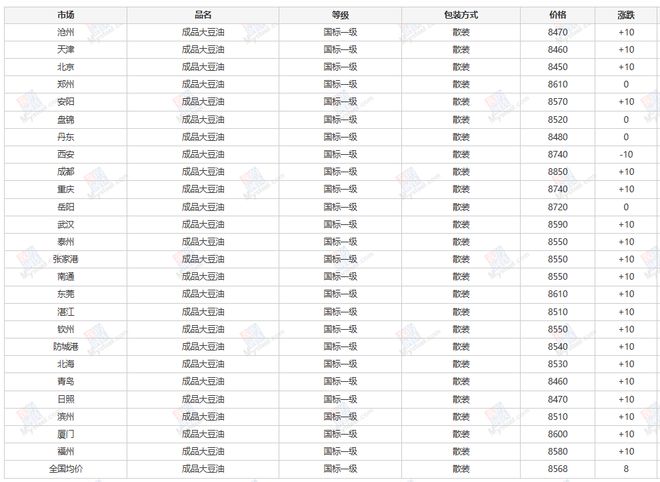
银河期货油脂日报-20251113
Yin He Qi Huo· 2025-11-13 10:28
1. Report Industry Investment Rating - No information provided regarding the industry investment rating 2. Core View of the Report - After a significant decline, the prices of edible oils have stabilized and are experiencing a technical rebound. However, in the short term, palm oil lacks a clear driving force, and its expected increase is limited. Domestic soybean oil supply is sufficient, and it is expected to remain range - bound. Rapeseed oil is in a continuous process of marginal inventory reduction, which supports its price [6][7][9] 3. Summary by Relevant Sections 3.1 Data Analysis - **Spot Prices and Basis**: Soybean oil spot prices in Zhangjiagang, Guangdong, and Tianjin are 8586, 8626, and 8496 respectively, with basis values of 310, 270, and 180. Palm oil spot prices in Guangdong, Zhangjiagang, and Tianjin are 8702, 8772, and 8862 respectively, with basis values of - 50, 20, and 110. Rapeseed oil spot prices in Zhangjiagang and Guangxi are 10335 and 10475 respectively, with basis values of 360 and 500 [3] - **Monthly Spread Closing Prices**: The 1 - 5 monthly spread for soybean oil is 222 (down 2), for palm oil is - 102 (down 12), and for rapeseed oil is 491 (up 41) [3] - **Cross - Variety Spreads**: The 01 - contract Y - P spread is - 436 (down 107), the OI - Y spread is 1659 (up 20), the OI - P spread is 1223 (up 127), and the oil - meal ratio is 2.71 (down 0.001) [3] - **Import Profits**: The 24 - degree palm oil from Malaysia and Indonesia has a disk profit of - 105, and the FOB price of Rotterdam's rapeseed oil has a disk profit of - 913 [3] - **Weekly Commercial Inventory of Edible Oils (2025 Week 45)**: Soybean oil inventory is 115.7 million tons, palm oil is 59.7 million tons, and rapeseed oil is 45.5 million tons [3] 3.2 Fundamental Analysis - **International Market**: In October 2024, India's palm oil imports were 602381 tons (down from 833017 tons in September). The 2024/25 palm oil imports were 7.58 million tons (down from 9.01 million tons last year), and its proportion in India's vegetable oil imports dropped below 50% for the first time. Soybean oil imports in October were 454619 tons (down from 549240 tons in September), and the 2024/25 imports were 5.47 million tons (up from 3.44 million tons last year). Sunflower oil imports in October were 260548 tons (down from 275386 tons in September), and the 2024/25 imports were 2.94 million tons (down from 3.5 million tons last year). India's vegetable oil imports in October were 1.33 million tons (down from 1.66 million tons in September), and the 2024/25 imports are expected to be 16.36 million tons (up from 16.23 million tons last year) [5] - **Domestic Market**: As of November 7, 2025 (Week 45), the national key - area palm oil commercial inventory was 59.73 million tons, a 0.76% increase from last week. The import profit inversion has narrowed, and the basis is stable. The soybean oil inventory was 115.72 million tons, a 4.82% decrease from last week. The inventory inflection point may have arrived, and the basis is stable. The coastal rapeseed oil inventory was 45.5 million tons, a decrease of 5.9 million tons, and it is in a continuous process of marginal inventory reduction. The basis is firm [6][7] 3.3 Trading Strategies - **Unilateral**: Consider short - term long positions on dips for palm oil or continue to wait and see. For soybean oil, wait for a pull - back to stabilize before lightly testing long positions. For rapeseed oil, consider going long on dips for the OI03 or 05 contracts [6][7][9] - **Arbitrage**: Wait and see [10] - **Options**: Wait and see [11]
中信期货晨报:国内商品期货涨多跌少,沪银领涨期市-20251113
Zhong Xin Qi Huo· 2025-11-13 07:59
1. Report Industry Investment Rating No relevant content provided. 2. Core Viewpoints of the Report - The global macro situation this week focuses on changes in US dollar liquidity. Although there is short - term tightness, it won't have a significant impact on major asset prices. There are two factors for improvement: marginal easing of monetary policy and normal release of funds in the TGA account when the US government resumes work [7]. - In October, China's export growth was weaker than expected, but there were more positive signs in inflation data, and consumer data may slightly exceed expectations [7]. - In November, the macro environment enters a vacuum period, and major assets may enter a short - term shock period. However, the overall allocation idea in the fourth quarter remains unchanged, and the macro environment is still favorable for risk assets. It is recommended to allocate major assets evenly in the fourth quarter, hold long positions in stock indices, non - ferrous metals (copper, lithium carbonate, aluminum, tin), and precious metals, and increase positions appropriately if there is a correction [7]. 3. Summary by Directory 3.1 Macro Highlights - **Overseas Macro**: The short - term tightness of US dollar liquidity won't have a large impact on major asset prices. Monetary policy is marginally easing, and the release of TGA account funds after the US government resumes work can relieve the short - term pressure [7]. - **Domestic Macro**: October's export growth was weaker than expected, but there were positive signs in inflation data, and consumer data may slightly exceed expectations [7]. - **Asset Views**: In November, major assets may enter a shock period. The overall allocation idea in the fourth quarter remains unchanged, and it is recommended to evenly allocate major assets, hold long positions in stock indices, non - ferrous metals, and precious metals, and increase positions if there is a correction [7]. 3.2 Viewpoint Highlights 3.2.1 Financial Sector - **Stock Index Futures**: Catalyzed by technology events, the growth style is active. There is a risk of overcrowding in small - cap funds, and the short - term trend is expected to be a volatile upward [8]. - **Stock Index Options**: The overall trading volume has slightly declined, and the short - term trend is expected to be volatile [8]. - **Treasury Bond Futures**: The bond market continues to be weak. The short - term trend is expected to be volatile, affected by policy, fundamental repair, and tariff factors [8]. 3.2.2 Precious Metals - **Gold/Silver**: Due to the easing of geopolitical and economic and trade situations, precious metals are in a phased adjustment. The short - term trend is expected to be volatile, affected by the US fundamentals, Fed's monetary policy, and global equity market trends [8]. 3.2.3 Shipping - **Container Shipping to Europe**: The peak season in the third quarter has passed, and there is a lack of upward momentum. The short - term trend is expected to be volatile, and attention should be paid to the rate of freight decline in September [8]. 3.2.4 Steel and Iron Ore - **Steel**: In the off - season, the fundamentals are under pressure, and the short - term trend is expected to be volatile, affected by the issuance of special bonds, steel exports, and iron - water production [8]. - **Iron Ore**: The short - term fundamentals are stable, and the short - term trend is expected to be volatile, affected by overseas mine production and shipment, domestic iron - water production, weather, port inventory, and policy [8]. 3.2.5 Black Building Materials - **Coke**: The game between coking and steel enterprises continues, and the short - term trend is expected to be volatile, affected by steel mill production, coking costs, and macro sentiment [8]. - **Coking Coal**: The market sentiment is weak, but the spot price is rising. The short - term trend is expected to be volatile, affected by steel mill production, coal mine safety inspections, and macro sentiment [8]. - **Silicon Iron**: The supply - demand driving force is limited, and it follows the valuation fluctuations of coal. The short - term trend is expected to be volatile, affected by raw material costs and steel procurement [8]. - **Manganese Silicon**: After the first - round steel procurement inquiry is announced, the price follows the decline of coking coal. The short - term trend is expected to be volatile, affected by cost prices and overseas quotes [8]. - **Glass**: Prices have been lowered in various regions, and downstream purchasing sentiment is weak. The short - term trend is expected to be volatile, affected by spot sales [8]. - **Soda Ash**: Supply exceeds demand, and cost - driven upward movement is limited. The short - term trend is expected to be volatile, affected by soda ash inventory [8]. - **Aluminum Oxide**: The fundamentals are still in an oversupply situation, and the price is under pressure. The short - term trend is expected to be volatile, affected by ore复产 and electrolytic aluminum复产 [8]. - **Aluminum**: The stock - futures linkage leads to an upward - volatile price. The short - term trend is expected to be a volatile upward, affected by macro risks, supply disruptions, and demand [8]. - **Zinc**: The export window is open, and the price is fluctuating at a high level. The short - term trend is expected to be volatile, affected by macro risks and zinc ore supply [8]. - **Lead**: Social inventory is slightly increasing, and the price is fluctuating. The short - term trend is expected to be volatile, affected by supply disruptions and battery exports [8]. - **Nickel**: Market sentiment is improving, and the price is fluctuating. The short - term trend is expected to be volatile, affected by macro and geopolitical changes, and Indonesian policies [8]. - **Stainless Steel**: Warehouse receipts are decreasing, and the price is fluctuating. The short - term trend is expected to be volatile, affected by Indonesian policies and demand growth [8]. - **Tin**: The inventory of Shanghai tin continues to decrease, and the price is fluctuating. The short - term trend is expected to be volatile, affected by the resumption of production in Wa State and demand improvement [8]. - **Industrial Silicon**: The supply in the southwest is rapidly decreasing, and the price is fluctuating. The short - term trend is expected to be volatile, affected by supply - side production cuts and photovoltaic installations [8]. - **Lithium Carbonate**: The resumption of production expectation is fluctuating, and the price may fluctuate significantly. The short - term trend is expected to be volatile, affected by demand, supply disruptions, and technological breakthroughs [8]. 3.2.6 Energy and Chemicals - **Crude Oil**: There is a lack of short - term driving forces, and the price is expected to be volatile, affected by OPEC+ production policies and the Middle East geopolitical situation [10]. - **LPG**: Refinery output has decreased, and import costs are under pressure. The short - term trend is expected to be volatile, affected by cost factors such as crude oil and overseas propane [10]. - **Asphalt**: The spot price in Shandong has stabilized, and the futures price is expected to be volatile, affected by sanctions and supply disruptions [10]. - **High - Sulfur Fuel Oil**: The futures price is volatile, and attention should be paid to the Russia - Ukraine conflict. The short - term trend is expected to be volatile, affected by geopolitics and crude oil prices [10]. - **Low - Sulfur Fuel Oil**: The refined oil market is strong, and the price may be on a volatile upward trend, affected by crude oil prices [10]. - **Methanol**: High inventory suppresses the price, and overseas disturbances are not significant. The short - term trend is expected to be volatile, affected by the macro - energy situation and overseas developments [10]. - **Urea**: Export information boosts the spot market, and the futures price is expected to be volatile in the short term, affected by export quotas and coal prices [10]. - **Ethylene Glycol**: The spot market is loose, and there is little hope of reversing the downward trend in the short term. The short - term trend is expected to be a volatile downward, affected by coal and oil prices, port inventory, and Sino - US trade friction [10]. - **PX**: The market sentiment is rational, and the processing fee is strongly supported by strong supply and demand. The short - term trend is expected to be volatile, affected by crude oil fluctuations and macro changes [10]. - **PTA**: The market sentiment is flat, and the basis is under pressure. The short - term trend is expected to be volatile, affected by crude oil fluctuations and macro changes [10]. - **Short - Fiber**: Consumers tend to buy on dips, and attention should be paid to the off - peak and peak season conversion. The short - term trend is expected to be volatile, affected by downstream yarn mill purchasing and peak - season demand [10]. - **Bottle Chips**: The market performance is flat, and it follows the cost passively. The short - term trend is expected to be volatile, affected by bottle - chip enterprise production cuts and new device commissioning [10]. - **Propylene**: Inventory needs time to be digested, and the price is expected to be on a volatile downward trend, affected by oil prices and the domestic macro situation [10]. - **PP**: Maintenance support is limited, and the price is expected to be on a volatile downward trend, affected by oil prices and domestic and overseas macro situations [10]. - **Plastic**: Downstream transactions have increased, but maintenance support is limited. The price is expected to be on a volatile downward trend, affected by oil prices and domestic and overseas macro situations [10]. - **Styrene**: There are still concerns about over - inventory, and the price is expected to be on a volatile downward trend, affected by oil prices, macro policies, and device operations [10]. - **PVC**: The weak reality suppresses the price, and it is expected to be volatile, affected by expectations, costs, and supply [10]. - **Caustic Soda**: With low valuation and weak expectations, the price is expected to be volatile, affected by market sentiment, production, and demand [10]. 3.2.7 Agriculture - **Oils and Fats**: Rapeseed oil is relatively strong, and attention should be paid to the effectiveness of upper - level technical resistance. The short - term trend is expected to be a volatile upward, affected by US soybean weather and Malaysian palm oil production and demand data [10]. - **Protein Meal**: US soybeans are testing the upper - level resistance, and it is recommended to hold reverse spreads on Dalian soybean meal. The short - term trend is expected to be volatile, affected by weather, domestic demand, macro factors, and Sino - US and Sino - Canadian trade wars [10]. - **Corn/Starch**: The market is in a short - term tight situation, and the price is expected to be volatile at a high level, affected by demand, macro factors, and weather [10]. - **Pigs**: Supply and demand are loose, and the price is weak. The short - term trend is expected to be a volatile downward, affected by breeding sentiment, epidemics, and policies [10]. - **Natural Rubber**: With the approaching expiration of the November contract, there may be a pulse - like upward movement. The short - term trend is expected to be volatile, affected by production - area weather, raw material prices, and macro changes [10]. - **Synthetic Rubber**: The short - term trend is expected to be volatile, affected by crude oil fluctuations [10]. - **Cotton**: The price has slightly declined, and the short - term trend is expected to be volatile, affected by demand and inventory [10]. - **Sugar**: The price is fluctuating within a narrow range, and the short - term trend is expected to be a volatile downward, affected by imports and Brazilian production [10]. - **Pulp**: The market is dominated by funds, and the long - position advantage remains. The short - term trend is expected to be volatile, affected by macro - economic changes and US dollar - denominated quotes [10]. - **Double - Glued Paper**: In the tendering peak season, the price is expected to stabilize in November and be volatile, affected by production and sales, education policies, and paper - mill operations [10]. - **Logs**: In the de - inventory cycle, the price is expected to be volatile, affected by special port fees, shipment volume, and dispatch volume [10].
建信期货油脂日报-20251113
Jian Xin Qi Huo· 2025-11-13 02:30
Report Overview - Report Date: November 13, 2025 [2] - Reported Industry: Oil and Fat [1] - Research Team: Agricultural Products Research Team [4] - Researchers: Yu Lanlan, Lin Zhenlei, Wang Haifeng, Hong Chenliang, Liu Youran [3] 1. Investment Rating - No investment rating information is provided in the report. 2. Core View - The oil and fat market has stabilized and rebounded, with rapeseed oil showing the strongest performance. Rapeseed oil inventory is decreasing, and attention should be paid to Australian rapeseed arrivals and China-Canada relations. Soybean oil has limited downside space and has buying value but is restricted by high inventory in the short term. Palm oil is expected to see reduced production and inventory starting from November. The oil and fat sector has rebounded from a low level, and trading should focus on band buying [7]. 3. Summary by Section 3.1 Market Review and Operation Suggestions - **Quotes**: Dongguan rapeseed oil traders' quotes are 01+620 for third-grade rapeseed oil and 01+720 for first-grade rapeseed oil. The basis price of first-grade soybean oil in the East China market is 01+270 in November and 01+280 from December to January. Guangdong palm oil traders' quotes are stable, with 18-degree palm oil at 01+120 (Guangzhou warehouse and Dongguan warehouse), 24-degree at 01 - 20 (Dongguan warehouse), and 28-degree at 01 - 20 (Dongguan warehouse) [7]. - **Market Analysis**: Rapeseed oil inventory is decreasing due to interrupted imports and suspended crushing. Soybean oil has limited downside space but is restricted by high inventory. Palm oil is expected to reduce production and inventory starting from November [7]. - **Operation Suggestion**: Focus on band buying [7]. 3.2 Industry News - **Malaysian Palm Oil Production**: From November 1 - 10, Malaysian palm oil production decreased by 2.16% month-on-month, with fresh fruit bunch (FFB) yield decreasing by 4.14% and oil extraction rate (OER) decreasing by 0.4% [10]. - **Domestic Palm Oil Inventory**: As of the end of the 45th week of 2025, the total domestic palm oil inventory was 55.2 million tons, a decrease of 0.3 million tons from the previous week; the contract volume was 4.2 million tons, a decrease of 0.3 million tons. The inventory of 24-degree and below palm oil was 53.3 million tons, a decrease of 0.5 million tons, and the high-degree palm oil inventory was 2.0 million tons, an increase of 0.3 million tons [10]. - **MPOB Report**: In October, Malaysian palm oil inventory increased by 4.4% to 2.46 billion tons, production increased by 11.02% to 2.04 billion tons, and exports increased by 18.58% to 1.69 billion tons. The surveyed October inventory was expected to be 2.44 billion tons, and production was expected to be 1.94 billion tons, with exports expected to be 1.48 billion tons [9][10]. 3.3 Data Overview - The report provides multiple data charts, including the spot prices of East China third-grade rapeseed oil, East China fourth-grade soybean oil, and South China 24-degree palm oil, as well as the basis changes of palm oil, soybean oil, and rapeseed oil, and the price spreads of palm oil contracts. All data sources are from Wind and the Research and Development Department of Jianxin Futures [14][15][22].
第八届国际脂质科学与健康学术年会在汉召开
Chang Jiang Ri Bao· 2025-11-12 13:15
记者从中国农科院油料所了解到,近日,第八届国际脂质科学与健康学术年会暨第五届美国油脂化学家协会中国分会年会在武汉召 开。作为脂质科学领域重要的国际学术交流平台,该会议自2016年起已由油料所成功举办八届,始终紧扣"多产油、产好油、吃好油、科学 用油"主线。 第八届国际脂质科学与健康学术年会现场 除主会场学术交流外,大会还同步推进了多项务实合作:拓展美国康奈尔大学、比利时根特大学等国际创新联盟成员单位,启动中国 —新西兰政府间国际合作项目,宣贯50余个油料油脂领域最新国家及行业标准;同期举办中日脂质与健康论坛、中国—东盟未来油脂科技 论坛,助力"一带一路"区域协同创新。值得关注的是,大会首次开设"青年科学家职业规划与创新能力提升培训交流会",为行业青年人才 成长搭建平台。 本次大会由中国农科院油料所联合美国油脂化学家协会中国分会、暨南大学、益海嘉里金龙鱼等单位共同主办,得到了中国农科院国 际合作局、湖北省农业农村厅、武汉市科技创新局等部门的大力支持。来自中国、美国、芬兰、日本等12个国家的400余位专家学者、企 业代表齐聚江城,围绕"新质生产力赋能油料脂质产业可持续发展"主题,共探脂质科学与健康领域的创新路径与 ...

银河期货油脂日报-20251112
Yin He Qi Huo· 2025-11-12 10:29
Group 1: Report Overview - Report Title: Galaxy Futures' Daily Report on Oils and Fats [1][2] - Report Date: November 12, 2025 [1][2] Group 2: Data Analysis Spot Prices and Basis - **Soybean Oil**: The 2601 closing price was 8288, up 50. Spot prices in Zhangjiagang, Guangdong, and Tianjin were 8548, 8598, and 8458 respectively. The basis in Zhangjiagang, Guangdong, and Tianjin were 310, 260, and 170 respectively, with no change in the basis [2]. - **Palm Oil**: The 2601 closing price was 8744, down 26. Spot prices in Guangdong, Zhangjiagang, and Tianjin were 8694, 8764, and 8854 respectively. The basis in Guangdong, Zhangjiagang, and Tianjin were -50, 20, and 110 respectively, with no change in the basis [2]. - **Rapeseed Oil**: The 2601 closing price was 9840, up 65. Spot prices in Zhangjiagang, Guangxi, and Guangdong were 10190, 10340, and 10340 respectively. The basis in Zhangjiagang, Guangdong, and Guangxi were 350, 500, and 500 respectively, with no change in the basis [2]. Month - to - Month Spreads - **Soybean Oil**: The 1 - 5 month - to - month spread was 224, up 12 [2]. - **Palm Oil**: The 1 - 5 month - to - month spread was -90, down 6 [2]. - **Rapeseed Oil**: The 1 - 5 month - to - month spread was 450, up 24 [2]. Cross - Variety Spreads - For the 01 contract, the Y - P spread was -456, up 76; the OI - Y spread was 1552, up 15; the OI - P spread was 1096, up 91; the oil - meal ratio was 2.71, up 0.01 [2]. Import Profits - The 24 - degree palm oil (from Malaysia & Indonesia) had a negative profit of -277, with a CNF price of 1057 in December. The Rotterdam rapeseed oil had a negative profit of -913, with a FOB price of 1080 in December [2]. Weekly Commercial Inventories (Week 45, 2025) - **Soybean Oil**: 115.7 tons this week, down from 121.6 tons last week and up from 107.8 tons last year [2]. - **Palm Oil**: 59.7 tons this week, up from 59.3 tons last week and up from 53.1 tons last year [2]. - **Rapeseed Oil**: 45.5 tons this week, down from 51.4 tons last week and up from 41.3 tons last year [2]. Group 3: Fundamental Analysis International Market - As of the week ending November 5, Argentine farmers sold 28.67 tons of 24/25 - year soybeans, with 22.97 tons purchased by local oil mills and 5.7 tons by the export industry. They also sold 3.11 tons of 25/26 - year soybeans, with 2.62 tons purchased by local oil mills and 0.49 tons by the export industry. The total sales of all - year soybeans were 32.2 tons, and the cumulative sales reached 8398.43 tons. The cumulative export sales registration of 24/25 - year soybeans was 1226.4 tons, and that of 25/26 - year soybeans was 186.7 tons [4]. Domestic Market - **Palm Oil**: Futures prices fluctuated and closed slightly lower. As of November 7, the national commercial inventory was 59.73 tons, up 0.45 tons from last week (0.76% increase). The import profit was around -200, and the basis was stable. It may have a limited upward movement due to lack of drivers and suggests short - term long positions at low prices or continued observation [5]. - **Soybean Oil**: Futures prices fluctuated and closed slightly higher. Last week, the actual soybean crushing volume was 180.57 tons, and the operating rate was 49.67%. As of November 7, the commercial inventory was 115.72 tons, down 5.86 tons from last week (4.82% decrease). The inventory may decline slightly, but supply is still sufficient. It is expected to fluctuate, and suggests waiting for a pull - back to enter long positions [5][6]. - **Rapeseed Oil**: Futures prices fluctuated and closed slightly higher. Last week, the coastal rapeseed crushing volume was 0 tons, and the operating rate was 0%. As of November 7, the coastal inventory was 45.5 tons, down 5.9 tons from last week. The import profit was around -1100, and the basis was strong. It is recommended to go long on OI03 or 05 contracts on pull - backs [6]. Group 4: Trading Strategies Strategy Recommendations - **Unilateral**: After a sharp decline, oils and fats have stabilized and rebounded technically. Palm oil may have limited upward movement, suggesting short - term long positions at low prices or continued observation [8]. - **Arbitrage**: Observation [8]. - **Options**: Observation [8]. Group 5: Related Attachments - The report includes charts on the basis of East - China first - grade soybean oil, South - China 24 - degree palm oil, East - China third - grade rapeseed oil, Y 1 - 5 month - to - month spread, P 1 - 5 month - to - month spread, OI 1 - 5 month - to - month spread, Y - P 01 spread, and OI - Y 01 spread [10][12]
商品日报(11月11日):贵金属再现强势 双焦大幅下跌
Xin Hua Cai Jing· 2025-11-11 09:05
Core Insights - Precious metals continue to strengthen, with silver leading the gains at over 3% and gold rising by 2.67% due to favorable market sentiment following the U.S. Senate's approval of a temporary funding bill [2] - The three major oils (rapeseed oil, palm oil, and soybean oil) are experiencing a rebound, supported by declining commercial inventories and tight supply expectations [3] - Double焦 (coke and coking coal) prices have dropped over 3%, influenced by government energy supply meetings and declining steel mill profitability [4] - Multi-crystalline silicon has seen a decline of over 2%, with production expectations decreasing in both silicon and downstream silicon wafer sectors [6] Precious Metals - Silver futures on the domestic market rose by 3.20%, while gold futures increased by 2.67% [2] - The market sentiment is buoyed by liquidity expectations following the U.S. government's funding approval, despite potential bearish fundamentals from economic conditions [2] Oilseeds - The main contracts for rapeseed oil increased by over 2%, while palm oil rose by over 1% [3] - Domestic commercial inventories of the three major oils have decreased by 100,000 tons week-on-week and 150,000 tons month-on-month, indicating tightening supply [3] Double焦 and Multi-crystalline Silicon - Double焦 prices fell over 3%, with the market affected by government directives on energy supply and declining steel production profitability [4] - Multi-crystalline silicon prices dropped over 2%, with production cuts expected in both upstream and downstream sectors, leading to a low-level consolidation phase [6]
银河期货油脂日报-20251110
Yin He Qi Huo· 2025-11-10 12:30
Group 1: Report General Information - Report Title: Galaxy Futures Oil Daily Report, November 10, 2025 [2] - Report Type: Agricultural Product R & D Report [1] Group 2: Investment Rating - Not provided in the report Group 3: Core Viewpoints - After a significant decline, the oil market has stabilized and is experiencing a technical rebound. However, palm oil lacks obvious short - term drivers, with limited expected upward space [5][10]. - Soybean oil is expected to maintain a volatile trend due to sufficient short - term supply and a lack of obvious drivers [6]. - Rapeseed oil's fundamentals have not changed much, but the continuous marginal reduction of inventory supports its price [8]. Group 4: Data Analysis Spot Price and Basis - **Soybean Oil**: The 2601 closing price was 8228, up 44. Spot prices in Zhangjiagang, Guangdong, and Tianjin were 8488, 8528, and 8398 respectively. The basis in Zhangjiagang, Guangdong, and Tianjin was 300, 260, and 170 respectively, with no change [3]. - **Palm Oil**: The 2601 closing price was 8690, up 30. Spot prices in Guangdong, Zhangjiagang, and Tianjin were 8590, 8710, and 8790 respectively. The basis in Guangdong, Zhangjiagang, and Tianjin was - 100, 20, and 100 respectively, with no change [3]. - **Rapeseed Oil**: The 2601 closing price was 9587, up 54. Spot prices in Zhangjiagang, Guangxi, and Guangdong were 9937, 10087 respectively. The basis in Zhangjiagang and Guangdong was 350 and 500 respectively, with no change [3]. Monthly Spread - **Soybean Oil**: The 1 - 5 monthly spread was 230, up 6 [3]. - **Palm Oil**: The 1 - 5 monthly spread was - 102, down 32 [3]. - **Rapeseed Oil**: The 1 - 5 monthly spread was 413, up 8 [3]. Cross - Variety Spread - The Y - P 01 spread was - 462, up 14; the OI - Y 01 spread was 1359, up 10; the OI - P 01 spread was 897, up 24; the oil - meal ratio was 2.69, up 0.01 [3]. Import Profit - The CNF price of 24 - degree palm oil from Malaysia and Indonesia was 1040 (shipment in December), with a disk profit of - 187. The FOB price of crude rapeseed oil from Rotterdam (shipment in December) was 1085, with a disk profit of - 1169 [3]. Weekly Commercial Inventory (Week 44, 2025, in 10,000 tons) - **Soybean Oil**: This week's inventory was 121.6, last week's was 125.0, and the same period last year was 110.1 [3]. - **Palm Oil**: This week's inventory was 59.3, last week's was 60.7, and the same period last year was 53.9 [3]. - **Rapeseed Oil**: This week's inventory was 51.4, last week's was 53.5, and the same period last year was 41.8 [3]. Group 5: Fundamental Analysis International Market - Malaysia's palm oil production in October 2025 was 2,043,886 tons, a month - on - month increase of 11.02%. The inventory was 2,464,452 tons, a month - on - month increase of 4.44% [5]. Domestic Market - **Palm Oil**: As of November 7, 2025, the national key - area commercial inventory was 59.73 tons, a week - on - week increase of 0.45 tons (0.76%). It is at a neutral level in the same period of history. The origin's quotation is stable, the import profit inversion has narrowed to about - 200, and the basis is stable [5]. - **Soybean Oil**: As of November 7, 2025, the national key - area commercial inventory was 115.72 tons, a week - on - week decrease of 5.86 tons (4.82%). It is at a relatively high level in the same period of history, and the inventory inflection point may have arrived. The basis is stable. With the decrease in soybean arrivals and the decline in soybean crushing, the inventory may slightly decrease, but overall supply is still sufficient [6]. - **Rapeseed Oil**: As of October 31, 2025, the coastal rapeseed oil inventory was 51.4 tons, a week - on - week decrease of 2.1 tons. It is at a high level in the same period of history, and the inventory is continuously decreasing. The European rapeseed oil FOB quotation is stable at around 1100 US dollars, and the import profit inversion has expanded to about - 1100. The domestic basis is stable and strong, and the coastal de - stocking trend is expected to continue [8]. Group 6: Trading Strategies - **Single - Side Strategy**: For palm oil, consider buying on dips or continue to wait and see due to limited upward space and lack of obvious drivers [10]. - **Arbitrage Strategy**: Wait and see [11]. - **Option Strategy**: Wait and see [12]