焦炭

Search documents
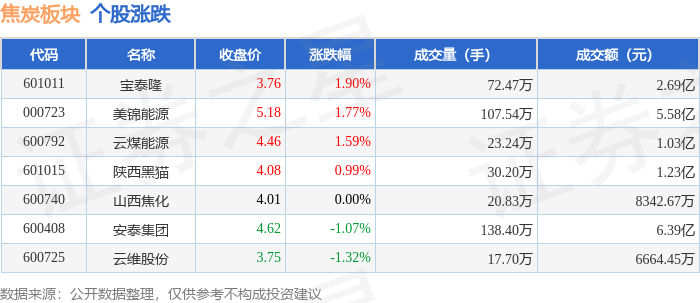
焦炭板块12月1日涨0.93%,宝泰隆领涨,主力资金净流出571.85万元
Zheng Xing Xing Ye Ri Bao· 2025-12-01 09:16
Core Insights - The coke sector experienced a 0.93% increase on December 1, with Baotailong leading the gains [1] - The Shanghai Composite Index closed at 3914.01, up 0.65%, while the Shenzhen Component Index closed at 13146.72, up 1.25% [1] Coke Sector Performance - Baotailong (601011) closed at 3.76, up 1.90%, with a trading volume of 724,700 shares and a transaction value of 269 million yuan [1] - Meijin Energy (000723) closed at 5.18, up 1.77%, with a trading volume of 1,075,400 shares and a transaction value of 558 million yuan [1] - Yunmei Energy (600792) closed at 4.46, up 1.59%, with a trading volume of 232,400 shares and a transaction value of 103 million yuan [1] - Shaanxi Black Cat (601015) closed at 4.08, up 0.99%, with a trading volume of 302,000 shares and a transaction value of 123 million yuan [1] - Shanxi Coking Coal (600740) closed at 4.01, unchanged, with a trading volume of 208,300 shares and a transaction value of 83.43 million yuan [1] - Antai Group (600408) closed at 4.62, down 1.07%, with a trading volume of 1,384,000 shares and a transaction value of 639 million yuan [1] - Yunwei Co. (600725) closed at 3.75, down 1.32%, with a trading volume of 177,000 shares and a transaction value of 66.64 million yuan [1] Fund Flow Analysis - The coke sector saw a net outflow of 5.7185 million yuan from main funds, while retail investors contributed a net inflow of 30.1792 million yuan [1] - Baotailong experienced a net outflow of 21.5245 million yuan from main funds, with a retail net inflow of 742,170 yuan [2] - Yunwei Co. had a net inflow of 272,730 yuan from main funds, while retail investors had a net outflow of 511,540 yuan [2] - Meijin Energy saw a net outflow of 238,110 yuan from main funds, with a retail net inflow of 541,110 yuan [2] - Shaanxi Black Cat had a net outflow of 980,990 yuan from main funds, with a retail net inflow of 310,290 yuan [2] - Antai Group experienced a net outflow of 1,540,570 yuan from main funds, while retail investors had a net inflow of 3,382,610 yuan [2]


广发期货《黑色》日报-20251201
Guang Fa Qi Huo· 2025-12-01 04:50
1. Report Industry Investment Rating - No information provided regarding the industry investment rating in the report. 2. Report's Core View - **Steel**: The demand for five major steel products remains at a relatively high level, improving compared to October, but the overall demand intensity in November is weaker than the same period last year. Due to significant production cuts, the supply - demand gap for rebar is favorable with good de - stocking. However, for hot - rolled coils, production cuts are limited, with supply and demand basically balanced and slow de - stocking of high inventories. The spread between hot - rolled coils and rebar for the January contract is expected to converge. Considering the seasonal weakening of future demand and high plate inventories, the upward price drive is not obvious, but production cuts support steel prices, so prices are expected to fluctuate. The rebar is expected to fluctuate between 3000 - 3200 yuan/ton, and hot - rolled coils between 3200 - 3350 yuan/ton. The basis of rebar will strengthen, while that of hot - rolled coils is weak, and the spread between them will continue to converge. There is an arbitrage opportunity of going long on rebar and short on iron ore for the January contract [2]. - **Iron Ore**: Last week, iron ore futures fluctuated at a high level. The global iron ore shipment decreased week - on - week, while the arrival volume at 45 ports increased. On the demand side, the steel mill's profit margin declined slightly, iron water production decreased, and the restocking demand of steel mills increased slightly. The production of five major steel products continued to rise, inventories continued to decline seasonally, and the apparent demand declined. Port inventories increased, the port clearance volume increased slightly, and the steel mill's equity ore inventory decreased. Looking forward, iron water production will decline seasonally this week, and the inventory contradiction of steel mills has improved significantly. With the current profit margin and inventory level of steel mills, it is not enough to trigger a negative feedback. Without new macro - drivers, it is difficult for iron ore to have an independent unilateral market. It is recommended to wait and see when the discount is repaired [4]. - **Coke**: Last week, coke futures fluctuated and declined. After mainstream coke enterprises proposed a fourth - round price increase, steel mills proposed a first - round price cut. On the supply side, the price cut range of coking coal in the Shanxi market expanded, coking profits were repaired, coke price adjustments lagged behind coking coal, coke enterprises increased prices, and coke production increased after price cuts. On the demand side, steel mills increased maintenance due to losses, iron water production declined, steel prices fluctuated weakly, steel mill profits decreased, and there was a willingness to suppress coke prices. In terms of inventory, coke - making plants and steel mills increased inventories, ports decreased inventories, and the overall inventory increased slightly in the middle position, with the supply - demand situation of coke weakening. Coke futures were dragged down by the sharp decline of coking coal futures. Strategically, it is recommended to take a bearish view on the unilateral market, with the range of 1500 - 1650 yuan/ton, and recommend the arbitrage strategy of going long on coke and short on coking coal [7]. - **Coking Coal**: Last week, coking coal futures showed a weak downward trend, and the spot market accelerated its decline, showing a pattern of futures - spot resonance decline. On the supply side, coal mine shipments worsened, some coal mines stopped production, the import of Mongolian coal increased, and the port inventory continued to rise. On the demand side, steel mills increased losses and maintenance, iron water production declined, coke production increased slightly after the recovery of coking profits, and the restocking demand weakened. In terms of inventory, coal washing plants, ports, and coke enterprises reduced inventories, while coal mines, ports of entry, and steel mills increased inventories, and the overall inventory increased slightly in the middle position. Strategically, it is recommended to take a bearish view on the unilateral market, with the range of 1000 - 1120 yuan/ton, and recommend the arbitrage strategy of going long on coke and short on coking coal [7]. 3. Summary by Relevant Catalogs Steel Steel Prices and Spreads - **Rebar**: Spot prices in East, North, and South China increased by 10 yuan/ton. The 05, 10, and 01 contracts also rose, with the 01 contract increasing by 17 yuan/ton to 3110 yuan/ton [2]. - **Hot - rolled Coils**: Spot prices in East and South China remained unchanged or increased by 10 yuan/ton, while in North China it decreased by 10 yuan/ton. The 05, 10, and 01 contracts all rose, with the 01 contract increasing by 9 yuan/ton to 3302 yuan/ton [2]. Cost and Profit - **Cost**: The steel billet price increased by 10 yuan/ton to 2980 yuan/ton, the slab price remained unchanged at 3730 yuan/ton. The cost of Jiangsu electric - furnace rebar remained unchanged at 3231 yuan/ton, and the cost of Jiangsu converter rebar decreased by 7 yuan/ton to 3171 yuan/ton [2]. - **Profit**: The profit of East China hot - rolled coils increased by 10 yuan/ton to - 64 yuan/ton, the profit of South China rebar increased by 10 yuan/ton to 116 yuan/ton, and other regional profits remained unchanged [2]. Production - The daily average iron water production decreased by 1.6 tons to 234.7 tons, a decrease of 0.7%. The production of five major steel products increased by 5.8 tons to 855.7 tons, an increase of 0.7%. Rebar production decreased by 1.9 tons to 206.1 tons, a decrease of 0.9%, among which electric - furnace production increased by 2.6 tons to 29.3 tons, an increase of 9.5%, and converter production decreased by 4.4 tons to 176.7 tons, a decrease of 2.4%. Hot - rolled coil production increased by 3.0 tons to 319.0 tons, an increase of 0.9% [2]. Inventory - The inventory of five major steel products decreased by 32.3 tons to 1400.8 tons, a decrease of 2.3%. Rebar inventory decreased by 21.9 tons to 531.5 tons, a decrease of 4.0%. Hot - rolled coil inventory decreased by 1.2 tons to 400.9 tons, a decrease of 0.3% [2]. Transaction and Demand - The building materials transaction volume increased by 1.2 tons to 10.4 tons, an increase of 12.7%. The apparent demand of five major steel products decreased by 6.2 tons to 888.0 tons, a decrease of 0.7%. The apparent demand of rebar decreased by 2.8 tons to 227.9 tons, a decrease of 1.2%. The apparent demand of hot - rolled coils decreased by 4.2 tons to 320.2 tons, a decrease of 1.3% [2]. Iron Ore Iron Ore - related Prices and Spreads - **Warehouse Receipt Cost**: The warehouse receipt costs of various iron ore powders decreased, with the largest decrease of 1.2% for Carajás fines and Brazilian blended fines [4]. - **01 Contract Basis**: The basis of various iron ore powders decreased, with the largest decrease of 38.1% for Carajás fines [4]. - **Spread**: The 5 - 9 spread decreased by 0.5 to 24.5, a decrease of 2.0%; the 9 - 1 spread increased by 1.0 to - 50.5, an increase of 1.9%; the 1 - 5 spread decreased by 0.5 to 26.0, a decrease of 1.9% [4]. Spot Prices and Price Indexes - The spot prices of various iron ore powders at Rizhao Port decreased, with the largest decrease of 1.2% for Brazilian blended fines. The Singapore Exchange 62% Fe swap price decreased slightly, while the Platts 62% Fe increased slightly [4]. Supply - The 45 - port arrival volume (weekly) increased by 548.2 tons to 2817.1 tons, an increase of 24.2%. The global shipment volume (weekly) decreased by 238.0 tons to 3278.4 tons, a decrease of 6.8%. The national monthly import volume decreased by 500.6 tons to 11130.9 tons, a decrease of 4.3% [4]. Demand - The daily average iron water production of 247 steel mills (weekly) decreased by 1.6 tons to 234.7 tons, a decrease of 0.7%. The 45 - port daily average port clearance volume (weekly) increased by 3.6 tons to 330.6 tons, an increase of 1.1%. The national monthly pig iron production decreased by 49.7 tons to 6554.9 tons, a decrease of 0.8%. The national monthly crude steel production decreased by 149.3 tons to 7199.7 tons, a decrease of 2.0% [4]. Inventory Changes - The 45 - port inventory increased by 108.6 tons to 15210.12 tons, an increase of 0.7%. The imported iron ore inventory of 247 steel mills (weekly) decreased by 58.8 tons to 8942.5 tons, a decrease of 0.7%. The inventory available days of 64 steel mills (weekly) remained unchanged at 20.0 days [4]. Coke Coke - related Prices and Spreads - The prices of Shanxi and Rizhao Port quasi - first - grade wet - quenched coke (warehouse receipts) remained unchanged. The coke 01 contract decreased by 33 yuan/ton to 1575 yuan/ton, and the 05 contract decreased by 20 yuan/ton to 1731 yuan/ton. The coking profit (weekly) decreased by 11 yuan/ton to - 54 yuan/ton [7]. Supply - The daily average coke production of all - sample coking plants increased by 1.1 tons to 63.8 tons, an increase of 1.7%. The daily average coke production of 247 steel mills increased by 0.1 tons to 46.3 tons, an increase of 0.2% [7]. Demand - The iron water production of 247 steel mills decreased by 1.6 tons to 234.7 tons, a decrease of 0.7% [7]. Inventory Changes - The total coke inventory increased by 4.0 tons to 884.7 tons, an increase of 0.5%. The coke inventory of all - sample coking plants increased by 6.5 tons to 71.8 tons, an increase of 9.9%. The coke inventory of 247 steel mills increased by 3.2 tons to 625.5 tons, an increase of 0.5%. The port inventory decreased by 5.6 tons to 187.4 tons, a decrease of 2.94% [7]. Supply - Demand Gap Changes - The coke supply - demand gap increased by 2.0 tons to - 3.6 tons, an increase of 55.34% [7]. Coking Coal Coking Coal - related Prices and Spreads - The price of Shanxi medium - sulfur primary coking coal (warehouse receipt) remained unchanged, while the price of Mongolian No. 5 raw coal (warehouse receipt) decreased by 5 yuan/ton to 1190 yuan/ton. The coking coal 01 contract decreased by 4 yuan/ton to 1067 yuan/ton, and the 05 contract decreased by 13 yuan/ton to 1152 yuan/ton. The sample coal mine profit (weekly) decreased by 28 yuan/ton to 559 yuan/ton, a decrease of 4.8% [7]. Supply - The raw coal production increased by 4.6 tons to 856.1 tons, an increase of 0.5%. The clean coal production increased by 4.9 tons to 438.8 tons, an increase of 1.1% [7]. Demand - The demand for coking coal is mainly reflected in the coke production. The daily average coke production of all - sample coking plants increased by 1.1 tons to 63.8 tons, an increase of 1.7%. The daily average coke production of 247 steel mills increased by 0.1 tons to 46.3 tons, an increase of 0.2% [7]. Inventory Changes - The clean coal inventory of Fenwei coal mines increased by 9.6 tons to 107.6 tons, an increase of 9.8%. The coking coal inventory of all - sample coking plants decreased by 27.9 tons to 1010.3 tons, a decrease of 2.7%. The coking coal inventory of 247 steel mills increased by 4.2 tons to 801.3 tons, an increase of 0.5%. The port inventory increased by 3.0 tons to 294.5 tons, an increase of 1.0% [7].
南华煤焦产业风险管理日报-20251201
Nan Hua Qi Huo· 2025-12-01 03:21
1. Report Industry Investment Rating - No industry investment rating is provided in the report. 2. Core Views of the Report - The supply of coking coal has limited marginal changes, but the terminal steel mills are under profit pressure, and the molten iron production continues to decrease, resulting in a slight oversupply of coking coal. The supply of coke is expected to increase, and there may be a pressure of inventory accumulation. The coking coal 01 contract has a clear short - term bearish trend, while the far - month 05 contract has medium - to - long - term long - allocation value. The current valuation of the coke main contract is reasonable, and it is not recommended to blindly participate in the downward market [4]. - There is still a rigid demand for winter storage, and the price decline will stimulate restocking demand. The macro - policy expectations of the first year of the "15th Five - Year Plan" and the "anti - deflation" policy will provide bottom support for the far - month contracts. However, the expectation of coke price cuts is increasing, and coke enterprises are cautious in purchasing, leading to marginal accumulation of upstream mine inventories. The 01 contract is suppressed by warehouse receipts, and a short - term bearish trend has formed [8]. 3. Summary by Relevant Catalogs 3.1. Double - Coking Price Range Forecast - **Price Range and Volatility**: The price range forecast for coking coal (01) in the month is 1000 - 1200, with a current 20 - day rolling volatility of 24.37% and a historical percentile of 41.27%. The price range forecast for coke (01) in the month is 1500 - 1750, with a current 20 - day rolling volatility of 23.45% and a historical percentile of 40.92% [3]. - **Risk Management Strategies**: - **Procurement for Coking Plants**: With the rapid decline of the coking coal main contract on the futures market and the relatively slow adjustment of spot prices in Shanxi, the basis is still high. Terminal users with coking coal procurement plans can wait for the spot price to decline before purchasing [3]. - **Management for Steel Mills**: As the first round of spot price cuts for coke is imminent and the futures market has already priced in 5 rounds of cuts, the space for further price cuts is limited. Steel mills should control coke arrivals and sell coke put options [3][4]. - **Sales Management for Coking Plants**: After the fourth round of spot price increases for coke is implemented, the futures price follows the decline of coking coal, the basis of coke strengthens, and the valuation is moderately high. Coking plants holding coke spot are advised to speed up sales [3]. 3.2. Black Warehouse Receipt Daily Report - **Warehouse Receipt Data**: The warehouse receipt data of various black commodities such as rebar, hot - rolled coil, iron ore, coking coal, coke, ferrosilicon, and ferromanganese on different dates are provided, showing their day - on - day and week - on - week changes [4]. - **Core Logic and Strategy Suggestions**: - **Core Logic**: The supply of coking coal has limited marginal changes, and the demand decreases, resulting in a slight oversupply. The supply of coke is expected to increase, and there may be inventory accumulation pressure. The spot price of coke may face more than 2 rounds of price cuts [4]. - **Strategy Suggestions**: Hold short positions in the coking coal 01 contract, and wait for a clear stabilization signal to layout long positions in the 05 contract. It is not recommended to blindly participate in the downward market of coke [4]. 3.3. Coal - Coking Futures and Spot Price Data - **Futures Price Spread**: The price spreads between different contracts of coking coal and coke on different dates are provided, including 09 - 01, 05 - 09, and 01 - 05 [6]. - **Spot Price and Profit**: The spot prices of various coking coal and coke products, as well as import and export profits, coking profits, and price ratios are provided [7]. 3.4. Factors Affecting Coal - Coking Prices - **Positive Factors**: There is still a rigid demand for winter storage, and the macro - policy expectations of the first year of the "15th Five - Year Plan" and the "anti - deflation" policy will provide bottom support for the far - month contracts [8]. - **Negative Factors**: The expectation of coke price cuts is increasing, and coke enterprises are cautious in purchasing, leading to marginal accumulation of upstream mine inventories. The 01 contract is suppressed by warehouse receipts, and a short - term bearish trend has formed [8].
宏观策略、大类资产配置与大宗投资机会-11月刊
Guo Tou Qi Huo· 2025-11-28 13:23
Report Title - The report is titled "Macro Strategy, Asset Allocation, and Commodity Investment Opportunities - November Issue: Internal Market Exchange Meeting Strategy Sharing" by the Research Institute of Guotou Futures [1] Industry Investment Rating - No industry investment rating is provided in the report Core Viewpoints - The report focuses on the current state of global macro - liquidity, geopolitical and economic - trade situations, and their impacts on financial products and commodities. It suggests that the market is in a state of transition, with a shift from "recovery" and "recession" trading to "safe - haven" or "stagflation" trading. Attention should be paid to the linkage between geopolitical situations and Fed policies, the movement of the Japanese yen, and domestic economic policies [2][5][7] Summary by Related Catalogs 1. Previous Market Review and Outlook - **Macro - running features**: In the past month, there has been a recurrence of dollar liquidity, along with geopolitical and economic - trade disturbances. The Fed's pursuit of a stable and strong dollar has brought a de - leveraging effect on global credit expansion. Domestic economic policies have shown limited changes [3][5] - **Asset - running features**: Asset pricing has shifted towards "safe - haven" or "stagflation" trading. Precious metals have squeezed out other risk assets, and the stock market has re - balanced between technology and value sectors [5] 2. Future Outlook (1 - 2 months) - **Key factors to watch**: Geopolitical situation and Fed policy linkage, Japanese yen movement, and domestic policy orientation. Different scenarios of geopolitical cooling or intensification will have different impacts on dollar liquidity and risk assets [7][8][10] 3. Outlook for Financial Products - **Equity indices**: After September, the market has shifted to wide - range oscillations. It is recommended to wait for policy turns on a defensive configuration basis [11] - **Treasury bonds**: The central bank is expected to smooth fluctuations through various means. The yield curve may flatten slightly, but policy and institutional behavior are key variables that may cause adjustments [11][28] 4. Outlook for Commodities - **General situation**: The precious - metal - led market is in a transition to a re - inflation market, but is affected by dollar liquidity. Attention should be paid to geopolitical situations and domestic policy signals [18][19] - **Specific commodities** - **Energy**: Crude oil is expected to be weak in the medium - term due to supply - demand dynamics. Asphalt is under long - term negative pressure, and fuel oil has different supply - demand situations for high - sulfur and low - sulfur types. The far - month of the European shipping line is weak [23][30][31] - **Chemicals**: The salt - chemical sector is in a weak situation. Different strategies are recommended for glass, soda ash, caustic soda, PVC, methanol, and urea [24][34][35] - **Non - ferrous metals and precious metals**: At the end of the year, the market shows a strategy of high - low switching. Copper is in high - level oscillations, and precious metals are in a stage of adjustment. The market for lithium carbonate is affected by pre - Spring Festival production arrangements [39][40][41] - **Black commodities**: Steel is likely to continue oscillating at the bottom, iron ore may face increasing downward pressure, coke is expected to be weak, and coking coal is in an oscillating pattern. Ferroalloys are under downward pressure [43][44] - **Agricultural products**: The supply of rapeseed is uncertain, the pig industry is in a capacity - reduction process, and the egg industry's supply pressure is expected to ease [46][47][48] - **Soft commodities**: Different situations exist for rubber, sugar, apples, and logs, with corresponding investment suggestions [49][50]
黑色金属日报-20251128
Guo Tou Qi Huo· 2025-11-28 12:44
Report Industry Investment Ratings - Thread steel: ★★★ [1] - Hot-rolled coil: ★★★ [1] - Iron ore: ★★★ [1] - Coke: ★☆☆ [1] - Coking coal: ★☆☆ [1] - Ferrosilicon: ★☆☆ [1] - Silicomanganese: Not provided Core Views - The steel market has seen a slight improvement in sentiment, but weak demand expectations still limit the upside. The supply pressure is gradually easing, and attention should be paid to policy changes in the real estate sector [2]. - The iron ore market is expected to be range-bound, with a generally loose fundamental situation but short-term liquidity disturbances in some ore varieties [3]. - The coke and coking coal markets are likely to experience weak and volatile price movements due to abundant carbon element supply and strong raw material price - squeezing sentiment from steel mills [4][6]. - The silicomanganese and ferrosilicon markets are affected by the expected decline in power and raw material costs, with overall demand showing some resilience [7][8]. Summary by Related Catalogs Steel - Thread steel: This week, the apparent demand and production decreased slightly, and the inventory continued to decline. The overall demand is weak, and the supply pressure is gradually easing [2]. - Hot - rolled coil: Demand declined, production continued to increase, and inventory decreased slowly. The pressure still needs to be alleviated [2]. - Overall: Steel mills are in a loss - making state, and the possibility of further blast furnace production cuts is high. Domestic demand is weak, and exports have declined from the high level. The market sentiment has improved, but weak demand expectations limit the upside [2]. Iron Ore - Supply: Global shipments are stronger than the same period, domestic arrivals have rebounded to the annual high, and port inventory is in an accumulation trend [3]. - Demand: Steel apparent demand is low, in the off - season, and steel mills' profitability is poor. Iron - making is in a seasonal production - cut trend [3]. - Outlook: The fundamentals are loose, but there are short - term liquidity disturbances in some ore varieties, and the market is expected to be range - bound [3]. Coke - Price: The price fluctuated downward during the day. The first round of price cuts is expected to be fully implemented next Monday [4]. - Supply and demand: Coking profits are average, daily production has slightly increased, and inventory has slightly increased. Downstream demand has some resilience, but steel mills have a strong desire to cut prices [4]. - Outlook: The price is likely to be weak and volatile [4]. Coking Coal - Supply: The output of coking coal mines has increased slightly, spot auction transactions are average, and transaction prices are mainly falling [6]. - Inventory: Total coking coal inventory has decreased slightly month - on - month, and production - end inventory has increased slightly [6]. - Outlook: The price is likely to be weak and volatile [6]. Silicomanganese - Cost: The market expects an increase in coal mine supply, leading to an expected decline in power costs and chemical coke prices [7]. - Supply and demand: Iron - making output has rebounded to a high level, weekly production has decreased slightly, and inventory is slowly increasing [7]. - Outlook: The bottom - support expectation has moved down [7]. Ferrosilicon - Cost: The market expects an increase in coal mine supply, leading to an expected decline in power costs and blue - carbon prices [8]. - Supply and demand: Iron - making output has rebounded to a high level, export demand has declined, and secondary demand has increased marginally. Overall demand has some resilience [8]. - Outlook: The bottom - support strength will be tested [8]
焦炭板块11月28日涨1.95%,云维股份领涨,主力资金净流入2569.67万元
Zheng Xing Xing Ye Ri Bao· 2025-11-28 09:15
Group 1 - The core viewpoint of the news is that the coke sector experienced a rise of 1.95% on November 28, with Yunwei Co., Ltd. leading the gains [1] - On the same day, the Shanghai Composite Index closed at 3888.6, up by 0.34%, while the Shenzhen Component Index closed at 12984.08, up by 0.85% [1] Group 2 - In terms of capital flow, the coke sector saw a net inflow of 25.6967 million yuan from main funds, while speculative funds experienced a net outflow of 33.8512 million yuan, and retail investors had a net inflow of 8.1545 million yuan [2] - Detailed capital flow for individual stocks in the coke sector is provided in a table [2]

广发期货《黑色》日报-20251128
Guang Fa Qi Huo· 2025-11-28 05:49
Group 1: Steel Industry Report Industry Investment Rating No investment rating information provided. Core View This week, the molten iron production decreased seasonally while the apparent demand was decent, reaching 888 million tons. Under the background of production cuts and inventory reduction, the contradictions in the steel market were not significant. The decline in molten iron production suppressed the price of iron ore. Although the supply - demand contradictions in the steel market were not prominent, iron ore and coking coal fluctuated weakly. It is expected that steel prices will experience a central decline within a range, with rebar referring to the 3000 - 3200 range and hot - rolled coil referring to the 3250 - 3400 range. The unilateral driving force is not obvious. Attention can be paid to the long - rebar and short - ore arbitrage operation of the January contract, as well as the convergence arbitrage of the hot - rolled coil to rebar spread of the January contract [1]. Summary by Directory - **Steel Prices and Spreads**: The prices of rebar and hot - rolled coil in different regions and contracts mostly declined. For example, the rebar spot price in East China decreased by 10 yuan/ton, and the hot - rolled coil 05 contract price decreased by 14 yuan/ton [1]. - **Cost and Profit**: The billet price decreased by 10 yuan/ton, and the slab price remained unchanged. The profits of most steel products decreased, such as the East China hot - rolled coil profit decreased by 12 yuan/ton [1]. - **Production**: The daily average molten iron production decreased by 1.6 tons to 234.7 tons, a decline of 0.7%. The production of five major steel products increased by 5.8 tons to 855.7 tons, an increase of 0.7%. The rebar production decreased by 1.9 tons, a decline of 0.9%, while the electric - furnace rebar production increased by 2.6 tons, an increase of 9.5% [1]. - **Inventory**: The inventory of five major steel products decreased by 32.3 tons to 1400.8 tons, a decline of 2.3%. The rebar inventory decreased by 21.9 tons to 531.5 tons, a decline of 4.0% [1]. - **Transaction and Demand**: The building materials trading volume decreased by 0.1 to 9.3, a decline of 0.5%. The apparent demand of five major steel products decreased by 6.2 tons to 888.0 tons, a decline of 0.7% [1]. Group 2: Iron Ore Industry Report Industry Investment Rating No investment rating information provided. Core View Yesterday, the iron ore futures fluctuated. On the supply side, the global iron ore shipment volume decreased last week, while the arrival volume at 45 ports increased significantly. On the demand side, the steel mill profit margin continued to decline, the molten iron volume decreased, and the steel mill restocking demand increased. The inventory of ports increased, the port clearance volume increased, and the steel mill's equity iron ore inventory decreased. Looking forward, the molten iron volume decreased this week, and the steel mill inventory contradiction improved significantly. With the current steel mill profit margin and inventory accumulation level, it is not enough to trigger a negative feedback. Without new macro - driving factors, it is expected that iron ore will be difficult to have an independent unilateral market. In the short term, it will operate weakly under the condition of futures discount repair and the latest decline in molten iron [5]. Summary by Directory - **Iron Ore - Related Prices and Spreads**: The prices of some iron ore varieties increased slightly, such as the PB powder's spot price in Rizhao Port increased by 1 yuan/ton. The 1 - 5 spread increased by 3.0 to 26.5, an increase of 12.8% [5]. - **Supply**: The 45 - port arrival volume (weekly) increased by 548.2 tons to 2817.1 tons, an increase of 24.2%. The global shipment volume (weekly) decreased by 238.0 tons to 3278.4 tons, a decline of 6.8% [5]. - **Demand**: The daily average molten iron production of 247 steel mills (weekly) decreased by 1.6 tons to 234.7 tons, a decline of 0.7%. The 45 - port daily average port clearance volume (weekly) increased by 1.7 tons to 331.6 tons, an increase of 0.5% [5]. - **Inventory Changes**: The 45 - port inventory increased by 108.6 tons to 15210.12 tons, an increase of 0.7%. The imported iron ore inventory of 247 steel mills (weekly) decreased by 58.8 tons to 8942.5 tons, a decline of 0.7% [5]. Group 3: Coke and Coking Coal Industry Report Industry Investment Rating No investment rating information provided. Core View Yesterday, the coke futures fluctuated and declined, and the night - session continued to be weak. The port trade quotation declined, and after the fourth - round price increase of mainstream coke enterprises was fully implemented, there was an expectation of price reduction. The coking coal futures showed a weak and fluctuating trend, and the spot price weakened, showing a pattern of futures - spot resonance decline. For coke, the supply - demand situation has weakened, and it is recommended to take a bearish view on the unilateral market with a reference range of 1500 - 1650 and recommend the 1 - 5 reverse spread arbitrage. For coking coal, the market supply has become looser, and it is also recommended to take a bearish view on the unilateral market with a reference range of 1000 - 1120 and recommend the 1 - 5 reverse spread arbitrage [8]. Summary by Directory - **Coke - Related Prices and Spreads**: The prices of coke futures and some spot varieties decreased. For example, the coke 01 contract price decreased by 12 yuan/ton, a decline of 0.7%. The coking profit increased by 11 yuan/ton to - 24 yuan/ton [8]. - **Coking Coal - Related Prices and Spreads**: The prices of coking coal futures and some spot varieties also decreased. The coking coal 01 contract price decreased by 14 yuan/ton, a decline of 1.2%. The sample coal mine profit decreased by 6 yuan/ton to 587 yuan/ton [8]. - **Supply**: The daily average coke production of all - sample coking plants increased by 1.1 tons to 63.8 tons, an increase of 1.7%. The daily average production of 247 steel mills increased by 0.1 tons to 46.3 tons, an increase of 0.2%. Some coal mines in Shanxi have stopped production, and the imported coking coal from Mongolia has increased significantly in customs clearance since November [8]. - **Demand**: The molten iron production of 247 steel mills decreased by 1.6 tons to 234.7 tons, a decline of 0.7% [8]. - **Inventory Changes**: The total coke inventory increased by 4.0 tons to 884.7 tons, an increase of 0.5%. The coking coal inventory in some sectors increased, while in some sectors decreased. For example, the fine - coal inventory of Fenwei coal mines increased by 10.4 tons to 98.0 tons, an increase of 11.9% [8]. - **Supply - Demand Gap**: The coke supply - demand gap calculation result increased by 1.5 tons to - 43 tons, an increase of 34.2% [8].
板块依旧分化,玻纯表现偏强
Zhong Xin Qi Huo· 2025-11-28 02:24
Report Industry Investment Rating - The medium - term outlook for the black building materials industry is "Oscillation" [7] Core View of the Report - In the off - season, the fundamentals of the black industry have limited bright spots, and prices are under pressure. Glass and soda ash prices rebounded from low levels due to supply - side disturbances. As the Central Economic Work Conference approaches, there may be positive news from the macro and policy fronts. Attention should be paid to the potential for short - term upward movements driven by improved macro sentiment [6] Summary by Relevant Catalogs Iron Element - Overseas mine shipments decreased month - on - month, with reduced shipments from Australia and Brazil and increased shipments from non - mainstream mines. Port stocks increased, steel mills' imported ore inventories decreased, and the demand for restocking has not been significantly released. Iron water production decreased month - on - month, and steel mills' profitability declined. The short - term iron ore price is expected to oscillate [3]. - The supply of scrap steel increased while demand remained stable. After the price decline, its cost - effectiveness improved, and the downside space is limited. The scrap steel price is expected to oscillate [3] Carbon Element - After profit recovery and relaxation of environmental protection measures, coke supply stabilized. In the short term, the rigid demand from steel mills remained strong, and the total inventory remained low. However, the cost support for spot goods continued to weaken, and the market expected price cuts. The coke futures price is expected to oscillate following coking coal [3]. - Domestic coking coal supply remained low, and its fundamentals have not significantly weakened. After the spot price correction, there is still an expectation of restocking for winter storage. The near - term futures contracts are affected by delivery, and the price is expected to oscillate. The far - term contracts are undervalued, and the fundamentals strongly support the price [3] Alloys - The cost of ferromanganese silicon provides support, but the market supply and demand remain loose, and the upward pressure on prices is significant. The futures price is expected to operate at a low level around the cost [6]. - The firm cost supports the bottom of the ferrosilicon price, but the market supply and demand are still loose, suppressing the upward price space. The futures price is expected to operate at a low level around the cost [6] Glass and Soda Ash - There are still expectations of supply disruptions for glass, but the mid - and downstream inventories are moderately high. If there is no more cold - repair by the end of the year, high inventories will suppress prices; otherwise, prices may rise. The soda ash price is close to the cost, with obvious bottom support. In the short term, it is expected to oscillate, and in the long term, the supply surplus will intensify, and the price center will decline [6]. Specific Products - **Steel**: In the off - season, demand is weakening, and the steel inventory is higher than the same period last year. The short - term futures price is expected to oscillate at a low level [8]. - **Iron Ore**: Iron water production decreased month - on - month, and the profitability continued to decline. The short - term ore price is expected to oscillate [9]. - **Scrap Steel**: The supply increased while demand remained stable. The price is expected to oscillate [11]. - **Coke**: Supply increased as profits improved, and cost support weakened. The futures price is expected to oscillate following coking coal [12]. - **Coking Coal**: The fundamentals marginally weakened, and the futures and spot prices are under pressure. The near - term contracts are expected to oscillate, and the far - term contracts are expected to oscillate strongly [13]. - **Glass**: Affected by the expected price increase from manufacturers, the sales improved. If there is no more cold - repair by the end of the year, prices will be under pressure; otherwise, they may rise [14]. - **Soda Ash**: The price is close to the cost, with obvious bottom support. In the short term, it is expected to oscillate, and in the long term, the supply surplus will intensify, and the price center will decline [16]. - **Ferromanganese Silicon**: The cost provides support, but the supply and demand are loose, and the futures price is expected to operate at a low level [17]. - **Ferrosilicon**: The cost supports the bottom, but the supply and demand are loose, and the futures price is expected to operate at a low level [18]
《黑色》日报-20251128
Guang Fa Qi Huo· 2025-11-28 02:22
1. Report Industry Investment Ratings No investment ratings were provided in the reports. 2. Core Views of the Reports Steel Industry - This week, the seasonal decline in hot metal production and stable apparent demand led to a relatively balanced steel market. However, the weak performance of iron ore and coking coal caused steel prices to decline within a certain range. The expected price range for rebar is 3000 - 3200 yuan, and for hot - rolled coils, it is 3250 - 3400 yuan. There is no obvious unilateral driving force, and attention can be paid to the arbitrage operations of going long on rebar and short on iron ore in the January contract, as well as the convergence arbitrage of the spread between hot - rolled coils and rebar in the January contract [1]. Iron Ore Industry - Yesterday, iron ore futures fluctuated. On the supply side, the global iron ore shipments decreased last week, while the arrivals at 45 ports increased significantly. On the demand side, the steel mills' profit margins continued to decline, hot metal production decreased, and the demand for restocking increased. In the inventory aspect, port inventories increased, the port clearance volume increased, and the steel mills' equity iron ore inventories decreased. Without new macro - driving factors, it is difficult for iron ore to have an independent unilateral market, and it is expected to run weakly in the short term [5]. Coke and Coking Coal Industry - Yesterday, coke futures declined with oscillations, and the night session continued to be weak. After the fourth round of price increases by mainstream coke enterprises was fully implemented, there are expectations of price cuts. The coking industry's profit has been restored, and production has increased. On the demand side, steel mills' losses have increased, hot metal production has declined, and steel prices have fluctuated weakly, so steel mills have the intention to suppress coke prices. Coking coal futures showed a weak oscillating trend, and the spot market weakened, resulting in a pattern of simultaneous decline in futures and spot. The supply side has some short - term disruptions, and the import volume of Mongolian coal has increased significantly. It is recommended to take a bearish view on both coke and coking coal in a volatile manner, and consider the 1 - 5 reverse arbitrage for both [8]. 3. Summaries Based on Related Catalogs Steel Industry Steel Prices and Spreads - Rebar spot prices in East China, North China, and South China decreased by 10 yuan; rebar futures contracts 05, 10, and 01 decreased by 11 yuan, 11 yuan, and 6 yuan respectively. Hot - rolled coil spot prices in North China and South China decreased by 10 yuan, while the price in East China remained unchanged; hot - rolled coil futures contracts 05, 10, and 01 decreased by 14 yuan, 13 yuan, and 11 yuan respectively [1]. Cost and Profit - The billet price decreased by 10 yuan, and the slab price remained unchanged. The profits of hot - rolled coils in East China, North China, and South China decreased by 12 yuan, 2 yuan, and 12 yuan respectively. The profits of rebar in East China and North China decreased by 2 yuan and 12 yuan respectively, while the profit in South China decreased by 2 yuan [1]. Production - The daily average hot metal production decreased by 1.6 tons to 234.7 tons, a decrease of 0.7%. The production of five major steel products increased by 5.8 tons to 855.7 tons, an increase of 0.7%. Rebar production decreased by 1.9 tons to 206.1 tons, a decrease of 0.9%, among which electric - furnace production increased by 2.6 tons to 29.3 tons, an increase of 9.5%, and converter production decreased by 4.4 tons to 176.7 tons, a decrease of 2.4%. Hot - rolled coil production increased by 3.0 tons to 319.0 tons, an increase of 0.9% [1]. Inventory - The inventory of five major steel products decreased by 32.3 tons to 1400.8 tons, a decrease of 2.3%. Rebar inventory decreased by 21.9 tons to 531.5 tons, a decrease of 4.0%. Hot - rolled coil inventory decreased by 1.2 tons to 400.9 tons, a decrease of 0.3% [1]. Transaction and Demand - The building materials trading volume decreased by 0.1 to 9.3, a decrease of 0.5%. The apparent demand for five major steel products decreased by 6.2 to 888.0 tons, a decrease of 0.7%. The apparent demand for rebar decreased by 2.8 to 227.9 tons, a decrease of 1.2%. The apparent demand for hot - rolled coils decreased by 4.2 to 320.2 tons, a decrease of 1.3% [1]. Iron Ore Industry Iron Ore - Related Prices and Spreads - The basis of the 01 contract for some iron ore varieties decreased, and the 1 - 5 spread increased by 3.0 to 26.5, an increase of 12.8% [5]. Spot Prices and Price Indexes - The spot prices of PB powder and Jinbuba powder at Rizhao Port increased by 1 yuan, while the prices of other varieties remained unchanged. The Singapore Exchange's 62% Fe swap increased by 0.1 to 104.9 dollars/ton, and the Platts 62% Fe increased by 0.8 to 107.4 [5]. Supply - The weekly arrivals at 45 ports increased by 548.2 tons to 2817.1 tons, an increase of 24.2%. The global weekly shipments decreased by 238.0 tons to 3278.4 tons, a decrease of 6.8%. The monthly national import volume decreased by 500.6 tons to 11130.9 tons, a decrease of 4.3% [5]. Demand - The daily average hot metal production of 247 steel mills decreased by 1.6 tons to 234.7 tons, a decrease of 0.7%. The daily average port clearance volume of 45 ports increased by 1.7 tons to 331.6 tons, an increase of 0.5%. The monthly national pig iron production decreased by 49.7 tons to 6554.9 tons, a decrease of 0.8%. The monthly national crude steel production decreased by 149.3 tons to 7199.7 tons, a decrease of 2.0% [5]. Inventory Changes - The 45 - port inventories increased by 108.6 tons to 15210.12 tons, an increase of 0.7%. The imported iron ore inventories of 247 steel mills decreased by 58.8 tons to 8942.5 tons, a decrease of 0.7%. The inventory available days of 64 steel mills remained unchanged at 20 days [5]. Coke and Coking Coal Industry Coke - Related Prices and Spreads - The prices of Shanxi quasi - first - grade wet - quenched coke (warehouse receipt) remained unchanged, while the prices of Rizhao Port quasi - first - grade wet - quenched coke (warehouse receipt) and coke futures contracts 01 and 05 decreased. The coking industry's profit increased by 11 yuan to - 24 yuan [8]. Coking Coal - Related Prices and Spreads - The prices of coking coal futures contracts 01 and 05 decreased, and the sample coal mine profit decreased by 6 yuan to 587 yuan [8]. Supply - The daily average coke production of all - sample coking plants increased by 1.1 tons to 63.8 tons, an increase of 1.7%. The daily average coke production of 247 steel mills increased by 0.1 tons to 46.3 tons, an increase of 0.2%. The raw coal production of Fenwei sample coal mines decreased by 2.4 tons to 851.5 tons, a decrease of 0.3%, and the clean coal production decreased by 1.8 tons to 433.8 tons, a decrease of 0.4% [8]. Demand - The hot metal production of 247 steel mills decreased by 1.6 tons to 234.7 tons, a decrease of 0.7%. The daily average coke production of all - sample coking plants and 247 steel mills increased [8]. Inventory Changes - Coke total inventories increased by 4.0 tons to 884.7 tons, an increase of 0.5%. Coking coal inventories showed a mixed trend, with some increasing and some decreasing [8]. Supply - Demand Gap Changes - The coke supply - demand gap increased by 1.5 tons to - 43 tons, an increase of 34.2% [8].
A股小幅低开,贵金属板块活跃
第一财经· 2025-11-28 01:39
Group 1 - The film and theater sector is experiencing a downturn, with Huayi Brothers hitting the daily limit down, and other companies like China Film, Huace Film, Wenguang Holdings, and Ciwen Media also declining [3][5]. - The A-share market opened lower, with the Shanghai Composite Index down 0.11%, Shenzhen Component down 0.04%, and ChiNext down 0.04% [5][6]. - The shipping index (European line) saw a significant increase of over 5.00%, currently reported at 1448.0 points [4]. Group 2 - The Hong Kong stock market opened with the Hang Seng Index up 0.25%, and the Hang Seng Tech Index rising by 0.43% [7][8]. - Semiconductor stocks showed positive movement, with SMIC rising nearly 2%, and the non-ferrous metals sector continued to rise, with Zijin Mining also up nearly 2% [8].