证券业

Search documents
宏观周报(5月第4周):海外风险偏好回落影响市场表现-20250526
Century Securities· 2025-05-26 01:32
Market Performance - The market experienced a decline with a weekly average trading volume of 1,173.3 billion CNY, down by 92.9 billion CNY from the previous week[9] - The Shanghai Composite Index fell by 0.57%, the Shenzhen Component by 0.46%, and the ChiNext Index by 0.88%[9] - The overall market sentiment weakened due to the exhaustion of optimistic expectations from China-US negotiations and a decline in overseas risk appetite[3] Monetary Policy - The 1-year Loan Prime Rate (LPR) was lowered by 10 basis points to 3%, and the 5-year LPR was also reduced by 10 basis points to 3.5%[3] - Major banks adjusted deposit rates downwards by 5-25 basis points, which is expected to lower financing costs for residents and enterprises[3] - The National Development and Reform Commission aims to finalize this year's construction project list by the end of June, potentially boosting construction activity in Q2[3] Economic Indicators - April economic data showed overall weakness, with ongoing downward pressure on housing prices, although export expectations have improved[3] - The average funding price increased slightly compared to the previous week, indicating a marginal tightening of liquidity[9] - The central bank's net injection in the open market was 1.2 trillion CNY, including a 375 billion CNY increase in Medium-term Lending Facility (MLF) operations[9] International Market Trends - US stock markets declined, with the Dow Jones down 2.47%, S&P 500 down 2.61%, and Nasdaq down 2.47%[9] - The 10-year US Treasury yield rose by 3 basis points to 4.51%, while the 2-year yield fell by 1.4 basis points to 3.98%[9] - Moody's downgraded the US credit rating from AAA to AA1, citing increased government debt and potential GDP growth slowdown due to tariff adjustments[3] Risk Factors - Risks include weaker-than-expected economic fundamentals and slower progress in China-US negotiations[3]
格林大华期货早盘提示-20250526
Ge Lin Qi Huo· 2025-05-25 23:31
1. Report Industry Investment Rating - The report gives a bullish rating for IH, IF, and a moderately bullish rating for IM, IC in the macro and financial sector regarding stock index futures [1]. 2. Core View of the Report - Short - term sharp drops in the stock market on Friday afternoon do not affect the long - term bullish outlook for the four major indices. The reduction of the 1 - year deposit rate below 1% is expected to drive the transfer of household savings and insurance funds to the stock market. The market style is likely to shift to the cyclical value style represented by the Shanghai 50 Index. The inflow of foreign capital in the next few quarters will be the main trading logic, and the market expects free - cash - flow and dividend - related ETFs to benefit the most [2]. 3. Summary by Relevant Catalogs Market Review - On Friday afternoon around 2 pm, the main indices of the two markets weakened suddenly, with a small intraday decline. The trading volume of the two markets was 1.15 trillion yuan, showing little change. The Shanghai 50 Index closed at 2711 points, down 21 points or - 0.80%; the CSI 300 Index closed at 3882 points, down 31 points or - 0.81%; the CSI 500 Index closed at 5653 points, down 50 points or - 0.88%; the CSI 1000 Index closed at 5989 points, down 76 points or - 1.26%. Among industry and theme ETFs, those with the highest gains were Auto ETF, Gold Stocks ETF, etc., and those with the highest losses were Fintech ETF, Gaming ETF, etc. Among the sector indices of the two markets, the top - rising ones were Controllable Nuclear Fusion, Passenger Vehicles, etc., and the top - falling ones were Industrial Internet, Sora Concept, etc. The futures of the Shanghai 50, CSI 300, CSI 500, and CSI 1000 indices saw net inflows of 12, 44, 16, and 2 billion yuan respectively [1]. Important Information - The CSRC stated that it will support high - quality unprofitable technology companies to list and promote the implementation of new cases under the fifth listing standard of the Science and Technology Innovation Board, and support high - quality red - chip technology companies to return to the domestic market [1]. - The central bank conducted a 5000 - billion - yuan MLF operation on May 23, with a net injection of 3750 billion yuan after deducting the 1250 - billion - yuan maturity [1]. - The China Association of Automobile Manufacturers summarized the experience of anti - "malicious involution" work, and self - discipline has become a key word in the automotive industry [1]. - The Shanghai Futures Exchange plans to improve the product system suitable for new productive forces and promote the R & D and listing of products such as cast aluminum alloy, and improve the institutional mechanism [1]. - Shipping companies such as CMA CGM and MSC plan to add a peak - season surcharge of up to $2000 per 40 - foot container from June 1, with a 156% increase in freight rates in two weeks [1]. - Huatai Securities believes that after the Hong Kong Stock Exchange reform in 2018, liquidity has improved significantly, and consumer and technology sectors account for half of the Hong Kong stock market [1]. - Some European Central Bank officials believe that the April interest - rate cut was an "advance" of the June cut, with a 90% probability of a cut next month and another cut expected this year [2]. - The US existing - home market in April was unexpectedly cold, with a 0.5% month - on - month decline in sales volume and an annualized sales volume of only 4 million units, the worst April since 2009 [2]. - Driven by new orders, the preliminary value of the US Markit Manufacturing PMI in May was 52.3, a three - month high, and the preliminary value of the Services PMI was 52.3, a two - month high [2]. - Fed Governor Christopher Waller said that if the Trump administration maintains tariffs at about 10%, the Fed may start cutting interest rates in the second half of 2025 [2]. - US President Trump plans to impose a 50% tariff on EU - imported goods starting from June 1 [2]. Market Logic - The short - term sharp drop in the stock market on Friday afternoon is not a concern. The central bank's MLF net injection and the CSRC's support for technology companies' listing, along with the 1 - year deposit rate falling below 1%, are expected to drive funds into the stock market [2]. Future Outlook - The short - term sharp drop on Friday afternoon does not affect the long - term bullish outlook for the four major indices. The decline of the 1 - year deposit rate is expected to drive funds into the stock market, and foreign capital inflow will be the main trading logic. The market style is expected to shift to the cyclical value style, and the market is expected to be dominated by the Shanghai 50 Index [2]. Trading Strategy - In stock index futures directional trading, the 1 - year deposit rate falling below 1% is expected to drive funds into the stock market, and the market style may shift to the cyclical value style. The short - term sharp drop on Friday does not affect the long - term bullish outlook for the four major indices [2]. - In stock index option trading, as the market is in a consolidation period, it is recommended to suspend the purchase of far - month deep - out - of - the - money call options [2].
利率周记(5月第4周):探究今年央行对债市的表态变化
Huaan Securities· 2025-05-25 13:25
1. Report Industry Investment Rating No relevant information provided in the content. 2. Core Viewpoints of the Report - The bond market in Q1 2025 was affected by "tight funds" and "negative Carry", with the central bank's stance and operations playing important roles. The central bank's statements and actions in Q1 led to a multi - level impact on the bond market, including the reversal of expectations, actual operational impacts, and the collapse of the long - position [4][9]. - Since Q2, the central bank has rarely mentioned concerns about bond market yields, with the key objective shifting to stable growth. The central bank has repeatedly mentioned increasing counter - cyclical adjustment, maintaining ample liquidity, and strongly supporting the real economy [16]. - Looking ahead, if interest rates show a rapid downward trend, the central bank may issue risk warnings again. The bond market is currently in a range - bound oscillation, and in terms of strategy, it is necessary to maintain duration and increase the weight of band trading in an environment of low coupons and expensive funds [16]. 3. Summary by Relevant Directory 3.1 Q1 Bond Market and Central Bank's Concerns - The bond market in Q1 was characterized by "tight funds" and "negative Carry". The central bank mentioned the excessive decline of long - term bond yields in several articles in January. The bond market showed some immunity to the central bank's "verbal intervention", and long - term bond yields remained in the range of 1.60% - 1.65% [4][5]. - The central bank's influence on the bond market in Q1 was multi - faceted. It reversed the expectation of a "moderately loose" monetary policy, increased the central level of capital interest rates while maintaining reasonable and ample liquidity, and led to the collapse of long - positions in the bond market in February [8][9]. - From the perspective of the interval returns of medium - and long - term bond funds, 75% of public funds in January - February 2025 were in a loss state, indicating that the short - term long - position clustering in the bond market was actually broken [10]. 3.2 Marginal Changes in the Central Bank's Stance on the Bond Market - There may be no so - called "desirable point". The central bank's articles this year mainly focused on "curbing the excessive decline of long - term bonds" and "preventing interest rate risks". Referring to the first article after the bond market correction at the beginning of the year, minus a 10bp policy interest rate cut, the corresponding 10 - year treasury bond yield may be 1.55% [13][16]. - Since Q2, the central bank has rarely mentioned concerns about bond market yields, and its key goal has shifted to stable growth. After the equal - tariff implementation on April 3, the central bank's short - term policy goal shifted from "preventing idle funds" and "stabilizing the exchange rate" in Q1 to "stable growth" [16]. - Historically, the central bank's risk warnings in Q1 preceded the inflection point of interest rates. If interest rates decline rapidly in the future, the central bank may issue risk warnings again. Currently, the bond market is in a range - bound oscillation, and strategies should focus on maintaining duration and increasing band trading [16].
沿着债市定价体系找机会
HTSC· 2025-05-25 11:09
Report Industry Investment Rating No investment rating for the industry is provided in the report. Report's Core View - Fundamental factors are unlikely to break the narrow - range fluctuation pattern of the bond market. The decline in deposit rates is a short - term positive for non - bank allocation demand. The bond market is reasonably priced compared to credit and other broad - spectrum interest rates, but has a lower cost - performance ratio compared to the stock market. Chinese bonds are a global interest - rate low - lying area. In the short term, continue to focus on non - bank allocation, PMI data, and bond supply. The judgment that the 10 - year Treasury bond will fluctuate in the range of 1.5% - 1.8% remains unchanged. [6] - In terms of operations, continue to recommend 3 - and 5 - year credit bonds and Tier 2 capital bonds, and seek opportunities for spread compression through short - end credit downgrading and long - end high - grade bonds. Long - term and ultra - long - term interest - rate bonds are more suitable for trading than allocation, and continue to buy on dips. The cost - performance ratio of the previously recommended ultra - long local bonds has slightly weakened, while that of policy - financial bonds has slightly increased. [6] Summary by Relevant Catalogs This Week's Strategy View: Looking for Opportunities along the Bond Market Pricing System - Last week, the funding situation was stable. Economic data was released, and the cuts in deposit rates and LPR were implemented. The auction result of the 50 - year Treasury bond was poor, and yields fluctuated within a narrow range. Throughout the week, the yield of the active 10 - year Treasury bond rose 1BP to 1.69% compared to the previous week, the 10 - year CDB bond yield fell 1BP to 1.74%, and the 30 - year Treasury bond yield remained unchanged at 1.92%. The 10 - 1 - year term spread widened, and credit spreads remained largely unchanged. [10] - The bond market has been in a narrow - range fluctuation pattern since the suspension of Sino - US tariffs. Last week's deposit - rate cut failed to break the bond - market equilibrium. Currently, investors generally believe that the bond market has a high probability of winning but a low odds ratio. The report explores bond - market pricing from multiple dimensions. [11] Comparison with Credit and Other Broad - Spectrum Interest Rates - The pricing of the bond market is basically reasonable. There is a transmission between bonds and deposits/loans through the price - comparison effect and institutional behavior. After the recent LPR cut, some banks maintained the original 3% mortgage rate for new mortgages. If 3% is the bottom line for mortgage rates, the 30 - year Treasury bond rate may have also bottomed out. Currently, the 30 - year Treasury bond is 2BP higher than the after - tax mortgage rate, with limited upside. [12][13] - In practice, three factors prevent a simple comparison between bonds and loans: different availability of the two types of assets, the influence of non - bank trading desks not being considered, and banks' asset - allocation decisions being affected by multiple factors other than just returns. The cut in deposit rates directly benefits non - bank bond allocation. In the future, banks will face increased difficulty in liability management. [14][15] Comparison with Overseas Markets - Chinese bonds have become a global interest - rate low - lying area, but the short - term adjustment risk is limited. Recently, the sharp rise in US and Japanese bond yields has attracted global attention. The root causes are the reshaping of the global financial order, high debt levels, tight monetary policies, and large - scale long - bond auctions. [2] - China's interest rates are at a global low, especially at the ultra - long end. However, there is no need to worry about Chinese bond yields rising in tandem with overseas markets in the short term, as the influence of overseas interest rates on the Chinese bond market is limited. In the process of global capital reallocation, Chinese bonds and stocks may be relatively beneficiary assets. In the long run (2 - 3 years), there are concerns about the repricing of term spreads. [2][22][26] Comparison with the Stock Market - The bond market has a lower cost - performance ratio compared to the stock market. Currently, the dividend yields of the CSI 300, the dividend index, and the Hang Seng High - Dividend Index are approximately 3.4%, 6.7%, and 8% respectively. Considering the tax - exemption effect of insurance investments in Hong Kong stocks, their value far exceeds that of investing in ultra - long bonds. [3] - In the past two years, the imbalance in the cost - performance ratio between stocks and bonds has persisted. The core reason is that stocks carry price - fluctuation risks while offering high dividends. If the stock market can maintain an upward - trending and less - volatile pattern, there is a possibility of bond - market funds gradually flowing into the stock market to achieve a balance between stocks and bonds. [3] Comparison of Spreads among Bond Market Varieties - Regarding the pricing model of policy rates → funds → short - end → long - end, currently, the role of the MLF policy rate has diminished, and OMO is the most important pricing anchor in the bond market. However, the current term spreads are relatively flat, making it difficult to price long - term and ultra - long - term bonds according to historical rules. In the future, it is difficult for the yield - curve shape to steepen trendily, and investors should focus on finding relative opportunities. [31][32] - In terms of credit spreads, in the context of debt resolution and stricter urban - investment supervision in recent years, the "scarcity of credit assets" has become more prominent. Credit spreads still have room for compression. Specifically, avoid 1 - year ordinary credit bonds for now; 3 - 5 - year credit spreads still offer good value, and high - grade (AAA) credit spreads over 5 years are relatively attractive. Currently, inter - bank certificates of deposit have a better cost - performance ratio than short - term credit bonds, but there may be supply - demand disturbances at certain times. [33][34] - The spreads among bond varieties have significantly compressed. Low - liquidity policy - financial bonds have a slightly better cost - performance ratio, while the cost - performance ratio of local bonds has slightly weakened. [40] This Week's Operation Suggestions - Currently, the bond - market pricing is reasonable compared to credit and other broad - spectrum interest rates, but has a lower cost - performance ratio compared to overseas markets and the stock market. The fundamentals are still in a state of differentiation and bottom - grinding. The decline in deposit rates is positive for non - bank allocation demand. The long - term trend of the bond market has not reversed, but the trading space is limited, and it remains in a narrow - range fluctuation pattern in the short term. [42] - The market lacks major catalysts, so only short - term information such as funds and institutional behavior can be traded. This week, pay attention to PMI and credit - demand data, which are expected to be relatively strong and slightly negative for bonds. In terms of funds, as this week enters the end - of - month trading period, the funding center may rise slightly, but the central bank is expected to provide active support. In terms of institutional behavior, the deposit - rate cut last week led to an increase in inter - bank certificates of deposit and increased subscriptions of funds by wealth - management products, indicating that deposit migration is occurring, providing real - world support for bond - market allocation demand. [42] - In the medium term, the decline in broad - spectrum interest rates will have a certain impact on the bond market. The low of the 10 - year Treasury bond this year is expected to be around 1.5%, but it may be difficult to break through in the second quarter. The upper limit is expected to be between 1.7% - 1.8%. Therefore, if there is further adjustment from the current level, consider entering the market for allocation. [42] - In terms of operations, continue to recommend 3 - and 5 - year credit bonds and Tier 2 capital bonds, and seek opportunities for spread compression through short - end credit downgrading and long - end high - grade bonds. The narrow - range fluctuation pattern of long - term and ultra - long - term interest - rate bonds remains unchanged, so continue to buy on dips. The cost - performance ratio of the previously recommended ultra - long local bonds has slightly weakened, while that of policy - financial bonds has slightly increased. Inter - bank certificates of deposit are initially in the allocation range, but may fluctuate at relatively high levels due to liability - side disturbances. [44] This Week's Core Focus This week, focus on China's industrial - enterprise profits in April, the official manufacturing PMI in May, the euro - zone economic sentiment index in May, the Fed's monetary - policy meeting minutes in May, the US PCE in April, and the end - of - month funding situation. [45]
华夏瑞享回报混合型证券投资基金 基金份额发售公告
Zhong Guo Zheng Quan Bao - Zhong Zheng Wang· 2025-05-24 09:30
Group 1 - The fund is named "Huaxia Rui Xiang Return Mixed Securities Investment Fund" and is a contract-based open-end mixed securities investment fund [12] - The fund management company is Huaxia Fund Management Co., Ltd., and the custodian is China Construction Bank [12] - The fund is open for subscription from May 27, 2025, to June 27, 2025, with a maximum fundraising period of three months [23] Group 2 - The initial fundraising target is set at RMB 5 billion, with a "last day proportion confirmation" method to control the fundraising limit [16] - The fund shares are categorized into A and C classes, with A class shares incurring front-end subscription fees and C class shares not incurring such fees [15][27] - Each share of both A and C classes has an initial value of RMB 1.00 [20][30] Group 3 - Management fees are determined based on the holding period and annualized return of each fund share, with different rates applicable depending on performance [13][14] - If the holding period is less than one year, a management fee of 1.20% is charged; if it exceeds one year, the fee varies based on performance metrics [13][14] - The fund may refuse subscription applications from single investors if their subscription exceeds 50% of the total fund shares [5] Group 4 - Investors must ensure that the funds used for subscription are legally sourced and comply with anti-money laundering requirements [3] - The fund's subscription process requires investors to open a fund account and a trading account with the sales institution [9][25] - The fund's effective subscription funds will generate interest during the fundraising period, which will be converted into fund shares for the investors [29][59]


【笔记20250523— 日本失去30年,我们只需要3年?】
债券笔记· 2025-05-23 13:36
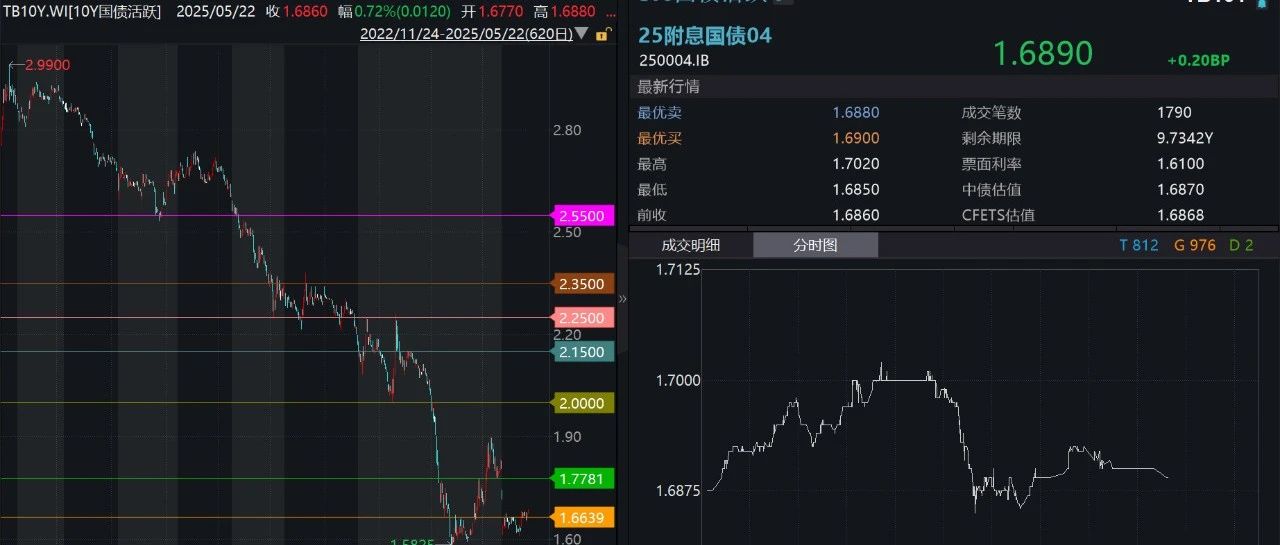
Core Viewpoint - The article discusses the impact of market rumors and the behavior of investors in response to these rumors, emphasizing the importance of following market trends regardless of the truth behind the rumors [1]. Group 1: Market Conditions - The central bank conducted a 1,425 billion yuan reverse repurchase operation, with 1,065 billion yuan maturing today, resulting in a net injection of 360 billion yuan [2]. - The interbank funding market showed a slight increase in funding prices, with DR001 around 1.57% and DR007 around 1.59% [2]. - The morning saw a tightening of the funding environment, while the afternoon experienced a loosening, leading to mixed movements in the bond market [3]. Group 2: Bond Market Dynamics - The issuance scale of government bonds was relatively high today, with the 10-year government bond rate opening slightly higher at 1.6875% before fluctuating downwards [4]. - The 10-year government bond rate reached around 1.7% during the day, influenced by tax payments and market sentiment [4]. - The 30-year Japanese government bond yield has surged by 85 basis points to 2.96% since early April, raising concerns about potential impacts on the domestic bond market [4]. Group 3: Revenue Comparisons - From January to April, the national non-tax revenue reached 1.5 trillion yuan, a year-on-year increase of 7.7%, marking a historical high for the same period [4]. - In contrast, local land transfer revenue was 934 billion yuan, which is half of the historical high in 2021 (2,138.3 billion yuan), representing the lowest level since 2015 for the same period [4].

央行、证监会等四部门发声,加快构建科技金融体制 | 政策与监管
清华金融评论· 2025-05-23 11:51
Core Viewpoint - The article discusses the recent policy measures introduced by multiple Chinese government departments to enhance the technology finance system, aiming to support high-level technological self-reliance and innovation in the country. Group 1: Policy Measures Overview - The policy measures focus on seven areas including venture capital, monetary credit, capital markets, technology insurance, and bond markets, proposing 15 specific initiatives to upgrade existing policies and introduce new ones [2][5]. - Establishment of a "National Venture Capital Guidance Fund" to encourage early, small, long-term investments in hard technology, enhancing the fundraising and exit channels for venture capital [2][3]. - Utilization of structural monetary policy tools to guide financial institutions in increasing credit support for technology enterprises, particularly for private SMEs [3][4]. Group 2: Capital Market Initiatives - The capital market will play a crucial role in supporting direct financing for technology enterprises, with the introduction of a "green channel" for capital market access and the establishment of a "technology board" in the bond market [4][17]. - The bond market "technology board" will facilitate flexible bond issuance and reduce costs for equity investment institutions, which are vital for early-stage investments in hard technology [17][19]. Group 3: Implementation Expectations - The policy aims to simultaneously address supply and demand sides, focusing on financing needs in key technology innovation areas [8][10]. - Emphasis on a systematic approach to release policy "combinatorial dividends" and promote collaborative development among various stakeholders [8][14]. - Establishment of a long-term financial support mechanism for technology innovation and addressing the financing challenges faced by technology SMEs [9][11]. Group 4: Innovation Scoring System - Introduction of an "Innovation Scoring System" to convert innovation data into financial metrics familiar to financial institutions, enhancing the ability to assess technology enterprises [12][13]. - Plans to optimize the core indicators of the scoring system and expand its application in various financial services [13]. Group 5: Regional Focus and Collaboration - The policy encourages regional collaboration, particularly in key innovation centers like Beijing, Shanghai, and the Guangdong-Hong Kong-Macau Greater Bay Area, to pilot technology finance initiatives [15][14]. - Local governments and financial institutions are urged to explore unique practices that can be replicated and promoted [15]. Group 6: Financial Ecosystem Development - The People's Bank of China emphasizes the need to build a supportive financial ecosystem for technology innovation, enhancing collaboration among banks, insurance, and securities institutions [21][22]. - Continuous improvement of the regulatory environment for technology enterprises, ensuring that fundraising is secure and used appropriately [29][30]. Group 7: Technology Insurance Role - Technology insurance is highlighted as a stabilizing factor for innovation, with measures to enhance compensation mechanisms and support for major technology tasks [36][38]. - The establishment of a risk-sharing mechanism for significant technology projects aims to provide comprehensive risk protection for technology enterprises [38].

央行、国家外汇局:境外上市募集资金以外币调回的可自主结汇使用
智通财经网· 2025-05-23 10:08
Core Viewpoint - The People's Bank of China and the State Administration of Foreign Exchange have issued a draft notice regarding the management of funds for domestic enterprises listed overseas, aiming to standardize foreign currency management policies and enhance the convenience of cross-border financing for domestic enterprises [1]. Group 1: Fund Management for Overseas Listings - Domestic enterprises listed overseas can repatriate funds raised in foreign currency or RMB, using capital project settlement accounts for transactions [1][4]. - The notice outlines that domestic enterprises must register their overseas listings with the local branch of the People's Bank of China within 30 working days after the issuance or completion of oversubscription [2]. - Changes in the overseas listing, such as name or address changes, must also be registered within 30 working days after the change occurs [3]. Group 2: Fund Repatriation and Usage - Funds raised from overseas listings should generally be repatriated promptly, with specific provisions for retaining funds for overseas investments subject to prior approval [4]. - The notice specifies that funds in RMB can be returned to either capital project settlement accounts or domestic RMB bank settlement accounts [4]. - The use of funds must align with the publicly disclosed documents related to the fundraising [4]. Group 3: Shareholder Transactions - Domestic shareholders must register any reduction in their overseas listed shares within 30 working days after the transaction [5]. - Shareholders wishing to increase their holdings must apply for registration 20 working days prior to the intended increase [11]. - The notice mandates that funds from share transactions should be repatriated promptly, either in RMB or foreign currency [13]. Group 4: Compliance and Regulatory Oversight - The People's Bank of China and the State Administration of Foreign Exchange will supervise and manage the registration, account opening, and fund exchange related to overseas listings [2][12]. - Financial institutions are required to ensure compliance with the notice, including maintaining records for anti-money laundering and anti-terrorism financing purposes [12]. - Violations of the notice may result in corrective measures and administrative penalties [13].
无差别抛售下长期日债收益率创历史新高,美债投资者急了?
Di Yi Cai Jing· 2025-05-23 08:49
Group 1 - The Bank of Japan officials are not in a hurry to intervene in the bond market despite rising pressures on Japanese government bonds [1][5] - The passage of Trump's tax reform plan has intensified global fiscal concerns, leading to a broad sell-off of long-term bonds across major economies, including Japan and Germany [1][3] - The 40-year Japanese government bond yield reached a historic high of 3.689%, while the 30-year bond yield hovered around 3.187% [3] Group 2 - Global investors are currently unfavorable towards long-term bonds due to concerns over inflation and economic outlook, which are impacting their willingness to hold such assets [4] - The rapid rise in Japanese bond yields is raising concerns that it may exacerbate the situation for U.S. Treasuries, as Japanese investors may start to repatriate funds back to Japan [6][7] - The potential for a sudden shift in Japanese investor behavior could lead to further downward pressure on U.S. bonds and the dollar [7]

突发大利空!美国、日本全线崩盘
天天基金网· 2025-05-23 03:20
Core Viewpoint - The article discusses the recent downgrade of the US credit rating by Moody's, leading to significant market reactions including a drop in stock prices and rising bond yields, indicating a potential crisis in the US debt market [2][3][11]. Group 1: US Debt Market Reactions - The 20-year US Treasury bond auction on May 22 resulted in a disappointing yield of 5.047%, marking the second time this yield has surpassed 5% [2][6]. - Following the auction, the yield on the 20-year Treasury bond rose to 5.127%, the highest level since November 2023 [8]. - The overall demand for the auction was slightly below average, with a bid-to-cover ratio of 2.46, the lowest since February [8]. Group 2: Economic Indicators and Concerns - The US federal government debt has exceeded $36 trillion, with a projected fiscal deficit of $1.83 trillion for 2024, and a record deficit of $3.13 trillion in 2020 [11][12]. - The public debt rate has reached 97.8%, with projections indicating it could rise to 107.2% by 2029 [18]. - The article highlights concerns that foreign investors are reluctant to fund the US's dual deficits at current price levels, as evidenced by a declining dollar index [11]. Group 3: Global Impact and Comparisons - The turmoil in the US debt market has triggered a "earthquake" in the Japanese bond market, with Japan's 20-year bond auction yielding the worst results since 2012 [20]. - Japan's government debt has reached 1,323.72 trillion yen, with a debt-to-GDP ratio of 232.7%, significantly higher than Greece during its debt crisis [22]. - Analysts warn that Japan could become a potential center for global financial risk due to its precarious fiscal situation [22].