
医药

Search documents
七部门联合推动服务型制造创新发展 到2028年,打造50个领军品牌,建设100个创新发展高地
Zheng Quan Shi Bao· 2025-10-12 22:01
Core Viewpoint - The Ministry of Industry and Information Technology and six other departments have jointly issued the "Implementation Plan for Deepening the Innovation and Development of Service-Oriented Manufacturing (2025-2028)", aiming to enhance the role of service-oriented manufacturing in high-quality development by 2028 [1] Group 1: Objectives and Tasks - The plan aims to complete 20 standard formulations, create 50 leading brands, and establish 100 innovation development hubs by 2028 [1] - It identifies seven main tasks and three special actions to promote the innovation and development of service-oriented manufacturing [1] Group 2: Challenges and Solutions - Current challenges in service-oriented manufacturing include weak supply capacity of key technologies, an incomplete standard system, uneven application of typical models across industries, and difficulties in statistical monitoring [1] - The plan proposes to strengthen technological innovation by focusing on key common technology breakthroughs and model innovations, and to publish a list of key common technologies for service-oriented manufacturing [1] Group 3: Support for Productive Services - The plan emphasizes the need to cultivate and expand key productive service industries, including technology services, industrial design, software and information services, productive financial services, intellectual property services, energy-saving and environmental protection services, and quality management services [2] - It aims to promote the application of service-oriented manufacturing models across various sectors, including raw materials, equipment manufacturing, electronics, and consumer goods [2] Group 4: Infrastructure and Technology Integration - The plan calls for strengthening new information infrastructure, deepening the integration of "5G + Industrial Internet", and enhancing the supply of industrial data elements [2] - It also emphasizes the integration of artificial intelligence technology with service-oriented manufacturing to foster innovation [2] Group 5: Brand and Platform Development - The plan includes actions to enhance shared manufacturing, develop shared manufacturing platforms and factories, and promote resource sharing in inspection and testing [3] - It aims to cultivate leading enterprises and brands in service-oriented manufacturing, along with strengthening brand evaluation and promotion [3] Group 6: Policy Support and Implementation - The plan requires robust policy support to ensure the implementation of related initiatives, including incorporating key common technology breakthroughs into the scope of technical transformation support [3] - It encourages local governments to increase support for manufacturing enterprises' service businesses and guides financial institutions to enhance financial services based on market principles [3]
香港“内联外通”优势在当前形势下更见突出
Ren Min Ri Bao· 2025-10-12 21:48
Group 1 - The Hong Kong government aims to strengthen ties with traditional markets while exploring new emerging markets to achieve better development [1][2] - In 2022, Hong Kong's foreign direct investment inflow reached $126 billion, ranking third globally [1] - The number of Hong Kong companies with parent companies from overseas and mainland China reached nearly 10,000, a historical high, with about 1,400 companies from the US, marking a 9% year-on-year increase [1] Group 2 - The Hong Kong government emphasizes its status as a free port under "One Country, Two Systems," maintaining a simple low tax regime and open, stable, and predictable trade policies [2] - Hong Kong continues to welcome foreign investment and business development, highlighting its advantages in internationalization and talent attraction [2]
我国将打造50个服务型制造领军品牌
Bei Jing Shang Bao· 2025-10-12 15:13
10月11日,工业和信息化部、人力资源社会保障部、商务部等七部门联合印发《深入推动服务型制造创 新发展实施方案(2025—2028年)》(以下简称《方案》),明确提出到2028年,服务型制造在制造业 高质量发展中的作用进一步增强,完成20项标准制定,打造50个领军品牌,建设100个创新发展高地。 建设100个创新发展高地 服务型制造是以客户需求为导向、以数智技术为支撑,通过创新优化生产组织形态、运营管理方式和商 业发展模式,将服务深度嵌入制造业产品全生命周期和各环节,延伸产业链、重塑价值链、构建新生 态,实现制造与服务融合发展的新型产业形态。 《方案》从企业、行业、区域和生态四个维度,提出体系化推动服务型制造创新发展的任务措施。 《方案》围绕构建以先进制造业为骨干的现代化产业体系、促进信息化和工业化深度融合,以深化改革 为动力,以推动科技创新和产业创新深度融合为引领,坚持应用牵引、创新驱动、融合发展,强化技术 创新、模式创新和成果推广应用,增强生产性服务业支撑能力,激发经营主体活力,夯实发展底座,优 化产业生态,打造服务型制造升级版,促进先进制造业与现代服务业深度融合,发展壮大新质生产力, 塑造制造业发展新动 ...


国泰海通 · 晨报1013|宏观、策略、海外策略、固收
国泰海通证券研究· 2025-10-12 13:40
Macro Perspective - The recent trade tensions initiated by the Trump administration are not expected to have a significant negative impact on the market, as the real drivers of asset performance are domestic economic and policy developments [4][5] - Historical context shows that previous tariff disputes led to temporary market reactions, but the U.S. government often softens its stance due to economic realities, suggesting that current tariff uncertainties may also be manageable [5][6] Investment Strategy - The current external shocks present a buying opportunity for Chinese markets, as the trade disputes are seen as disturbances rather than a trend reversal [10] - Unlike previous trade conflicts, the current situation has clearer boundaries regarding risks, and domestic financial stability is more assured, making it a favorable time to increase investments in quality assets [11][12] Industry Comparison - The investment focus should remain on emerging technologies, with sectors like AI, semiconductors, and financials showing strong potential for growth [13] - The financial sector, after adjustments, is expected to provide stable returns, with recommendations for stocks in brokerage, banking, and insurance [13] Overseas Strategy - There has been a notable increase in southbound capital inflows into Hong Kong stocks, while foreign capital outflows have slowed, indicating a shift in market dynamics [16] - Southbound investments are diversifying across various sectors, while foreign investments remain concentrated in technology and finance [16] Fixed Income Analysis - The bond market is expected to experience limited upward movement in interest rates, with a stable outlook for October, despite ongoing trade tensions [20][21] - The current environment suggests a potential for slight declines in bond yields, but overall, the bond market is likely to remain stable [20][21]

【太平洋研究院】10月第二周线上会议
远峰电子· 2025-10-12 11:02
Group 1: Company Events and Themes - The company "蜂助手" is focusing on AI edge computing and chip communication through a private placement [3][39] - A deep report on the upstream life sciences industry is scheduled, indicating a focus on healthcare and pharmaceuticals [7][39] - An update on the color metal industry is planned, reflecting ongoing developments in materials science [19][39] Group 2: Financial Analysis and Recommendations - A mid-term report analysis of 兴业银行 (Industrial Bank) will be conducted, highlighting its investment value [22][39] - A discussion on the pharmaceutical industry and updates on 华领医药 (Hualing Pharmaceutical) is set, suggesting potential investment opportunities in healthcare [28][39] - An electronic industry outlook report is scheduled, indicating a focus on technology and electronics sectors [34][39]


10月港股金股:震荡上行中
Soochow Securities· 2025-10-12 09:32
Group 1 - The report indicates that despite short-term adjustments in the Hong Kong stock market, it remains in a trend of oscillating upward with a solid bottom [1] - The report maintains a positive outlook on AI technology, suggesting that while US tech giants may influence the trading rhythm of Hong Kong's AI sector, the acceleration of China's AI progress offers recovery potential for leading tech stocks in Hong Kong [2] - The report emphasizes a focus on cyclical recovery, with the market awaiting guidance from the Fourth Plenary Session and the 15th Five-Year Plan, suggesting tactical trading in cycles and consumption [2] Group 2 - The report lists a selection of "golden stocks" for October, including Alibaba, Kuaishou, Xiaopeng Motors, and others, with detailed financial metrics such as market capitalization, EPS, and PE ratios for 2026 and 2027 [2][6] - Alibaba is highlighted for its strong cloud business growth driven by AI, with significant investments in AI infrastructure expected to enhance its competitive edge and maintain high margins [9][10] - Kuaishou is recognized for its advancements in AI video generation technology, positioning it as a leading player in the domestic market [16][17] Group 3 - Xiaopeng Motors is projected to achieve substantial revenue growth, with expected revenues of 830 billion, 1494 billion, and 2229 billion RMB for 2025, 2026, and 2027 respectively, alongside a path to profitability by 2026 [23] - The report discusses the strategic focus of Xiaopeng Motors on building a platform-based technology foundation to enhance its competitive advantage in the electric vehicle market [27] - The report anticipates that the Robotaxi business of Cao Cao Mobility will benefit from the ongoing transformation of the ride-hailing market, with projected revenues of 206.7 billion, 262.4 billion, and 323.7 billion RMB for 2025 to 2027 [30] Group 4 - Horizon Robotics is noted for its leadership in automotive intelligent driving solutions, with a significant market opportunity as the penetration of high-level autonomous driving increases [35] - The report highlights the commercial potential of the pharmaceutical company Kelun-Biotech, with ongoing clinical trials and product registrations expected to drive growth [41] - The report emphasizes the robust pipeline and financial health of Hutchison China MediTech, with expectations for revenue growth driven by successful commercialization of existing products [51][52] Group 5 - China Petroleum & Chemical Corporation is positioned to benefit from regulatory changes aimed at standardizing and scaling the refining industry, with expectations for improved cash flow and dividend yield [70][74] - The report discusses the food and beverage company Guoquan's strategic expansion into rural markets, with plans to open 1,000 new stores, reflecting a strong growth trajectory [78][79]
国泰海通海外:南向流入港股提速 外资偏好科技
智通财经网· 2025-10-12 09:08
Core Viewpoint - Southbound capital inflow into Hong Kong stocks has accelerated, with a cumulative net inflow of HKD 395.2 billion in Q3, an increase compared to Q2 [1][2] Flow Perspective - In Q3, southbound funds continued to flow into Hong Kong stocks, with a cumulative net inflow of HKD 395.2 billion, which is an increase from Q2 [2] - The outflow of foreign capital has slowed down, with a cumulative net outflow of HKD 66.4 billion in Q3, marking a decrease in outflow for three consecutive quarters [2] - The proportion of southbound holdings in Hong Kong stocks has reached a new high, with the Hong Kong Stock Connect holding amount rising from 20.7% at the end of Q2 to 21.8% at the end of Q3 [2] Industry Perspective - In Q3, the main inflows from southbound funds were into consumer discretionary, non-bank financials, and pharmaceuticals, while software and hardware saw net outflows in Q2 [3] - Foreign capital dominates most sub-sectors in Hong Kong stocks, particularly in the internet, finance, and most consumer sectors [3] - Southbound funds have gained significant pricing power in sectors such as semiconductors, general consumption, and general dividends over the past two years [3]

策略化选股月报(2025/10):科创板组合9月录得显著收益,10月模型推荐调低价值风格配置-20251012
Huafu Securities· 2025-10-12 07:23
- The report includes six quantitative stock selection strategies: multi-strategy stock selection, extreme style high BETA stock selection, "dividend+" preferred stock strategy, moving average trend strategy, sentiment price-volume strategy, and STAR Market strategy[20][21][22] - **Multi-strategy stock selection**: This strategy combines four sub-strategies (value stocks, growth stocks, quality stock selection, and distressed stock clearing) using traditional risk parity and momentum-optimized risk parity to adjust weights. The weights are based on the past 12 months' risk characteristics and 80-day momentum rank sorting. In October 2025, the quality stock selection strategy had the highest weight at 35.71%, while the value stock strategy had the lowest at 15.61%[22][23][27] - **Extreme style high BETA stock selection**: This strategy divides non-ST stocks into four groups (large-cap growth, large-cap value, small-cap growth, small-cap value) based on market capitalization and growth-value criteria. It uses specific factors like low turnover, low volatility, and high dividend yield for large-cap value stocks, and profitability and expected net profit factors for large-cap growth stocks. For small-cap value stocks, it employs low volatility and reversal factors, while for small-cap growth stocks, it uses expected profit growth and turnover rate factors. In October 2025, the large-cap value strategy had the highest weight at 50%, while the small-cap growth strategy had the lowest at 17.29%[45][47][48] - **"Dividend+" preferred stock strategy**: This strategy enhances traditional dividend strategies by selecting stocks with high dividend yields from the CSI 800 and CSI 1000 indices. It incorporates factors like volatility, ROE, valuation, and profit growth. The October 2025 portfolio included 30 stocks, with an average market capitalization of 1320.14 billion RMB, concentrated in the banking sector (40%) and utilities (16.7%)[75][76][79] - **Moving average trend strategy**: This strategy uses the relative position of moving averages to represent trend and reversal states. It calculates the trend strength factor as "(20-day moving average - 240-day moving average) / 20-day moving average" and selects stocks from the CSI 800 index. The October 2025 portfolio included 33 stocks, with an average market capitalization of 1794.32 billion RMB, concentrated in the oil and petrochemical sector (29.23%) and communication (19.11%)[107][108][109] - **Sentiment price-volume strategy**: This strategy combines price-volume resonance factors with market sentiment scoring (LWMA240). It adjusts factor scoring based on sentiment scores and avoids excessive price-volume resonance. The October 2025 portfolio included 50 stocks, with an average market capitalization of 409.69 billion RMB, concentrated in electronics (20%), automotive (16%), and communication (12%)[131][136][137] - **STAR Market strategy**: This strategy focuses on the STAR Market, emphasizing factors like analyst expectations, cash flow, valuation, volatility, and trend breakthroughs. It excludes stocks with low expectations, high volatility, and high price-to-cash flow ratios. The October 2025 portfolio included 30 stocks, with an average market capitalization of 457.35 billion RMB, concentrated in electronics (76.12%)[156][159][163] - **Performance results**: - Multi-strategy stock selection: September 2025 absolute return -0.38%, relative return -2.95%; annualized excess return since 2017: 13.68%, IR: 1.55[30][41][44] - Extreme style high BETA stock selection: September 2025 absolute return -3.28%, relative return -5.77%; annualized excess return since 2011: 21.01%, IR: 2.27[62][68][74] - "Dividend+" preferred stock strategy: September 2025 absolute return 0.83%, relative return -1.77%; annualized excess return since 2011: 10.93%, IR: 1.09[85][97][102] - Moving average trend strategy: September 2025 absolute return 0.60%, relative return -1.99%; annualized excess return since 2016: 13.40%, IR: 0.93[116][123][129] - Sentiment price-volume strategy: September 2025 absolute return 1.54%, relative return -1.08%; annualized excess return since 2014: 17.94%, IR: 1.13[143][151][155] - STAR Market strategy: September 2025 absolute return 10.92%, relative return -0.5%; annualized excess return since 2020: 24.62%, IR: 1.28[163][170][175]
香江观澜:重点企业纷至,香港“磁吸力”彰显
Zhong Guo Xin Wen Wang· 2025-10-12 05:20
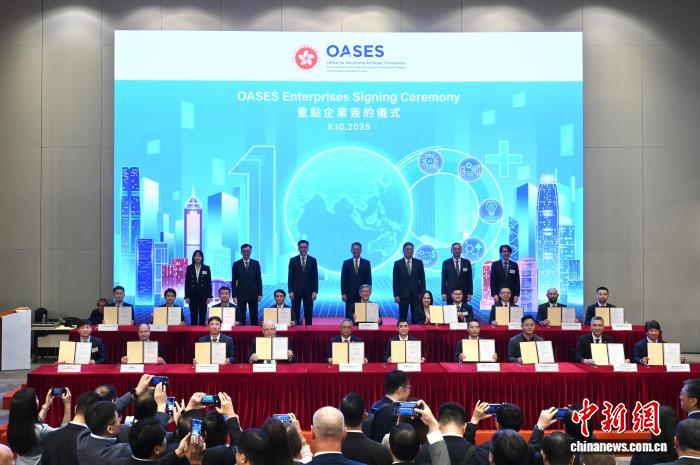
Core Insights - A new batch of 18 key enterprises has signed agreements to establish operations in Hong Kong, including three global pharmaceutical leaders and companies in AI, autonomous driving, microelectronics, and cross-border financial services [1][2] - The total number of key enterprises attracted to Hong Kong has exceeded 100, bringing approximately HKD 600 billion in investments and creating around 22,000 jobs [1][2] Group 1: Attraction of Enterprises - The latest batch of key enterprises includes a significant proportion of overseas companies, accounting for 40%, indicating Hong Kong's enhanced "magnetic pull" for international businesses [2] - Roche, one of the world's top ten pharmaceutical companies, highlighted the favorable environment for medical innovation fostered by the Hong Kong government [2] - The presence of these enterprises aligns with Hong Kong's industrial upgrade direction, injecting new momentum into the economy [2] Group 2: Economic Impact and Future Directions - The focus of the new enterprises is on cutting-edge fields such as pharmaceuticals, AI, and cultural technology, which aligns with Hong Kong's policy direction for developing innovative industries [2] - The Hong Kong government aims to support the sustainable growth of these enterprises by fostering high-value manufacturing and promoting new industrialization [5] - Recent international rankings reaffirm Hong Kong's status as the world's freest economy and its position as a leading global financial center, reflecting its increasing competitiveness [6]
华金证券:十月慢牛趋势不变,风格难改
Sou Hu Cai Jing· 2025-10-12 03:45
Core Viewpoint - The main factors influencing the A-share market in October are policies and external events, liquidity, and fundamentals, with historical data indicating a tendency for the market to be volatile during this month [1][2]. Group 1: Historical Performance - Since 2010, the Shanghai Composite Index has shown an upward trend in October during years when the "Five-Year Plan" was implemented, such as in 2010, 2015, and 2020 [2][3]. - Out of the last 15 years, the index has risen in 8 instances during October [2]. Group 2: Influencing Factors - Policies and external events are the core influencing factors; positive developments may lead to market gains, while tightening policies or negative external shocks could weaken the market [2][3]. - Liquidity conditions are also crucial; a loose liquidity environment can boost the market, as seen in 2010 with the anticipation of QE2, in 2015 with interest rate cuts, and in 2019 with Fed rate cuts [2][3]. - The performance of the third-quarter reports is expected to significantly impact the market in October, with potential structural recovery in earnings [2][3]. Group 3: October Outlook - The A-share market is likely to continue a slow bullish trend in October, supported by positive policy expectations and a potentially loose liquidity environment [3]. - The upcoming Fourth Plenary Session may enhance positive policy expectations, while geopolitical tensions could remain a concern, particularly regarding U.S.-China trade relations [3]. - Economic conditions are expected to show weak recovery, with third-quarter earnings reports indicating a structural rebound in sectors like technology and cyclical industries [3]. Group 4: Sector Allocation - The technology and growth sectors are expected to outperform in October, particularly those related to the "14th Five-Year Plan," which emphasizes technological innovation and domestic demand [4]. - Historical data suggests that industries with strong earnings reports during the third-quarter disclosure period tend to perform well, with high growth expected in technology and cyclical sectors [4]. - The current Fed rate cut cycle may favor technology and certain cyclical industries, with a higher likelihood of leading performance from sectors like computing, automotive, and electronics [4]. - Recommendations include accumulating positions in sectors benefiting from policy support and improving fundamentals, such as communication, machinery, electronics, and renewable energy [4].