存储芯片

Search documents
存储超级周期助推:三星市值首破1000万亿韩元大关!韩国首家
Sou Hu Cai Jing· 2026-02-04 10:50
Core Insights - Samsung Electronics has reached a historic milestone by surpassing a market capitalization of 1,000 trillion Korean Won (approximately 688 billion USD), becoming the first company in South Korea to achieve this landmark [2][4]. Group 1: Market Performance - On Wednesday, Samsung's market capitalization briefly touched approximately 1,002 trillion Korean Won, with its stock price rising to 169,400 Korean Won, an increase of 1.13% from the previous trading day [4]. - At market close, the stock price settled at 169,100 Korean Won, reflecting a gain of 0.96%, stabilizing the market capitalization at around 1,001 trillion Korean Won [5]. - Since surpassing 100,000 Korean Won per share last October, Samsung's stock has surged by 125% over the past year, with a cumulative increase of about 41% in the current year [5]. Group 2: Industry Dynamics - The demand for high-performance storage chips has been robust, contributing to Samsung's stock price surge [5]. - Samsung and SK Hynix are expected to significantly raise NAND flash memory prices in the first half of this year, with product profit margins projected to reach between 40% and 50%, marking the highest levels in nearly a decade [5].

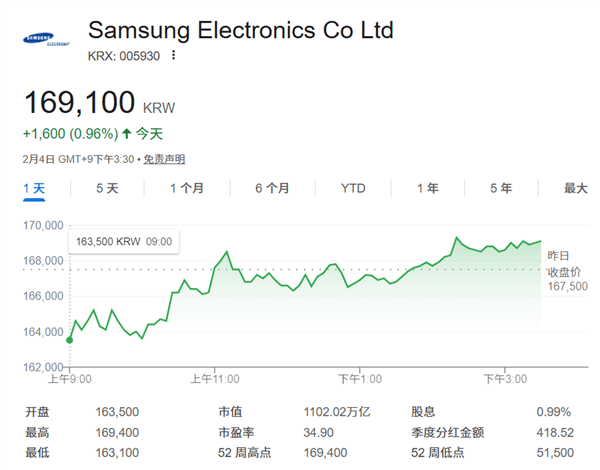
“存储饥渴”催生业绩牛股!佰维存储、江波龙等利润暴增,业内预测涨价潮贯穿2026
Hua Xia Shi Bao· 2026-02-04 08:20
Core Viewpoint - The semiconductor sector, particularly memory chip stocks, is experiencing significant stock price volatility despite strong fundamentals, with expectations of continued price increases in the memory industry through 2026 [1][2][3]. Group 1: Stock Performance - Major memory chip companies saw substantial stock declines on February 2, with companies like Zhongwei Semiconductor down 13.67% and Puran shares down 13.01% [2]. - The recent downturn is attributed to profit-taking after a period of gains and concerns over weakening DRAM spot prices, alongside negative sentiment from the U.S. semiconductor market [2][3]. Group 2: Earnings Forecasts - Companies in the memory sector are projecting strong earnings for 2025, with Bawei Storage expecting revenue between 10 billion and 12 billion yuan, a year-on-year increase of 49.36% to 79.23% [3][4]. - Jiangbolong anticipates revenue of 22.5 billion to 23 billion yuan, reflecting a growth of 150.66% to 210.82% compared to the previous year [3][4]. Group 3: Market Dynamics - The global shift in memory production and rising prices are benefiting Chinese memory companies, driven by increased demand from AI servers and edge computing [6]. - The demand for high-profit memory products is expected to rise, with significant growth in AI server shipments projected for 2024 [6]. Group 4: Price Trends - Predictions indicate that memory product prices will continue to rise, with NAND Flash prices expected to increase by 33% to 38% and DRAM prices by 55% to 60% in the first quarter of 2026 [7][8]. - TrendForce has revised its forecasts, now expecting DRAM contract prices to rise by 90% to 95% and NAND Flash prices by 55% to 60% in the same period, reflecting ongoing supply-demand imbalances [8].

AI投资告别“讲故事”:公募四季报告诉你,2026年该投什么?
券商中国· 2026-02-04 06:29
Core Viewpoint - The 2025 fund quarterly report indicates a shift in investment strategy from emotion-driven to performance-based, emphasizing stability and safety in the market [1] Group 1: Market Activity and Fund Performance - The average daily trading volume in A-shares reached 3.11 trillion yuan, a month-on-month increase of over 10%, indicating active trading despite the approaching Spring Festival [1] - As of December 2025, the net asset value of domestic public funds in China reached 37.71 trillion yuan, nearing the 38 trillion yuan mark, and has set a historical high for nine consecutive months [1] Group 2: Passive vs. Active Funds - By the end of 2025, the market value of stock index funds reached 4.7 trillion yuan, a quarter-on-quarter increase of 3.4%, while active equity funds fell to 3.39 trillion yuan, down 5.2% [4] - The gap between passive and active funds widened from 970 billion yuan in Q3 2025 to 1.31 trillion yuan by the end of 2025, reflecting a growing preference for transparent and cost-effective investment tools [4][5] Group 3: Sector Focus and Investment Trends - In 2025, active equity funds showed a reduction in allocation to TMT sectors, with a notable increase in the communication sector by approximately 1.9 percentage points [7] - Companies in the storage chip sector, such as Baiwei Storage, are expected to see significant profit growth, with projected net profits increasing by 427.19% to 520.22% year-on-year [8] Group 4: Safety and Stability in Investments - Commodity funds saw a surge of over 40% in scale, with gold-related ETFs increasing by over 100 billion yuan, highlighting a shift towards safe-haven assets amid global economic uncertainties [10] - The "fixed income plus" products reached a scale of 2.74 trillion yuan by the end of 2025, growing approximately 60% year-on-year, catering to cautious investors seeking stable returns [11]




A股低开,贵金属板块走强
第一财经· 2026-02-04 01:48
Market Overview - The A-share market opened lower with the Shanghai Composite Index down 0.08%, the Shenzhen Component down 0.39%, and the ChiNext Index down 0.80% [3][4] - The Hong Kong market also opened lower, with the Hang Seng Index down 0.14% and the Hang Seng Tech Index down 0.87% [5][6] Sector Performance - The storage chip sector experienced significant declines, with companies like Deep Kangjia A hitting the daily limit down, and others such as Puran, Lanke Technology, Baiwei Storage, and Shannon Chip also opening lower [2] - The AI computing power industry chain saw a downturn, particularly in the storage and CPO sectors, while semiconductor and consumer electronics themes were among the hardest hit [4] - Conversely, gold, basic metals, and oil and gas sectors showed signs of rebound [4]



2月4日早餐 | 一号文件发布;贵金属大反弹
Xuan Gu Bao· 2026-02-04 00:10
大家早上壕! 先看海外要闻: 美股爆发AI恐慌,Anthropic新工具掀软件股抛售,美股科技板块、尤其是软件股,遭遇去年4月以来最惨抛售。资金涌入小盘股、价值股以及黄 金等。收盘标普500跌幅0.84%,道指跌幅0.34%,纳指跌幅1.43%。 科技七姐妹大跌1.5%,英伟达一度跌5%。绩后Paypal暴跌约20%、AMD盘后大跌超7%。 纳斯达克金龙中国指数收跌0.94%,硕迪生物收跌将近7%,大全新能源跌超4%,阿里跌约3%,阿特斯涨约5%。 美债收益率小幅走低,10年期美债收益率下行0.6个基点至4.266%。美元跌0.15%。 加密货币盘中暴跌。比特币一度跌超7%、跌破去年4月低点,以太坊一度暴跌约9%、逼近2100美元,尾盘均显著反弹,但仍下跌。 现货黄金大反弹6.2%,一度逼近5000美元。白银日内涨幅一度达12%,随后涨幅回落、仍涨逾7%。原油日内涨超2%,报道称美军在阿拉伯海击 落了一架伊朗无人机。 英伟达接近达成一份协议,将在本轮投资中对OpenAI出资200亿美元。 西部数据称已有客户询问2030年供应。 国内重大事件汇总: 1、中央一号文件《中共中央 国务院关于锚定农业农村现代化 扎实 ...
长江存储、长鑫存储启动大扩产!
国芯网· 2026-02-03 12:05
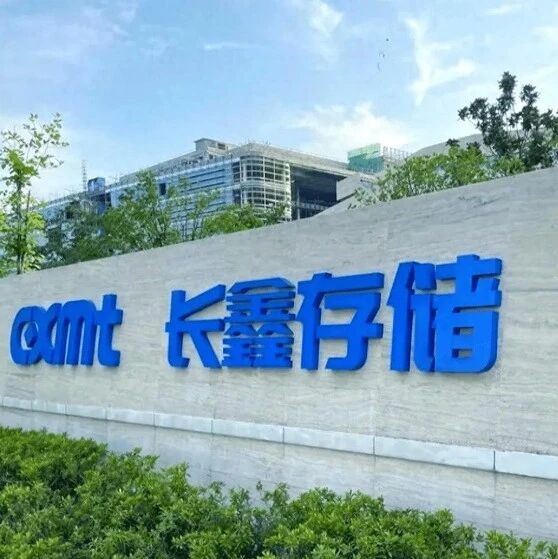
国芯网[原:中国半导体论坛] 振兴国产半导体产业! 不拘中国、 放眼世界 ! 关注 世界半导体论坛 ↓ ↓ ↓ ***************END*************** 半导体公众号推荐 半导体论坛百万微信群 2月3日消息,在全球存储芯片供应严重短缺的背景下,中国两大存储巨头正加速扩张以抢占市场先机。 据日经亚洲报道,中国两大头部存储芯片制造商,长鑫存储与长江存储已启动史上最大规模扩产计划, 力图缩小与三星、SK海力士等国际龙头的差距。 报道称,作为中国最大DRAM厂商,长鑫存储正在上海建设新工厂,新增产能将达其合肥总部基地的两 至三倍。 该厂计划于2026年下半年启动设备安装,2027年正式投产,产品覆盖服务器、PC、汽车电子等领域, 同时,公司还在上海扩建HBM生产线,瞄准AI算力需求。 有知情人士表示,长鑫存储在合肥、北京的两处工厂已处于满负荷运转状态,"本土企业需求极为旺 盛,公司希望尽快扩大产能。" 至于中国头部NAND厂商长江存储也在武汉建设第三座工厂,计划于2027年投产。 据透露,长江存储已明确新厂产能规划,除生产NAND外,50%产能将用于DRAM制造;同时还将与本 土存储封装企业 ...
全市场超4800只个股上涨,A500ETF易方达(159361)、沪深300ETF易方达(510310)助力一键布局核心资产
Sou Hu Cai Jing· 2026-02-03 11:17
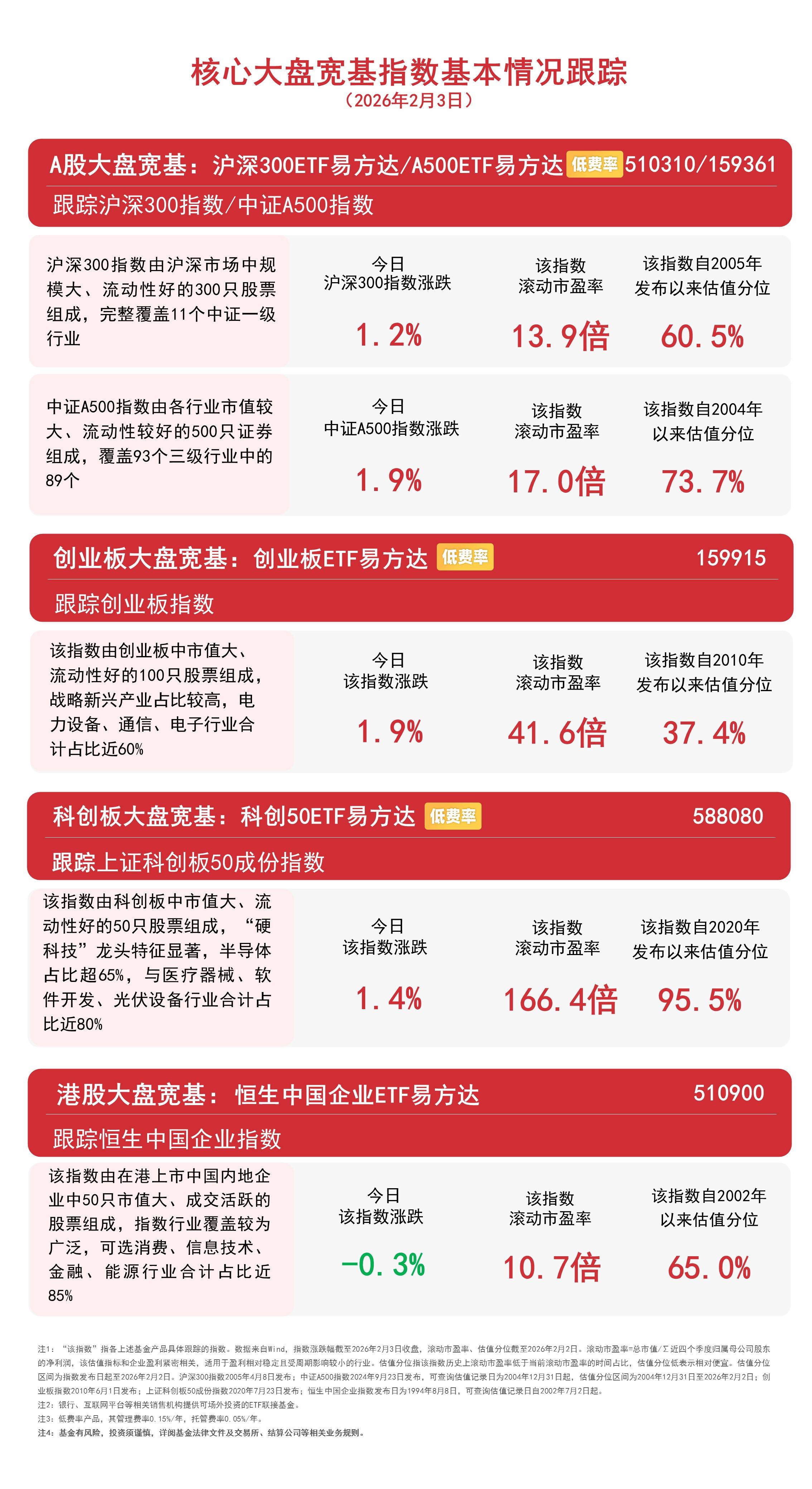
Group 1 - The A-share market experienced a collective rebound on February 3, with over 4,800 stocks rising across the market [1] - Key sectors that performed well included photovoltaic equipment, CPO, commercial aerospace, engineering machinery, rare earth permanent magnets, cloud gaming, storage chips, cultivated diamonds, and epoxy propylene [1] - The CSI A500 index rose by 1.9%, the CSI 300 index increased by 1.2%, the ChiNext index gained 1.9%, and the STAR Market 50 index went up by 1.4%, while the Hang Seng China Enterprises Index fell by 0.3% [1] Group 2 - The ChiNext ETF tracks the ChiNext index, which consists of 100 stocks with high market capitalization and liquidity, with a significant proportion in strategic emerging industries, particularly in the power equipment, communication, and electronics sectors, which together account for nearly 60% [3] - The STAR 50 ETF tracks the STAR Market 50 index, composed of 50 stocks with high market capitalization and liquidity, prominently featuring "hard technology" leaders, with semiconductors making up over 65% and combined with medical devices and software development, accounting for 80% [5]
定点爆破
Datayes· 2026-02-03 11:07
Group 1 - The article discusses potential tax adjustments targeting the financial and internet service sectors, with concerns that the tax rate for internet value-added services may rise from 6% to align more closely with the 32% rate of the liquor industry due to high profit margins [1][2] - There are rumors that high-tech enterprises may no longer qualify for the 15% preferential tax rate, shifting to a standard 25% corporate income tax rate, which could significantly impact major internet companies like Tencent and Alibaba [1][2] - The recent VAT law changes have raised investor concerns about possible tax increases across various sectors, including internet services and finance [2] Group 2 - Citigroup believes the likelihood of widespread tax increases in the short term is low, but the era of significant tax reductions may be over, as fiscal pressures mount due to factors like declining land transfer revenues and increased social security expenditures [6] - The article notes that the current economic environment shows weak domestic demand, which may limit the government's ability to implement broad tax hikes [6] Group 3 - The A-share market experienced a rebound, with the Shanghai Composite Index rising by 1.29%, and trading volume decreased by 411.38 billion yuan compared to the previous day [12] - The aerospace sector saw significant activity, with several stocks hitting the daily limit, driven by upcoming space missions and increased interest in space-related technologies [12][13] - The article highlights the performance of various sectors, noting that the power equipment, defense, and machinery sectors saw the largest net inflows of capital, while non-ferrous metals and banking sectors faced outflows [30][38] Group 4 - The article mentions that the central government's recent policy document emphasizes agricultural modernization and the integration of AI and technology in agriculture, which could create investment opportunities in related sectors [19] - In the semiconductor industry, major Chinese manufacturers are planning significant expansions to close the gap with market leaders amid a global chip shortage [20] Group 5 - The CDN industry is expected to experience growth as cloud service providers have begun raising prices, breaking a long-standing trend of price declines [21] - The robotics sector is seeing increased investment, with significant funding rounds reported for companies focused on humanoid robots and AI applications [22]
推出Mini SSD,佰维重构端侧AI存储
半导体芯闻· 2026-02-03 09:56
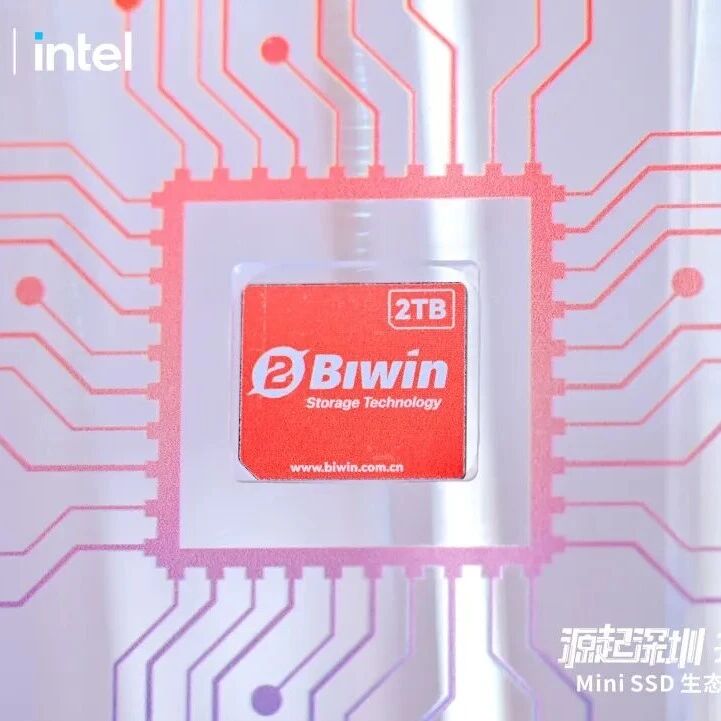
Core Viewpoint - Shenzhen Baiwei Storage is gaining attention as a dark horse in the storage industry, with projected net profits for 2025 expected to increase significantly compared to the previous year, driven by technological advancements and market demand for storage solutions [1][2]. Financial Performance - Baiwei Storage anticipates a net profit attributable to shareholders of 850 million to 1 billion yuan for the fiscal year 2025, representing an increase of 688.77 million to 838.77 million yuan year-on-year, which translates to a growth of 427.19% to 520.22% [1]. - The fourth quarter of 2025 is expected to see a net profit of 819.59 million to 969.59 million yuan, reflecting a year-on-year growth of 1225.40% to 1449.67% and a quarter-on-quarter increase of 219.89% to 278.43% [1]. Technological Advancements - The company's success is attributed to its continuous investment in new technologies, advanced packaging capabilities, and wafer-level advanced testing manufacturing [2]. - Baiwei Storage is one of the first companies to integrate research and development in packaging and testing, providing a comprehensive solution of "storage + wafer-level advanced testing" [2]. Market Trends - The rise of edge AI is reshaping the storage landscape, with predictions that AI smartphones and PCs in China will see penetration rates exceeding 50% and 80%, respectively, in the next three years [4]. - The demand for storage solutions is increasing as various industries explore the potential of AI applications, leading to new challenges and requirements for storage products [5]. Product Innovation - The Mini SSD, introduced by Baiwei Storage, is a response to the evolving market needs, characterized by high performance, large capacity, and compact size [9][10]. - The Mini SSD has received multiple international awards, including TIME's "Best Invention of the Year" and "Best-in-Show" at Embedded World North America 2025, highlighting its innovative design and market acceptance [12][13]. Product Features - The Mini SSD features a size of 15mm x 17mm x 1.4mm, which is 60% smaller than M.2 2230 SSDs, and offers a capacity range from 512GB to 2TB [15]. - It supports PCIe 4.0x2 interface and NVMe 1.4 protocol, achieving read speeds of 3700MB/s and write speeds of 3400MB/s, along with IP68 dust and water resistance [16]. Ecosystem Development - Baiwei Storage is collaborating with top industry partners to build an open and prosperous ecosystem for the Mini SSD, aiming to leverage AI opportunities in the market [20]. - The company is committed to continuously upgrading the Mini SSD and introducing more innovative products to empower the industry [21].
帮主郑重收评:4800股狂欢!三大指数涨超1%,明日该追还是守?
Sou Hu Cai Jing· 2026-02-03 09:22
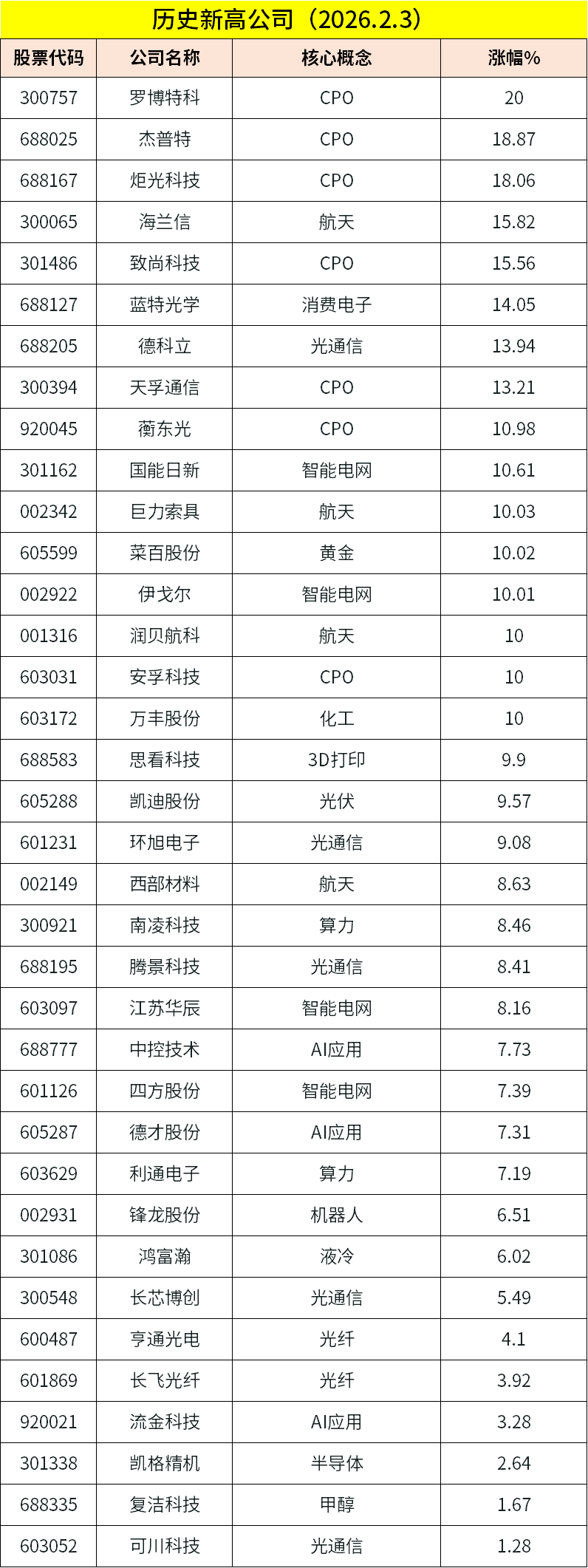
Core Viewpoint - The recent surge in the A-share market is attributed to a combination of policy support and capital inflow, leading to a positive market sentiment and significant gains across various sectors, particularly in technology and photovoltaic stocks [1][5][6] Group 1: Market Performance - Over 4,800 stocks in the A-share market experienced gains, with major indices rising over 1%, and the Shenzhen Component Index soaring by 2.19% [1] - The North Star 50 index saw an increase of over 3%, indicating strong market momentum [1] Group 2: Sector Highlights - The space photovoltaic sector saw collective gains, driven by initiatives from Elon Musk's space exploration and domestic projects, supported by policy and demand [3] - The CPO sector, including companies like Robotech and Tianfu Communication, benefited from the surge in AI computing demand, with high-speed optical modules being essential for data centers [4] - The storage chip sector is experiencing active performance due to a global supply-demand mismatch, with price increases from major players like Samsung and SK Hynix, opening a window for domestic alternatives [4] Group 3: Investment Strategies - Investors are advised to hold onto quality stocks in the photovoltaic, CPO, and storage chip sectors while locking in profits during price surges [5] - Defensive sectors like banking and insurance are expected to see a rebound before the Spring Festival, suggesting a potential for recovery [5] - New investors are encouraged to focus on undervalued stocks in the photovoltaic sector and high-performing stocks in the storage chip sector, employing a cautious approach with stop-loss settings [5] Group 4: Future Outlook - The overall market trend is positive, but differentiation among stocks is expected, with a warning against chasing stocks without solid fundamentals [6] - Continuous monitoring of popular sectors, especially CPO and storage chips, is essential for strategic positioning in the upcoming market movements [6]