有色金属

Search documents
中观行业比较月报(2026年1月):轮动中把握景气线索,关注涨价与科技-20260203
Ping An Securities· 2026-02-03 01:13
Group 1 - The report indicates that in January, the A-share market experienced a strong upward trend, with both cyclical and technology sectors performing well, leading to a significant increase in major indices [8][9] - The report highlights that 26 out of 31 sectors in the Shenwan index saw gains, with non-ferrous metals, oil and petrochemicals, and basic chemicals benefiting the most from rising commodity prices, showing increases between 12% and 23% [8][12] - The report notes that the semiconductor sector, particularly storage, is leading the price increase cycle, driven by sustained demand for AI hardware and software [3][12] Group 2 - The upstream cycle is characterized by significant price increases in non-ferrous metals, with many commodities reaching over 90% of their two-year high percentile range, while oil and chemical products are also seeing price increases, albeit remaining below historical averages [2][16] - The midstream manufacturing sector is experiencing price hikes in materials related to the new energy industry, with exports supporting the demand in certain sectors, although domestic demand remains weak [2][3] - The consumer sector shows signs of marginal improvement, with prices for live pigs and liquor stabilizing, while the real estate market continues to face challenges with negative sales area and price growth [3][4] Group 3 - The valuation comparison indicates that the non-ferrous and TMT sectors have seen significant valuation expansion, currently positioned at historically high percentiles, while valuations in banking and certain consumer sectors have contracted [5][6] - The report suggests that the spring market trend is likely to continue, with structural opportunities emerging, particularly in sectors with price increases and technology [5][6] - The report emphasizes the importance of monitoring the cyclical and semiconductor sectors for potential investment opportunities, as well as focusing on competitive midstream manufacturing companies [5][6]
84股获连续融资净买,量化拆解机构动作
Sou Hu Cai Jing· 2026-02-03 01:13
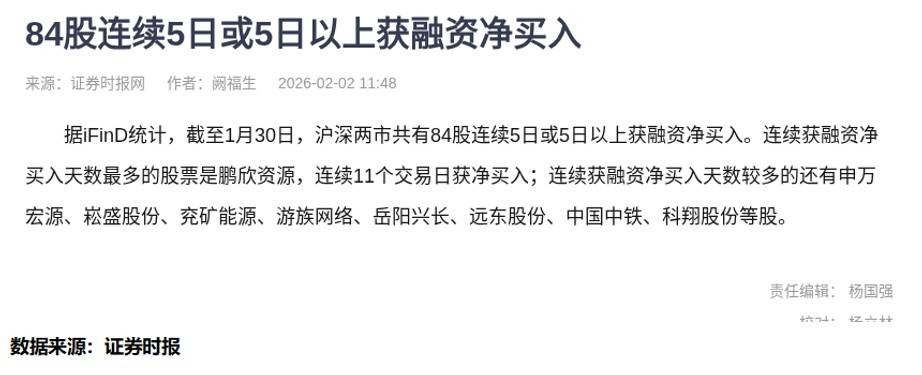
Group 1 - The core viewpoint of the article emphasizes that the A-share market operates under a unique logic where trading often occurs in anticipation of news rather than in direct response to it, leading to a phenomenon of "buying rumors, selling news" [1][3][15] - Recent statistics show that as of January 30, 84 stocks in the Shanghai and Shenzhen markets have received net financing inflows for five consecutive trading days or more, indicating sustained investor interest in these stocks [1][3] - The article highlights the importance of understanding the underlying trading behaviors rather than being swayed by surface-level market movements and news, suggesting that quantitative big data can provide insights into true market participation [1][5][12] Group 2 - The article discusses the misleading nature of news in trading, noting that many investors experience confusion when reacting to news, as the A-share market's trading logic differs from that of overseas markets [3][15] - A key metric in quantitative data analysis is "institutional inventory," which reflects the active participation of institutional funds in trading, rather than just their buying or selling actions [6][12] - The article illustrates that the true direction of stock movements is determined by the real participation of funds, with examples showing that stocks with active institutional inventory can recover quickly, while those without may struggle despite apparent rebounds [9][11][15] Group 3 - The article emphasizes the value of quantitative tools in developing a rational investment mindset, helping investors to focus on the real participation of funds rather than being influenced by emotional or subjective decisions [16] - By consistently using quantitative analysis, investors can cultivate a habit of viewing the market from a data perspective, reducing decision-making errors and enhancing their ability to navigate complex market environments [16]

美国制造业PMI超预期,沪指险守4000点
Dong Zheng Qi Huo· 2026-02-03 01:10
1. Report Industry Investment Ratings No relevant information provided. 2. Core Views of the Report - The US manufacturing PMI exceeded expectations, leading to a rebound in risk appetite and a strengthening of the US dollar index. The short - term economic downward pressure has eased, and the market risk preference has recovered. The short - term dollar is expected to continue to rise [15]. - Gold prices continued to decline on Monday, and silver hit the daily limit down. The market is still digesting the negative impact of Wash being nominated as the Fed Chairman. The short - term sharp decline of precious metals may end, but it is difficult to rise rapidly, and it is expected to enter a volatile stage [13]. - A - shares had a sharp adjustment, and the Shanghai Composite Index barely held above 4000 points. The weakening of the "inflation up, bulk prices up, economic recovery" logic led to a sharp decline in related sectors and dragged down the stock market. In the short term, the stock index lacks the momentum to rise and still needs to oscillate to digest the capital pressure [23]. - For commodities, different varieties have different trends. For example, palm oil exports increased, and the inventory decreased; iron ore supply pressure is high, and the price is expected to oscillate weakly; coal prices are expected to be strong in February; and the prices of some energy - chemical products such as crude oil and asphalt are affected by geopolitical and market factors [37][34][32]. 3. Summary According to the Directory 3.1 Financial News and Comments 3.1.1 Macro Strategy (Gold) - The US 1 - month ISM manufacturing PMI was 52.6, the highest since August 2022, with an expected 48.5 and a previous value of 47.9. Fed Bostic expects no rate cuts in 2026. Gold prices continued to decline on Monday, and silver hit the daily limit down. The short - term sharp decline of precious metals may end, but it is difficult to rise rapidly, and it is expected to enter a volatile stage. It is recommended to wait for the market volatility to decline, and the adjustment pressure of silver is greater than that of gold, and the gold - silver ratio will rise [11][13]. 3.1.2 Macro Strategy (Foreign Exchange Futures - US Dollar Index) - Trump called on Republicans to take control of the election process from the states. The US 1 - month ISM manufacturing PMI was the highest since February 2022, which led to a rebound in risk appetite and a strengthening of the US dollar index. The short - term dollar is expected to continue to rise [14][15]. 3.1.3 Macro Strategy (US Stock Index Futures) - The US 1 - month ISM manufacturing PMI far exceeded expectations. Oracle launched a $25 billion bond issuance. The US government shutdown postponed the release of the January employment report. It is expected that the US stock market will maintain high - level volatility [17][18][19]. 3.1.4 Macro Strategy (Stock Index Futures) - The A - share market had a sharp adjustment, and the Shanghai Composite Index barely held above 4000 points. The weakening of the "inflation up, bulk prices up, economic recovery" logic led to a sharp decline in related sectors and dragged down the stock market. In the short term, the stock index lacks the momentum to rise and still needs to oscillate to digest the capital pressure [23]. 3.1.5 Macro Strategy (Treasury Bond Futures) - The central bank carried out 750 billion yuan of 7 - day reverse repurchase operations, with a net withdrawal of 755 billion yuan on the day. The performance of treasury bond futures was slightly weak. It is recommended to moderately pay attention to the opportunity of shorting T [25]. 3.2 Commodity News and Comments 3.2.1 Black Metals (Rebar/HRC) - 276 steel enterprises completed the publicity of ultra - low emission transformation. The 2 - month auto market will enter a stage of adjustment. Steel prices followed the decline of peripheral metals. The inventory of building materials has increased significantly, and the demand has weakened seasonally. It is recommended to treat steel prices with an oscillatory mindset, and the short - term decline space is expected to be limited [27][30]. 3.2.2 Black Metals (Steam Coal) - On February 2, the price of steam coal in the northern port market remained stable. With the approach of the festival, the supply has shrunk, and some terminal enterprises still have pre - holiday replenishment needs, which support the coal price to a certain extent. It is expected that the coal price will be strong in February, and attention should be paid to the temperature and new energy power generation in February [32]. 3.2.3 Black Metals (Iron Ore) - The construction of the port and railway in Baffin Island was approved to support the expansion plan of Mary River Mine. The supply of iron ore is at a high level, and the demand is temporarily static. It is expected that the iron ore price will oscillate weakly [34]. 3.2.4 Agricultural Products (Soybean Oil/Rapeseed Oil/Palm Oil) - As of January 30, 2026, the domestic palm oil inventory was 701,400 tons, a decrease of 40,900 tons from the previous week, a decrease of 5.51%. The export volume of Malaysian palm oil from January 1 - 31 increased by 17.93% month - on - month. After the macro - sentiment stabilizes, long positions can be continued to be arranged [36][37]. 3.2.5 Agricultural Products (Soybean Meal) - The Brazilian soybean harvest progress is slightly faster than that of the same period last year. The domestic soybean meal inventory of oil mills has increased. It is expected that the domestic and foreign futures prices will maintain a weak - oscillatory trend [38][40]. 3.2.6 Non - ferrous Metals (Copper) - The copper concentrate processing fee is at a low level, and the EU is considering new sanctions on Russian copper. The copper price has dropped significantly due to the decline of precious metals. In the short term, the volatility is still relatively large. It is recommended to buy on dips in the medium - term and wait - and - see for arbitrage [41][42][44]. 3.2.7 Non - ferrous Metals (Lead) - The domestic social inventory of lead ingots has increased. The lead market is currently in a situation of weak supply and demand. It is expected that the social inventory will increase seasonally. It is recommended to wait - and - see in the short - term and pay attention to the medium - term long - position opportunity [45]. 3.2.8 Non - ferrous Metals (Zinc) - The zinc price has dropped significantly. The domestic inventory has increased seasonally. It is recommended to wait - and - see temporarily and manage positions well [48][49]. 3.2.9 Non - ferrous Metals (Tin) - The supply of tin is expected to ease, but the supply concentration is high. The short - term tin price is expected to be weak and oscillatory. Attention should be paid to the implementation of the supply recovery expectation and the improvement of consumption [51][52]. 3.2.10 Energy Chemicals (Crude Oil) - Iran said it was willing to close or suspend its nuclear program. Trump reached a trade agreement with India. The oil price has dropped significantly. It is expected to maintain an oscillatory trend in the short - term, and attention should be paid to the changes in the Iranian situation [53][55]. 3.2.11 Energy Chemicals (Asphalt) - The inventory of asphalt refineries has decreased, and the social inventory has increased. The short - term asphalt price is under pressure, and the subsequent trend depends on whether there are sudden changes in the geopolitical situation [57]. 3.2.12 Energy Chemicals (Methanol) - Iran hopes to avoid war with the US through diplomatic efforts. It is recommended to short the methanol 05 contract, with a stop - profit point of 2183 yuan/ton, and aggressive investors can lower the stop - profit to the previous box area of 2120 - 2150 yuan/ton [58][60]. 3.2.13 Energy Chemicals (Styrene) - The inventory of styrene in East China ports has changed. The short - term styrene market has large fluctuations, and it is recommended to wait - and - see and reduce the risk exposure before the Spring Festival [61][63]. 3.2.14 Energy Chemicals (Caustic Soda) - The price of liquid caustic soda in Shandong is stable. The high - supply, weak - demand, and high - inventory situation has not changed. The short - term rebound height of caustic soda is expected to be limited, and the disk may be under pressure again [64][65]. 3.2.15 Energy Chemicals (PVC) - The price of PVC powder has risen, but the transaction is not good. The PVC market is under supply pressure, and the downstream demand is expected to weaken. The current rise is mainly due to policy expectations, and the upward rebound height should not be overly optimistic, but it may still be relatively strong in the short - term under the catalysis of sentiment [66][67].
中金:A股出现较大调整 短期波动已开始提供逢低布局机会
智通财经网· 2026-02-03 01:04
Core Viewpoint - The A-share market experienced significant adjustments due to increased external uncertainties, including the nomination of the next Federal Reserve Chairman affecting expectations for U.S. monetary easing and a global decline in commodity prices impacting market sentiment [1][3] Market Performance - The A-share market showed weak performance today, with the Shanghai Composite Index falling by 2.5%. The market has been in a correction phase since January 13 due to high turnover rates and overheated sentiment. Major indices, including the CSI 300 and the ChiNext Index, also saw declines of 2.1% and 2.5% respectively, while the STAR Market Index dropped by 3.9% [2][3] External Factors - The adjustment in the A-share market is primarily attributed to external uncertainties, such as the nomination of Kevin Walsh as the next Federal Reserve Chairman, which has altered market expectations for monetary policy. Walsh's previous hawkish stance has led to reduced expectations for a dovish shift in Fed policy, causing market volatility [3][4] - Additionally, a significant drop in global commodity prices has affected risk appetite and sentiment in equity markets. The price of gold, which had surged earlier, saw a decline of over 20% from its peak, contributing to a broader sell-off in commodities and impacting investor sentiment [3][4] Investment Strategy - The current market volatility presents opportunities for bottom-fishing investments. Despite the fluctuations, positive factors such as ample liquidity, improving earnings, and industry trends remain unchanged. The company suggests that the short-term volatility has begun to create opportunities for strategic investments [4][5] - In the medium term, the company emphasizes that the restructuring of international order and the resonance with China's industrial innovation trends are the core drivers of the current market rally and the revaluation of Chinese assets. These conditions are expected to continue supporting the performance of Chinese assets through 2026 [4][5] Sector Focus - The company recommends focusing on several sectors for investment: 1. Growth sectors such as AI technology, which is expected to enter an application phase by 2026, with opportunities in optical modules and cloud computing infrastructure [5] 2. Export-oriented sectors, including home appliances, engineering machinery, and gaming, which are seen as certain growth opportunities [5] 3. Cyclical sectors that are nearing improvement points in supply-demand dynamics, such as chemicals and renewable energy [5] 4. High-dividend quality stocks, which are expected to attract long-term capital due to their stable cash flows and dividend certainty [5]
宏观金融类:文字早评2026-02-03-20260203
Wu Kuang Qi Huo· 2026-02-03 01:01
Report Industry Investment Rating No relevant content provided. Report's Core View - In the long - term, the policy's support for the capital market remains unchanged. For stocks, a strategy of buying on dips is recommended. For bonds, the market is expected to continue in a volatile pattern. For precious metals, it is advisable to stay on the sidelines for now. For various industrial products and agricultural products, specific analysis should be based on their respective supply - demand situations, cost factors, and market sentiment [4][8][11]. Summary by Directory 1. Macro - finance 1.1 Stock Index - **Market Information**: The Shanghai Gold Exchange adjusted the margin level and the daily limit for silver deferred contracts. Dozens of varieties such as Shanghai silver, palladium, and platinum hit the daily limit down. Tesla plans to mass - produce dry electrode technology and will unveil its third - generation humanoid robot, with an expected annual production of one million units. Geely's sales in January exceeded BYD's, with overseas sales increasing by 121.2% and 51.47% respectively year - on - year. The DRAM contract price for OEMs is around $10 - 20 per GB, much lower than the spot price [2]. - **Strategy View**: In the long - term, the policy supports the capital market. In the short - term, attention should be paid to the market rhythm, and the strategy should be to buy on dips [4]. 1.2 Treasury Bonds - **Market Information**: On Monday, the main contracts of TL, T, TF, and TS had different changes in closing prices. China's January RatingDog manufacturing PMI rose to 50.3, and the manufacturing industry maintained an expansion trend. Citigroup Research warned that the gold valuation has reached an extreme level [5]. - **Strategy View**: The economic recovery foundation is not yet solid, and there is still room for reserve requirement ratio and interest rate cuts. The central bank maintains an attitude of caring for funds, and the bond market is expected to continue in a volatile pattern [8]. 1.3 Precious Metals - **Market Information**: Shanghai gold rose 3.61%, and Shanghai silver fell 17.04%. On Monday, gold and silver were heavily sold, hitting the daily limit down. The US manufacturing PMI in January 2026 was significantly higher than expected, indicating a recovery in the industry [9]. - **Strategy View**: The sharp reversal of the macro - market expectation led to a large - scale exit of long positions. The strong recovery of the US manufacturing industry may make the Fed more cautious about interest rate cuts, suppressing precious metal prices. It is recommended to stay on the sidelines for now [11]. 2. Non - ferrous Metals 2.1 Copper - **Market Information**: The US dollar index continued to rise, and non - ferrous metals declined. LME copper inventories decreased, and domestic electrolytic copper social inventories increased slightly [13]. - **Strategy View**: Trump's plan to start a strategic key mineral reserve program and the better - than - expected manufacturing PMI in the US and the eurozone have eased the sentiment. The copper supply is expected to be stable, and the copper price is expected to stabilize [14]. 2.2 Aluminum - **Market Information**: The sharp decline in silver prices spread pessimism, and the aluminum price dropped significantly. Domestic aluminum ingot and aluminum rod inventories continued to accumulate, and the demand was weak [15]. - **Strategy View**: Although the domestic demand is weak, the LME aluminum inventory is relatively low, and the aluminum price has strong support. If the precious metal volatility decreases and the domestic inventory situation is better than the seasonal average, the aluminum price is expected to stabilize [16]. 2.3 Zinc - **Market Information**: The zinc price fell on Monday. The LME zinc inventory accumulation slowed down, and the overseas natural gas price increase raised concerns about the cost of European smelters [17]. - **Strategy View**: The zinc price is currently following the sector to make up for the macro - attribute increase. The subsequent trading focus may return to the industrial logic [18]. 2.4 Lead - **Market Information**: The lead price fell on Monday. The lead ore and recycled waste inventories increased, and the downstream battery enterprise operating rate decreased slightly [19]. - **Strategy View**: The industrial situation of lead is weak. The better - than - expected US manufacturing PMI has eased the panic to some extent [20]. 2.5 Nickel - **Market Information**: On February 2, the nickel price dropped significantly. The nickel ore price remained stable, and the nickel iron price fluctuated upward [21]. - **Strategy View**: The nickel price is expected to be weak in the short - term. The market may return to real - world trading, and the increase in refined nickel production and inventory will put pressure on the price [22]. 2.6 Tin - **Market Information**: On February 2, the tin price fell and hit the daily limit down. The supply increase was limited, and the demand was weak [23]. - **Strategy View**: The tin market supply - demand is marginally loose, and the inventory is rising. The tin price is expected to fluctuate widely in the short - term. It is recommended to stay on the sidelines [23]. 2.7 Lithium Carbonate - **Market Information**: The lithium carbonate price dropped significantly. The contract total position reached a new low since late October [24]. - **Strategy View**: The buying sentiment in the commodity market has cooled significantly. Although the fundamentals of lithium carbonate are expected to improve, the market atmosphere has a greater impact. It is recommended to be cautious and observe or try with a light position [24]. 2.8 Alumina - **Market Information**: The alumina index rose slightly on February 2. The Guinea ore price is expected to decline, and the alumina smelting capacity is in excess [25]. - **Strategy View**: It is recommended to stay on the sidelines in the short - term. Attention should be paid to the supply - side policy, Guinea ore policy, and the Fed's monetary policy [26]. 2.9 Stainless Steel - **Market Information**: The stainless steel price dropped on Monday. The downstream procurement enthusiasm was not high, and the inventory turnover slowed down [27]. - **Strategy View**: The cost support of the industrial chain is still strong, and the price has strong support below. The bullish view remains unchanged [28]. 2.10 Casting Aluminum Alloy - **Market Information**: The casting aluminum alloy price dropped significantly on February 2. The cost price dropped significantly, and the inventory decreased slightly [30]. - **Strategy View**: Although the demand is average, the price has support in the short - term due to supply - side disturbances and seasonal tightness of raw material supply [31]. 3. Black Building Materials 3.1 Steel - **Market Information**: The steel price continued to fluctuate at the bottom. The螺纹 steel production remained high, and the demand decreased seasonally. The hot - rolled coil demand was relatively stable, and the inventory continued to decline slightly [33]. - **Strategy View**: The black series is in a bottom - game stage with multiple factors. It is expected to continue to fluctuate in the short - term, and attention should be paid to inventory changes and policy adjustments [34]. 3.2 Iron Ore - **Market Information**: The iron ore price dropped on Monday. The overseas iron ore shipments increased, and the port inventory continued to accumulate [35]. - **Strategy View**: The overseas shipments are entering the off - season, and the supply pressure is gradually easing. The price has support below and is expected to fluctuate. Attention should be paid to steel mills' replenishment and iron - making production rhythm [36]. 3.3 Coking Coal and Coke - **Market Information**: The coking coal and coke prices fluctuated on February 2. The coking coal supply is gradually becoming looser, and the downstream inventory replenishment willingness is low [37]. - **Strategy View**: In the short - term, the prices are expected to continue to fluctuate. Attention should be paid to the short - term impact of market sentiment and the high - volatility risk [41]. 3.4 Glass and Soda Ash - **Market Information**: The glass price remained stable, and the soda ash price dropped slightly. The glass inventory decreased slightly, and the soda ash inventory increased slightly [42][44]. - **Strategy View**: The glass market is expected to continue to fluctuate in the short - term, and the soda ash market is expected to be weakly stable and fluctuate [43][46]. 3.5 Manganese Silicon and Ferrosilicon - **Market Information**: The manganese silicon and ferrosilicon prices dropped slightly on February 2. The manganese silicon supply is loose, and the ferrosilicon supply - demand is basically balanced [47]. - **Strategy View**: The future market trend is mainly affected by the black sector's direction and cost factors. Attention should be paid to the manganese ore situation and "dual - carbon" policy [49]. 3.6 Industrial Silicon and Polysilicon - **Market Information**: The industrial silicon price dropped slightly, and the polysilicon price dropped slightly. The industrial silicon supply decreased, and the polysilicon demand decreased [50][52]. - **Strategy View**: The industrial silicon supply - demand is expected to improve in the short - term, and the price is expected to fluctuate. The polysilicon supply is expected to shrink in the first quarter, and the futures price is expected to be under pressure [51][53]. 4. Energy and Chemicals 4.1 Rubber - **Market Information**: Multiple commodities dropped significantly, and the rubber market was affected by both long and short factors. The tire enterprise operating rate and the natural rubber inventory had different changes [55][56]. - **Strategy View**: It is recommended to trade short - term according to the market, set stop - losses, and strictly control risks. The strategy of buying NR and shorting RU2609 can be re - established [58]. 4.2 Crude Oil - **Market Information**: The crude oil price dropped significantly, and the refined oil prices also dropped. The European refined oil inventory had different changes [59]. - **Strategy View**: The current oil price has priced in a high geopolitical premium. It is recommended to take profits on rallies and focus on mid - term layout [60]. 4.3 Methanol - **Market Information**: The methanol price dropped, and the MTO profit increased [61]. - **Strategy View**: The current methanol price has priced in almost all geopolitical premiums, and the negative feedback may continue, putting pressure on the upward space [62]. 4.4 Urea - **Market Information**: The urea price dropped slightly, and the overall basis was - 17 yuan/ton [63]. - **Strategy View**: The current internal - external price difference has opened the import window, and the fundamentals are expected to be bearish. It is recommended to short on rallies [64]. 4.5 Pure Benzene and Styrene - **Market Information**: The pure benzene price dropped, and the styrene price had different trends in spot and futures. The supply and demand sides had different changes [65]. - **Strategy View**: The styrene non - integrated profit has been significantly repaired. It is recommended to gradually take profits [66]. 4.6 PVC - **Market Information**: The PVC price dropped, the production was at a high level, and the downstream demand was weak. The export was the only short - term support [67]. - **Strategy View**: The domestic supply is strong and the demand is weak. The short - term price is supported by electricity price expectations and export rush. Attention should be paid to capacity and operating rate changes [68]. 4.7 Ethylene Glycol - **Market Information**: The ethylene glycol price dropped, the supply load was high, and the demand load decreased. The port inventory continued to accumulate [69]. - **Strategy View**: The supply - demand situation needs to be improved by increasing production cuts. The valuation is expected to be compressed in the medium - term [70]. 4.8 PTA - **Market Information**: The PTA price dropped, the supply was in high - maintenance, and the demand decreased due to the off - season. The inventory increased during the Spring Festival [71]. - **Strategy View**: The PTA processing fee has a high expected component, and there is a risk of correction in the short - term. There is room for valuation increase after the Spring Festival, and attention should be paid to buying on dips [73]. 4.9 p - Xylene - **Market Information**: The p - xylene price dropped, the load was high, and the downstream PTA was in maintenance. The inventory was expected to accumulate before the maintenance season [74]. - **Strategy View**: The mid - term pattern is good. Attention should be paid to the opportunity of buying on dips following the crude oil price [75]. 4.10 Polyethylene (PE) - **Market Information**: The PE price dropped, the upstream operating rate increased, and the downstream operating rate decreased slightly. The inventory decreased [76]. - **Strategy View**: The PE valuation has room to decline. The supply support has returned, and the demand is in the off - season [77]. 4.11 Polypropylene (PP) - **Market Information**: The PP price dropped, the upstream operating rate decreased slightly, and the downstream operating rate decreased slightly. The inventory decreased [78]. - **Strategy View**: In the short - term, there is no prominent contradiction. The supply - surplus pattern is expected to change in the first quarter of next year, and it is recommended to buy on dips for the PP5 - 9 spread [80]. 5. Agricultural Products 5.1 Hogs - **Market Information**: The domestic hog price generally rose, but the short - term price is expected to stabilize [82]. - **Strategy View**: The short - term price is under pressure, and it is recommended to sell on rallies. The long - term price has support, and attention should be paid to the downside support after the decline [83]. 5.2 Eggs - **Market Information**: The national egg price mostly declined, and it is expected to be stable in the short - term [84]. - **Strategy View**: The short - term price may fluctuate weakly, and the long - term price may correct the valuation. It is recommended to short on rallies [85]. 5.3 Soybean and Rapeseed Meal - **Market Information**: The protein meal futures price dropped, and the domestic soybean inventory decreased. The USDA report data was slightly bearish, but the short - term fundamentals are improving [86][87]. - **Strategy View**: The protein meal price may be bottoming out [88]. 5.4 Oils - **Market Information**: The oil futures price dropped, the Malaysian palm oil production decreased, and the domestic oil inventory decreased slightly. The short - term price was affected by the decline of commodities [89][90]. - **Strategy View**: The long - term oil price may have bottomed out. It is recommended to wait for a correction and then try to buy [90]. 5.5 Sugar - **Market Information**: The sugar futures price dropped slightly, and the global sugar market is expected to have a supply surplus. The Indian sugar production increased, and the domestic sugar import increased [91]. - **Strategy View**: The international sugar price may rebound after the northern hemisphere's harvest. The domestic sugar price has limited downward space. It is recommended to wait and see [93]. 5.6 Cotton - **Market Information**: The cotton futures price dropped, the spinning mill operating rate decreased, and the domestic cotton commercial inventory decreased slightly. The US cotton export decreased [94][95]. - **Strategy View**: The short - term cotton price fluctuates widely, and the long - term price has room to rise. Attention should be paid to the opportunity of buying on dips before the Spring Festival [96].
春季行情未完,调整是布局机会
Huajin Securities· 2026-02-03 00:50
Market Overview - On February 2, 2026, the Shanghai Composite Index fell by nearly 2.5%[1] - The decline was attributed to expectations of tightening overseas liquidity and adjustments in cyclical sectors[6] Market Trends - The spring market rally is not over; adjustments present opportunities for low-cost positioning[11] - Short-term policy expectations remain positive, with limited external risks anticipated[11] Industry Insights - Adjustments in technology growth and certain cyclical sectors are expected to outperform in the near term[12] - From January 30, 2026, the declines in cyclical sectors included a 14.8% drop in non-ferrous metals and an 8.6% drop in steel[13] Performance Forecasts - High growth rates are projected for sectors such as beauty care (451.0%), non-bank financials (271.2%), and defense industry (140.3%) for 2025[17] - The transportation sector and non-ferrous metals are expected to see significant year-on-year profit growth of 31.2% and 22.6%, respectively[19] Risk Factors - Historical experiences may not apply to future market conditions, and unexpected policy changes could impact investment decisions[33] - Economic recovery may not meet expectations due to external disruptions or unforeseen events[33]
券商晨会精华 | 回调创造介入机会
智通财经网· 2026-02-03 00:45
Market Overview - The market experienced significant fluctuations with all three major indices dropping over 2%, and the Sci-Tech 50 index falling over 3% [1] - The total trading volume in the Shanghai and Shenzhen markets was 2.58 trillion, a decrease of 250.8 billion compared to the previous trading day [1] - Over 4,600 stocks declined, with 123 stocks hitting the daily limit down [1] Sector Performance - The liquor sector showed resilience, with stocks like Huangtai Liquor and Jinhui Liquor performing well [1] - The electric grid equipment sector also performed strongly, with multiple stocks reaching the daily limit up [1] - Conversely, sectors such as non-ferrous metals, oil and gas, chemicals, coal, and semiconductors saw significant declines, particularly the non-ferrous metals sector, which faced severe losses [1] Analyst Insights - Huatai Securities suggested that the current market pullback creates opportunities for entry, emphasizing a mid-term positive outlook for Chinese assets despite short-term liquidity pressures [2] - Zhongtai Securities recommended focusing on sectors with strong demand and certainty, particularly in commodities related to geopolitical tensions and renewable energy [3] - Guotai Securities noted the need to observe potential style shifts in the market, particularly around the Chinese New Year, and highlighted the ongoing debate regarding inflation trends leading into 2026 [4]


金属全线下跌 期铜收跌逾2% 受累于投机客撤出市场【2月2日LME收盘】
Wen Hua Cai Jing· 2026-02-03 00:45
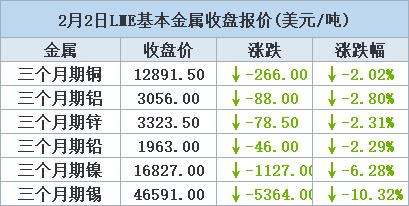
Group 1: Copper Market Overview - LME three-month copper prices continued to decline, reaching a three-week low, as speculators exited the market after prices surged to record highs the previous week. However, positive economic data from China limited the extent of the decline [1][6] - On February 2, LME three-month copper closed down by $266.00, or 2.02%, at $12,891.50 per ton [2] - Despite the recent price drop, LME copper prices have increased by 33% over the past six months, with concerns about potential supply shortages due to mine shutdowns [3] Group 2: Speculative Activity and Price Dynamics - Speculators withdrew from the market after a rapid price increase, with WisdomTree's commodity strategist expressing a positive long-term outlook for copper prices but acknowledging the need for a healthy market correction [3] - Analysts warned that the sharp rise in copper prices was not supported by fundamental supply and demand factors, with Macquarie's analyst suggesting that prices should fall below $11,000 per ton to reflect fundamentals [4] Group 3: Other Metals Performance - Other base metals also experienced declines, with three-month nickel prices dropping by 6.28% to $16,827 per ton and three-month tin prices plummeting by 10.32% to $46,591 per ton [7][8] - Three-month aluminum and lead prices fell by 2.8% and 2.29%, respectively, with aluminum closing at $3,056.00 per ton and lead at $1,963.00 per ton [2][9] Group 4: Chinese Economic Impact - Positive manufacturing data from China in January helped stabilize market sentiment, with increased export orders and production growth noted [6] - However, as the Chinese New Year approaches, industrial consumers are hesitant to purchase high-priced copper, indicating a weakening demand outlook [7]
2026:一定重视“4个再均衡”
Hua Er Jie Jian Wen· 2026-02-03 00:27
Core Viewpoint - The transition towards "new and old coexisting" for institutional investors is occurring, indicating a shift from "new surpassing old" in 2025 to a balanced allocation in 2026, emphasizing the need to invest in both AI technology and cyclical sectors like manufacturing and commodities [1][3]. Group 1: Technology Sector Rebalancing - The essence of the "new" is the downward movement of AI technology, transitioning towards the fourth stage of supply-demand gaps, with upstream gaps in copper, storage, and power equipment, and downstream gaps in AI applications and components [1][3]. - The internal rebalancing within technology indicates a need to avoid simplistic trading strategies based on risk preferences [3]. Group 2: Export and Overseas Business Rebalancing - The "old" aspect reflects a shift in exports and overseas business towards the midstream, with traditional industries stabilizing and growing profits as they move from downstream manufacturing to midstream sectors like engineering machinery, wind power, chemicals, and industrial metals [1][3]. - The rebalancing in overseas business highlights the increasing profitability and growth potential of midstream manufacturing compared to downstream exports [3][24]. Group 3: Resource Pricing Rebalancing - In 2026, resource pricing may not align with the assumption of a consistently weak dollar, suggesting a potential for a stronger dollar, emphasizing the return to commodity attributes and a decline in financial attributes [1][4]. - The focus on resource pricing indicates that commodities driven by supply-demand fundamentals are more likely to see price increases, making them attractive for continued investment [4][24]. Group 4: Institutional Investor Trends - Observations from Q4 2025 indicate a clear consensus among institutional investors on AI technology, overseas equipment, and globally priced resources as key investment areas, with these sectors showing significant gains in the A-share market [2][5]. - The increase in FOF products and the rise of passive funds reflect a strong demand for stable, income-generating investment products, while active funds are experiencing a decline [5][41]. Group 5: Sector-Specific Insights - In Q4 2025, institutional investors increased their holdings in sectors such as non-ferrous metals, communication, basic chemicals, non-bank financials, and machinery, while reducing exposure in pharmaceuticals, computing, electronics, media, and renewable energy [5][6]. - The allocation towards AI technology is showing divergence, with a decrease in holdings for sectors with weaker earnings visibility, while sectors with strong earnings, like CPO, are seeing increased investment [6][10].
中金:调整即序章
中金点睛· 2026-02-02 23:55
Core Viewpoint - The A-share market is experiencing a phase of adjustment after a rapid rise, with potential for a slow bull market supported by favorable factors. The current market favors growth styles, with emerging opportunities in low-priced stocks [2]. Group 1: Energy and Basic Materials - Coal prices are in a state of fluctuation, with January prices for thermal coal, coking coal, and coke rising by 2%, 4%, and 2% respectively. The coal industry maintains stable profitability and cash flow, with a current dividend yield of 5.3% [9]. - Oil prices have shown a 14% increase month-on-month in January, but a year-on-year decrease of 11%. Geopolitical risks are rising, impacting oil supply and prices [10]. - The prices of non-ferrous metals have seen significant increases, with lithium carbonate prices rising by 35% in January. The demand is supported by AI applications and the proliferation of new energy [11]. Group 2: Industrial Products - The AI industry chain remains highly prosperous, with strong domestic demand for engineering machinery and a projected 18% increase in domestic excavator sales by 2025. The photovoltaic industry is also seeing price recoveries [3]. - The automotive sector is facing a projected 6% decline in sales by November 2025, with a focus on opportunities related to overseas markets and smart driving [3]. Group 3: Consumer Products - Traditional consumer sectors are experiencing a decline, with sales of washing machines, refrigerators, and air conditioners dropping by 27%, 37%, and 36% year-on-year in December 2025. The effectiveness of consumption support policies is under observation [4]. - The average purchase price of live pigs remains stable at 14 yuan/kg, with a total pig stock of 429.67 million heads by the end of 2025, indicating a relatively abundant supply [4]. Group 4: Technology - The domestic AI application landscape is seeing significant developments, with multiple domestic large models being released. The semiconductor industry remains robust, with global sales increasing by 30% year-on-year in November [5]. - The gaming industry is recovering, with 1,771 game licenses issued in 2025, indicating a positive trend [5]. Group 5: Financials - The stock market sentiment has improved significantly, with insurance premium income rising by 7% year-on-year in December 2025. The average daily trading volume of A-shares exceeded 30 trillion yuan in January [5].