有色金属

Search documents
2月首个交易日A股调整 机构称春季行情仍值得期待!
Xin Lang Cai Jing· 2026-02-02 23:46
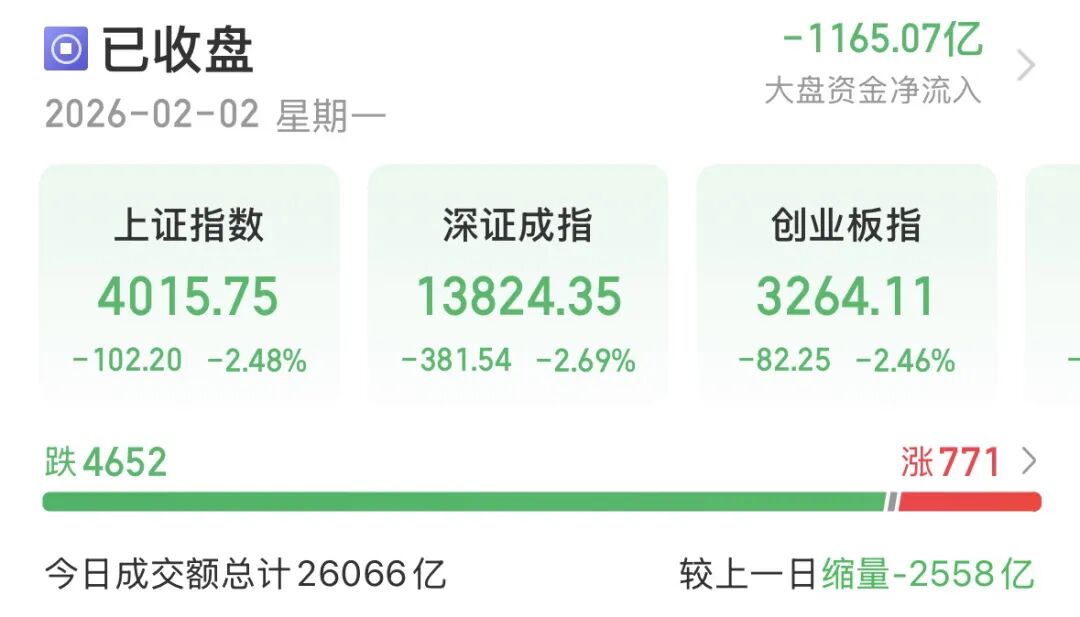
分析人士认为,节前风险偏好抬升的制约因素偏多,但本轮春季行情启动的核心驱动因素并未发生根本 性变化,春节后胜率提升,若市场调整或将成为新的布局窗口。短期市场大概率维持震荡,节后春季行 情有望延续。 A股市场调整 截至2月2日收盘,上证指数、深证成指、创业板指、科创综指、北证50指数分别下跌2.48%、2.69%、 2.46%、3.95%、2.03%。 大小盘股均出现调整,大盘股集中的上证50指数、沪深300指数分别下跌2.07%、2.13%,小微盘股集中 的中证1000指数、中证2000指数、万得微盘股指数分别下跌3.39%、2.41%、1.51%。 个股方面,个股多数下跌,整个A股市场上涨股票数为771只,44只股票涨停,4652只股票下跌,123只 股票跌停。 从盘面上看,特高压、白酒、培育钻石、智能电网等板块表现活跃,黄金珠宝、存储器、工业金属、磷 化工等板块领跌。申万一级行业中,仅有食品饮料、银行行业上涨,分别上涨1.11%、0.17%;其他行 业均下跌,有色金属、钢铁、基础化工行业跌幅居前,分别下跌7.62%、5.93%、5.69%,煤炭、石油石 化行业也均跌逾5%。 有色金属板块中,西部材料涨逾6 ...


暴跌了,然后呢?
对冲研投· 2026-02-02 23:33
Core Viewpoint - The recent sharp decline in commodity prices is primarily driven by emotional panic rather than a collapse in the fundamental supply and demand dynamics of the commodities themselves [2][6]. Group 1: Causes of the Decline - The core reason for the market crash is the collapse of sentiment in precious metals, which led to a sell-off across various sectors, including non-ferrous metals like copper and aluminum [2][3]. - Two key news events acted as "triggers" for the market panic: the nomination of Kevin Warsh as the next Federal Reserve Chairman, raising concerns about the end of the "cheap money era," and the easing of geopolitical tensions between the U.S. and Iran, which reduced the "geopolitical risk premium" in oil prices [3][4]. - The market was already saturated with speculative positions and high leverage, which exacerbated the sell-off when negative news emerged, leading to forced liquidations and a vicious cycle of price declines [5][6]. Group 2: Sector Analysis - **Non-Ferrous Metals**: Despite the sharp declines, the fundamental support for copper and aluminum remains intact. Issues such as declining ore grades and limited new supply for copper persist, while demand from sectors like home appliances and electric vehicles is expected to rise [8][10]. - **Energy and Chemicals**: The oil and chemical sectors experienced significant declines due to the removal of geopolitical risk premiums and concerns over weak global oil demand. However, coal and salt chemicals showed resilience as their costs are more tied to domestic coal prices [11][12]. - **Black Metals**: The black metal sector is facing pressure from both weak seasonal demand and the negative sentiment from precious metals. However, the rate of inventory accumulation is not alarming, providing some buffer against drastic price drops [13]. - **Agricultural Products**: Agricultural commodities are less affected by the recent market turmoil, as their prices are primarily driven by domestic supply and demand factors, making them more resilient to macroeconomic fluctuations [14]. Group 3: Investment Strategy - Investors are advised to distinguish between emotional market reactions and the intrinsic value of commodities. The current market turmoil is seen as a temporary emotional response rather than a fundamental shift in value [15][20]. - The recommended strategy is to adopt a wait-and-see approach, avoiding aggressive positions until market volatility decreases and signs of stabilization appear [16][19]. - Preparation for future opportunities is essential, including reassessing the supply-demand dynamics of favored commodities and planning entry strategies [17][18].

2月首个交易日A股调整 机构称春季行情仍值得期待
Zhong Guo Zheng Quan Bao· 2026-02-02 20:45
大小盘股均出现调整,大盘股集中的上证50指数、沪深300指数分别下跌2.07%、2.13%,小微盘股集中 的中证1000指数、中证2000指数、万得微盘股指数分别下跌3.39%、2.41%、1.51%。 个股方面,个股多数下跌,整个A股市场上涨股票数为771只,44只股票涨停,4652只股票下跌,123只 股票跌停。 从盘面上看,特高压、白酒、培育钻石、智能电网等板块表现活跃,黄金珠宝、存储器、工业金属、磷 化工等板块领跌。申万一级行业中,仅有食品饮料、银行行业上涨,分别上涨1.11%、0.17%;其他行 业均下跌,有色金属、钢铁、基础化工行业跌幅居前,分别下跌7.62%、5.93%、5.69%,煤炭、石油石 化行业也均跌逾5%。 有色金属板块中,西部材料涨逾6%,永杰新材涨逾5%,翔鹭钨业、宁波富邦均涨逾3%,晓程科技跌逾 18%,铜陵有色、锌业股份、白银有色、恒邦股份等多股跌停,其中铜陵有色、锌业股份、白银有色等 多只股票跌停板上均有大额封单。消息面上,现货黄金、现货白银价格大跌。 对于A股市场调整的原因,安爵资产董事长刘岩表示,2月2日A股整体走低是外部市场冲击、内部收益 兑现和节前资金避险三重逻辑的共 ...
沪市首份2025年年报披露 沪市公司业绩预增态势喜人
Shang Hai Zheng Quan Bao· 2026-02-02 18:45
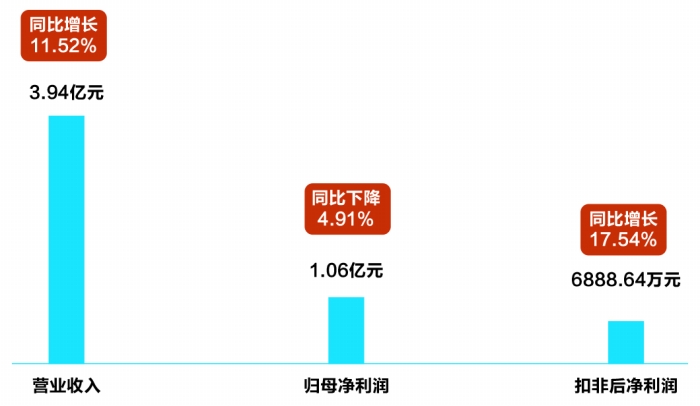
Core Viewpoint - Chip导科技's 2025 annual report reveals a mixed performance with revenue growth but a decline in net profit, while the company plans to expand into automotive electronics through strategic acquisitions [2][5]. Financial Performance - In 2025, Chip导科技 achieved revenue of 394 million yuan, an increase of 11.52% year-on-year [2]. - The net profit attributable to shareholders was 106 million yuan, a decrease of 4.91% compared to the previous year [2]. - The net profit after deducting non-recurring items was 68.89 million yuan, reflecting a growth of 17.54% year-on-year [2]. - The company plans to distribute a cash dividend of 4.30 yuan per 10 shares, totaling 50.57 million yuan, which accounts for 47.64% of the net profit [2]. Business Growth - Chip导科技's power semiconductor sales increased by 25.74% in 2025, driven by robust demand in the consumer electronics sector [3]. - The global semiconductor market is expected to continue its positive trend, with a projected revenue growth of 22.5% in 2025, reaching 772 billion dollars [3]. Research and Development - In 2025, Chip导科技 launched over 150 new power device products and holds a total of 141 valid intellectual property rights [4]. - The company emphasizes its commitment to technological innovation and value creation for customers [4]. Strategic Expansion - Chip导科技 plans to acquire 100% of Jishun Technology and 17.15% of Shunlei Technology, moving towards a Fab-lite model that includes design, packaging, and manufacturing [5]. - The total transaction value for these acquisitions is 403 million yuan, with performance commitments from Shunlei Technology for net profits in the coming years [5]. Industry Outlook - The overall performance of listed companies in the Shanghai market is showing a stable growth trend, particularly in the electronics, basic chemicals, and biopharmaceutical sectors [6]. - Companies like Lanke Technology and Dingtong Technology are also reporting significant profit increases, driven by trends in AI and communication technology [6].
A股收评:盘后,大家愤怒了!大跌102点!周二会迎来救赎了
Sou Hu Cai Jing· 2026-02-02 16:31
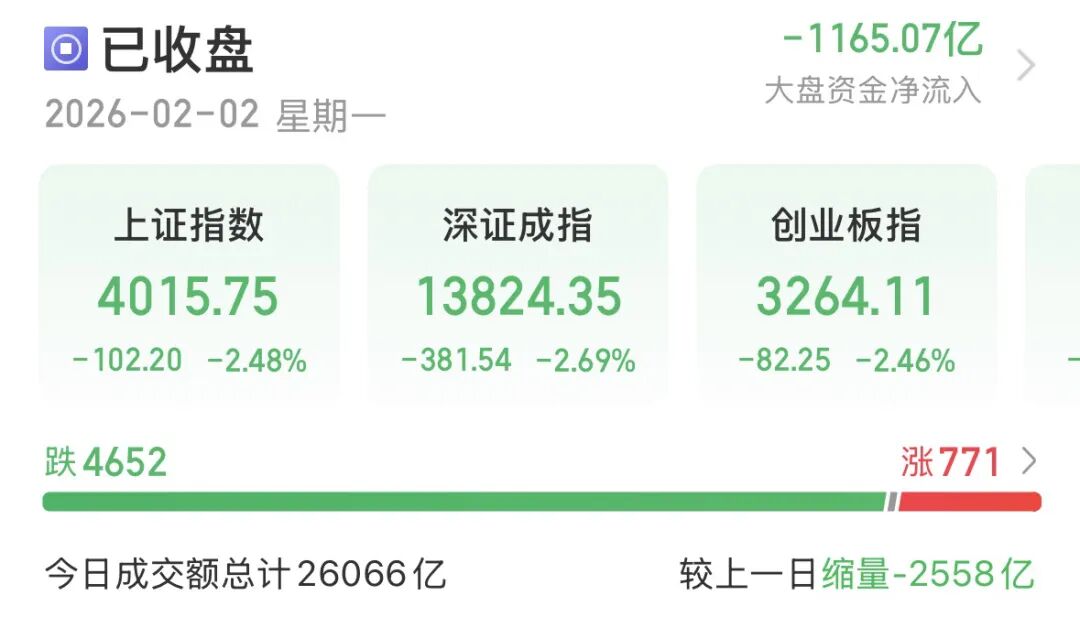
这场暴跌的导火索直指贵金属市场的史诗级崩盘。周末,伦敦金银价格突发闪崩,黄金单日跌幅超12%,白银暴跌35%,国内沪银期货主力合约直接封死跌 停板。A股贵金属板块应声崩溃,晓程科技、招金黄金等十余只个股竞价跌停,板块整体跌幅超过8%。此前支撑市场人气的黄金有色板块瞬间瓦解,成为 拖累指数的"元凶"。 暴跌背后,是多重利空因素的共振。美联储主席提名事件成为关键转折点——特朗普提名鹰派人物凯文·沃什执掌美联储,市场预期其可能推行"缩表 降 息"组合拳,导致美元指数快速走强,全球流动性收紧担忧升温。与此同时,上海黄金交易所紧急上调白银合约保证金比例至26%,杠杆资金被迫平仓,引 发连锁踩踏。 春节前的资金避险行为进一步放大了市场波动。随着长假临近,投资者"持币过节"意愿强烈,内资单日流出超700亿元,两市成交额缩量至2.6万亿元以下。 缺乏增量资金支撑的市场犹如"无水之舟",稍有抛压便快速下沉。 板块分化在此次大跌中展现得淋漓尽致。贵金属、油气、有色金属等资源板块成为重灾区,白银有色、中曼石油等个股跌停;而防御性板块则逆势崛起,白 酒股集体飘红,金徽酒、皇台酒业涨停,电网设备概念股三变科技、保变电气等超10只个股涨 ...
4652只个股收绿 原因找到了!
Guo Ji Jin Rong Bao· 2026-02-02 15:29
2月2日,A股遭遇重挫,午后跌幅进一步扩大,沪指、创业板指均跌逾2%。市场呈现普跌格局,4652只个股收跌,有色、煤炭、石油、化工等资源类板 块成为下跌"重灾区",科技板块亦集体走弱,仅白酒、银行等少数板块逆势护盘。 今日盘面板块大面积下挫,仅白酒饮料、输变电设备、特高压、银行等少数板块逆市护盘。相比之下,小金属概念、稀缺资源、黄金概念、化工原料、汽 车芯片、钢铁等板块跌幅居前。 | 东财概念指数 | | | | | 东财行业指数 | | | A股市场核心指数 | | | | | --- | --- | --- | --- | --- | --- | --- | --- | --- | --- | --- | --- | | 跨境支付 0.41% | | 超级品牌 0.55% | | | | | | 国证1000 -2.72% | | 沪深300 -2.13% | | | | | | | 银行 0.57% | | | 饮料 1.67% | | | | | | 小金属概念 | 白酒 | 智能电网 | | | | | | 中证A100 -2.68% | 深证成指 | FIFFSO -2.07% | | | -7. ...




金银大跌,资源品板块等待降波后低吸机会
Sou Hu Cai Jing· 2026-02-02 15:23
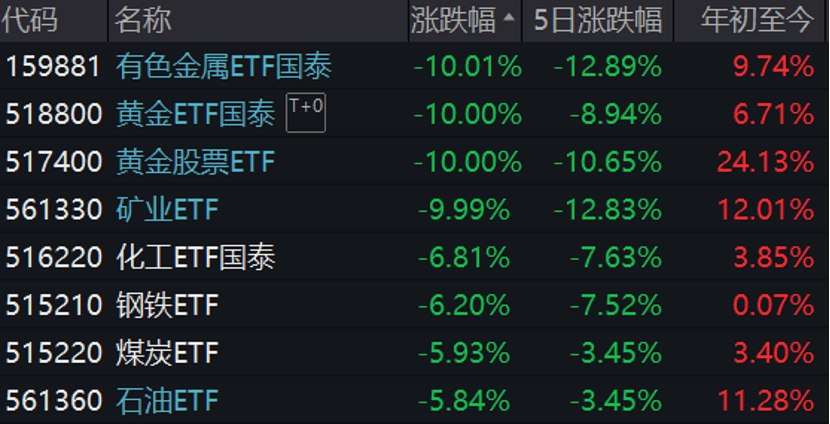
Group 1: Market Performance - The performance of various ETFs shows significant declines, with the Nonferrous Metals ETF down by 10.01% over five days and 12.89% year-to-date, while the Gold ETF is down by 10.00% over five days and 8.94% year-to-date [1] - Gold and silver prices experienced a sharp drop, with gold spot prices falling to nearly $4,400 per ounce and silver approaching $71 per ounce, marking a historic decline of 9.25% on January 31 [1] Group 2: Market Dynamics - The Chicago Mercantile Exchange raised margin requirements for metal futures, increasing gold margin from 6% to 8% and silver from 11% to 15%, which significantly impacts market liquidity and may force speculative investors to liquidate positions [4] - The recent surge in gold prices above $5,500 per ounce and silver above $120 per ounce was driven by a combination of factors, including geopolitical tensions and a shift in investor confidence towards precious metals [4] Group 3: Investment Outlook - The long-term outlook for gold remains strong, supported by monetary easing, its safe-haven status, and the trend of de-dollarization globally, despite short-term volatility [9][10] - Central banks worldwide, including China, continue to increase their gold reserves, indicating sustained demand for gold as a strategic asset [10][13] - The potential for a super cycle in commodities is anticipated, driven by economic recovery and expansionary fiscal policies, particularly in the context of the upcoming U.S. midterm elections [18]
数说公募主动权益基金四季报:规模、份额双降、周期、金融配置权重上升
SINOLINK SECURITIES· 2026-02-02 14:03
1. Report's Investment Rating for the Industry - The provided content does not include the industry investment rating [1] 2. Core Views of the Report - In Q4 2025, after nearly a year of upward trend, the A - share market started to move sideways and fluctuate. The broad - based indexes showed mixed performance. Large - and mid - cap value indexes outperformed growth indexes significantly. Active equity funds' scale and share decreased, while the issuance quantity and scale increased slightly [3]. - The average stock position of equity funds slightly shrank, and the Hong Kong stock position also declined. Funds increased their allocation in cyclical and financial sectors and made structural adjustments in technology, medicine, and consumption sectors [3]. - The performance of theme funds in different industries was divergent. Cyclical theme funds performed the best, while pharmaceutical theme funds performed the worst [3]. - In Q4, the FOF's most heavily - held active equity fund was "Fullgoal Steady Growth", and among new - generation fund managers with less than 3 years of experience, "Rongtong Industry Trend Selection" had the highest holding ratio [3] 3. Summary of Each Section 3.1 Fund Market Overview 3.1.1 Performance Review - In Q4 2025, the A - share market moved sideways and fluctuated after a year - long upward trend. Only the Shanghai Composite Index rose by 2.22%, while the Shenzhen Component Index and CSI 300 declined by 0.01% and 0.23% respectively. The ChiNext Index and STAR 50 Index dropped by 1.08% and 10.10% respectively. The Hang Seng Index and related Hong Kong indexes also fell [8]. - In terms of style, large - and mid - cap value indexes outperformed growth indexes significantly, with the large - cap value index leading. The cyclical and financial indexes had leading quarterly gains, while the stable, consumption, and growth indexes lagged [8] 3.1.2 Industry Index Performance - Except for 9 industries such as medicine and beauty care, the indexes of other industries in the Shenwan 31 industries achieved positive returns in Q4. Resources and military industries performed well, while the pharmaceutical industry was weak overall. The top 5 industries in terms of growth were non - ferrous metals (16.25%), petroleum and petrochemicals (15.31%), communications (13.61%), national defense and military industry (13.1%), and light manufacturing (7.53%) [11] 3.1.3 Equity Fund Performance - In Q4 2025, ordinary stock funds, partial - stock hybrid funds, and flexible allocation funds declined by 1.94%, 1.60%, and 0.04% respectively, while balanced hybrid funds rose by 0.87%. In terms of risk, balanced hybrid funds with lower stock positions had the best drawdown performance in Q4, and ordinary stock funds had the largest drawdown. In the long - term of 5 years, flexible allocation funds showed better risk - return performance [32] 3.1.4 Scale and Share - As of the end of Q4 2025, the total scale of active equity funds was 3.81 trillion yuan, a quarter - on - quarter decrease of 4.53 pct, and the total share was 2.56 trillion shares, a quarter - on - quarter decrease of 2.91 pct. Among them, partial - stock hybrid funds had the largest scale and share, while balanced hybrid funds had the smallest [35] 3.1.5 New Fund Issuance - In Q4, the issuance quantity and scale of active equity funds increased slightly. A total of 100 new funds were issued, with a total scale of 441.67 billion yuan, an increase of 4.72 billion yuan compared with the previous quarter. Partial - stock hybrid funds had the largest new issuance scale in this quarter [37] 3.2 Fund Positioning Characteristics 3.2.1 Stock/Hong Kong Stock Positions - In Q4 2025, the equity fund positions slightly shrank, with the average stock position at 88.05%, a decrease of 0.88 percentage points compared with the end of the previous quarter. The Hong Kong stock position also decreased, with the average investment market value of Hong Kong stocks accounting for 11.62% of the net value, a decrease of 1.85 percentage points compared with the previous quarter [44] 3.2.2 Heavy - Positioned Stock Sector Allocation - In Q4, technology was the most heavily - positioned sector of active equity funds. Except for the cyclical, manufacturing, and financial sectors, the proportion of other sectors decreased. The funds increased their allocation in cyclical products, mainly due to the marginal improvement of macro - expectations, the re - pricing of pro - cyclical profit elasticity, and the increased requirements for portfolio certainty and volatility control [47] 3.2.3 Heavy - Positioned Stock Industry Allocation - The electronics industry remained the largest heavy - positioned industry of equity funds, but the allocation ratio decreased. Non - ferrous metals were significantly increased. The concentration of the top 5 industries slightly decreased from 58.58% in Q3 to 58.40% [50] 3.2.4 Top Ten Heavy - Positioned Stocks - In terms of market value proportion, the top 10 heavy - positioned stocks of equity funds were Zhongji Innolight, Xinyisheng, CATL, Tencent Holdings, Zijin Mining, Alibaba - W, Cambricon - U, Luxshare Precision, SMIC, and Kweichow Moutai. In Q4, the market value proportion of Zhongji Innolight, Xinyisheng, and Ping An of China increased significantly, while that of Foxconn Industrial Internet, Alibaba - W, and EVE Energy decreased relatively more [52] 3.2.5 Heavy - Positioned Stock Market Value and Concentration - In terms of market value distribution of heavy - positioned stocks, the style of equity fund positions continued to strengthen towards mid - and large - cap stocks. In terms of concentration, the concentration of the top 50, 100, and 200 stocks slightly decreased, but basically continued the previous trend [61] 3.3 Fund Company Analysis 3.3.1 Scale of Top 20 Fund Companies - In Q4 2025, the equity fund scale of the top 20 fund companies compared with Q3 showed mixed changes. The top 5 institutions were E Fund Management, China Europe Asset Management, GF Fund Management, Fullgoal Fund Management, and Huatai - PineBridge Fund Management. Among the companies ranked 6 - 20, the equity scale of Yongying Fund Management further increased, and its ranking rose by 2 places [64] 3.3.2 Heavy - Positioned Industries of Top 20 Fund Companies - According to the heavy - positioned stocks of active equity funds in Q4, the first - largest heavy - positioned industries of the top 20 fund companies were mainly electronics and medicine and biology. Dacheng Fund's first - largest heavy - positioned industry was non - ferrous metals, showing certain differentiation [65] 3.3.3 Heavy - Positioned Stocks of Top 20 Fund Companies - In Q4, the average concentration of the top 3 heavy - positioned stocks of the top 20 fund companies was 14.27%, and the concentration of the top 5 heavy - positioned stocks was 21.04%, showing a slight increase compared with the previous quarter. Xingquan Fund had the highest concentration of the top 3 heavy - positioned stocks at 28.51% [67] 3.4 Theme Fund Analysis 3.4.1 Fund Performance - In Q4, the performance of theme funds in different industries was divergent. Cyclical theme funds performed the best, with a quarterly increase of 10.10%. Financial and manufacturing theme funds followed, with quarterly average returns of 2.93% and 1.46% respectively. Pharmaceutical theme funds had the worst performance, with a quarterly decline of 13.15%. Hong Kong - stock and consumption theme funds also had negative average returns [71] 3.4.2 Pharmaceutical and Consumption Theme Funds - In pharmaceutical theme funds, the sub - sectors with relatively high market value proportions were chemical preparations and other biological products. The sub - sectors with increased heavy - position proportions were medical R & D outsourcing and traditional Chinese medicine. In consumption theme funds, the sub - sectors with relatively high market value proportions were liquor and agriculture, forestry, animal husbandry, and fishery. The sub - sectors with increased heavy - position proportions were food processing and social services [75] 3.4.3 Technology and New Energy Theme Funds - In technology theme funds, the sub - sectors with relatively high market value proportions were artificial intelligence and consumer electronics. The sub - sectors with increased heavy - position proportions were optical modules and IDC. In new - energy theme funds, the sub - sectors with relatively high market value proportions were energy storage and solid - state batteries. The sub - sectors with increased heavy - position proportions were resource stocks and solid - state batteries [79] 3.5 FOF Positioning Analysis 3.5.1 Funds with High Holding Ratios - In Q4 2025, the active equity fund with the highest holding ratio in FOF's heavy - positioned funds was "Fullgoal Steady Growth", with a holding market value accounting for 2.53% of the total heavy - positioned funds, an increase of 0.13% compared with the previous quarter. "Bodaojiu Hang" and "China Europe Dividend Premium" ranked second and third [81] 3.5.2 Funds with High Holding Quantities - In Q4 2025, the active equity fund with the largest number of heavy - positioned holdings in FOF was still "Fullgoal Steady Growth", followed by "Bodaojiu Hang" and "China Europe Dividend Premium". The number of FOFs holding these two funds increased by 1 and 7 respectively compared with the previous quarter [83] 3.5.3 Changes in Holding Ratio/Quantity - In Q4 2025, the active equity funds with the largest increase in holding ratio and quantity in FOF's heavy - positioned funds were "Huatai - PineBridge Extended Growth Theme" and "China Europe Dividend Premium" respectively [85] 3.5.4 New - Generation Fund Managers (Less Than 3 Years) - Among the active equity funds managed by new - generation fund managers with less than 3 years of experience, the fund with the highest holding ratio in FOF's heavy - positioned funds in Q4 was "Rongtong Industry Trend Selection", with a holding ratio of 0.70%, a quarter - on - quarter increase of 0.37% [87] 3.5.5 Self - Holding Fund Situations of Major Fund Companies - E Fund's FOF heavily held its own equity funds worth 21.81 billion yuan, accounting for 84.51% of all heavy - positioned equity funds. China Europe's FOF held its own equity funds worth 8.63 billion yuan, accounting for 94.49%. Fullgoal's FOF held its own equity funds worth 3.83 billion yuan, accounting for 51.82%. Huatai - PineBridge's FOF held its own equity funds worth 7.70 billion yuan, accounting for 70.11%. Xingzheng Global's FOF held its own equity funds worth 10.16 billion yuan, accounting for 61.48% [89][92][95][97][99]



锡业股份:截至1月30日收市股东人数104028户
Zheng Quan Ri Bao· 2026-02-02 13:45
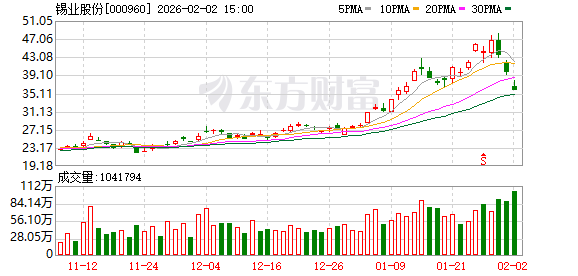
Group 1 - The core point of the article is that as of January 30, 2026, the registered number of shareholders for Xiyang Co., Ltd. is 104,028 households [2]

4652只个股收绿,原因找到了!
Guo Ji Jin Rong Bao· 2026-02-02 13:26
Market Overview - A-shares experienced a significant decline on February 2, with the Shanghai Composite Index and ChiNext Index both dropping over 2% [2][4] - The market showed a broad-based decline, with 4,652 stocks closing lower, particularly in resource sectors such as metals, coal, oil, and chemicals [4][9] - The trading volume decreased significantly, with daily turnover dropping by 255.8 billion to 2.61 trillion [5] Sector Performance - Resource stocks were heavily impacted, with declines exceeding 5% in sectors like non-ferrous metals, steel, basic chemicals, coal, and oil [8][9] - The food and beverage sector, particularly liquor stocks, showed resilience, with several companies like Jinhuijiu and Youyou Food hitting the daily limit [6][7] - Banking stocks also performed relatively well, with several banks showing slight gains despite the overall market downturn [8] Market Sentiment and Factors - The decline was attributed to a combination of external market disturbances, profit-taking, and heightened risk aversion ahead of the holiday [3][11] - Analysts suggest that the market may need 3 to 5 trading days to stabilize, with a focus on whether the Shanghai Composite can hold above the 4,000-point mark [3][15] - The current market environment is characterized as a healthy technical correction rather than a trend reversal, with no signs of panic selling or liquidity crisis [12][14] Investment Strategy - Investors are advised to avoid high-volatility sectors in the short term and to wait for clear signs of market stabilization before gradually increasing positions in quality sectors [3][16] - There is a recommendation to focus on defensive sectors such as electric grid equipment and high-dividend blue chips, while avoiding emotional selling [15][17] - The market is expected to recover quickly post-holiday, supported by liquidity replenishment and policy expectations from the upcoming Two Sessions [15][17]