电子

Search documents
新贵扩军!A股百元股突破200只 呈现明显“科技味” 电子行业上榜量第一
Shen Zhen Shang Bao· 2026-01-08 18:08
1月8日A股收盘,寒武纪收报1444.00元/股,排名第一;贵州茅台、源杰科技位居二、三名,收盘价分 别为1412.30元/股、715.00元/股。 从市场表现来看,去年1月8日至今年1月8日,A股207只百元股中,仅11只个股逆市下跌;百元股平均 涨幅达182%,远高于全部A股平均涨幅56%。 新年伊始,沪指重回4000点创10年来新高,A股百元股数量大幅扩容。据记者统计,截至1月8日收盘, A股百元股数量达207只,较去年同期增加137只,同比增长196%。 从行业分布来看,A股207只百元股中,以申万一级行业分类,较为集中的行业有电子、计算机、机械 设备、电力设备、汽车、医药生物、食品饮料等,其中,电子行业有76只股票上榜,位居第一名,占比 36.72%;计算机、机械设备行业均有22只股票上榜,并列第二名;电力设备行业有17只股票上榜,位 居第三名。 百元股呈现明显"科技味" 记者统计发现,百元股的分布呈现出明显的"科技味"。科创板、创业板、北交所的百元股数量达165 只,占比近八成,达79.71%。沪市主板、深市主板分别有27只、14只。以科创板为例,在90只科创板 百元股中,寒武纪以1444.00元 ...
中证指数月度报告(2025年12月)
Shang Hai Zheng Quan Bao· 2026-01-08 16:49
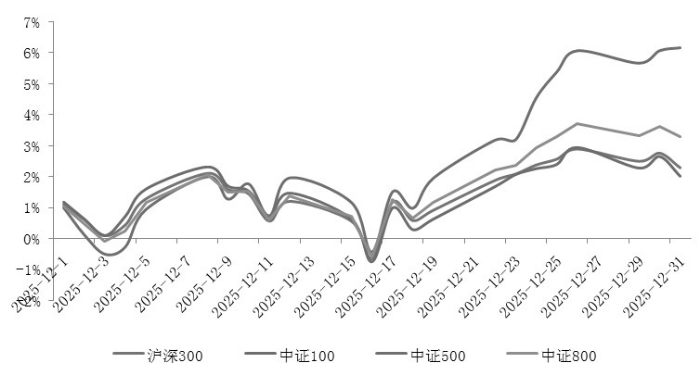
主要指数月度走势 主要指数占对应市场市值比例 主要股票指数月度表现 交易日数:23 开盘 最高 最低 收盘 涨跌点数 涨跌幅 日均成交量 日均成交金额 (百万股) (亿元) 沪深300十大权重 中证分类债券指数月度走势 沪深300行业指数月度表现 上证综指行业月度表现 □ 中证指数有限公司、上海证券报联合推出 沪深300 4539.19 4676.13 4484.27 4629.94 103.28 2.28% 17257 4265 中证100 4412.38 4548.77 4348.85 4486.47 89.11 2.03% 7422 2282 中证800 4959.71 5149.57 4898.79 5109.17 163.69 3.31% 34735 7428 中证200 5464.14 5685.39 5391.27 5649.80 211.61 3.89% 9717 2152 中证500 7053.85 7495.06 6958.63 7465.57 434.02 6.17% 17478 3163 中证700 6185.98 6504.17 6104.73 6473.08 311.50 5.06 ...

A股增量资金空间测算-居民存款与机构资金潜力展望
2026-01-08 16:02
Summary of Key Points from the Conference Call Industry Overview - The focus is on the A-share market in China, particularly regarding the inflow of incremental funds and the impact of various financial instruments and investor behaviors on the stock market. Core Insights and Arguments - **Incremental Funds from Resident Deposits**: It is estimated that the scale of resident deposit migration will reach between 1 trillion to 4 trillion yuan by 2026, with an annual inflow of approximately 1 trillion yuan into the stock market. This migration is expected to enhance M2 growth, providing additional funds for the stock market [1][2] - **Insurance Funds as a Stable Investment Source**: Insurance funds are projected to contribute over 1 trillion yuan annually to the stock market. By Q3 2025, the equity asset allocation of life and property insurance companies has significantly increased, indicating a strong trend towards stock and fund holdings [1][5] - **Growth of Private and Public Funds and ETFs**: The rapid development of private equity, public funds, and ETFs is noted, with ETFs attracting many investors due to their flexibility and low costs. The annual growth potential in these areas is estimated to be between 1 trillion to 2 trillion yuan [1][6][12] - **IPO Contributions to Market Liquidity**: A-share IPOs are expected to inject several hundred billion yuan into the market annually, particularly benefiting hard manufacturing and hard technology companies during favorable market conditions [3][10] - **Impact of Resident Deposit Migration on Stock Market**: The migration of resident deposits is a crucial indicator, with significant increases in non-bank financial institution deposits suggesting that funds are gradually entering the stock market. The ratio of new resident deposits to GDP is expected to decline, indicating more funds will be available for investment [4][15] - **Long-term Role of Insurance Funds**: Insurance funds are seen as a key driver for medium to long-term capital entering the market. The allocation towards technology stocks has increased, with expectations of substantial funds waiting to enter the market in the coming years [5][8] - **Market Outlook and Slow Bull Trend**: The A-share market is anticipated to enter a slow bull phase, with long-term funds gradually allocating to equity assets. The market is expected to rely on technology and new consumption sectors in 2025, shifting focus to manufacturing in 2026 [1][7] - **Contributions from Active Funds and Private Equity**: Active funds in the secondary market contribute approximately 100 billion yuan, while private equity could bring in over 1 trillion yuan annually, especially considering stock price increases [11] - **Financing Balance and Market Expansion**: The financing balance is currently high but not at peak levels seen in 2015, indicating potential for upward movement. The annual incremental space for financing balance is estimated at around 100 billion yuan [13][14] Other Important Insights - **Investment Behavior Trends**: The gradual shift of long-term funds into equity assets is a notable trend not seen in the past two decades, with policy direction favoring a slow bull market rather than a rapid rise [7] - **Sector-Specific Investment Focus**: Future allocations by insurance funds are expected to diversify beyond financial stocks to include leading companies in sectors with favorable economic conditions [8][9]
上市公司动态 | 温氏股份2025年净利预降41%-46%;金力永磁2025年净利预增127%-161%;微盟集团公布与淘宝闪购合作
Sou Hu Cai Jing· 2026-01-08 15:21
Group 1: Company Performance - Wens Foodstuff Group (温氏股份) expects a net profit of 5.00 billion to 5.50 billion yuan for 2025, representing a year-on-year decline of 40.73% to 46.12% [1][2] - The net profit after deducting non-recurring gains and losses is projected to be 4.80 billion to 5.30 billion yuan, down 44.64% to 49.86% compared to the previous year [1][2] - The decline in performance is attributed to a significant drop in the sales price of live pigs, which averaged 13.71 yuan per kilogram, a decrease of 17.95% year-on-year, and a reduction in profits from the pig farming business [1][2] Group 2: IPO and Financing Activities - Gude Electric Materials (固德电材) has received approval for its IPO on the ChiNext board, aiming to raise 1.176 billion yuan for the production of new energy vehicle components and other projects [3] - Tongcheng New Materials (彤程新材) is planning to issue H-shares and apply for listing on the Hong Kong Stock Exchange, although details remain uncertain [4] - Huasheng Lithium Battery (华盛锂电) is also preparing to issue H-shares for listing in Hong Kong to enhance its international strategy and financing capabilities [5] - Quanxin Co., Ltd. (全信股份) plans to issue convertible bonds to raise no more than 312 million yuan for various projects and working capital [6] Group 3: Mergers and Acquisitions - Beifang Changlong (北方长龙) intends to acquire 51% of Shunyi Technology (顺义科技) through a cash transaction, which will make Shunyi a subsidiary of Beifang Changlong [8] Group 4: Regulatory Compliance - Yingjixin Technology (英集芯) received a regulatory warning from the Shanghai Stock Exchange for inaccurate and incomplete information disclosure regarding its IPA1299 chip product [9] - Yihuilong Biotechnology (亚辉龙) was also warned by the Shanghai Stock Exchange for inconsistent statements in its announcements and insufficient risk disclosures [10] Group 5: Company Announcements - Jinli Permanent Magnet (金力永磁) forecasts a net profit of 660 million to 760 million yuan for 2025, an increase of 127% to 161% year-on-year, driven by increased R&D investment and market expansion [11] - Yinqu Technology (盈趣科技) anticipates a net profit of 540 million to 660 million yuan for 2025, reflecting a growth of 114.69% to 162.40% year-on-year, supported by revenue growth and increased R&D efforts [13] - Yongxi Electronics (甬矽电子) expects a net profit of 75 million to 100 million yuan for 2025, representing a year-on-year increase of 13.08% to 50.77% due to growth in the semiconductor industry [15] - China Merchants Energy Shipping (招商轮船) projects a net profit of 6.0 billion to 6.6 billion yuan for 2025, an increase of 17% to 29% year-on-year, benefiting from market recovery and non-recurring gains [16]


国泰海通|电子:钛合金持续渗透,国内企业积极布局
国泰海通证券研究· 2026-01-08 14:11
Core Viewpoint - Titanium alloys are expected to continue penetrating various applications, driven by advancements in powder metallurgy and 3D printing technologies, which will further expand their usage [1][2][3]. Group 1: Titanium Alloy Applications - The first foldable screen product from Apple is anticipated to be released in 2026, which is expected to significantly increase the demand for titanium alloys due to their high strength, corrosion resistance, and favorable surface texture [3]. - Key applications of titanium alloys in foldable screens include: 1. Middle frame: Titanium alloy frames exhibit superior bending resistance compared to aluminum alloys while achieving lightweight, thus better protecting the screen and internal components [3]. 2. Screen backing: It supports the screen to ensure display quality and touch experience, guiding the screen to bend at specific angles during folding and unfolding, reducing creases. Using pure titanium backing can significantly lower the device's weight, balancing weight, performance, and processing costs [3]. 3. Other applications: Due to better toughness and corrosion resistance, titanium alloys are expected to be used in components like foldable screen axis covers [3]. - The development of 3D printed titanium alloys offers high design freedom, enabling the production of complex hollow or integrated structures that CNC cannot achieve, with gradual applications in aerospace, medical fields, and high-end consumer electronics [3]. Group 2: Domestic Enterprises and Market Demand - Domestic companies are deeply engaged in titanium alloy production and are expected to benefit from a surge in downstream demand [4]. - Powder metallurgy can also be utilized to prepare advanced fusion materials, with domestic enterprises actively overcoming critical bottlenecks. As global demand for sustainable energy grows, the commercialization of nuclear fusion continues to advance [4]. - The materials used in nuclear fusion reactors must withstand extreme conditions, including high-energy neutron irradiation, high temperatures, high heat flux, and strong magnetic fields, necessitating high-performance materials [4]. - Companies like Tiangong International are making significant progress in developing fusion materials through powder metallurgy, including advanced reduced activation ferritic-martensitic (RAFM) steel and high-boron steel for nuclear power, with core applications in shielding layers and vacuum chamber interlayers, which are expected to benefit from the upcoming demand for nuclear fusion [4].

泰晶科技:公司加大汽车电子、光通信等高增长领域的产品布局与产线投入
Zheng Quan Ri Bao Wang· 2026-01-08 14:09
Group 1 - The company, Taijing Technology (603738), is increasing its product layout and production line investment in high-growth areas such as automotive electronics, optical communication, data centers, and AI computing power [1] - The company claims to have the capability to meet market demand in these sectors [1]

大类资产配置月报:攻防兼备,择机布局-20260108
Guo Yuan Qi Huo· 2026-01-08 13:12
Report Industry Investment Rating No relevant content provided. Core Viewpoints of the Report - In 2026, the equity market is expected to start a new upward wave in Q1, with a long - position overweight strategy for the stock index. The bond market may continue its weak performance at the beginning of 2026 but could have a rebound after the Spring Festival, with a short - position hedge before the Spring Festival and a long - position underweight after. Commodities should be structurally allocated, with long - position overweight on precious metals, non - ferrous metals, and new energy commodities, long - position standard allocation (timing) on black building materials and agricultural products, and short - position standard allocation on crude oil [4]. Summary by Relevant Catalogs 1. Review of the Performance of Major Asset Classes - **Equity Market**: In December 2025, the A - share market oscillated upward, switching back to the growth - oriented style. Most primary industry indices rose, with national defense, communications, non - ferrous metals, non - bank finance, and machinery leading the monthly gains [8][10]. - **Bond Market**: The performance of short - and long - term bonds diverged. Short - term Treasury yields declined while long - term yields increased, and the Treasury term spread widened significantly. By December 31, 2025, the 2 - year and 5 - year Treasury yields dropped to 1.3605% and 1.3830% respectively, while the 10 - year and 30 - year yields rose to 1.8473% and 2.2674% [13]. - **Commodities**: The prices of domestic commodity futures were differentiated, with precious metals leading the gains. As of December 28, 2025, the precious metals index soared 14.38%, the metal index rose 6.18%, the industrial products index increased 1.44%, and the agricultural products index slightly declined 0.59% [17]. 2. Outlook and Analysis of Major Asset Classes - **Macroeconomic Aspect**: Abroad, the probability of further interest rate cuts by the Fed may decrease. Domestically, the probability of interest rate cuts in Q1 2026 is low, but a reserve requirement ratio cut is still expected [19][28]. - **Equity Assets**: In the short - to - medium term, the cross - year market has started, and the equity market is expected to start a new upward wave in Q1 2026. In the long - term, the policy and liquidity environment in 2026 are favorable to the market [31][32]. - **Bond Assets**: The bond market may continue its weak performance at the beginning of 2026, with the upper limit of the 10 - year Treasury yield before the Spring Festival likely between 1.90% - 1.95%. After the Spring Festival, there may be an oversold rebound opportunity [35][36]. - **Commodities**: The differentiation pattern of commodities will continue. Crude oil may remain weak after a short - term rebound. Industrial metals may face supply - demand imbalance, and agricultural product prices may fluctuate more due to various factors. Precious metals may experience significant short - term fluctuations but maintain an upward long - term trend [37][38]. 3. Allocation Strategies for Major Asset Classes - **Domestic Stock Index**: In 2026, the equity market should be strategically allocated, with a long - position overweight in January. Focus on industries such as the AI industry chain, leading companies going global, industries with improved supply - demand relationships, and the industrialization of cutting - edge technologies [40]. - **Commodities**: Increase the weight of commodities in the asset allocation. Overweight precious metals, non - ferrous metals, and new energy commodities; standard - allocate black building materials and agricultural products (timing); and short - allocate crude oil [41][42]. - **Treasury Bonds**: Hedge with short positions before the Spring Festival and underweight long positions after the Spring Festival. The bond market will remain volatile in 2026 and should be under - allocated [43].
多家公司刷新股权激励进展 从“一次性工具”向“常态化”跨越
Zheng Quan Ri Bao Wang· 2026-01-08 13:08
今年以来,多家上市公司"刷新"股权激励的相关进展,或是公告了行权结果,或是公告了回购股份用于 股权激励的进展。 1月5日,豪威集成电路(集团)股份有限公司发布公告,对股权激励计划自主行权结果等信息进行了说 明;1月5日,徐工集团工程机械股份有限公司发布公告,对回购股份用于股权激励或员工持股的进展给 予说明;1月6日,深圳市优优绿能(301590)股份有限公司发布公告,对向2025年股权激励计划激励对 象授予股票期权与限制性股票的相关信息进行说明;1月8日,瑞芯微(603893)电子股份有限公司发布 了关于股权激励计划2025年第四季度自主行权结果的相关公告。 激励热潮覆盖面不断扩展的背后,是上市公司将核心团队利益与公司长远发展深度绑定的举措。在政策 支持与市场需求的双重驱动下,正呈现出从一次性工具迈向常态化的新特征,成为企业激发内生动力、 提升核心竞争力的重要抓手。 深圳市前海排排网基金销售有限责任公司研究总监刘有华告诉《证券日报》记者,2025年的密集回购为 2026年股权激励提供了充足"弹药"。首先,回购让公司提前锁定低价股份,显著降低激励成本,提升计 划可执行性。其次,使用库存股进行激励可避免增发带来的 ...
市政府主要领导会见王巍、刘二飞、张鸿俊等企业家
Xin Lang Cai Jing· 2026-01-08 12:50
Group 1 - The Longcheng government is actively engaging with well-known entrepreneurs to promote industrial integration with capital and finance, aiming to enhance the industrial chain and ecosystem for urban development [1] - Experts at the mergers and acquisitions training session provided in-depth guidance on the entire acquisition process, advantageous industry path design, and operation of industrial funds, tailored to the actual development of Longcheng [1] - Entrepreneurs expressed their commitment to resource integration and exploring cooperation models to promote the development of the biopharmaceutical industry cluster in Longcheng [1] Group 2 - Entrepreneurs recognized the unique ice and snow resources in Longcheng and the vast market potential of the ice and snow industry [2] - Discussions focused on technological innovation in ice and snow equipment and collaboration across the industry chain, with a commitment to actively participate in the development of the ice and snow equipment industry in Longcheng [2]
2025年并购重组有何新动向?
Ge Long Hui· 2026-01-08 12:27
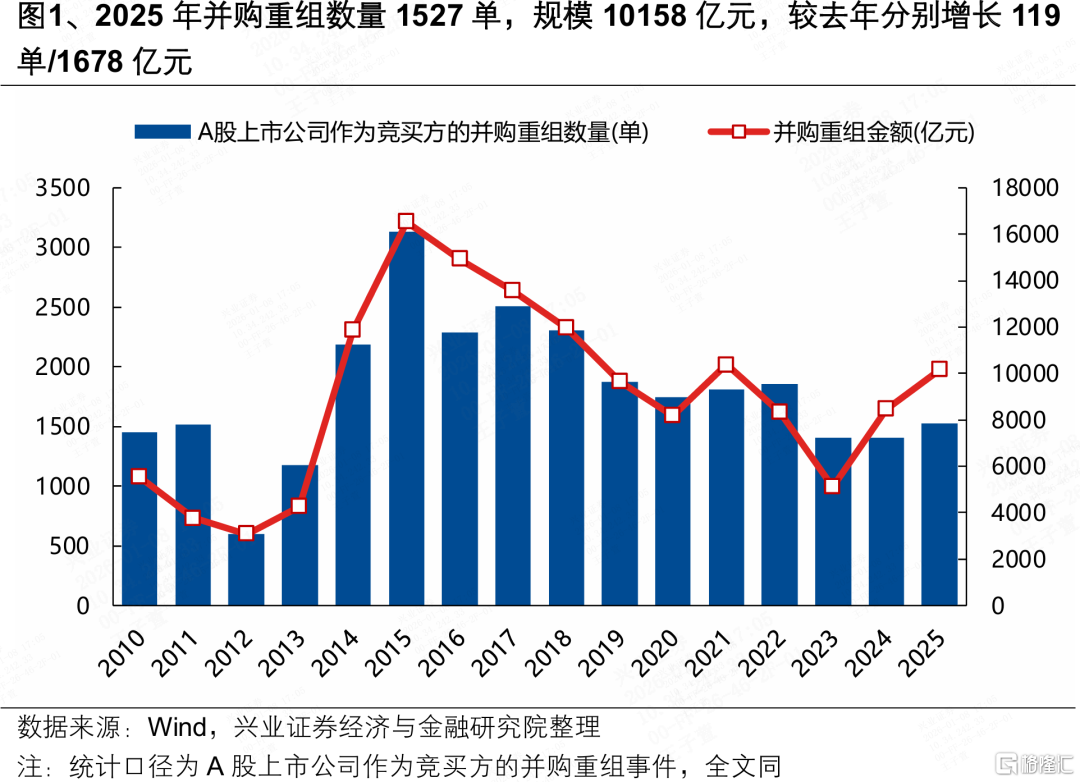
一、规模:创2022年以来新高,下半年进一步提速 政策支持叠加市场回暖下,2025年并购重组市场持续活跃,规模创2022年以来新高。并购重组作为高质量发展下推动资源整合的关键途径,以2024年9月 24日发布的"并购六条"为代表,政策支持推动并购重组市场持续活跃。2025年,随着资本市场持续回暖、企业转型加速,推动并购重组活跃度进一步提 升。2025年A股上市公司作为竞买方的并购重组案例共1527单,涉及规模达10158亿元,创2022年以来新高,较去年分别增长119单/1678亿元。 节奏上,2025年下半年企业并购重组进程加快。下半年,资本市场回暖步伐加快,为并购重组市场的进一步活跃奠定良好基础。2025年H1/H2并购重组数 量分别为665/862单,涉及规模分别达4174/5984亿元。 二、行业:新质生产力行业数量较多,传统行业贡献大规模并购 2025年,A股上市公司并购重组案例主要集中在新质生产力行业,部分传统行业贡献大规模并购案例。2025年,并购重组数量较多的行业主要包括化工、 电子、医药、机械设备、电力设备、汽车、计算机等,多为新质生产力行业,充分体现出在新质生产力驱动下,强链补链已成为并购 ...