服务

Search documents
Apogee(APOG) - 2026 Q1 - Earnings Call Transcript
2025-06-27 14:00
Financial Data and Key Metrics Changes - Net sales increased by 4.6% to $346.6 million, primarily driven by $22 million of inorganic sales from the acquisition of UW Solutions [10][11] - Adjusted EBITDA margin decreased to 9.9%, primarily due to a less favorable mix and higher aluminum costs [11] - Adjusted diluted EPS declined to $0.56, driven by lower adjusted EBITDA, higher interest expense, and a higher adjusted effective tax rate [11][12] Business Line Data and Key Metrics Changes - Metals segment net sales declined by 3.4%, with adjusted EBITDA margin decreasing to 7.3% due to a less favorable mix and higher aluminum costs [11][12] - Services segment achieved a 7.6% increase in net sales, marking its fifth consecutive quarter of growth, although adjusted EBITDA margin decreased to 5.7% due to higher tariff expenses [12] - Glass segment net sales declined, with adjusted EBITDA margin moderating due to reduced volume from lower end market demand [12] - Performance Surfaces segment saw net sales increase, driven by inorganic sales from UW Solutions, but adjusted EBITDA margin declined to 18.8% due to lower margins from UW Solutions [12] Market Data and Key Metrics Changes - The revenue pipeline for Glass is improving, positioning the segment for growth beginning in Q3 and Q4 [7][10] - Metals showed sequential improvement from Q4, with expectations for continued improvement in Q2 [6][11] Company Strategy and Development Direction - The company is focusing on operational improvements and cost mitigation strategies, particularly through Project Fortify Phase two, which is expected to drive annualized savings of $13 million to $15 million [6][10] - The company is actively pursuing M&A opportunities to diversify its business mix and enhance growth prospects [8][15] Management's Comments on Operating Environment and Future Outlook - Management expressed confidence in building momentum for the second half of the fiscal year, driven by improvements in metals, growth in glass revenues, and strong organic growth in Performance Surfaces [17] - The company raised its fiscal year outlook for net sales and adjusted diluted EPS, expecting net sales in the range of $1.4 billion to $1.44 billion and adjusted diluted EPS between $3.8 and $4.2 [14][17] Other Important Information - The company is experiencing challenges due to increased tariffs but is implementing successful mitigation plans [6][10] - The balance sheet remains strong, with a consolidated leverage ratio of 1.6 and no near-term debt maturities [13] Q&A Session Summary Question: Can you elaborate on the glass business and the revenue pipeline? - Management noted good visibility six months out and mentioned a pivot to smaller jobs to fill gaps due to market softness, with improved quote activity and award rates [22][24] Question: What is the outlook for segment margin targets? - Management indicated that metals and services face headwinds due to tariffs, and while they hope to reach the bottom of their target ranges, it may be challenging in the first half [28][30] Question: What is driving the sequential improvement in the metals segment? - Management highlighted operational improvements and regaining customer confidence as key factors driving sales and margin improvements [40][42] Question: What is the status of Project Fortify Phase two? - Minimal savings were seen in Q1, with more expected to materialize in Q2, particularly following the closure of a Canadian facility [45][47] Question: Can you quantify the EPS impact from tariffs in Q1? - The impact was initially estimated at $0.45 to $0.55, but was updated to $0.35 to $0.45 for the full year, with a favorable trend noted in Q1 [48][50] Question: How is the M&A pipeline being affected by the current environment? - Management stated that while M&A activity has slowed due to macro issues, they continue to focus on strategic targets identified over the past two years [63][65]

国联民生证券:拥抱商社产业新机遇 把握产品上行期
智通财经网· 2025-06-20 06:01
Core Viewpoint - The report from Guolian Minsheng Securities highlights the emergence of a "new consumption" sector driven by external market fluctuations, subdued domestic demand, and a scarcity of quality consumer assets, suggesting that structured opportunities will continue to evolve in the market [1] Group 1: New Consumption Trends - The "new consumption" trend is characterized as a strong alpha market that is less affected by macro disturbances, with quality new consumer brands experiencing growth due to structural dividends and product cycles [2] - Sectors such as beauty care and gold jewelry are expected to see a recovery in optional consumption, with brands that have differentiated market experiences likely to achieve counter-cyclical growth [2] Group 2: IP and AI Opportunities - The IP retail industry in China, exemplified by companies like Sanrio, has maintained high levels of prosperity since 2021, with a complete and high-quality industrial chain emerging from content production to diverse consumer monetization [3] - The AI sector is also witnessing increased application scenarios and consumer payment conversions, particularly in human resource management and B2B cross-border e-commerce [3] Group 3: Offline Retail and Services - The overall revenue growth for offline services and retail is expected to remain under pressure in 2024 and Q1 2025, but there are signs of improvement in consumption data at both the macro and micro levels [4] - The combination of policy support and low base effects is anticipated to sustain the upward trend in consumption data, with specific sectors like hotels and personal services showing signs of stabilization and growth [4]
5月经济平稳增长表现出较强韧性
First Capital Securities· 2025-06-16 09:47
Economic Performance - In May, industrial added value increased by 5.8% year-on-year, exceeding the expected 5.7%, but down 0.3 percentage points from April[2] - The cumulative value from January to May is still 0.5 percentage points higher than the total for last year[2] - Retail sales of consumer goods in May grew by 5.1% year-on-year, surpassing the expected 4.9%, and up 1.3 percentage points from April[2] - Cumulative fixed asset investment growth from January to May was 3.7%, below the expected 4.0%, but still 0.5 percentage points higher than last year[2] Sector Analysis - Manufacturing sector investment from January to May saw a cumulative year-on-year growth of 8.5%, down 0.3 percentage points from January to April, and 0.7 percentage points lower than last year[10] - Infrastructure investment (excluding electricity) grew by 5.6%, down 0.2 percentage points from January to April, but up 1.2 percentage points from last year[10] - Real estate investment showed a decline of 10.7%, down 0.4 percentage points from January to April, and 0.1 percentage points lower than last year[10] Trade and Exports - In May, exports increased by 4.8% year-on-year, down 3.3 percentage points from April, while cumulative exports from January to May were up 0.2 percentage points from last year[11] - Imports decreased by 3.4%, down 3.2 percentage points from April, with cumulative imports down 12.3% from last year[11] - The trade surplus in May was $103.2 billion, a historical high, with a cumulative surplus of $471.9 billion from January to May, representing a year-on-year increase of 40%[11] Economic Challenges - The urban surveyed unemployment rate in May was 5.0%, slightly below the expected 5.1%, but youth unemployment remains high, affecting consumer confidence[4] - The CPI in May was -0.1%, indicating ongoing deflationary pressures, while the PPI was -3.3%[25] - Real estate sector challenges continue to impact overall economic growth, with new housing starts down 22.8% year-on-year from January to May[33]
国家统计局:5月以旧换新政策持续显效,消费市场增长加快
news flash· 2025-06-16 07:09
Core Insights - The consumer market in May showed significant recovery, driven by effective consumption policies, early promotional events, and increased holiday periods, leading to a notable rise in consumer demand [1][4] Group 1: Market Sales Performance - In May, the total retail sales of consumer goods reached 41,326 billion yuan, marking a year-on-year growth of 6.4%, with an acceleration of 1.3 percentage points compared to April, representing the highest monthly growth rate in 2024 [1] - The retail sales in county and rural markets grew by 5.4% from January to May, outpacing urban retail sales growth by 0.6 percentage points, with the county and rural market accounting for 38.9% of total retail sales, an increase of 0.1 percentage points year-on-year [1] Group 2: Product Category Growth - In May, retail sales of goods increased by 6.5%, with nearly 90% of product categories in large retail units experiencing growth. Notable increases were seen in sports and entertainment goods (28.3%), staple food (14.6%), and tobacco and alcohol (11.2%) [1] - The "old-for-new" policy significantly boosted sales in categories such as home appliances (53%) and communication equipment (33%), with growth rates accelerating by 14.2 and 13.1 percentage points respectively compared to April [2] Group 3: Online and Offline Retail Dynamics - From January to May, online retail sales of physical goods grew by 6.3%, outpacing overall retail sales growth by 1.3 percentage points, with online sales accounting for 24.5% of total retail sales [3] - Physical retail stores showed stable improvement, with retail sales in large retail units growing by 4.5% from January to May, with warehouse membership stores exceeding 30% growth [3] Group 4: Service Retail Market Trends - Service retail sales increased by 5.2% from January to May, slightly outpacing goods retail growth, driven by enhanced service offerings and diverse consumption scenarios [4] - The tourism and dining sectors saw significant growth, with dining revenue increasing by 5.0% compared to the previous period, reflecting a strong recovery in consumer spending [4]
今天 消费升级能改变什么(中国消费向新而行)
Ren Min Ri Bao· 2025-06-04 21:37
Core Insights - The article discusses the phenomenon of consumption upgrade, highlighting its transformative impact on individual lifestyles and the broader economy [1][6]. Group 1: Changes in Consumer Behavior - The shift from basic needs to quality and emotional value in consumption is evident, with consumers increasingly prioritizing "how good" products are over mere availability [1][3]. - The middle-income group has expanded significantly, with over 400 million people now enjoying a per capita disposable income exceeding 40,000 yuan [1]. Group 2: Market Expansion and Trends - The retail sales of social consumer goods are projected to reach 48.3 trillion yuan in 2024, marking an increase of over 80% from 25.9 trillion yuan in 2014 [3]. - The "Z generation" and elderly consumers are key demographics driving consumption upgrades, with the market for "Guochao" (national trend) expected to reach 2.29 trillion yuan in 2024 [2]. - The rural retail market is also expanding, with a projected retail sales figure of 6.67 trillion yuan in 2024, growing at a rate of 4.3% year-on-year [2]. Group 3: Quality and Experience in Consumption - There is a notable increase in spending on education and entertainment, with a 13.9% growth in the first quarter of the year, outpacing the overall consumer spending growth of 8.7% [2]. - The knowledge payment industry is expected to grow from 2.65 billion yuan in 2016 to 280 billion yuan this year, indicating a strong demand for enriched experiences [4]. Group 4: Opportunities for High-Quality Development - The interaction between production and consumption is becoming more frequent, leading to a virtuous cycle where demand drives supply and vice versa [5]. - The implementation of policies promoting the replacement of old consumer goods is expected to significantly boost the sales of energy-efficient appliances and new energy vehicles [5]. - The service retail sector is projected to grow by 6.2% in 2024, with service consumption related to consumption structure upgrades maintaining double-digit growth [5].
8场人才招聘会“职”为你来
Zheng Zhou Ri Bao· 2025-05-27 00:53
Core Points - Zhengzhou Talent Exchange Center will host eight diverse recruitment fairs in June, targeting college graduates, skilled talents, and job seekers in emerging industries [1] - The recruitment fairs will take place at Zhengzhou Talent Building, located at 169 Longhai West Road, 12th floor [1] Group 1: Recruitment Fair Themes - The recruitment fairs will feature five major themed events, including "Youth Start" for recent and past college graduates, covering fields such as finance, IT, and administration [1] - "Intelligent Manufacturing Future" will focus on high-end equipment manufacturing and new energy vehicles, offering high-skilled positions like CNC technology and mechanical design [1] - "Wisdom Gathering in Central Plains" will target core engineering fields, attracting advanced manufacturing and high-tech companies, providing diverse roles in technical research and project management [1] - "Digital Empowerment" will focus on emerging industries such as AI, big data, and cloud computing, recruiting high-level talents for technology research and product operations [1] - A comprehensive talent exchange event will cover various sectors including marketing, finance, logistics, and services, suitable for all job seekers [1] Group 2: Schedule of Events - The recruitment fairs will occur every Tuesday and Friday in June, with specific events scheduled as follows: - June 3: "Youth Start" for college graduates - June 6: Comprehensive talent exchange - June 10: "Intelligent Manufacturing Future" - June 13: Comprehensive talent exchange - June 17: "Wisdom Gathering in Central Plains" - June 20: Comprehensive talent exchange - June 24: "Digital Empowerment" - June 27: Comprehensive talent exchange [2]
关税延期只是缓兵之计?分析师警告美欧贸易"较量远未结束"
Hua Er Jie Jian Wen· 2025-05-26 12:38
特朗普要求仍不明确,欧盟面临两难 特朗普推迟欧盟关税大限,市场暂时松了一口气,但美欧之间的贸易较量仍远未结束,分析师警告投资 者应"系好安全带",为更多波动做好准备,贸易战威胁依然笼罩在全球市场之上。 据央视新闻此前报道,当地时间25日,美国总统特朗普表示,欧盟请求将关税谈判期限延长至7月9日, 他已同意这一请求。特朗普称,本次与欧盟就关税问题的谈话"非常愉快"。欧盟委员会也证实,欧美贸 易代表定于26日周一(欧洲时间)下午进行通话,并表示特朗普与冯德莱恩的对话为谈判注入了"新动 力"。 这一消息点燃投资者的乐观情绪。欧股周一集体大涨,一举扭转上周五的颓势,欧元兑美元升至一个月 高点,而作为避险资产的黄金价格应声下跌。然而,在分析师们看来,欧美谈判的前景仍不明朗,市场 波动性恐将加剧。 伦敦Zaye Capital Markets首席投资官Naeem Aslam警告称,关税延期虽然引发了"试探性的风险偏好反 弹",但前景仍不明朗。他在一封电子邮件中表示: 展望未来,欧美贸易舞蹈是一场"高风险的探戈",7月9日将是下一个引爆点。欧盟正在推动 分阶段降低关税和"相互尊重""谈判,但特朗普的"美国优先"姿态可能会将 ...
消费第一城,为何把"增收"放首位?
Mei Ri Jing Ji Xin Wen· 2025-05-24 15:41
Group 1 - Shanghai has been surpassed by Chongqing in terms of total retail sales of consumer goods for the first time in seven years, with a gap of approximately 14.6 billion yuan [1][2] - The Shanghai government has introduced a comprehensive consumption promotion plan, which includes six major actions aimed at boosting consumer spending [1][3] - The plan emphasizes "increasing income for urban and rural residents" and "supporting consumption capacity," indicating a shift in focus towards income as a driver of consumption [1][3][5] Group 2 - Other provinces such as Hunan, Zhejiang, Guangdong, and Hubei have also launched similar consumption promotion policies, aligning with national strategies that prioritize income growth and consumption capacity [3][4] - Guangdong's approach focuses on attracting talent and supporting local employment, while Zhejiang emphasizes the role of enterprises in stabilizing employment [4][5] - Shanghai's strategy includes future-oriented initiatives like skill training in key industries, addressing structural employment issues, and enhancing family support measures [5][6] Group 3 - The shift in Shanghai's policy is crucial as consumer spending has been affected by stagnant income growth, with a notable decline in disposable income growth rates [6][12] - In 2022, Shanghai's per capita disposable income was 88,400 yuan, the highest in the country, but its growth rate was only 4.2%, marking a significant drop [6][12] - The relationship between income and consumption is highlighted, with a focus on increasing employment to enhance consumer spending capacity [13][14] Group 4 - The current consumption policies aim to bridge the gap between consumers' income and their spending capabilities, promoting a holistic approach to economic growth [14][16] - The transition from an investment-driven economy to a consumption-driven one is emphasized, with a need for structural reforms to stimulate consumer demand [17][18] - Shanghai's strengths in service consumption are noted, with rapid growth in this sector despite overall retail sales slowing down [18]


国际黄金强势反弹拉升 日企呼吁日本央行暂停加息计划
Jin Tou Wang· 2025-05-22 02:03
美国商品期货交易委员会(CFTC)数据显示,截至5月21日,黄金ETF持有量为919.88吨,较上一交易日 减持了1.72吨。 最新路透调查显示,在日本经济面临关键转折点时,近三分之二的日本企业正急切呼吁日本央行暂停加 息计划。这项由日经研究在5月7日至16日期间进行的调查,覆盖了504家日本企业,其中224家匿名回 应。结果显示,高达65%的企业明确表示希望央行暂缓加息,另有10%的企业甚至呼吁降息,仅25%的 企业支持继续加息。这一强烈呼声背后,是日本经济第一季度意外萎缩的现实,以及特朗普政府关税政 策带来的巨大不确定性。 多家受访企业高管直言,特朗普关税政策如同一片难以驱散的阴云,正严重干扰企业的战略规划。一位 不愿具名的服务业公司经理在调查中写道:"当前最大的挑战是根本看不清谈判走向。任何利率调整都 应该等到政策能见度恢复后再做决定。"更严峻的是,电子行业高管指出,若美国对日本商品加征关 税,叠加加息导致的日元升值,出口行业将遭受"双重暴击"——既要承担关税成本,又要面对汇率波动 带来的利润侵蚀。 【上一交易日黄金行情解析】 黄金ETF最新持仓数据: | 日期 | 净持仓量(盎司) | 净持仓量(吨) ...
中华全国商业信息中心:4月消费市场延续稳定增长态势 实物商品网上零售占比提升
智通财经网· 2025-05-21 06:46
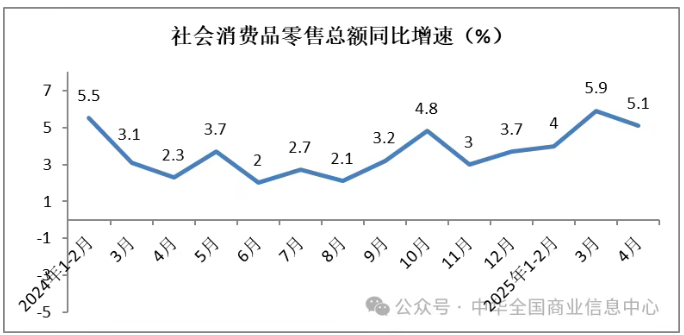
Group 1: Market Sales Growth - In April, the retail sales of consumer goods reached 37,174 billion yuan, with a year-on-year growth of 5.1%, accelerating by 0.5 percentage points compared to the first quarter [3] - From January to April, the total retail sales of consumer goods amounted to 161,845 billion yuan, showing a year-on-year increase of 4.7%, which is 0.1 percentage points faster than the first quarter [3] Group 2: Urban vs Rural Consumption - In April, urban retail sales reached 32,376 billion yuan, growing by 5.2% year-on-year, with an acceleration of 0.7 percentage points compared to the first quarter; rural retail sales were 4,798 billion yuan, with a year-on-year growth of 4.7%, slowing down by 0.2 percentage points [5] - For the period of January to April, urban retail sales totaled 140,433 billion yuan, with a year-on-year increase of 4.7%, while rural retail sales reached 21,412 billion yuan, growing by 4.8%, which is a slowdown of 0.1 percentage points [5] Group 3: Retail Growth in Key Sectors - In April, retail sales of goods amounted to 33,007 billion yuan, with a year-on-year growth of 5.1%, accelerating by 0.5 percentage points compared to the first quarter; among these, retail sales of key enterprises reached 13,762 billion yuan, growing by 6.6%, which is 0.8 percentage points faster than the first quarter [7] - From January to April, retail sales of goods totaled 143,651 billion yuan, with a year-on-year increase of 4.7%, while key enterprises recorded 58,885 billion yuan, growing by 6.0%, which is 0.2 percentage points faster than the first quarter [7] Group 4: Online Retail Performance - In April, online retail sales of physical goods grew by 6.1% year-on-year, with an acceleration of 0.4 percentage points compared to the first quarter; from January to April, online retail sales reached 39,265 billion yuan, growing by 5.8%, which is faster than the first quarter by 0.1 percentage points [9] - Online retail sales accounted for 24.3% of the total retail sales of consumer goods [9] Group 5: Offline Retail Stability - In April, offline retail sales grew by 4.7% year-on-year, with an acceleration of 0.5 percentage points compared to the first quarter; from January to April, offline retail sales increased by 4.3%, which is 0.1 percentage points faster than the first quarter [10] - Among key retail enterprises, convenience stores, specialty stores, supermarkets, department stores, and brand specialty stores saw year-on-year growth of 9.1%, 6.4%, 5.2%, 1.7%, and 1.4% respectively [10] Group 6: Upgraded Product Sales - In April, nearly 90% of product categories in key enterprises saw retail sales growth, with significant increases in jewelry (25.3%), cosmetics (7.2%), and sports and entertainment products (23.3%) [13] - The sales of home appliances, cultural and office supplies, furniture, and building materials grew by 38.8%, 33.5%, 26.9%, and 9.7% respectively, with substantial acceleration compared to the first quarter [13] Group 7: Service Retail Growth - From January to April, service retail sales grew by 5.1% year-on-year, with an acceleration of 0.1 percentage points compared to the first quarter, driven by strong demand in travel and leisure services [14] - Service retail growth outpaced product retail growth by 0.4 percentage points [14] Group 8: Consumer Price Stability - In April, the Consumer Price Index (CPI) decreased by 0.1% year-on-year, consistent with the first quarter; among eight categories, seven saw price increases, while transportation and communication prices fell by 3.9% [18] - The average CPI for January to April showed a decline of 0.1% compared to the same period last year, maintaining the same rate as the first quarter [18]