
装备制造

Search documents
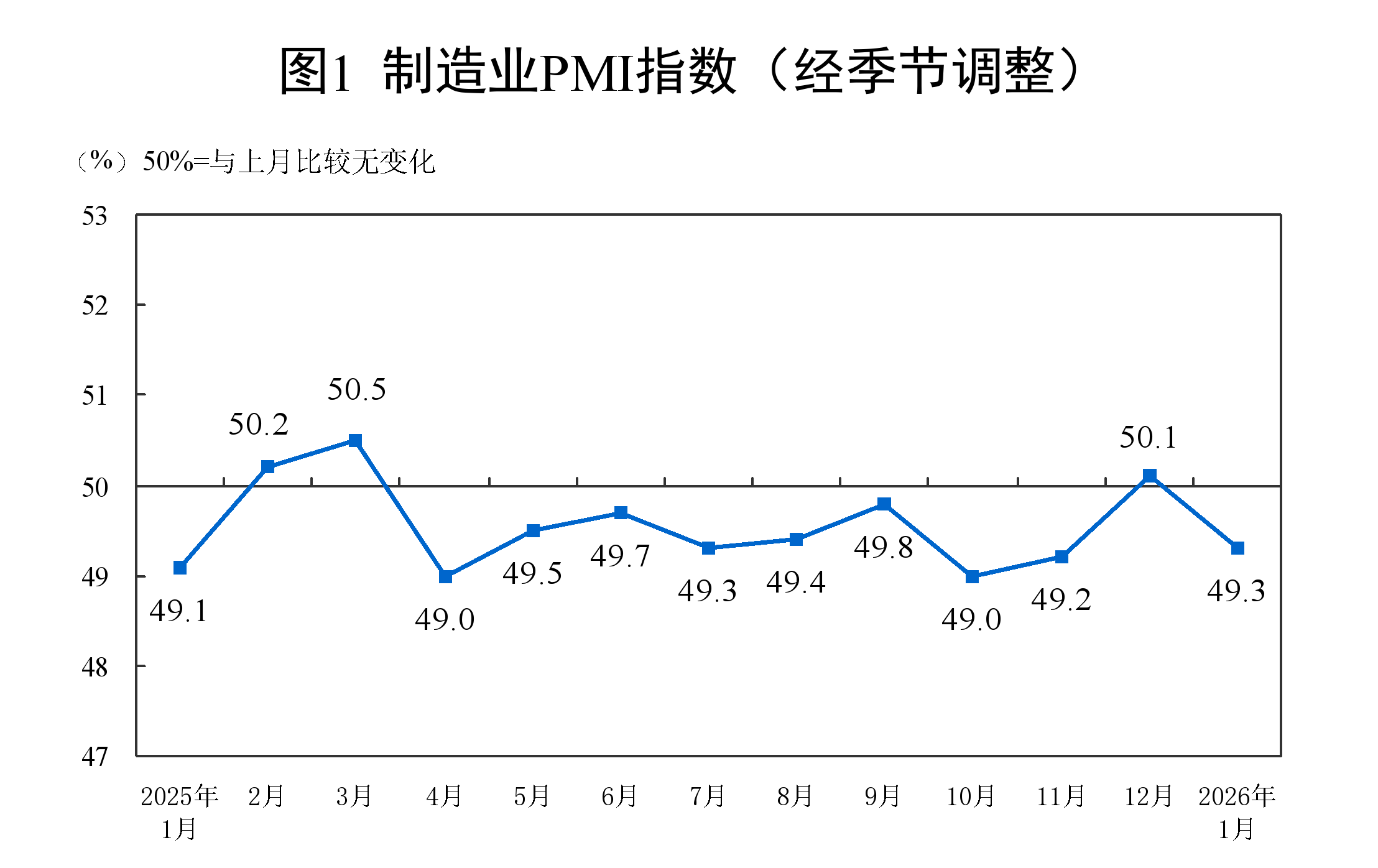
1月制造业PMI49.3%,制造业市场价格总体改善
2 1 Shi Ji Jing Ji Bao Dao· 2026-02-01 02:29
Core Viewpoint - The manufacturing Purchasing Managers' Index (PMI) in China for January is reported at 49.3%, indicating a decline of 0.8 percentage points from the previous month, reflecting a downturn in manufacturing activity [1][5][8]. Manufacturing PMI Analysis - The decline in manufacturing PMI is attributed to seasonal factors as some industries enter a traditional off-peak period, coupled with insufficient market demand [1][8]. - The production index stands at 50.6%, indicating continued expansion in manufacturing production, while the new orders index is at 49.2%, showing a decrease in market demand [6][8]. - High-tech manufacturing PMI remains strong at 52.0%, indicating sustained positive development in related industries [1][8]. Price Index Improvement - The overall price level in the manufacturing sector has improved, with the main raw materials purchasing price index at 56.1% and the factory price index at 50.6%, both showing increases from the previous month [2][14]. - The factory price index has risen above the critical point for the first time in nearly 20 months, suggesting a general improvement in manufacturing market prices [2][14]. Employment and Inventory Trends - The employment index is reported at 48.1%, indicating a slight decline in hiring conditions within the manufacturing sector [12]. - The raw materials inventory index is at 47.4%, reflecting a continued decrease in major raw material stocks, while finished goods inventory has increased, suggesting accelerated production activities ahead of the Spring Festival [13][12]. Future Expectations - The production and business activity expectation index is at 52.6%, remaining above the critical point, although it marks the lowest level since the second half of 2025 [15]. - There is a noted concern regarding the decline in new export orders, which fell to 47.8%, indicating a contraction in external demand and potential challenges for future manufacturing activity [7][15].

以技艺解难题 以创新促发展——“大国工匠助企甘肃行”活动综述
Xin Lang Cai Jing· 2026-02-01 01:44
Core Viewpoint - The "Great Craftsman Assisting Enterprises in Gansu" event aims to enhance the high-quality development of Gansu's key industrial chains and advanced manufacturing through the collaboration of skilled craftsmen and local workers [1][4]. Group 1: Event Overview - The event commenced on January 25 in Lanzhou New Area, involving 50 national craftsmen and 20 local craftsmen, who formed 12 working groups to address technical challenges in 19 enterprises [1]. - The initiative focuses on integrating craftsmanship, solving problems through skills, and promoting innovation to inject strong momentum into Gansu's industrial development [1][4]. Group 2: Addressing Technical Challenges - A specific technical issue was raised by a chief operator regarding welding cracks in steel castings, which hindered production and increased costs [2]. - A national craftsman provided detailed solutions, including process adjustments like annealing and preheating, demonstrating a hands-on approach to problem-solving [2][3]. Group 3: Innovation and Collaboration - The event introduced a collaborative model between national and local craftsmen, aiming for a three-way win: skill transfer, capacity enhancement, and resolution of technical issues for enterprises [4]. - The participating craftsmen come from various critical sectors, including manufacturing, aerospace, and energy, showcasing their expertise in significant national projects [4]. Group 4: Long-term Empowerment - The initiative is part of a broader strategy to enhance the role of craftsmen in supporting small and medium enterprises, addressing their technological challenges, and boosting local economic development [6]. - The program emphasizes establishing long-term mentorship relationships between national craftsmen and frontline workers, promoting skill transfer through various teaching methods [6]. Group 5: Future Directions - The provincial labor union plans to institutionalize the "Great Craftsman Assisting Enterprises in Gansu" as a regular service brand, aligning with the development needs of key industries like new energy and modern agriculture [7]. - The initiative aims to create a collaborative ecosystem between craftsmen and enterprises, enhancing the overall skill level and fostering a culture of innovation and excellence among local workers [7].
1月份我国制造业生产保持扩张
Xin Lang Cai Jing· 2026-01-31 20:32
Group 1 - The manufacturing Purchasing Managers' Index (PMI) for January is reported at 49.3%, indicating a slight contraction in the manufacturing sector [1] - The non-manufacturing business activity index stands at 49.4%, while the comprehensive PMI output index is at 49.8%, suggesting overall economic activity is below the expansion threshold [1] - The production index is at 50.6%, indicating that manufacturing production is still expanding [1] Group 2 - The price indices for major raw materials and factory output have risen, with the purchasing price index at 56.1% and the factory price index at 50.6%, marking a significant increase from the previous month [1] - The factory price index has risen above the critical point for the first time in nearly 20 months, indicating an overall improvement in market prices within the manufacturing sector [1] - High-tech manufacturing continues to lead with a PMI of 52.0%, remaining above 52.0% for two consecutive months, reflecting a positive development trend in related industries [2] Group 3 - Large enterprises maintain a PMI of 50.3%, indicating continued expansion, while small and medium-sized enterprises show a decline in their PMIs to 48.7% and 47.4%, respectively [2] - The production and business activity expectation index is at 52.6%, indicating optimistic expectations among enterprises [2] - Industries such as agricultural product processing and food and beverage sectors have maintained high expectation indices above 56.0%, reflecting strong confidence in recent industry developments [2]
两会好声音|马晶梅委员:加速数智化 提升高技术制造业竞争优势
Xin Lang Cai Jing· 2026-01-31 16:27
Group 1 - The core report emphasizes the promotion of high-end, intelligent, and green development in the manufacturing industry, with Heilongjiang Province identifying digitalization as a key engine for building a modern industrial system [2] - By 2024, Heilongjiang plans to implement policies to accelerate the digital transformation of manufacturing, having already cultivated 335 provincial-level digital workshops and smart factories across key sectors such as equipment manufacturing, petrochemicals, and pharmaceuticals [2] - Suggestions from provincial political advisor Ma Jingmei include implementing core technology breakthroughs and digital empowerment actions, focusing on high-end industrial software and sensors, and establishing special funds to support collaborative digital innovation centers between schools and enterprises [2] Group 2 - A targeted support plan for small and medium-sized enterprises (SMEs) will be promoted, including the establishment of provincial special funds and tools like service vouchers and solution subsidies to reduce transformation costs [3] - The creation of a talent cultivation mechanism integrating industry and education is proposed, which includes systematic training for engineers and management personnel to enhance digital skills, as well as special allowances for high-level talent [3] - A digital engineer sharing platform and school-enterprise co-education alliance will be established to align talent training with industry needs [3]

中采PMI点评(26.01):1月PMI:春节效应前置
Shenwan Hongyuan Securities· 2026-01-31 15:24
Group 1: PMI Data Overview - January manufacturing PMI decreased to 49.3%, down 0.8 percentage points from December's 50.1%[1] - Non-manufacturing PMI fell to 49.4%, a decline of 0.8 percentage points from the previous month's 50.2%[1] Group 2: Factors Influencing PMI Changes - The significant drop in January PMI is attributed to the early return of workers for the Spring Festival and weak domestic demand[2] - The national migration scale index increased from 4% to approximately 8.6% year-on-year, indicating an earlier return home[2] Group 3: Sector-Specific Insights - Labor-intensive sectors, such as consumer goods and high-energy industries, saw larger PMI declines of 2.1 and 1 percentage points, respectively, to 48.3% and 47.9%[3] - The construction sector's PMI dropped 4 percentage points to 48.8%, while service sector PMI remained relatively stable at 49.5%, down only 0.2 percentage points[3] Group 4: Future Economic Outlook - Despite short-term weaknesses in manufacturing and construction due to the Spring Festival, the overall economic recovery trend is expected to continue in the coming months[4] - Service sector expectations may improve due to increased travel and holiday consumption, supported by recent policy measures[4]
1月制造业PMI点评:关注价的积极信号
Huachuang Securities· 2026-01-31 14:45
1. Report Industry Investment Rating No information about the industry investment rating is provided in the report. 2. Core Viewpoints - In January 2026, China's official manufacturing PMI was 49.3%, a month - on - month decrease of 0.8pct; the official non - manufacturing PMI was 49.4%, also a month - on - month decrease of 0.8pct; the composite PMI output index was 49.8%, a decrease of 0.9pct from the previous month. The PMI returned below the boom - bust line due to factors such as demand overdraft at the end of the previous year, early holiday closures around the Spring Festival, and the impact of cold snaps on construction demand [5][8]. - Positive signals include the simultaneous recovery of price indices and a continued decline in the proportion of enterprises reporting insufficient demand in January, indicating that the direction of demand stabilization remains unchanged [5][11]. - For the bond market, the decline in PMI is affected by short - term factors. The price increase expectations brought by the transformation of new and old driving forces and "anti - involution" are difficult to disprove for the time being. The PMI may continue to weaken in February during the Spring Festival, but the "Golden March" may see a strong recovery, and attention should be paid to the potential impact of fundamental data on bond market expectations [5][12]. 3. Summary by Directory 3.1 Manufacturing PMI: Short - term factors lead to a return to the contraction range 3.1.1 Supply and Demand: Orders decline more deeply while production remains in expansion - New orders dropped to 49.2% in January, returning to the contraction range, reflecting the demand overdraft effect from the previous month. The month - on - month decline in new orders was 1.6pct, lower than most previous periods but better than January 2025. Domestic demand orders slowed down more significantly than new export orders [15]. - Production slowed down but remained in the expansion range. In January, production decreased by 1.1pct month - on - month to 50.6%. The decline in production was due to pressure on the demand side, and the production index of the consumer goods manufacturing industry dropped below the boom - bust line, while the production of new - driving - force industries remained highly prosperous, increasing the differentiation [16]. 3.1.2 Foreign Trade: Strong imports and weakening export orders - New export orders decreased by 1.2pct month - on - month to 47.8%, with the contraction intensifying. Factors such as new US tariffs on some high - tech manufacturing products, trade tariff frictions between the US and Europe, and the approaching Spring Festival led to a slowdown in the growth of new export orders. However, imports increased by 0.3pct month - on - month to 47.3%, showing a stable improvement for three consecutive months [20]. 3.1.3 Price: Both purchase and ex - factory prices rise, but profits may still be squeezed - In January, the raw material purchase price and ex - factory price increased by 3.0pct and 1.7pct month - on - month to 56.1% and 50.6% respectively. The ex - factory price returned above the boom - bust line for the first time since May 2024. However, the increase in the ex - factory price was less than that of raw materials, indicating limited downstream demand to absorb price increases and potential pressure on corporate profits [24]. 3.1.4 Inventory: Slower destocking of finished products - Raw material inventory decreased by 0.4pct month - on - month to 47.4%, indicating that production remained prosperous and procurement slowed down, with a relatively faster digestion of raw materials. Finished product inventory increased by 0.4pct month - on - month to 48.6%, with the destocking pressure rising for three consecutive months [28]. 3.2 Non - manufacturing PMI: Seasonal factors affect construction, leading to a significant slowdown in construction activities - In January, the non - manufacturing PMI was 49.4%, a month - on - month decrease of 0.8pct. The service industry PMI decreased by 0.2pct month - on - month to 49.5%, and the construction industry PMI decreased by 4.0pct month - on - month to 48.8%, shifting from expansion to contraction [29]. - The slowdown in construction activities was due to cold weather and the approaching Spring Festival. Construction projects entered the off - season, and investment demand is expected to be further released after the Spring Festival in February [29]. - The service industry showed potential demand and industry differentiation. In January, the financial industry in the service sector was highly prosperous, while industries such as the Internet and railway transportation declined, and the retail and catering industries remained in the contraction range. The Spring Festival holiday may boost the consumer service industry in February [32].
【甘快看·聚焦2026甘肃两会】产业进化论 甘肃结构经济高质量发展新密码
Xin Lang Cai Jing· 2026-01-31 13:20
Core Viewpoint - Gansu province is accelerating its high-quality development during the "14th Five-Year Plan" period through strategic determination, reform innovation, and open collaboration, aiming to write a chapter of Chinese-style modernization for Gansu [1]. Group 1: Industrial Development - Gansu is focusing on becoming a strong industrial province by enhancing leading enterprises, supplementing industrial chains, and clustering industries [4]. - The province is implementing 1,424 "three transformations" projects to upgrade key industrial chains under the "14+1" framework [4]. - Gansu is creating advanced manufacturing clusters, including the Jinbailanwu non-ferrous metals cluster and two national advanced manufacturing clusters in Baohan and Tian [4]. Group 2: Industry Growth Metrics - The annual growth rate of the non-ferrous metallurgy industry value added is 17.8% [6]. - The petrochemical industry has an annual growth rate of 4.8% [6]. - The equipment manufacturing industry shows an annual growth rate of 9.9% [6]. - The new materials industry has seen a remarkable growth of 195.6% in output value [6]. - The biopharmaceutical industry has an output value growth of 83.5% [6]. - The traditional Chinese medicine industry reached an output value of 1,109 billion [6]. - The new energy and new energy equipment manufacturing industry achieved an output value of 1,006.6 billion [6]. Group 3: Innovation and Technology - Gansu has optimized and restructured 14 national key laboratories and established 13 enterprise innovation alliances [7]. - The annual growth rate of technology contract transaction value is 20.85% [7]. - Five new national champion enterprises and 1,003 specialized and innovative small and medium-sized enterprises have been added, with three enterprises listed on the main board and five on the "New Third Board" [7]. - Ten enterprises have entered the "China Hidden Unicorn 500" list [7]. - Huatiandian's integrated circuit packaging and testing scale ranks third in China [7]. - The heavy ion cancer treatment system has become a "national key device" [7]. - Gansu has built the world's first "needle-based molten salt experimental reactor" in Wuwei [7]. Group 4: Resource Production Growth - Gold production has increased by 544.4% [9]. - Silver production has grown by 199.2% [9]. - Refined copper production has risen by 110.9% [9]. - Coal production has increased by 71.5% [9]. - Crude oil production has grown by 31.2% [9]. - Natural gas production has surged by 141% [9]. Group 5: Economic Growth Projections - The province's GDP is expected to grow at an annual rate of over 5% [11]. - Labor productivity is projected to increase by an annual rate of 5% [11]. - Gansu aims to build a modern industrial system with unique advantages, targeting four national advanced manufacturing clusters and six trillion-level industrial clusters [11].

1月中国制造业PMI回落至49.3% 企业预期仍乐观
Xin Lang Cai Jing· 2026-01-31 04:02
分企业类型看,大型企业PMI为50.3%,仍位于扩张区间,大型企业支撑作用持续显现;中、小型企业 PMI分别为48.7%和47.4%,比上月下降1.1个和1.2个百分点。 中新社北京1月31日电 (记者 王恩博)中国国家统计局1月31日公布,由于部分制造业行业进入传统淡 季,加之市场有效需求仍显不足,1月份中国制造业采购经理指数(PMI)回落至49.3%,但企业预期仍保 持乐观。 1月份,生产经营活动预期指数为52.6%,继续高于临界点。从行业看,农副食品加工、食品及酒饮料 精制茶等行业生产经营活动预期指数连续两个月位于56.0%以上较高景气区间,相关企业对近期行业发 展信心较强。(完) 具体而言,1月份,生产指数为50.6%,制造业生产保持扩张;新订单指数为49.2%,市场需求有所回 落。从行业看,农副食品加工、铁路船舶航空航天设备等行业生产指数和新订单指数均高于56.0%,产 需释放较快;石油煤炭及其他燃料加工、汽车等行业两个指数均低于临界点,相关行业市场需求放缓, 企业生产有所回落。 受近期部分大宗商品价格上涨等因素影响,1月份,主要原材料购进价格指数和出厂价格指数分别为 56.1%和50.6%,比上月 ...
1月份我国制造业PMI为49.3%
Xin Hua Wang· 2026-01-31 03:35
Group 1 - The manufacturing Purchasing Managers' Index (PMI) for January is reported at 49.3%, a decrease of 0.8 percentage points from the previous month, indicating a decline in manufacturing activity due to seasonal factors and insufficient market demand [1] - The production index stands at 50.6%, indicating continued expansion in manufacturing production, while the new orders index is at 49.2%, reflecting a drop in market demand [1] - Industries such as agricultural processing and aerospace equipment show production and new orders indices above 56.0%, indicating rapid release of production and demand, while sectors like petroleum and automotive are below the critical point, signaling a slowdown in market demand [1] Group 2 - The PMI for large enterprises is at 50.3%, remaining in the expansion zone, while the PMIs for medium and small enterprises are at 48.7% and 47.4%, respectively, both showing a decline from the previous month [2] - High-tech manufacturing continues to lead with a PMI of 52.0%, maintaining a strong development trend, while the equipment manufacturing PMI is at 50.1%, also in the expansion zone [2] - The production expectation index is at 52.6%, indicating optimistic expectations among enterprises, particularly in agricultural processing and beverage industries, which have maintained indices above 56.0% for two consecutive months [2]
苏州市人力资源服务业与制造业融合发展十大工程(2026-2027年)
Su Zhou Ri Bao· 2026-01-31 00:27
Group 1 - The core viewpoint of the news is the comprehensive upgrade of the "Suzhou Talent Network" employment service portal, which aims to enhance data sharing between departments and utilize big data analysis and intelligent prediction technologies to align human resources with industry development trends [1] - The initiative includes the release of key industry and human resource maps covering advanced manufacturing and service sectors, facilitating precise talent cultivation and improving service quality [1] Group 2 - The project targets the top 100 global human resource service providers and aims to attract over 10 leading institutions in intelligent manufacturing and digital economy by 2027 [2] - It plans to nurture high-growth human resource service institutions, with a goal of cultivating more than 10 institutions with annual revenues exceeding 1 billion by 2027 [2] Group 3 - The focus is on collaborative innovation within key industry clusters such as electronic information and biomedicine, supporting the selection of leading enterprises and institutions for pilot projects in overseas talent development and high-end recruitment services [3] - By 2027, the goal is to establish at least 10 "Human Resource Service-Manufacturing Innovation Alliances" and set up at least 2 postdoctoral research stations or provincial innovation practice bases [3] Group 4 - The initiative aims to create skill training complexes that encourage collaboration among enterprises, human resource service providers, and vocational schools, with a target of establishing at least 10 training bases by 2027 [4] Group 5 - The plan includes forming regional and industry-specific recruitment coalitions to address structural and seasonal labor shortages, with a target of creating at least 10 effective recruitment coalitions by 2027 [5] - These coalitions aim to serve over 500 key enterprises and resolve labor needs for more than 100,000 individuals annually [5] Group 6 - The project emphasizes enhancing human resource service exports by establishing overseas service points and fostering collaboration with enterprises venturing abroad [6][7] - By 2027, the goal is to cultivate over 10 quality overseas service institutions and provide services to more than 1,000 outbound enterprises [7] Group 7 - The initiative supports the development of AI applications in human resources, focusing on areas like intelligent recruitment and virtual training, with a target of nurturing at least 30 innovative projects by 2027 [8] Group 8 - The plan includes providing public management diagnostic services to small and medium-sized enterprises (SMEs) and developing modular, lightweight, and SaaS-based service packages to enhance recruitment efficiency [9] - By 2027, the goal is to serve over 1,000 SMEs and develop at least 20 standardized service products [9] Group 9 - The initiative aims to build an innovative ecosystem by organizing industry training and activities, targeting to conduct at least 200 events by 2027 and serve over 1,000 human resource-related enterprises [10] Group 10 - The project supports the construction of human resource service industrial parks, aiming for full coverage at the county level by 2027 and promoting the development of specialized and branded parks [11] - It plans to establish at least 100 service stations in manufacturing clusters to enhance resource sharing and functional complementarity [11]