
食品

Search documents
黑芝麻筹划易主;2025年暑期档票房突破70亿元丨消费早参
Mei Ri Jing Ji Xin Wen· 2025-08-04 23:14
Group 1 - Anta Sports is rumored to be acquiring Reebok, which could significantly enhance its influence in the global sports brand market, particularly in Europe and the US [1] - Anta's half-year report for 2025 shows a mid-single-digit growth in retail sales for its brand compared to the same period in 2024, while FILA's retail sales grew in the high single digits, and other brands saw a 60% to 65% increase [1] - The potential acquisition may lead to a reshaping of the competitive landscape in the domestic sports apparel sector, prompting investors to monitor financial leverage changes and brand synergy effects [1] Group 2 - Black Sesame announced plans for a potential change in control, with its major shareholder considering transferring approximately 20% of its shares to a state-owned enterprise in the cultural tourism and health industry [2] - The transfer of control could inject resources from the cultural tourism and health sectors into Black Sesame, promoting business diversification [2] - If the transaction is completed, it may enhance the company's governance structure and improve resource integration capabilities, providing a new case for local state-owned enterprise reform [2] Group 3 - The total box office for the summer season of 2025 has surpassed 7 billion yuan, indicating a strong recovery in domestic entertainment consumption [3] - The film "Nanjing Photo Studio" has achieved a total box office of over 1.5 billion yuan within 10 days of its release, ranking third in the 2025 box office chart [3] - The robust box office performance may strengthen market expectations for profitability recovery in the film industry, potentially leading to a revaluation of cinema and content production companies [3]

商品包装轻装上架应成常态
Jing Ji Ri Bao· 2025-08-04 22:10
Core Viewpoint - The excessive packaging of products has been criticized for its environmental impact and resource waste, prompting a joint initiative by various consumer and industry associations in China to advocate for reduced packaging and promote green consumption [1][2]. Group 1: Overpackaging Issues - Excessive packaging is a significant concern, with statistics indicating that packaging waste accounts for approximately 30% to 40% of urban household waste in China, much of which is due to overpackaging [1]. - The push for high-end, intricate packaging by businesses not only raises consumer costs but also contradicts the principles of green and low-carbon development [1]. Group 2: Regulatory Measures - New national standards aimed at limiting excessive packaging will be enforced starting September 2023 and April 2024, setting clear requirements for packaging void ratios, layers, and costs [2]. - Specific products, such as mooncakes and rice dumplings, are restricted to a maximum of three layers of packaging, placing responsibility on producers to comply with these standards [2]. Group 3: Design and Innovation - Effective packaging design should balance simplicity and functionality, enhancing product value while avoiding waste [2]. - Companies are encouraged to innovate in packaging design, focusing on aesthetics and functionality, such as creating packaging that can be reused or repurposed [2][3]. Group 4: Industry Responsibility - The initiative by industry associations aims to raise awareness among businesses about the importance of self-regulation and reducing excessive packaging from the source [3]. - Companies are urged to invest in green technologies and new materials that facilitate resource conservation and recycling, thereby aligning with energy-saving and environmental standards [3].
宏观经济专题:7月出口或有韧性
KAIYUAN SECURITIES· 2025-08-04 13:43
Supply and Demand - Industrial production shows marginal weakening, with construction activity at seasonal lows, particularly in asphalt and cement operations[2] - Some chemical chains and automotive steel tire production rates have declined, with PX operating rates returning to historical midpoints[2] - Construction demand remains weak, with apparent demand for rebar, wire rod, and building materials below historical levels[2] Prices - International commodity prices are fluctuating, with oil, copper, aluminum, and gold showing a generally strong trend[3] - Domestic industrial products, excluding some building materials, are experiencing a rebound in prices, with the South China comprehensive index showing an upward trend[3] Real Estate - New housing transactions remain at historical lows, with a 16% week-on-week increase in transaction area, but still down 38% and 17% compared to 2023 and 2024 respectively[4] - Second-hand housing transactions are also weak, with prices declining and transaction volumes in major cities like Beijing and Shanghai showing year-on-year decreases of 8% and 2% respectively[4] Exports - July exports are expected to show resilience, with a projected year-on-year increase of approximately 2.8%, and container shipping data indicating a potential increase of around 7%[5] Liquidity - Recent weeks have seen a rise in funding rates, with R007 at 1.49% and DR007 at 1.42% as of August 1[70] - The central bank has conducted a net withdrawal of 15,675 billion yuan through reverse repos in the same period[70] Risk Factors - Potential risks include unexpected fluctuations in commodity prices and stronger-than-expected policy measures[75]
巴菲特,遭遇罕见滑铁卢
Guo Ji Jin Rong Bao· 2025-08-04 12:28
8月2日晚间,"股神"沃伦·巴菲特旗下的伯克希尔·哈撒韦公司(下称"伯克希尔")公布最新财报: 2025年二季度营业利润同比下降3.79%。 截至8月1日,伯克希尔股价今年累计上涨4.3%,而同期标准普尔500指数的总回报率为6.9%。 今年5月,94岁高龄的巴菲特在股东大会上宣布退休,并计划于年底卸任首席执行官。这样的二季 度业绩将给"接棒者"留下不小的挑战。不过,短期业绩对伯克希尔来说通常意义不大,因为其管理重点 是提升长期价值,而非满足季度目标。 多个核心指标下滑 报告显示,伯克希尔多个核心财务指标出现下滑。 今年上半年,伯克希尔实现营业利润208亿美元,同比下降8.8%。其中,公司第二季度营业利润总 计111.6亿美元,较去年同期的116亿美元有所下降;第二季度净利润降至约123.7亿美元,同比暴跌 59%;保险承保业务税前总利润为25.3亿美元,较去年同期的28.4亿美元下降近11%。 今年第一季度,伯克希尔的现金储备在5月至7月间下降至3440亿美元,而在5月3日召开年度股东大 会时,公司的现金储备约为3470亿美元。 值得注意的是,上半年伯克希尔抛售了45亿美元的股票,仅二季度就抛售约30亿美元 ...
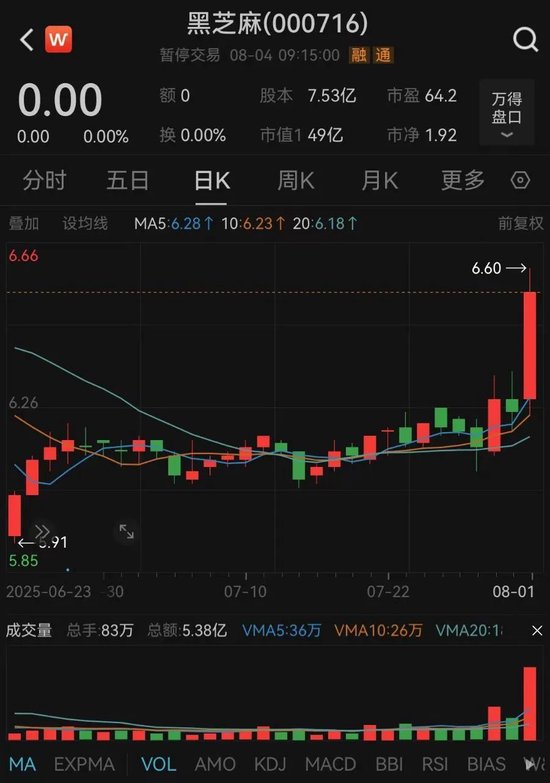
黑芝麻拟换老板,有人发帖“神预言”,公司回应
2 1 Shi Ji Jing Ji Bao Dao· 2025-08-04 09:33
Core Viewpoint - Black Sesame (000716.SZ) announced that its controlling shareholder, Guangxi Black Five Categories Food Group, is planning to transfer its shares, which may lead to a change in company control. The stock will be suspended for up to two trading days starting August 4, 2025 [1]. Group 1: Share Transfer and Control Change - The controlling shareholder intends to transfer approximately 20% of the company's total shares to a state-owned enterprise in Guangxi's cultural tourism and health industry [1]. - The involved parties are currently discussing the specific transaction plan and agreements, but no formal agreements have been signed yet [1]. Group 2: Stock Performance - Black Sesame's stock price has been volatile this year, with a decline of 4.94% from the beginning of the year. As of August 1, the stock closed at 6.54 CNY per share, with an intraday increase of 4.81% [2]. Group 3: Information Disclosure Issues - The company has faced multiple issues regarding information disclosure, including a warning letter from the Guangxi Securities Regulatory Bureau for non-operational fund occupation and unauthorized external guarantees [4]. - Significant disclosure failures were noted, such as the failure to timely disclose the occupation of company funds by the controlling shareholder and related parties [4]. Group 4: Financial Performance - Black Sesame's financial performance has been poor in recent years, with revenue only slightly increasing in 2021, while other years saw significant declines. The net profit fluctuated dramatically, with losses exceeding 200 million CNY in 2021 and 2022, followed by a slight recovery in 2023 and 2024 [6]. - In Q1 2025, the company reported revenue of 442 million CNY, a year-on-year decrease of 3.74%, and a net profit of 2.25 million CNY, down 29.61% year-on-year [6]. Group 5: Past Business Ventures - Black Sesame has attempted several cross-industry transformations that did not meet expectations, including a 256 million CNY acquisition of a logistics park in 2015, which was divested two years later [6]. - The company also invested 700 million CNY in an e-commerce platform, which faced performance issues, leading to a reduction in its e-commerce operations in 2024 [6]. - In 2023, Black Sesame announced a 3.5 billion CNY investment in the energy storage battery sector, but the project was suspended a year later due to market conditions [6].

黑芝麻拟换老板,有人发帖“神预言”,公司回应
21世纪经济报道· 2025-08-04 09:25
Core Viewpoint - The controlling shareholder of Heizhima, Guangxi Heiwulei Food Group, is planning to transfer approximately 20% of its shares, which may lead to a change in the company's control. The stock has been suspended for trading for up to two days as the parties negotiate the transaction details [1]. Group 1 - Heizhima's stock price has been volatile, with a year-to-date decline of 4.94%. As of August 1, 2023, the stock closed at 6.54 yuan per share, with a daily increase of 4.81% [1]. - The company has faced scrutiny for its information disclosure practices, receiving a warning from the Guangxi Securities Regulatory Bureau for non-operational fund occupation and unauthorized guarantees [2]. - Heizhima has a history of delayed disclosures regarding external guarantees, including a 65.53 million yuan guarantee for a loan to Nanning Children's Hospital, which was only disclosed in October 2024 [3]. Group 2 - Heizhima's financial performance has been poor, with revenue only slightly increasing in 2021, while experiencing significant declines in other years. The company reported a total loss exceeding 200 million yuan in 2021 and 2022, with a slight recovery in 2023 and 2024. However, in Q1 2025, revenue was 442 million yuan, down 3.74% year-on-year, and net profit was 2.25 million yuan, down 29.61% [5]. - Prior to the potential change in ownership, Heizhima attempted several unsuccessful cross-industry transformations, including a 256 million yuan acquisition of a logistics park in 2015, which was divested two years later, and a 700 million yuan acquisition of an e-commerce platform that later underperformed [5]. - In 2023, Heizhima announced a 3.5 billion yuan investment in the energy storage battery sector, planning to build a facility in Nanchang, but this project was suspended a year later due to market conditions [5].

六个生活信号,透露出一个事实:大家真没钱了?
Sou Hu Cai Jing· 2025-08-03 23:02
Group 1 - The core viewpoint of the articles highlights a significant shift in consumer behavior, with a surge in bank deposits reaching 47 trillion, a 32% year-on-year increase, indicating deep economic anxiety and a return to conservative spending habits [2] - The trend of "consumption downgrade" is evident across various sectors, with high-end products seeing declining sales while basic necessities remain in demand, as reflected in the rising food consumption and falling sales of cosmetics and luxury goods [2] - The luxury goods market has experienced a notable decline, with an 18% drop in overall luxury sales in the first quarter, signaling a shift away from consumption upgrades even among high-net-worth individuals [2] Group 2 - The restaurant industry is also affected, with a preference for affordable meal options under 30, while traditional dining experiences are losing popularity, emphasizing the importance of cost-effectiveness [4] - The real estate market is witnessing a downturn in rental prices in major cities, driven by a decrease in demand as young people leave urban areas for various reasons, leading to landlords offering incentives to retain tenants [4] - The automotive market has shifted from luxury vehicles to more practical options, with a decline in sales of high-end brands and a rise in demand for small electric cars and used vehicles, reflecting a change in consumer priorities towards economic practicality [4]

食品饮料周观点:育儿补贴政策落地,推新积极挖掘增量-20250803
GOLDEN SUN SECURITIES· 2025-08-03 10:36
Investment Rating - The report maintains an "Increase" rating for the food and beverage industry, indicating a positive outlook for the sector [5]. Core Insights - The implementation of the childcare subsidy policy is expected to stimulate growth in the food and beverage sector, particularly benefiting the infant formula and dairy product markets [4]. - The report highlights three main investment themes in the liquor segment: strong leading brands, sustained regional advantages, and recovery-driven elastic stocks [1][2]. - In the beer and beverage segment, Budweiser faces sales pressure but is seeing price recovery, while the sugary tea category is gaining market share during peak seasons [3]. Summary by Sections Liquor Industry - Leading brands such as Moutai, Wuliangye, and Luzhou Laojiao dominate the global rankings, with Moutai valued at $58.4 billion, maintaining its position as the most valuable liquor brand globally [2]. - The liquor sector is transitioning from scale growth to high-quality development, with a focus on brand strength and market positioning [2]. Beer and Beverage Sector - Budweiser's Q2 2025 results show a revenue decline of 3.9% and a profit drop of 31.1%, with a notable 6.2% decrease in sales volume [3]. - The sugary tea segment is experiencing a resurgence, with brands like Kang Shifu and Uni-President maintaining leading positions, and sales of Yuanqi Forest's iced tea growing by 53.9% year-on-year [3]. Food Sector - The national childcare subsidy program, effective from January 1, 2025, is projected to enhance birth rates and subsequently increase demand for dairy products [4]. - New product launches by companies like Qiaqia and Ximai are aimed at expanding market presence and tapping into health-oriented consumer trends [4][7].



宏观经济宏观周报:高频指标运行稳健,房地产表现相对较优-20250803
Guoxin Securities· 2025-08-03 08:43
Economic Growth Indicators - The Guosen High-Frequency Macro Diffusion Index A turned negative this week, while Index B showed seasonal decline, indicating a stable economic growth momentum[1] - Real estate sector performance improved, while investment and consumption sectors showed a decline, with the real estate sector performing relatively better[1] - The standardized Index B decreased by 0.14, remaining close to historical average levels, suggesting steady domestic economic growth[1] Asset Price Predictions - Current domestic interest rates are low, while the Shanghai Composite Index is high, indicating a potential downward adjustment in the index next week[1] - The predicted ten-year government bond yield for the week of August 8, 2025, is expected to rise, while the Shanghai Composite Index is anticipated to decline[1] - The predicted ten-year government bond yield is 2.34%, compared to the actual value of 1.72%, indicating a significant deviation[19] Price Tracking - Food prices increased by approximately 0.5% month-on-month in July, while non-food prices decreased by about 0.5%, leading to an overall CPI increase of around 0.5%[2] - The Producer Price Index (PPI) is expected to show a month-on-month increase of about 0.1% in July, with a year-on-year recovery to -3.3%[2]
招商宏观:从库存和关税因素看美铜价格波动
智通财经网· 2025-08-03 03:23
Core Viewpoint - The data from May 2025 indicates that the U.S. is entering an active destocking phase, with total inventory increasing by 2.62% year-on-year and total sales increasing by 3.30% year-on-year, both showing a decline from previous values [1][2]. Overall Inventory Cycle - In May, total U.S. inventory increased by 2.62% year-on-year, down from 3.15% previously, while total sales increased by 3.30% year-on-year, down from 3.68% [2]. - The U.S. is confirmed to be in an active destocking phase, with a significant import surge occurring from November 2024 to March 2025, and imports returning to normal levels in April and May 2025 [2]. - A short-term replenishment demand is expected in June and July 2025, but active destocking is anticipated to continue thereafter, with excess imports expected to be depleted by November 2025 [2]. U.S. Industry Inventory Cycle - Among 14 major industries in May, six are in active destocking, including upstream oil, natural gas, and consumer fuels, chemical products, midstream transportation, and downstream automotive and automotive parts, textiles, clothing, luxury goods, and food, beverages, and tobacco [3]. - Historical inventory levels show that construction materials, chemical products, metals and mining, paper and forestry products, and technology hardware and equipment have higher inventory levels compared to historical percentiles [3]. Upstream Inventory Trends - Oil, natural gas, and consumer fuels have been in active replenishment from July 2023 to May 2024, transitioning to active destocking by June 2024 and remaining in that phase until May 2025 [4]. - Chemical products are expected to transition from passive replenishment to active destocking by May 2025 [5]. - Construction materials and metals and mining are currently in passive replenishment, with a high likelihood of transitioning to active destocking in the future [6]. Midstream Inventory Trends - The transportation sector is likely in active destocking, while paper and forestry products, as well as electrical equipment and appliances, are in passive replenishment [7]. - Mechanical manufacturing has transitioned to active replenishment as of March 2025 [7]. Downstream Inventory Trends - The automotive and automotive parts sector is in active replenishment as of December 2024 [8]. - Household durable goods, textiles, clothing, luxury goods, food, beverages, and tobacco are in passive replenishment, with some expected to transition to active replenishment in April and May 2025 [8].