AI

Search documents
武汉市委金融办答21记者问:抢抓资本市场改革“三大机遇”,推动更多科创企业上市
2 1 Shi Ji Jing Ji Bao Dao· 2025-06-20 06:17
Core Viewpoint - Wuhan is accelerating the integration of technology and finance to establish itself as a national technology finance center, with significant progress in the listing of companies in recent years [2][3]. Group 1: Company Listings - Wuhan has seen substantial advancements in company listings, with 8 new domestic and foreign listed companies expected in 2024, including the first stocks in emerging industries such as domestic databases and AI chips [2]. - Notable recent listings include Honghai Technology on the Beijing Stock Exchange and Yuanguang Technology as the first stock for intelligent time-series data services on the Hong Kong Stock Exchange [2]. Group 2: Policy Opportunities - The resumption of the fifth set of standards for unprofitable companies on the Sci-Tech Innovation Board presents a new policy window for quality unprofitable tech companies to go public [3]. - The China Securities Regulatory Commission (CSRC) is promoting the "1+6" policy measures to deepen reforms on the Sci-Tech Innovation Board, which includes the introduction of six reform measures [2][3]. Group 3: Support for Overseas Listings - The CSRC supports qualified companies in going public overseas, with 13 companies from Wuhan, including Dazhong Oral and Wodetong, planning to list abroad [3]. - The city aims to facilitate overseas listings by connecting with regulatory bodies and intermediaries, particularly leveraging the Hong Kong Stock Exchange's "Tech Company Special Line" [3]. Group 4: Capital Market Development - Wuhan is enhancing its capital market fundraising capabilities through online and offline collaborations with major stock exchanges, providing services such as listing guidance and merger restructuring [4]. - The establishment of a "golden seed" and "silver seed" reserve pool of 500 companies, along with a database of 35 companies under review, aims to continuously improve listing services [4].
6.20犀牛财经早报:权益类基金建仓按下“加速键” 全球首款低空无人机感知基站亮相
Xi Niu Cai Jing· 2025-06-20 01:47
Group 1: Equity Funds and Market Opportunities - A total of 47 new equity funds have been established since June, with many entering the investment phase within half a month of their launch [1] - Fund managers are accelerating their investments in the A-share market due to strong policy support and the emergence of structural investment opportunities [1] - The current market environment is characterized by a gradual recovery in valuations, driven by favorable policies and the strong growth potential of emerging industries [1] Group 2: Lithium Iron Phosphate Market Dynamics - There is a significant increase in long-term contracts for lithium iron phosphate, with orders reaching billions, indicating expanding market demand [1] - The cumulative installed capacity of power batteries in China from January to May reached 241.4 GWh, a year-on-year increase of 50.4%, with lithium iron phosphate batteries accounting for 81.4% of the total [1] - In the energy storage sector, lithium iron phosphate batteries are projected to dominate, with a forecasted global market share of 92.5% in 2024 [1] Group 3: Unmanned Logistics Vehicles - Over 40 unmanned delivery vehicles from various companies have been tested in Shenzhen, with expectations for the number of operational vehicles to exceed 1,000 by the end of 2025 [2] - Unmanned logistics vehicles are primarily responsible for the "last mile" delivery, significantly enhancing logistics efficiency and reducing costs [2] Group 4: 5G-A Technology Developments - The 2025 World Mobile Communication Conference showcased multiple applications of 5G-A technology, which can reduce data transmission latency to under 20 milliseconds [4] - Major telecom operators in China are deploying 5G-A networks across various cities, with over a hundred devices expected to support this technology by the end of 2025 [4] Group 5: Financial Sector Developments - A total of 103 listed companies in Shenzhen changed their auditing firms in 2024, reflecting a significant shift in the auditing landscape [5] - The acquisition of 96.08% of Wanhe Securities by Guosen Securities has been approved by the Shenzhen Stock Exchange, marking the third broker merger to receive such approval since last year [5] Group 6: Corporate Actions and IPOs - Cloud Intelligence is seeking to raise up to HKD 320 million (approximately USD 40.8 million) through an IPO in Hong Kong, with shares priced between HKD 165 and 205 [7] - Shanjin International has authorized its management to initiate preparations for issuing H-shares and listing in Hong Kong, aiming to enhance its global strategy [8]
云知声IPO:12亿亏损背后的业务困局与项目制生死考
3 6 Ke· 2025-06-19 23:15
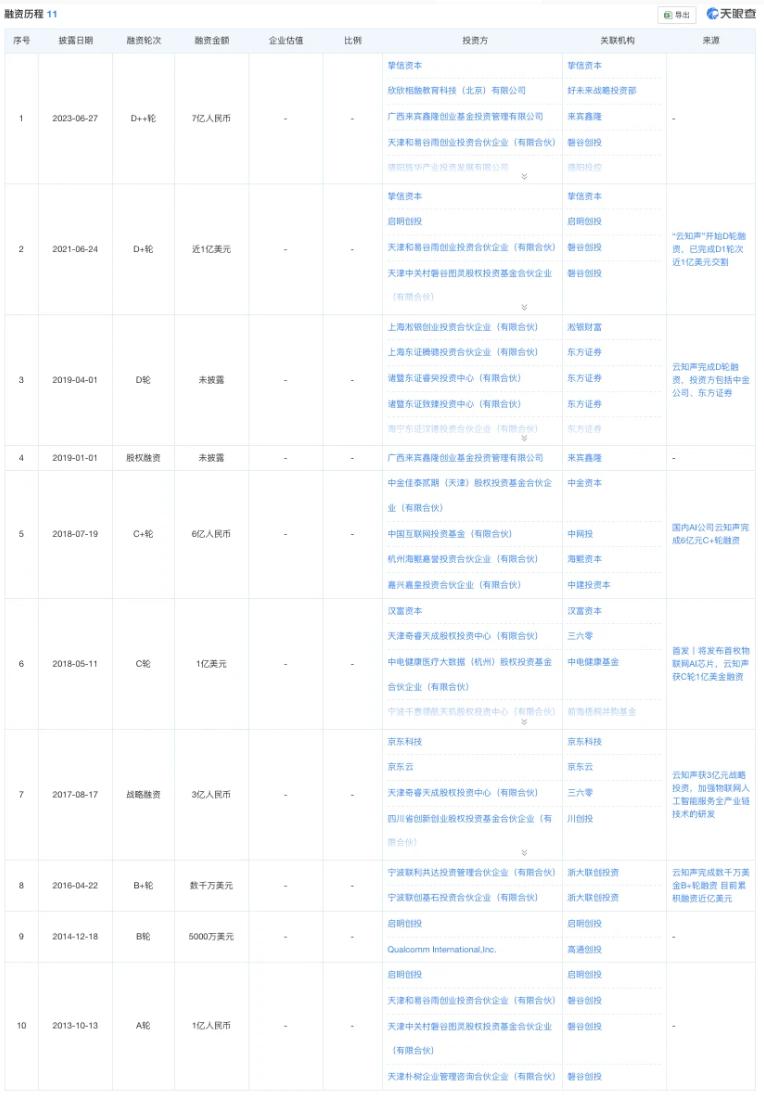
Core Viewpoint - Yunzhisheng, an early player in AI, is preparing for its IPO after multiple attempts, facing challenges in customer growth and financial stability despite revenue increases [1][2][4]. Financial Performance - In 2024, Yunzhisheng reported total revenue of 939 million RMB, a year-on-year increase of 29.16%, with daily life business contributing 740 million RMB, accounting for 78.5% of total revenue [4][12]. - The company incurred a loss of 454 million RMB in 2024, marking a 21.39% increase in losses, with cumulative losses exceeding 1.2 billion RMB [4][5]. Customer Dynamics - Customer growth has stagnated, with the number of major clients in daily life decreasing from 78 to 71 in 2024, and customer retention rates dropping from 70.4% in 2022 to 53.3% in 2024 [12][13][14]. - The revenue per major customer increased, with daily life clients contributing 1.8 million RMB each in 2024, up 20.99% year-on-year [15]. Funding and Investment - Yunzhisheng has completed 11 rounds of financing since its establishment, raising over 340 million USD, with the latest D++ round raising 700 million RMB [2][3]. - The upcoming IPO aims to raise funds primarily for investment in AI infrastructure and talent development [11]. Business Model and Strategy - The company relies heavily on a project-based model, which has led to high costs and low margins, posing long-term sustainability risks [16][17]. - There is a need for a strategic shift towards verticalization and product standardization to enhance competitiveness against larger players in the AI sector [16][17]. Technological Development - Yunzhisheng has transitioned from voice recognition to large models, launching the Shanhai model with 60 billion parameters, but still lags behind leading competitors in terms of scale and application [9][10]. - The reliance on third-party outsourcing for R&D has raised concerns about the company's core technological capabilities [9].

市场更新:预期提振有待政策进一步加力
Bank of China Securities· 2025-06-19 09:46
Market Overview - Investment demand is expected to be boosted by further policy support, with a focus on the defensive value of consumption and dividend sectors[1] - In May, retail sales growth was strong, particularly in dining and retail goods, driven by "two new" policies, with notable performance in home appliances and communication equipment[2] - Fixed asset investment growth weakened marginally due to real estate investment drag, while government bonds remained a key support for new social financing in May[2] Market Sentiment - The A-share market is likely to continue a consolidation pattern in the short term, with risk premium levels nearing the 10-year average plus one standard deviation, indicating market sentiment is close to a short-term peak[2] - Short-term market dynamics are expected to remain volatile with rapid sector rotation, requiring patience for policy acceleration and sustained macroeconomic support[2] Investment Style - The market is anticipated to be dominated by low valuation factors in the short term, with small-cap, high-profit, and high-valuation stocks expected to outperform[2] - Credit growth and fundamental recovery in May were relatively weak, suggesting a continued preference for low-risk investments until policy release points arrive[2] Sector Focus - Attention should be given to essential consumption and dividend sectors during the risk disturbance window, with the top 10 industries for AI sector allocation including light industry manufacturing, public utilities, and pharmaceuticals[2] - The industry distribution primarily aligns with essential consumption and dividend styles, indicating a defensive investment strategy[2] Risk Factors - Risks include weaker-than-expected policy implementation and potential global recession risks exceeding expectations[2]
再通胀牛市系列4:如何看待微盘新高
Huachuang Securities· 2025-06-19 08:36
Group 1 - The report emphasizes that the micro-cap stocks are benefiting from liquidity expansion, with the current market environment favoring small-cap growth stocks due to a lack of a clear trend in the market and ongoing inflation concerns [2][3][15] - The micro-cap stock index has shown a strong performance, with a cumulative increase of 30% year-to-date, significantly outperforming the broader market [3][11][19] - The report highlights that the shareholder structure of micro-cap stocks is predominantly composed of individual investors, which positions them to benefit from the release of excess household savings into the stock market [4][23][34] Group 2 - The report identifies that the micro-cap sector is primarily driven by liquidity rather than fundamentals, as earnings growth is not a major pricing factor in the current environment [4][45][53] - The micro-cap industry covers sectors such as manufacturing and technology, including themes like AI, robotics, and innovative pharmaceuticals, which are expected to benefit from ongoing industrial policy support [5][63][64] - The trading mechanisms in the micro-cap space, such as higher price limits on exchanges like the Beijing Stock Exchange and ChiNext, provide greater elasticity compared to the main board, enhancing the attractiveness of micro-cap stocks [57][58]
产品要全球化,创始人股权分配是否也要全球化?
Hu Xiu· 2025-06-19 06:02
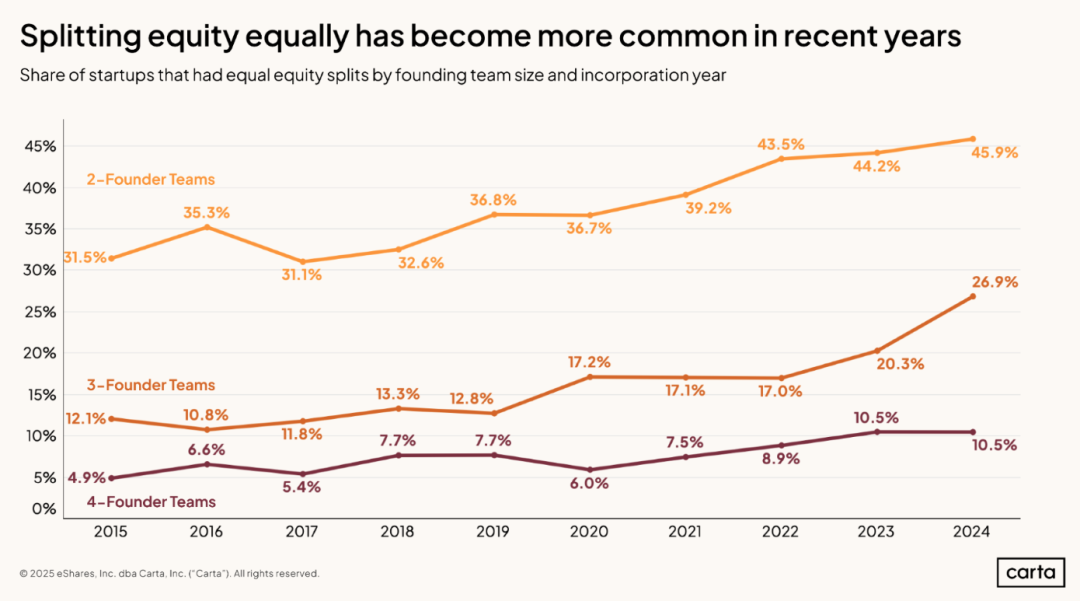
Core Insights - The article discusses the evolving trend of equity distribution among founding teams in the context of globalization and the AI era, highlighting a shift from traditional unequal distributions to more equitable arrangements [1][25][30] - It emphasizes that equity distribution reflects the power structure, incentive mechanisms, and future development trajectories of companies, suggesting that a more balanced equity distribution may be beneficial for long-term success [1][9][28] Group 1: Trends in Equity Distribution - In the U.S., the trend of equal equity distribution among founding teams is becoming the norm, with the percentage of two-person teams opting for a 50-50 split rising from 31.5% in 2015 to 45.9% in 2024 [2][5] - For three-person founding teams, the proportion choosing equal equity has increased from 12.1% to 26.9% during the same period, indicating a significant shift towards equity equality [2][5] - The median equity distribution for two-person teams has narrowed from 60-40 in 2019 to 51-49 in 2024, showing a trend towards more equitable arrangements even when not perfectly equal [5][10] Group 2: Reasons Behind the Shift - The shift towards equal equity distribution is attributed to the professionalization of founder roles, where all founders are expected to be fully committed to the startup, making traditional hierarchical equity structures less justifiable [8][10] - The trend is particularly pronounced in technology-intensive sectors like AI and machine learning, where collaborative efforts are essential for success due to the complexity of products [10][26] - Equal equity distribution is associated with higher team cohesion and better performance in subsequent funding rounds, suggesting a positive correlation between equity equality and company success [9][10] Group 3: Y Combinator's Equity Philosophy - Y Combinator (YC) advocates for generous equity distribution among co-founders, emphasizing that equity should incentivize future contributions rather than reward past efforts [10][11] - YC's perspective highlights that the majority of a startup's work lies ahead, and early contributions should not disproportionately dictate equity splits [11][14] - The importance of maintaining founder motivation is underscored, as inequitable distributions can lead to resentment and decreased morale among team members [12][14] Group 4: Practical Strategies for Equity Distribution - In the context of globalization and AI, companies are encouraged to adopt near-equal equity distributions if all founders are fully committed and essential to the company's success [26][28] - Implementing vesting schedules and cliffs can protect the company while providing adequate incentives for founders, ensuring that equity distribution does not become a future liability [15][26] - The article suggests that equity distribution should reflect the actual contributions and commitments of founders, aligning with the company's long-term goals and global strategy [26][29] Group 5: Long-term Considerations - The article concludes that equity distribution is a critical factor influencing team dynamics, investor perceptions, and company culture, especially in the context of globalization and AI [30][31] - As more Chinese startups enter the global market, adopting internationally recognized equity distribution models may become increasingly common, enhancing competitiveness in the global landscape [31][32]
6月19日早餐 | 美股稳定币龙头大涨;多项金融新政发布
Xuan Gu Bao· 2025-06-19 00:09
Market Overview - Federal Reserve Chairman Jerome Powell anticipates significant inflationary pressures, overshadowing optimistic sentiments from Trump's comments on Iran negotiations, leading to a slight decline in major U.S. stock indices [1] - The S&P 500 index closed down 0.03%, the Dow Jones down 0.10%, while the Nasdaq rose 0.13% [1] - Technology stocks led the gains in the U.S. market, with banks benefiting from proposed easing of capital regulations on U.S. Treasury transactions [1] - Circle, the first stablecoin company, surged over 34% following the U.S. Senate's passage of a stablecoin regulatory framework [1] Commodity and Financial Markets - Gold prices fell over 1% from intraday highs, while platinum reached an eleven-year high [3] - Oil prices experienced volatility, declining after Trump expressed a desire to avoid U.S. involvement in Middle Eastern conflicts [3] AI and Technology Developments - OpenAI has initiated a price war by discounting its ChatGPT enterprise version, putting Microsoft in a reactive position [4] - Sam Altman, in a recent interview, discussed the potential of AI to discover new sciences and the future prevalence of AI companions and humanoid robots [5] Regulatory and Policy Updates - The Central Financial Committee of China issued opinions to support the development of Shanghai as an international financial center, emphasizing the use of blockchain in supply chain finance [8] - The China Securities Regulatory Commission released guidelines to enhance the inclusivity of the Sci-Tech Innovation Board [8] Industry Insights - Goldman Sachs predicts a boom in China's AI/AR glasses market, projecting sales to reach 7 million units by 2030 [7] - The Ministry of Industry and Information Technology of China aims for over 70% digitalization in key business processes of large textile enterprises by 2027 [9] Stock Market Highlights - Circle's market capitalization reached approximately $44.4 billion (around 320 billion RMB) after a significant price increase [15] - The price of platinum has risen over 60 CNY per gram in the past month, with a nearly 30% increase [16][17] - DRAM prices saw a significant increase, with DDR4 experiencing a 53% rise in May, the largest increase since 2017 [18][19]


啤酒板块反弹!PCB概念股为何集体爆发?
Sou Hu Cai Jing· 2025-06-18 22:59
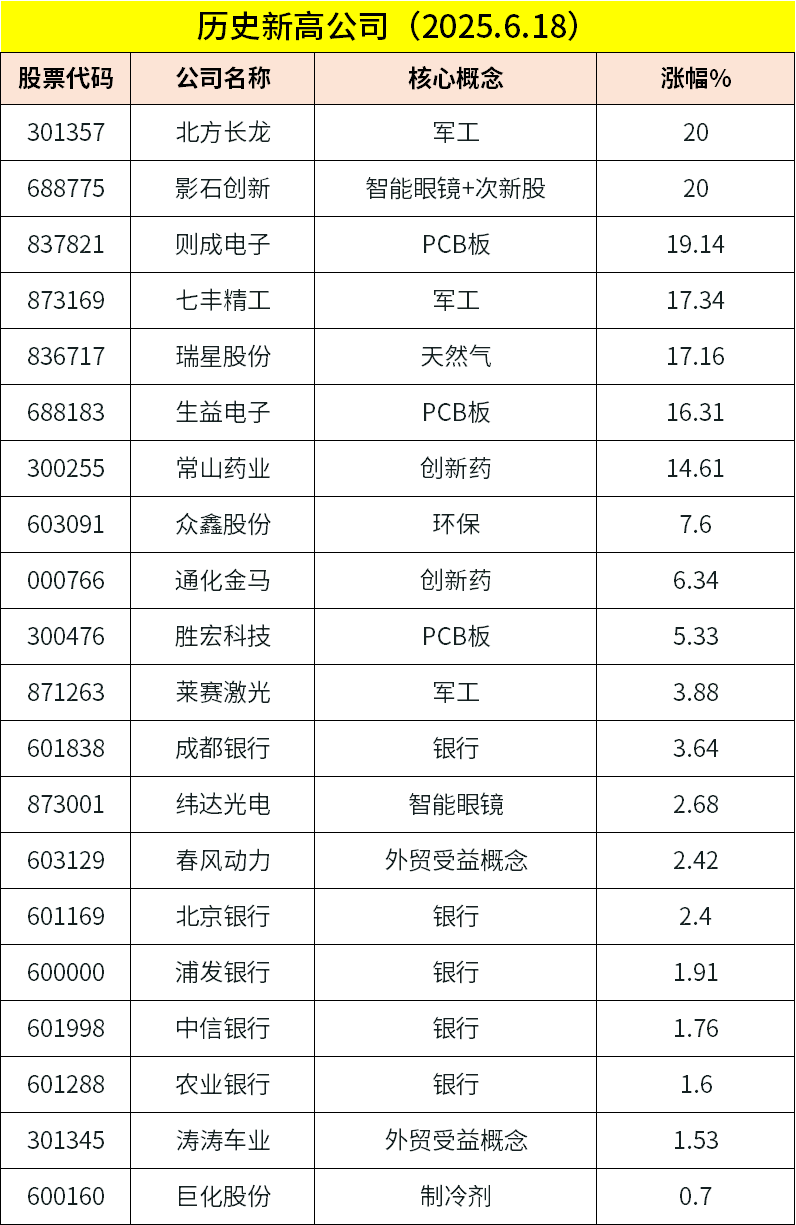
Market Overview - On June 18, A-shares experienced a rebound after hitting a low, with the three major indices slightly rising. The total trading volume reached 1.19 trillion yuan, a decrease of 16.1 billion yuan compared to the previous trading day. Over 3,400 stocks declined, indicating a mixed market sentiment [2][3]. Sector Highlights - **Banking Sector**: The banking sector showed strong performance in the morning, with stocks like Shanghai Bank and Pudong Development Bank rising. The recent international turmoil has led to a shift towards defensive sectors, while domestic economic recovery is boosting loan demand. It is expected that bank profitability will stabilize by 2025 [5][6]. - **Beer Sector**: The beer sector rebounded, with Yanjing Beer leading with over a 5% increase. Despite previous panic selling due to rumors of a "liquor ban," the fundamental outlook for the beer industry remains positive, especially with the upcoming summer consumption peak [7]. - **Military Trade Sector**: The military trade sector saw significant gains, with companies like Great Wall Industry hitting the daily limit. Factors such as escalating conflicts in the Middle East and the Paris Air Show have heightened interest in military products, particularly domestic military aircraft [8][9]. - **Non-Banking Financial Sector**: The non-banking financial sector underperformed, with companies like Dongwu Securities and Guosen Securities experiencing notable declines. Rising market risk aversion is likely impacting trading activity and short-term profitability for brokerages [10]. - **PCB Sector**: The PCB sector performed exceptionally well, with companies like Huadian Technology hitting the daily limit. Meta's announcement of a new AI chip, which requires advanced PCB designs, is expected to significantly boost demand for high-end PCBs [11][12]. - **AI Computing Sector**: The AI computing sector saw a collective rise, with PCB, optical modules, and storage segments performing particularly well. The market remains optimistic about the sustained demand for AI infrastructure, driven by Meta's upcoming AI chip launch [12]. Company Highlights - **Top Group**: Top Group's stock surged by 3% following Elon Musk's announcement of significant upgrades to the third generation of the Optimus robot. As a core supplier for Tesla's robotics, the company is expected to benefit directly from this development, despite a decline in first-quarter performance [14].


业内人士:在下半年经济底部探明前,基本面率先见底的行业会有比较多的机会
news flash· 2025-06-18 12:48
Core Viewpoint - The A-share market has shown a trend of oscillating upward since April 7, indicating a recovery phase, with opportunities emerging in industries that have seen their fundamentals bottom out before the overall economy does [1] Industry Summary - The overall performance of AH shares has been characterized by a gathering of market sentiment amid divergences and a gradual repair of valuations during fluctuations [1] - Industries expected to present more opportunities include innovative pharmaceuticals, new consumption, AI-related sectors, non-ferrous metals, and non-bank financials, as they are likely to see their fundamentals improve first [1] - Many industries are experiencing a relief from deflationary pressures, aided by adjustments in upstream prices, technological breakthroughs, and the benefits of engineering talent, leading to a gradual exit from profit troughs for many mid- and downstream sectors [1] - From a medium-term perspective, the A-share market is anticipated to continue following the main theme of Chinese manufacturing [1]
大厂做AI,必败吗?深度拆解字节跳动AI帝国:从豆包到火山引擎,字节能否大象转身?
混沌学园· 2025-06-18 10:05
Core Viewpoint - ByteDance has made a remarkable comeback in the AI sector, achieving a market share of 46.4% in the enterprise-level AI market with its Doubao model, surpassing competitors like Baidu and Alibaba [1][6][4]. Group 1: Business Perspective - ByteDance's Doubao model 1.6 was launched at a significantly lower cost, with pricing strategies that reduced costs by nearly 63% compared to competitors, making it more attractive for enterprises [6][3]. - The rapid growth in AI model usage is driven by a combination of improved vendor capabilities and reduced pricing, with Doubao leading the price-cutting trend in the market [7][6]. - The average cost for enterprises using Doubao is approximately 2.6 yuan per million tokens, which is substantially lower than the industry average [6][7]. Group 2: Product Perspective - The Doubao app has quickly risen to become one of the top AI applications globally, with daily active users reaching 945 million by October 2024, surpassing Baidu's Wenxin Yiyan [10][8]. - ByteDance effectively utilizes its vast content ecosystem and precise recommendation algorithms to drive traffic to Doubao, leading to exponential user growth [12][11]. - The integration of Doubao with other ByteDance products, such as Feishu, enhances its utility and user engagement, positioning it as a comprehensive AI solution [12][10]. Group 3: Organizational Perspective - ByteDance has undergone significant organizational restructuring to enhance its AI capabilities, creating specialized teams such as Seed for model development and Flow for AI application development [21][15]. - The company has actively recruited top AI talent from leading tech firms to bolster its research and development efforts, demonstrating a commitment to innovation [17][15]. - The new organizational structure has led to improved efficiency and product performance, with Doubao achieving capabilities that meet or exceed expectations within a short timeframe [21][24].