
家电

Search documents
民营企业最怕什么?宪法宣传周,格力董明珠说出了心里话!
Sou Hu Cai Jing· 2025-12-03 16:20
Core Insights - The article emphasizes the importance of a stable legal environment for the growth of private enterprises, highlighting that clarity in laws encourages companies to invest and innovate [2][3][5][21]. Group 1: Legal Environment and Business Confidence - The implementation of the Private Economy Promotion Law has provided a sense of security for private enterprises, making them feel more stable and confident in their operations [5][21]. - The recent actions to standardize administrative law enforcement have shifted the dynamic, where businesses feel less fear of making mistakes and more confidence in the regulatory environment [6][11]. - The stability of the legal framework allows companies to focus on long-term strategies rather than being distracted by external uncertainties [21][31]. Group 2: Gree's Business Strategy - Gree Electric Appliances exemplifies how a company can transform national stability into its own competitive advantage through strong internal capabilities and innovation [3][8][18]. - Gree's success is attributed to its focus on mastering core technologies and maintaining a robust quality control system, which has allowed it to thrive in a competitive market [12][18][27]. - The company has expanded its operations beyond air conditioning into smart equipment and renewable energy, demonstrating a strategic approach to growth based on manufacturing fundamentals [17][28]. Group 3: Innovation and Adaptation - Gree's management recognizes that internal challenges, such as management weaknesses and technological difficulties, are more critical than external competition [11][18]. - The company has adapted its marketing strategies, including engaging directly with consumers through live streaming, which reflects a shift towards more transparent communication [22][25]. - Gree's commitment to continuous improvement and innovation is evident in its investment in self-research and development, ensuring it remains competitive in the global market [17][28].



扩张、增长、突破……透过多维经济数据看中国经济的“稳”与“进”
Yang Shi Wang· 2025-12-03 16:08
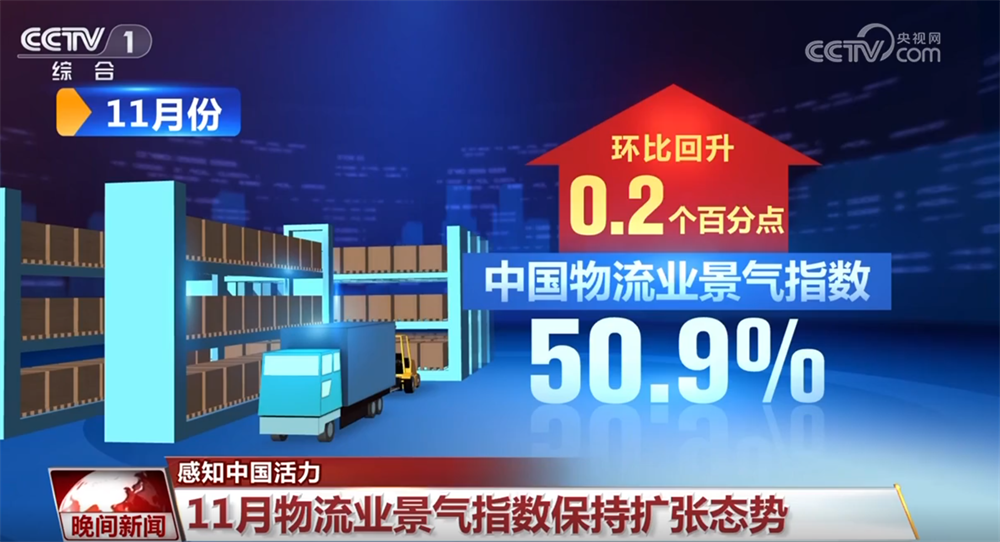
Economic Overview - China's economy shows a steady growth trend, with the logistics industry maintaining an expansionary stance in November [1] - The logistics industry prosperity index for November is reported at 50.9%, reflecting a month-on-month increase of 0.2 percentage points [3] Logistics Industry Insights - The logistics business volume index across eastern, central, and western regions of China is relatively balanced [3] - Demand sectors indicate a rebound in manufacturing, a slowdown in energy, and stable consumption [3] - Key industries such as transportation equipment, home appliances, smart devices, and automotive parts are experiencing strong demand [3] - The postal and express delivery business volume index for November stands at 70.2%, with offline entities, social e-commerce platforms, and comprehensive e-commerce platforms performing steadily [3] Service Trade Performance - In the first ten months, China's service trade imports and exports totaled 65,844.3 billion yuan, marking a year-on-year growth of 7.5% [5] - Service exports reached 29,090.3 billion yuan, growing by 14.3%, while the service trade deficit decreased by 2,693.9 billion yuan [5] - Knowledge-intensive service trade continues to grow, with imports and exports amounting to 25,121.5 billion yuan, a 6.4% increase [5] - The surplus in knowledge-intensive services expanded by 1,036 billion yuan compared to the previous year, reaching 4,254.3 billion yuan [5] Consumer Goods Market - From January to November, the "old-for-new" consumption policy has driven sales of related goods exceeding 25,000 billion yuan, benefiting over 360 million people [7] - The automotive sector saw over 11.2 million vehicles replaced, while home appliances and digital products also experienced significant upgrades [7] - The government has allocated 300 billion yuan in special long-term bonds to support the "old-for-new" consumption initiative [7] Telecommunications Sector - The telecommunications industry has shown overall stability in the first ten months of the year [9] - The user base for 5G, gigabit broadband, and the Internet of Things continues to expand, with 5G mobile phone users reaching 1.184 billion, accounting for 64.7% of mobile phone users [9] - Mobile internet traffic has seen a robust growth, exceeding 320 billion GB, with a year-on-year increase of 16.8% [9]
金融工程日报:沪指震荡下挫,AI应用、锂电池题材领跌-20251203
Guoxin Securities· 2025-12-03 14:46
证券研究报告 | 2025年12月03日 金融工程日报 沪指震荡下挫,AI 应用、锂电池题材领跌 市场表现:20251203 大部分指数处于下跌状态,规模指数中沪深 300 指数表 现较好,板块指数中北证 50 指数表现较好,风格指数中中证 500 价值指数 表现较好。交通运输、有色金属、煤炭、综合金融、家电行业表现较好,传 媒、计算机、房地产、商贸零售、综合行业表现较差。培育钻石、超硬材料、 锗镓锑墨、铝产业、铝空气电池等概念表现较好,WEB3.0、百度平台、小红 书平台、RCS、ChatGPT 等概念表现较差。 市场情绪:20251203 收盘时有 53 只股票涨停,有 16 只股票跌停。昨日涨停 股票今日收盘收益为 1.17%,昨日跌停股票今日收盘收益为-5.91%。今日封 板率 61%,较前日下降 7%,连板率 24%,较前日下降 0%。 市场资金流向:截至 20251202 两融余额为 24865 亿元,其中融资余额 24689 亿元,融券余额 176 亿元。两融余额占流通市值比重为 2.6%,两融交易占市 场成交额比重为 9.7%。 折溢价:20251202 当日 ETF 溢价较多的是 G60 创 ...
董明珠践行少说话承诺,格力累计分红超1700亿
Sou Hu Cai Jing· 2025-12-03 13:45
Core Viewpoint - Gree Electric Appliances has maintained a high dividend policy, distributing over 170 billion yuan in total dividends since its listing, but faces challenges with declining revenue and net profit in recent quarters, highlighting the need for operational efficiency and market adaptation [5][10][23]. Dividend Policy - Gree's 2025 mid-term profit distribution plan proposes a cash dividend of 10 yuan per 10 shares, totaling 5.585 billion yuan, with cumulative dividends exceeding 170 billion yuan since its listing [6][9]. - Gree ranks approximately 17th in total dividends among A-share companies, with the highest dividends being distributed by state-owned enterprises [6][9]. - The company has a dividend-to-financing ratio of about 33 times, placing it in the top ten among A-share companies [6][9]. Financial Performance - For the first three quarters of 2025, Gree reported revenue of 137.65 billion yuan, a year-on-year decrease of 6.6%, and a net profit of 21.46 billion yuan, down 2.3% [10][11]. - Gree's revenue decline is attributed to its heavy reliance on the air conditioning business, which constitutes 78.38% of total revenue, and is affected by industry downturns [10][13]. Market Position and Competition - Gree faces increasing competition from rivals like Midea and Haier, which have diversified their business models and reported revenue growth, while Gree's market share in the air conditioning sector is under pressure from emerging competitors like Xiaomi [12][13]. - The company's recent channel reforms have temporarily hindered domestic sales, contributing to the revenue decline [12]. Leadership and Shareholding - Dong Mingzhu, Gree's chairperson, holds approximately 1.008 billion shares, making her the sixth-largest shareholder and the largest individual shareholder [14][19]. - Dong's annual salary is reported at 14.37 million yuan, and she stands to gain significant dividends from Gree's high payout policy [16][19].

超2.5万亿元,惠及超3.6亿人次
中国能源报· 2025-12-03 13:23
Group 1 - The core viewpoint of the article highlights that the old-for-new consumption policy in China has significantly boosted sales, exceeding 2.5 trillion yuan in the first eleven months of the year, benefiting over 360 million people [1] Group 2 - The old-for-new program has led to the replacement of over 1.12 million vehicles [1] - The program has facilitated the replacement of more than 12.84 million home appliances [1] - Subsidies for new purchases of mobile phones and digital products have exceeded 9.015 million units [1] - The initiative has resulted in the replacement of over 1.29 million electric bicycles [1] - The home renovation and kitchen and bathroom upgrades have seen over 120 million items renewed [1]

市场情绪延续偏弱
Tebon Securities· 2025-12-03 13:13
Market Overview - The A-share market is experiencing a weak sentiment with major indices showing a general decline, particularly in the growth sectors which are adjusting more significantly than value sectors [3][6] - The Shanghai Composite Index closed at 3878.00 points, down 0.51%, while the Shenzhen Component Index fell 0.78% to 12955.25 points, and the ChiNext Index decreased by 1.12% to 3036.79 points [3] Stock Market Analysis - The market lacks a clear leading sector, with significant fluctuations observed in the commercial aerospace sector, influenced by recent rocket launch news [6][10] - Defensive sectors and some cyclical stocks are showing resilience against the overall market decline, suggesting a rotation in investment strategies [6][7] Bond Market Insights - The bond futures market is characterized by a clear differentiation in performance across maturities, with long-term bonds underperforming while mid to short-term bonds are stabilizing [10] - The 30-year bond contract saw a decline of 0.26%, while the 10-year bond contract increased by 0.06%, indicating a mixed sentiment in the bond market [10] Commodity Market Trends - Financial commodities are outperforming industrial commodities, with the Nanhua Commodity Index down 0.28% while industrial products are under pressure [10][11] - The industrial product index has decreased by 7.19% since the beginning of the year, reflecting weak demand and a contraction in manufacturing activity [10] Investment Strategy Recommendations - The report suggests maintaining a balanced allocation between technology and dividend stocks to hedge against sector rotation risks [7][12] - Focus on structural opportunities in undervalued defensive sectors and industries aligned with the "15th Five-Year Plan" trends [7][12] Recent Trading Hotspots - Key investment themes include dividend stocks for their attractive yields, AI applications driven by major tech advancements, and consumer sectors benefiting from currency appreciation [12] - The brokerage sector is highlighted due to active trading volumes and potential changes in trading regulations [12]
全球大类资产配置和A股相对收益策略:看多实物黄金和CTA策略,权益等待下一轮周期
China Securities· 2025-12-03 12:45
Group 1 - The report maintains a bullish outlook on physical gold and CTA strategies while suggesting a wait-and-see approach for equities until the next cycle [3] - The absolute returns for global multi-asset allocation strategies in November were -0.16% for low-risk, -1.04% for medium-high risk, and -2.94% for A-share sector and style rotation, with year-to-date returns of 3.49%, 22.12%, and 27.88% respectively [3][10] - The forecast for the ROE of the Wind All A and Wind All A non-financial indices for Q4 2025 is 7.50% and 6.60%, respectively, with a downward adjustment compared to the previous month [3][40] Group 2 - The report indicates a downtrend in A-share sentiment index from historical highs, with a similar decline in the Hong Kong stock sentiment index [3] - The report suggests a bullish stance on large-cap and value styles in A-shares, particularly in sectors such as home appliances, utilities, defense, electronics, computers, and insurance [3] - The report highlights that the current institutional focus is shifting towards basic chemicals, defense, textiles, non-bank financials, and media, while attention on the telecommunications sector is decreasing [3] Group 3 - The report predicts that gold priced in USD will continue to strengthen, supported by a weak economic outlook and increased market volatility [3][70] - The report notes that the A-share market is experiencing a rotation in sector performance, with a focus on industries with higher financial health indicators [3] - The report emphasizes the importance of monitoring liquidity, stock dispersion, and volatility as many sectors are approaching crowded indicator thresholds [3]
LG电子更换CEO:“家电王者”如何拯救电视巨亏与增长焦虑
Xi Niu Cai Jing· 2025-12-03 12:44
Core Insights - LG Electronics has appointed a new CEO, Ryu Jae-cheol, to strengthen its core competitiveness amid significant performance challenges, replacing the previous CEO, Jo Seong-jin [2] - The company is facing declining revenue and profits, with Q3 2025 revenue reported at 21.87 trillion KRW, a 1.4% decrease year-on-year, and operating profit down 8.4% to 688.9 billion KRW [2] - The Media Solutions (MS) division, responsible for TVs and displays, reported an operating loss of 302.6 billion KRW, contrasting sharply with the profitability of other divisions [2] Financial Performance - LG Electronics' overall revenue for Q3 2025 was 21.87 trillion KRW, down 1.4% from the previous year, while operating profit decreased by 8.4% to 688.9 billion KRW [2] - The MS division's losses are attributed to increased marketing expenses and one-time restructuring costs, alongside pressures from weak global demand and rising logistics costs [3] Market Position - LG Electronics' market share in the global TV segment has declined to 11.7%, ranking fourth behind Samsung, Hisense, and TCL, with a gap of 3.2 percentage points from TCL [4] - The global TV shipment volume for Q3 2025 was approximately 49.75 million units, with LG's market share significantly reduced from a peak of 18.5% in 2021 [4] Competitive Landscape - In the OLED segment, LG's growth has stagnated, with a mere 0.2% increase in OLED TV shipments to 1.3 million units in the first half of the year, while Samsung's shipments surged by 49.3% [5] - LG faces increasing competition in the MiniLED TV market, where TCL and Hisense hold over 50% market share, posing a significant challenge to LG's high-end offerings [5] - The company's presence in the Chinese consumer electronics market is diminishing, with local brands dominating and LG's mobile business already exited, leading to challenges in maintaining market share and brand visibility [5]
前11个月消费品以旧换新带动销售超2.5万亿元
Yang Shi Wang· 2025-12-03 12:28
Core Insights - The core message highlights the significant impact of the "trade-in" policy on consumer goods sales in China, with a total sales amount exceeding 2.5 trillion yuan and benefiting over 360 million people [1] Group 1: Sales Impact - The trade-in program for consumer goods has driven sales exceeding 2.5 trillion yuan from January to November this year [1] - The automotive sector saw over 11.2 million vehicles traded in, while home appliances accounted for over 12.844 million units [1] - Digital products, including mobile phones, received subsidies for over 9.015 million units, and electric bicycles saw over 1.291 million units traded in [1] Group 2: Policy Support - The Chinese government has allocated 300 billion yuan in special long-term bonds to support the trade-in program across four batches this year [1] - The acceleration of policy effects is fostering the development of new consumption patterns, particularly in digital and green sectors [1] Group 3: Industry Transformation - The trade-in initiative is promoting the green transformation of related industries, indicating a shift towards more sustainable consumption practices [1]
瑞银:中国消费正在发生结构性变化,关注板块 “阿尔法”投资机会
Xin Hua Cai Jing· 2025-12-03 12:06
Group 1 - The Chinese consumer market is showing significant "differentiation" characteristics, with new consumption sectors like trendy toys, chain tea drinks, high-end gold jewelry, and pet consumption emerging as bright spots despite an overall weak consumption environment [1] - The trendy toy industry has evolved into a "global emotional consumer product" aimed at adults, with Chinese companies facing challenges in leveraging supply chain advantages and localizing products for global markets [1] - The pet economy has maintained double-digit growth in recent years, with a clear trend of consumption upgrading, and despite recent profit pressures from online competition, there remains long-term growth potential for Chinese pet industry companies [1] Group 2 - There is a structural change in Chinese consumption, with some service sectors like high-end tourism and elderly care still facing supply shortages, indicating that consumers are changing their consumption methods rather than reducing consumption [2] - The home appliance sector is one of the fastest-growing areas in consumption, benefiting from subsidy policies implemented since last year, although the effectiveness of these subsidies may be diminishing [2] - The "takeout war" has had a significant impact on the restaurant industry, with leading tea drink companies experiencing substantial order growth in the first half of the year, but the marginal impact of takeout has begun to weaken, leading to some companies facing "increased revenue without increased profit" [2] - Smaller restaurant businesses are more negatively affected by the "takeout war," as they lack bargaining power in negotiations with delivery platforms, resulting in cost pressures that some are unable to sustain [2]