
化工品制造

Search documents
乙二醇强势反弹,后市怎么看?
对冲研投· 2026-01-22 09:36
Core Viewpoint - The article discusses the recent rebound in ethylene glycol prices, driven by increased maintenance of overseas facilities and expectations of reduced imports due to weather conditions in North America [3][7]. Supply and Demand Analysis - As of January 22, ethylene glycol futures saw a significant increase of 166 yuan to 3847 yuan/ton, marking a 4.5% rise [3]. - The supply-demand balance indicates that domestic production remains high, with an operating rate of 73.43% for ethylene glycol and 79.4% for synthetic gas as of January 22 [8]. - Despite the seasonal decline in demand due to the upcoming Spring Festival, the overall supply is expected to remain substantial, leading to an estimated inventory pressure of 40-50 thousand tons in January and February [10][11]. Maintenance and Production Updates - Several overseas facilities are undergoing maintenance, including two plants in Taiwan and multiple facilities in Saudi Arabia, which are expected to impact import levels positively [5][6][7]. - The maintenance schedules include significant capacity reductions, with Saudi Arabia's Sharq plant (45,000 tons) and others scheduled for repairs, potentially affecting market supply [6][7]. Price Outlook - Ethylene glycol prices are currently at historical low valuation levels, with expectations of limited downside due to improved import conditions and seasonal demand recovery anticipated in March [12]. - The article suggests that while short-term price fluctuations may continue, a rebound in prices is likely as domestic production enters a brief vacuum and demand increases in the first half of the year [12].


每日核心期货品种分析-20260119
Guan Tong Qi Huo· 2026-01-19 11:12
Report Summary 1. Report Industry Investment Rating No information provided. 2. Core Viewpoints - The domestic futures market showed mixed performance on January 19, 2026, with some commodities rising and others falling. Different commodities have different supply - demand situations and price trends affected by various factors such as policies, geopolitical events, and seasonal factors [5]. 3. Summary by Commodity Metals - **Copper**: The price of Shanghai copper declined. Although there is short - term demand slump, the copper fundamentals remain tight. With the decline in mining and smelting, and the continuous implementation of domestic stable - growth policies, the price is in a stage of correction [8][10]. - **Silver and Gold**: Shanghai silver and gold futures rose, with significant capital inflows into their relevant contracts [5][6]. - **Tin**: Shanghai tin futures fell by more than 5% [5]. - **Lithium Carbonate**: It showed a downward trend overall. Despite supply - side disturbances, the strong demand for exports keeps the overall situation strong, but one should be cautious about market sentiment [11]. - **Iron Ore**: It fell by nearly 3%, and there was significant capital outflow from its relevant contracts [5][6]. Energy - **Crude Oil**: OPEC+ maintained the production plan, and the market is in a supply - surplus pattern. With geopolitical risks in the Middle East and other regions, the price is expected to fluctuate and consolidate [12][13]. - **Asphalt**: The supply is at a low level, and the demand will further slow down. Affected by the situation in Venezuela, the price is expected to fluctuate, and it is recommended to use the reverse spread strategy [14]. Chemicals - **PP**: The downstream demand is weak, and the supply - demand pattern improvement is limited. It is expected to fluctuate within a range, and the L - PP spread is expected to narrow [16]. - **Plastic**: The开工 rate has increased, but the downstream demand is decreasing. It is expected to fluctuate within a range, and the L - PP spread is expected to narrow [17][18]. - **PVC**: The supply is relatively stable, and the downstream demand is in the off - season. With the impact of export policies, the 03 - 05 contracts are expected to fluctuate strongly [19]. Others - **Coking Coal**: The price decline has slowed down. With the increase in winter storage, the market is expected to improve [20]. - **Urea**: The price declined. Although the supply is stable, the downstream procurement has not kept up with the futures price increase. With the approaching of the spring plowing season, it is recommended to go long on dips [21][22]. Financial Futures - **Stock Index Futures**: The performance of different stock index futures varied. The IF and IC contracts rose, while the IH contract fell slightly, and the IM contract rose slightly [5][6]. - **Treasury Bond Futures**: The 2 - year contract remained flat, while the 5 - year, 10 - year, and 30 - year contracts declined [6].
金融期货早评-20260119
Nan Hua Qi Huo· 2026-01-19 05:10
Report Summary 1. Report Industry Investment Rating No specific industry investment ratings are provided in the report. 2. Core Views - **Asset Allocation**: In the equity market, Chinese stocks have high return odds, while US stocks need to be carefully differentiated, and Japanese stocks offer short - term event - driven opportunities. In the fixed - income market, the Chinese bond market will likely fluctuate, and the US bond market will be volatile. In commodities and foreign exchange, crude oil will be highly volatile, the value of gold will be prominent, and the RMB exchange rate is expected to fluctuate around the equilibrium level with a mild appreciation basis [1]. - **Exchange Rates**: The RMB is expected to appreciate against the US dollar before the Spring Festival. The appreciation space depends on the strength of the US dollar index and the central bank's regulation of the RMB exchange rate [3]. - **Stock Index Futures**: The short - term adjustment of the stock index is only a slowdown in rhythm, not a trend reversal. It is expected to strengthen again after the adjustment [4]. - **Treasury Bonds**: The bond market may need new catalysts to continue rising. It is recommended to hold medium - term long positions and wait and see in the short term [5][6]. - **Commodities** - **Carbonate Lithium**: There is support on the demand side before the Spring Festival. In the long - term, the industry fundamentals support its value, but beware of the impact on downstream demand. Investors can look for structural long - making opportunities [7][8]. - **Industrial Silicon and Polysilicon**: In the short term, pay attention to polysilicon enterprises' production resumption. In the medium - term, polysilicon prices may decline, but industrial silicon has support at the bottom [8][10][11]. - **Copper**: The copper price is affected by multiple events. It is recommended to pay attention to volume - price fluctuations and avoid new positions above 100,000 yuan [11][14]. - **Aluminum and Related Products**: Aluminum prices may rise in the long - term; alumina is expected to be weak in the medium - term; casting aluminum alloy is recommended to pay attention to the price difference with aluminum [15][16]. - **Zinc**: There is support at the bottom in the short - term, and it is advisable to observe the entry opportunity after a significant correction [18]. - **Nickel - Stainless Steel**: The trend is volatile, and the quota issuance rhythm is the core factor [19]. - **Tin**: It may maintain high - level wide - range fluctuations [20]. - **Lead**: It will mainly fluctuate in a range [21]. - **Oils and Fats and Feeds** - **Oilseeds**: The external market of US soybeans is weak, the domestic soybean meal has limited downward space, and rapeseed meal may be re - priced internationally [22][23]. - **Oils**: The support for rapeseed oil is weakening, and attention can be paid to the narrowing of the rapeseed - palm oil price difference [24][25]. - **Energy and Oil and Gas** - **Fuel Oil**: The high - sulfur fuel oil has a weak long - term trend, and the low - sulfur fuel oil has a sluggish cracking spread. It is recommended to wait and see [26][27][28]. - **Asphalt**: The basis may be passively strengthened, and it is recommended to pay attention to the positive spread [28][29]. - **Precious Metals** - **Platinum and Palladium**: They are in a high - level wide - range shock. Be wary of the callback risk during the Spring Festival [31][32][35]. - **Gold and Silver**: They are in an easy - to - rise and hard - to - fall pattern. Long - term bullish, but pay attention to position control [35][36]. - **Chemicals** - **Pulp - Offset Paper**: The current situation is bearish, and it is recommended to wait and see [38][40][41]. - **LPG**: Pay attention to geopolitical changes and domestic device maintenance [41][42]. - **PTA - PX**: It is recommended to buy on dips in the long - term, but there may be a phased correction in the short - term [42][44]. - **MEG - Bottle Chips**: The excess supply will suppress the valuation, and the "reversal" may rely on macro - narrative [44][45]. - **Methanol**: It is recommended to wait and see due to the uncertainty of the geopolitical logic [46]. - **PP**: Pay attention to the actual implementation of device maintenance [48][49]. - **PE**: It may maintain a weak trend in the short - term [49][50]. - **Pure Benzene - Styrene**: Styrene is relatively strong, but do not chase high prices [50][51][52]. - **Rubber**: The fundamental pressure still exists, and it is recommended to wait and see [53][68][69]. - **Urea**: It is recommended to hold long positions, with a possible short - term correction [54][55]. - **Glass and Soda Ash**: Soda ash has an over - supply expectation; glass has a weak supply - demand pattern [56][57]. - **Propylene**: The price may rise in the short - term, and pay attention to geopolitical and device changes [57][58]. - **Black Metals** - **Rebar and Hot - Rolled Coil**: They will maintain a range - bound trend in the short - term [59]. - **Iron Ore**: The price is over - valued in the short - term, but there is support at the bottom [59][60][61]. - **Coking Coal and Coke**: Pay attention to the macro - sentiment and the resumption of domestic mines after the Spring Festival [62]. - **Silicon Iron and Silicon Manganese**: They may oscillate at the bottom after the correction [62][63]. - **Agricultural and Soft Commodities** - **Hogs**: The price will continue to fluctuate, and it is difficult to have a trend change in the short - term [64][65]. - **Cotton**: It may fluctuate in a narrow range, and pay attention to downstream imports and orders [65][66]. - **Sugar**: It is expected to fluctuate in the short - term, and pay attention to the production progress in Thailand and India [66][67]. - **Eggs**: The price is supported before the Spring Festival, and it is advisable to buy on dips in the near - term contracts [68]. - **Apples**: The disk may continue to decline if the Spring Festival stocking does not improve [70][71]. - **Red Dates**: The price will likely fluctuate at a low level in the short - term and be under pressure in the long - term [72]. - **Logs**: The 03 contract is expected to oscillate in the range of 760 - 795 yuan, and consider the 3 - 5 positive spread [73][74][75]. 3. Summary by Directory Financial Futures - **Market News**: The US plans to impose tariffs on 8 European countries; China adjusts the minimum down - payment ratio for commercial housing mortgages; China's electricity consumption in 2025 exceeded 10 trillion kWh; the CSRC emphasizes market stability [1]. - **Core Logic**: Five core logic lines for asset allocation are proposed, covering the Fed's policy, geopolitics, global growth sources, social vulnerability, and policy cycle differences [1]. - **Exchange Rate**: The RMB is expected to appreciate against the US dollar before the Spring Festival, and its appreciation is affected by the US dollar index and central bank regulation [3]. - **Stock Index Futures**: The short - term adjustment of the stock index is temporary, and it is expected to strengthen again [4]. - **Treasury Bonds**: The bond market needs new catalysts, and it is recommended to hold long positions in the medium - term and wait in the short - term [5][6]. Commodities - **New Energy** - **Carbonate Lithium**: The price dropped last week, but the demand is supported before the Spring Festival. In the long - term, the industry fundamentals are stable [7]. - **Industrial Silicon and Polysilicon**: Industrial silicon fluctuates widely, and polysilicon focuses on inventory reduction. Pay attention to polysilicon enterprises' production resumption [8][10]. - **Non - ferrous Metals** - **Copper**: The price dropped last week due to multiple factors. It is recommended to pay attention to volume - price fluctuations [11][14]. - **Aluminum and Related Products**: Aluminum prices may rise in the long - term; alumina is expected to be weak in the medium - term; casting aluminum alloy is recommended to pay attention to the price difference with aluminum [15][16]. - **Zinc**: There is support at the bottom in the short - term, and it is advisable to observe the entry opportunity after a significant correction [18]. - **Nickel - Stainless Steel**: The trend is volatile, and the quota issuance rhythm is the core factor [19]. - **Tin**: It may maintain high - level wide - range fluctuations [20]. - **Lead**: It will mainly fluctuate in a range [21]. - **Oils and Fats and Feeds** - **Oilseeds**: The external market of US soybeans is weak, the domestic soybean meal has limited downward space, and rapeseed meal may be re - priced internationally [22][23]. - **Oils**: The support for rapeseed oil is weakening, and attention can be paid to the narrowing of the rapeseed - palm oil price difference [24][25]. - **Energy and Oil and Gas** - **Fuel Oil**: The high - sulfur fuel oil has a weak long - term trend, and the low - sulfur fuel oil has a sluggish cracking spread. It is recommended to wait and see [26][27]. - **Asphalt**: The basis may be passively strengthened, and it is recommended to pay attention to the positive spread [28][29]. - **Precious Metals** - **Platinum and Palladium**: They are in a high - level wide - range shock. Be wary of the callback risk during the Spring Festival [31][32]. - **Gold and Silver**: They are in an easy - to - rise and hard - to - fall pattern. Long - term bullish, but pay attention to position control [35][36]. Chemicals - **Pulp - Offset Paper**: The pulp price dropped, and the offset paper futures are bearish. It is recommended to wait and see [38][40][41]. - **LPG**: Pay attention to geopolitical changes and domestic device maintenance [41][42]. - **PTA - PX**: It is recommended to buy on dips in the long - term, but there may be a phased correction in the short - term [42][44]. - **MEG - Bottle Chips**: The excess supply will suppress the valuation, and the "reversal" may rely on macro - narrative [44][45]. - **Methanol**: It is recommended to wait and see due to the uncertainty of the geopolitical logic [46]. - **PP**: Pay attention to the actual implementation of device maintenance [48][49]. - **PE**: It may maintain a weak trend in the short - term [49][50]. - **Pure Benzene - Styrene**: Styrene is relatively strong, but do not chase high prices [50][51][52]. - **Rubber**: The fundamental pressure still exists, and it is recommended to wait and see [53][68][69]. - **Urea**: It is recommended to hold long positions, with a possible short - term correction [54][55]. - **Glass and Soda Ash**: Soda ash has an over - supply expectation; glass has a weak supply - demand pattern [56][57]. - **Propylene**: The price may rise in the short - term, and pay attention to geopolitical and device changes [57][58]. Black Metals - **Rebar and Hot - Rolled Coil**: They will maintain a range - bound trend in the short - term [59]. - **Iron Ore**: The price is over - valued in the short - term, but there is support at the bottom [59][60][61]. - **Coking Coal and Coke**: Pay attention to the macro - sentiment and the resumption of domestic mines after the Spring Festival [62]. - **Silicon Iron and Silicon Manganese**: They may oscillate at the bottom after the correction [62][63]. Agricultural and Soft Commodities - **Hogs**: The price will continue to fluctuate, and it is difficult to have a trend change in the short - term [64][65]. - **Cotton**: It may fluctuate in a narrow range, and pay attention to downstream imports and orders [65][66]. - **Sugar**: It is expected to fluctuate in the short - term, and pay attention to the production progress in Thailand and India [66][67]. - **Eggs**: The price is supported before the Spring Festival, and it is advisable to buy on dips in the near - term contracts [68]. - **Apples**: The disk may continue to decline if the Spring Festival stocking does not improve [70][71]. - **Red Dates**: The price will likely fluctuate at a low level in the short - term and be under pressure in the long - term [72]. - **Logs**: The 03 contract is expected to oscillate in the range of 760 - 795 yuan, and consider the 3 - 5 positive spread [73][74][75].
金融期货早评-20260115
Nan Hua Qi Huo· 2026-01-15 02:12
1. Report Industry Investment Ratings No relevant content is provided in the report. 2. Core Views of the Report - The current global macro - economy is in a pattern of stagflation pressure, institutional disputes, and geopolitical tensions. Overseas, the large - scale liquidity released during the crisis response stage has led to a stagflation situation. The Fed's interest - rate decisions have been involved in political games, and the Trump tariff issue has increased global trade uncertainties. Geopolitical tensions may also disrupt cross - border trade. Domestically, China's exports showed strong resilience in 2025, and the export situation in 2026 may be optimistic [2]. - The RMB exchange rate is expected to continue to appreciate before the Spring Festival. The appreciation is supported by the acceleration of China's foreign trade recovery, but its rhythm will be affected by the US dollar index and the central bank's regulation [4]. - The stock index market may experience a short - term adjustment due to the regulatory action of raising the minimum margin ratio for margin trading, but the upward trend is expected to resume after the adjustment [5]. - The possibility of a short - term reserve requirement ratio cut has decreased for treasury bonds. The bond market's short - term upward space is limited [6][7]. - The container shipping market for European routes is expected to be in a weak and volatile pattern in the short term. Traders can consider short - selling on rallies [11]. - For new energy commodities, lithium carbonate futures are expected to enter a high - level volatile state, and industrial silicon and polysilicon prices are affected by factors such as export tax rebates and inventory [13][16]. - In the non - ferrous metals market, copper prices are in a high - level consolidation state, and aluminum prices may be volatile at a high level in the short term, while other non - ferrous metals also have different trends and investment suggestions [17][22]. - For oilseeds and fats, the external soybean market is weak, and the domestic soybean meal and rapeseed meal markets have different supply and demand situations. The palm oil market may experience a short - term correction [28][30]. - In the energy and oil and gas market, high - sulfur fuel oil may experience a rebound due to supply disruptions, and low - sulfur fuel oil is under pressure. Asphalt prices may be relatively strong in the short term [31][36]. - For precious metals, platinum and palladium may face short - term callback risks, while gold and silver are in a pattern of being prone to rise and difficult to fall [37][43]. - In the chemical market, the pulp and offset paper markets are relatively stable, and LPG, PTA - PX, and other chemical products have different supply - demand situations and price trends [46][55]. - In the black market, steel products are in a bottom - oscillating state supported by raw materials, and iron ore, coking coal, coke, and ferroalloys also have their own market characteristics [64][68]. - For agricultural and soft commodities, cotton prices may have short - term callback risks, sugar prices are under pressure in an oscillating state, and apples, dates, and logs have different market trends [69][77]. 3. Summary by Relevant Catalogs 3.1 Financial Futures - **Macro**: China's trade surplus exceeded $1 trillion for the first time in 2025. The country's foreign trade imports and exports reached 45.47 trillion yuan, a 3.8% year - on - year increase. In December, exports of rare earths increased by 32% year - on - year. Overseas, there are issues such as the Fed's interest - rate decision disputes, the Trump tariff case, and geopolitical tensions [1]. - **RMB Exchange Rate**: The RMB is expected to appreciate before the Spring Festival. China's foreign trade recovery in December was significant, with exports in US dollars increasing by 6.6% year - on - year and imports increasing by 5.7%. The US dollar index is in a high - level volatile state, and the RMB's appreciation is also affected by the central bank's regulation [3][4]. - **Stock Index**: The regulatory action of raising the minimum margin ratio for margin trading from 80% to 100% aims to cool down the over - heated market. The short - term market may fluctuate, but the upward trend is expected to resume [5]. - **Treasury Bonds**: Short - term reserve requirement ratio cuts are less likely. The bond market's short - term upward space is limited due to the stock market's upward trend [6][7]. - **Container Shipping for European Routes**: The market is in a weak and volatile state. Spot freight rates are declining, and there are both negative and positive factors. Traders can consider short - selling on rallies [9][11]. 3.2 New Energy - **Lithium Carbonate**: The futures price has significantly corrected. The spot market is in a "not - off - season" state, but the futures price may enter a high - level volatile state. Short - term investors are advised to realize profits and wait for opportunities to enter the market at low prices [13]. - **Industrial Silicon and Polysilicon**: The prices are in a wide - range volatile state. The demand for photovoltaic exports may drive short - term demand, but polysilicon inventory is high. In the medium term, polysilicon prices may decline, while industrial silicon has support at low prices [16]. 3.3 Non - Ferrous Metals - **Copper**: The spot premium has increased, but the transaction is stagnant. The futures price is in a high - level consolidation state. It is not recommended to open new positions above 100,000 yuan, and enterprises can consider constructing option strategies [17][19]. - **Aluminum**: The price may be volatile at a high level in the short term due to factors such as the Trump tariff and the cancellation of the VAT export rebate for photovoltaic products. In the medium and long term, the price is expected to rise [22]. - **Other Non - Ferrous Metals**: Zinc, nickel - stainless steel, tin, lead, etc. have their own market characteristics, such as zinc being in a strong and volatile state, and tin having upward momentum [23][26]. 3.4 Oilseeds and Fats - **Oilseeds**: The external soybean market is weak, and the domestic soybean meal and rapeseed meal markets have different supply and demand situations. The soybean meal market may be strong in the near term and weak in the far term, and the rapeseed meal market is in a state of weak supply and demand [28][29]. - **Fats**: The palm oil market may experience a short - term correction due to the Indonesian government's decision not to implement B50 this year. The soybean oil and rapeseed oil markets are affected by factors such as supply and policy [30]. 3.5 Energy and Oil and Gas - **Fuel Oil**: High - sulfur fuel oil may experience a rebound due to supply disruptions caused by US sanctions. Low - sulfur fuel oil is under pressure due to improved supply [31][33]. - **Asphalt**: The price may be relatively strong in the short term due to factors such as the winter - storage policy and geopolitical tensions. The market is in a state of limited upward and downward space [34][36]. 3.6 Precious Metals - **Platinum and Palladium**: The prices are affected by factors such as geopolitical conflicts, index parameter adjustments, and the Fed's monetary policy. There may be short - term callback risks, but the long - term bullish foundation remains [37][40]. - **Gold and Silver**: The price of silver is rising rapidly, and the gold - silver ratio has fallen below 50. The precious metals market is in a pattern of being prone to rise and difficult to fall, but short - term fluctuations may increase [41][43]. 3.7 Chemicals - **Pulp - Offset Paper**: The market is relatively stable, and the current situation is slightly bearish. It is advisable to wait and see and avoid chasing short positions [46]. - **LPG**: The price is supported by geopolitical factors, but the increase in PDH maintenance has a negative impact on the market. Attention should be paid to geopolitical changes and domestic device maintenance [48]. - **PTA - PX**: The demand feedback is intensifying, and the short - term upward momentum is weakening. PX is expected to be in a tight supply - demand situation in the first half of 2026, but the PTA processing fee increase space is limited [48][51]. - **MEG - Bottle Chips**: The demand feedback is negative, and the supply - demand situation is under pressure. The price may be affected by macro factors, and it is advisable to wait and see [51][53]. - **PP**: The supply pressure is relieved in the short term due to increased device maintenance. Attention should be paid to the actual implementation of device maintenance plans [54][55]. - **PE**: The spot price is strong, but the supply is expected to increase in the long term, and the demand may decline seasonally [56][57]. - **Pure Benzene - Styrene**: The pure benzene market is in an oversupply situation and follows the cost - end fluctuations. The styrene market is strong due to factors such as exports and macro - news, and attention should be paid to export increments and supply returns [57][58]. - **Urea**: The price may rise in the first half of 2026 due to the agricultural demand peak season, but there may be a short - term correction. It is recommended to hold long positions [59][60]. - **Soda Ash - Glass - Caustic Soda**: Soda ash is in an oversupply situation, and the price is restricted by high - level inventory. Glass has high - level inventory in the middle - stream, and the spot pressure exists. Caustic soda is in a state of weak reality, and the price is expected to be in a wide - range volatile state [60][62]. - **Propylene**: The price may rise due to cost factors and device maintenance. Attention should be paid to geopolitical impacts on the cost - end and PDH device changes [62][63]. 3.8 Black - **Rebar and Hot - Rolled Coil**: The rebar demand is seasonally weak, and the supply of steel products is increasing. The prices of steel products are in a bottom - oscillating state supported by raw materials [64][65]. - **Iron Ore**: The market sentiment has declined. The supply is abundant, and the demand is difficult to support continuous large - scale production increases. It is not recommended to chase long positions at the current position [65][66]. - **Coking Coal and Coke**: The spot trading has improved, and the basis has strengthened. The supply is stable, and the demand is expected to increase. Attention should be paid to macro - sentiment changes [66][67]. - **Silicon Iron and Silicon Manganese**: The supply pressure is high, but the prices are supported by the cost - end. Silicon iron is starting to accumulate inventory, and silicon manganese has a large inventory base [67][68]. 3.9 Agricultural and Soft Commodities - **Cotton**: The price is in a high - level consolidation state. There may be short - term callback risks due to factors such as the squeeze on domestic cotton consumption by imported yarn. The callback amplitude may be limited [69][70]. - **Sugar**: The price is under pressure in an oscillating state. Short - term prices are strongly oscillating, and attention should be paid to the trend of raw sugar [70][72]. - **Apple**: The price is rising strongly. The market has a problem of shortage of delivery products, and attention should be paid to the Spring Festival stocking situation [73][74]. - **Date**: The price is oscillating at a low level. The domestic supply is abundant, and the price may be under pressure in the long term [74][75]. - **Log**: The price is oscillating within a range, and the short - term bottom is confirmed. The price may have a limited rebound, and attention should be paid to spot price changes and post - holiday demand [75][77].
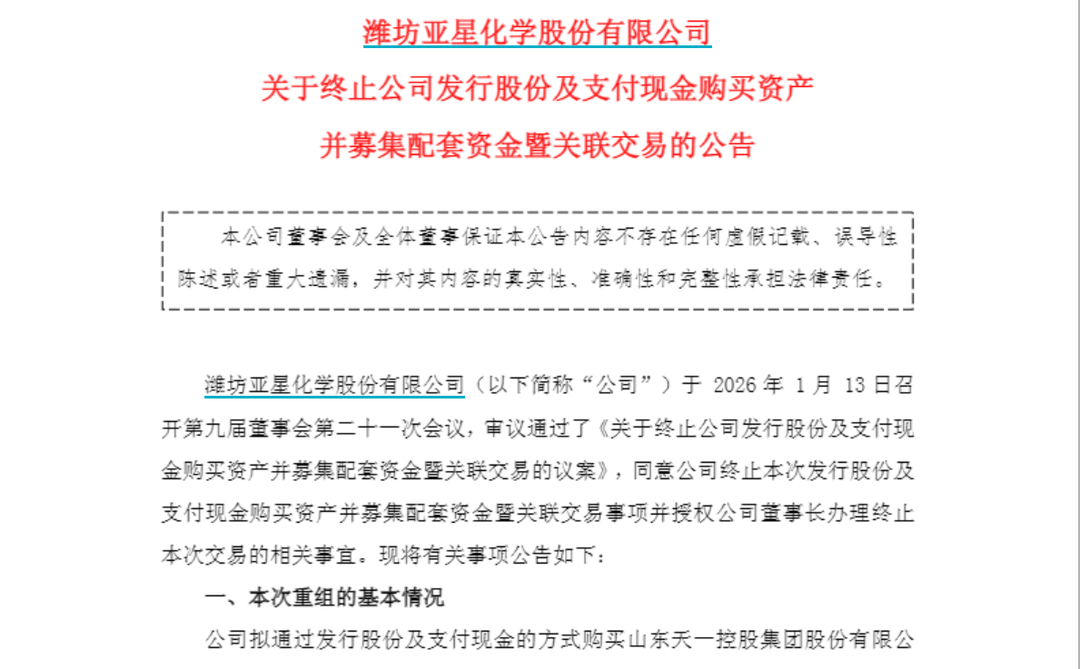
潍坊这家上市公司重大并购“闪崩”!此前已“十连跌”,原因是→
Sou Hu Cai Jing· 2026-01-15 00:24
Core Viewpoint - The company Yaxing Chemical has decided to terminate its planned share issuance due to failure to reach consensus with transaction parties amid changing market conditions, which has led to a decline in its stock price and financial performance [3][5]. Group 1: Company Overview - Yaxing Chemical, established in August 1994 and located in Weifang City, specializes in the research, production, and sales of chemical products including chlorinated polyethylene (CPE), polyvinylidene chloride (PVDC), and other chemical materials [6]. Group 2: Financial Performance - Yaxing Chemical has faced declining performance, with net profits decreasing year by year, resulting in a loss in 2024. Specifically, the company reported revenues of 847 million yuan, 825 million yuan, and 910 million yuan for the years 2022, 2023, and 2024, with net profits of 109 million yuan, 6 million yuan, and a loss of 97 million yuan respectively [8]. - In the first three quarters of 2025, Yaxing Chemical's losses further expanded, with revenues of 641 million yuan, a year-on-year decline of 2.53%, and a net loss of 144 million yuan, a decrease of 46.4% year-on-year [8]. Group 3: Stock Performance - Following the announcement of the share issuance, Yaxing Chemical's stock was suspended from trading from November 4 to November 17, 2025, and experienced a "10cm" limit up on the first two trading days after resuming [3]. - However, after two days of price increases, the stock price fell for three consecutive trading days, with a notable high of 11.85 yuan per share on November 20, 2025, before entering a volatile phase [5]. - As of January 14, 2026, the stock closed at 8.03 yuan per share, down 2.67% [5].
每日核心期货品种分析-20260109
Guan Tong Qi Huo· 2026-01-09 12:13
Report Summary 1. Report Industry Investment Rating No information about the report industry investment rating is provided in the content. 2. Core Viewpoints - The domestic futures market showed mixed performance on January 9, 2026. Palladium led the gainers, while polysilicon suffered the most significant losses. Stock index futures generally rose, and bond futures mostly declined. Different commodities had their own supply - demand situations and price trends affected by various factors such as geopolitical events, production changes, and policy announcements [7][8] 3. Summary by Commodity Commodity Performance - As of the close on January 9, palladium rose over 6%, low - sulfur fuel oil and SC crude oil rose over 3%, and fuel oil rose over 2%. Among the decliners, polysilicon dropped over 8%, and沪镍 and BR rubber declined over 2%. Stock index futures like IF, IH, IC, and IM all rose, while bond futures TS, TF, T, and TL mostly fell. In terms of capital flow,中证 2603,中证 1000 2603, and沪深 2603 had capital inflows, while沪铜 2602, polysilicon 2605, and 30 - year treasury bond 2603 had outflows [7][8] Market Analysis - **Copper (沪铜)**: After a significant rise in the past two days, it declined. The strike at a Chilean copper mine may reduce production by 70%. In December 2026, China's electrolytic copper production increased. The downstream copper products market is in the year - end settlement period, and the copper foil market has stronger demand. With high inventory and weak follow - up procurement, copper is expected to have limited downward adjustment [10] - **Lithium Carbonate**: It reached a high and then declined. A research team made a major breakthrough in lithium resource separation technology. In December 2025, production increased, and the inventory is accumulating. Although there are some policies to support the terminal market, the upward momentum is weakening [12] - **Crude Oil**: OPEC + decided to maintain the production plan and suspend the increase in February and March 2026. The US crude oil inventory decreased unexpectedly, but the refined oil inventory increased. The overall oil inventory is rising, and the market still worries about demand. The situation in Venezuela and Iran may affect oil prices, and the price is in a weak oscillation [13][14] - **Asphalt**: The supply decreased, with a decline in the start - up rate and expected production in January 2026. The downstream start - up rate mostly dropped, and the inventory rate rose. The US military action in Venezuela may affect domestic asphalt production and cost. The price is expected to fluctuate significantly [15][17] - **PP**: The downstream start - up rate decreased slightly, and the enterprise start - up rate increased slightly. The cost is affected by the weak oil price. With new production capacity and reduced downstream orders, the upward space is limited, and the L - PP spread is expected to narrow [18] - **Plastic**: The start - up rate remained stable, and the downstream start - up rate increased slightly. New production capacity was put into operation, and the agricultural film season is ending. The upward space is limited, and the L - PP spread is expected to narrow [19][20] - **PVC**: The upstream calcium carbide price is stable. The supply - side start - up rate increased, and the downstream start - up rate had a slight change. The export orders decreased, and the inventory is high. It is recommended to wait and see in the traditional off - season [21][23] - **Coking Coal**: The price showed a weak oscillation. The Mongolian coal supply may slow down, and domestic production increased. After the fourth round of coke price cuts, the fifth round is less likely to be implemented. The coking enterprises increased inventory, and the steel industry has a low - load operation expectation [24] - **Urea**: It opened low and closed down. The supply increased as the shutdown devices resumed production. The market trading activity decreased, and the inventory started to accumulate. It is expected to oscillate in the short term [25][26]
股市必读:中化国际(600500)1月8日主力资金净流出266.63万元,占总成交额2.59%
Sou Hu Cai Jing· 2026-01-08 18:50
Group 1 - The core viewpoint is that Sinochem International (600500) is expected to report a loss for the entire year of 2025 due to declining prices of chemical products, which has significantly impacted its operating performance [1][2] - As of January 8, 2026, Sinochem International's stock closed at 4.09 yuan, with a 0.99% increase and a trading volume of 252,700 shares, amounting to a total transaction value of 103 million yuan [1] - The company reported a net profit of -1.331 billion yuan attributable to shareholders by the end of Q3 2025, indicating substantial financial challenges ahead [1] Group 2 - On January 8, the main funds experienced a net outflow of 2.66 million yuan, accounting for 2.59% of the total transaction value [2] - Retail investors showed a net inflow of 9.45% of the total transaction value, amounting to 9.7379 million yuan, indicating some level of interest from smaller investors despite the overall negative outlook [1][2]

聚聚聚聚聚聚聚聚聚:聚聚聚聚聚聚聚聚聚聚聚
Zi Jin Tian Feng Qi Huo· 2026-01-08 08:58
1. Report Industry Investment Ratings - PTA: Core view - neutral; Month - spread - neutral; Spot - neutral; Cost - neutral; Device change - neutral; Downstream demand - neutral; Supply - demand balance - cautiously bullish; Processing profit - cautiously bearish [5] - PX: Core view - neutral; Month - spread - neutral; Spot - neutral; Device change - cautiously bearish; Import - cautiously bearish; Downstream demand - neutral; Supply - demand balance - cautiously bullish; Processing profit - cautiously bearish [6] - Ethylene glycol: Core view - neutral; Month - spread - cautiously bearish; Spot - cautiously bearish; Device change - neutral; Import - cautiously bullish; Downstream demand - neutral; Supply - demand balance - neutral; Processing profit - neutral [7] 2. Core Views of the Report - PTA: During the holiday, PTA changed little, polyester slightly reduced its load, the near - end balance was tight, the seasonal inventory accumulation pressure from January to February was not large, and the spot processing fee expanded significantly. After the valuation repair, the driving force was average. Short - term attention should be paid to the impact of cost and funds [5][53] - PX: The supply and demand of PX were acceptable. In the short term, PXN was above 350, and the supply at home and abroad both increased marginally. The short - term valuation was not low. Attention should be paid to the opportunities after the callback [6][81] - Ethylene glycol: The overseas maintenance of ethylene glycol increased, and the subsequent import volume might decrease. Although the expected arrival was not low, it still faced seasonal inventory accumulation. In the short term, it was expected to fluctuate within a range [7][132] 3. Summaries According to Relevant Catalogs Terminal Demand and Polyester - Terminal demand: Seasonal decline, mainly digesting raw material inventory before and after the holiday, downstream inventory for about half a month. As of January 4, the operating rates of texturing, weaving, and dyeing decreased to 74% (-5%), 59% (-1%), and 69% (-) respectively [10] - Polyester load: As of January 4, it was around 90.8%. The polyester cash flow was squeezed, and the average inventory reached about 11.4 days. The pre - holiday raw materials were strong, the polyester profit was squeezed, and the cash flow was in deficit. Large manufacturers reduced production, but the current inventory was not high, so the load was maintained. The estimated loads in December and January were 91% and 88% respectively. After mid - January, polyester factories had plans to gradually reduce production due to poor efficiency [15][42] - Polyester inventory: Currently stable with a slight increase, and the pressure was not large. As of January 4, the inventories of POY, DTY, FDY, and staple fiber were 13.3, 23.7, 13.6, and 9.7 days respectively [16] - Polyester profit: Generally poor. Before the holiday, the cost was strong, and the profit of the polyester filament industry chain was compressed. The cash flows of filament and chips were significantly in deficit [27] PTA - Device changes: Three sets of YS were under maintenance, Zhongtai restarted, Dushan 1 restarted, Dushan 3 was under maintenance, Weilian increased its load to 90%. In January, New Materials and Ineos had maintenance plans. Long - term shutdown devices were expected to continue maintenance in 2026, and the planned maintenance volume from January to February was not low. Attention should be paid to whether the devices would restart after the processing fee repair [45][46] - Inventory: As of January 4, the social inventory of PTA (excluding credit warehouse receipts) decreased to 2.3 million tons, the factory inventory decreased, and the warehouse receipt inventory slightly decreased. The current inventory pressure was not large [47] - Balance sheet: The near - end was tight, the processing fee was repaired significantly. Attention should be paid to whether the devices would restart. The seasonal inventory accumulation pressure from January to February was not high. Short - term attention should be paid to the impact of cost and funds [51][53] PX - Device changes: The domestic operating rate was 90.6%, and the Asian load was 80.9%. Domestically, Yangzi, Weilian, and Fuhua slightly increased their loads, Fujia restarted one line, and Tianjin Petrochemical was under maintenance. In Asia, two sets of Indonesian devices slightly increased their loads, the GS disproportionation restarted slightly ahead of schedule, and the Indian OMPL device was planned to restart in February [77][81] - Balance sheet: The supply and demand of PX were in a loose balance. PXN rebounded to around 360+, and the valuation was not low. Attention should be paid to the capital changes [79][81] - Price difference: The spread between the PX outer and inner markets widened, the 3 - 5 month spread of PX was stable, and the TA05 processing fee was repaired to over 300 [82] Ethylene Glycol - Device changes: As of January 4, the total domestic load of ethylene glycol was 73.7%, and the coal - based load was 75.8%. The domestic maintenance volume changed little. Fude, Shenghong, and Sinochem Quanzhou were under maintenance. Henan Energy in Yongcheng was replacing the catalyst, Yankuang was under maintenance, and Huayi restarted. The new 200,000 - ton Ningxia Changyi device was in stable operation [99][104] - Import: Overseas device maintenance was not low. There were maintenance plans for two 720,000 - ton lines of Formosa Plastics in Taiwan, China, two sets of 450,000 - ton and 700,000 - ton devices in Saudi Arabia, a 530,000 - ton device in Kuwait, and a 400,000 - ton device in Iran (planned to be maintained at the end of the month), and a 500,000 - ton device in Iran was under maintenance. The South Asian device in the United States was under maintenance, and GCGV was reducing its load. The arrivals from November to December were not low, with 580,000 tons imported in November and an estimated 700,000 tons in December. The arrivals from January to February might decrease [119] - Inventory: As of January 5, the port inventory of MEG in the main ports of East China was about 725,000 tons, a decrease of 5,000 tons month - on - month. The overall inventory was neutral. From December 29 to January 4, the expected arrival was about 106,000 tons, and the actual arrival was 83,000 tons. From January 4 to 11, the expected arrival was 178,000 tons, and the port inventory was expected to increase slightly. The raw material inventory days of polyester factories for ethylene glycol were 14.6 days, and the downstream inventory slightly increased [127] - Balance sheet: The overseas maintenance increased, the import expectation improved, providing support below. However, the arrivals were still high, and it was in the process of seasonal inventory accumulation, with limited upward driving force. In the short term, it was expected to fluctuate within a range [129][132]
PX-PTA-MEG:地缘事件频发,关注成本扰动
Xin Lang Cai Jing· 2026-01-07 09:27
Group 1: PX/PTA Market Overview - The current polyester market is primarily trading on the expectation of tight supply for PX and PTA in the first half of 2026, with the main contracts for PX and PTA having a longer time until expiration, making the bullish logic temporarily unrefutable [1] - The geopolitical events in the Middle East are causing signs of oil price stabilization, which supports chemical products, thus maintaining a long-term bullish outlook for PX and PTA [1][2] - Short-term feedback from the polyester industry chain indicates a negative response to the rising raw material prices of PX and PTA, necessitating adjustments in trading positions [1] Group 2: Cost and Supply Dynamics - The geopolitical situation in Iran poses a risk of further escalation, leading to a bullish outlook on oil prices, while the impact of the U.S. capturing Venezuelan President Maduro on oil prices is limited [2] - Domestic PX production is expected to decrease due to maintenance plans at Zhejiang Petrochemical, while overseas facilities are also undergoing maintenance, leading to a tightening supply outlook for PX [2][23] - PTA processing fees have significantly increased, while downstream profits have sharply declined, indicating a competitive struggle for profits between upstream and downstream sectors [2][9] Group 3: Demand and Inventory Trends - Demand is entering a seasonal downturn, with textile companies experiencing a decline in orders and an increase in finished product inventory, leading to a rise in polyester factory maintenance [3][60] - The overall inventory of PTA is decreasing, with a notable drop in warehouse receipts, indicating a tightening supply situation [44][39] - Polyester factory inventory levels are increasing, with raw material stocking days showing a slight rise, reflecting a cautious approach to inventory management amid declining demand [63][65] Group 4: Price and Profitability Insights - The price of PX has seen a slight decline, with the CFR Taiwan price at $893 per ton, down $25 from the previous week [8] - PTA processing margins have improved significantly, with average processing fees exceeding 300 yuan per ton, indicating a recovery in profitability for PTA producers [16] - MEG prices are expected to stabilize due to geopolitical influences, with a slight increase in production capacity utilization rates observed [50][48]

光大期货:1月5日能源化工日报
Xin Lang Cai Jing· 2026-01-05 12:50
Group 1: Oil Market Overview - Recent oil prices have shown low volatility, with Brent crude closing at $60.8 per barrel and WTI at $57.33 per barrel as of January 2 [1] - A significant geopolitical event occurred on January 3, with the U.S. launching an operation against Venezuela, resulting in the capture of President Maduro, which is expected to lead to a spike in oil prices due to supply concerns [1][2] - Venezuela's current oil production is approximately 1 million barrels per day, with major production areas including the Orinoco heavy oil belt and the Maracaibo basin [2] Group 2: Geopolitical Impact - The change in Venezuela's political regime introduces high uncertainty regarding its oil production and trade flows, potentially shifting exports from west to east [2] - Colombia has called for an emergency meeting of the UN Security Council to address the regional stability concerns arising from the situation in Venezuela [2] - The geopolitical tensions are likely to increase risk premiums in the oil market, pushing prices higher in the short term [4] Group 3: OPEC+ and Inventory Data - OPEC+ is set to hold a meeting on January 4 to discuss production policies, with expectations of maintaining current output levels in the first quarter of 2026 [3] - U.S. oil inventories have shown a decrease, with total crude oil stocks at 836.107 million barrels, down by 1.686 million barrels from the previous week [3] - Gasoline and distillate inventories have increased, indicating mixed signals in the oil supply-demand balance [3] Group 4: Short-term Price Projections - The short-term outlook for oil prices suggests a potential for a pulse-like increase due to geopolitical tensions and supply disruption fears [4] - In the medium to long term, if U.S. companies regain access to Venezuelan oil, production could increase significantly, alleviating some structural issues in the oil market [4] Group 5: Fuel Oil Market Dynamics - High-sulfur fuel oil supply is expected to remain stable, with December shipments from the Middle East at approximately 4.6 million tons, despite a decrease from the previous month [6] - Demand for high-sulfur fuel oil is showing marginal improvement, with imports to China expected to be around 1 million tons in December [6] - The market remains focused on geopolitical developments, particularly the ongoing tensions between the U.S. and Venezuela, which could impact supply chains [7] Group 6: Asphalt Supply and Demand - The geopolitical situation between the U.S. and Venezuela is causing uncertainty in the supply of diluted asphalt, although current supply remains stable [9] - China's asphalt production is projected to be around 2.1 million tons in January, reflecting a slight decrease from December [9] - The market is currently experiencing a weak demand environment, particularly in northern regions, as construction activities slow down [9]