
地产

Search documents
嘉实基金尚可:资源品上涨逻辑发生质变 或开启数年级别的长周期
Zhong Zheng Wang· 2026-02-26 13:33
中证报中证网讯(记者张凌之)2月26日,嘉实国证自由现金流ETF基金经理尚可在中国证券报"中证点金 汇"直播间表示,当前资源品上涨的核心逻辑已发生质变,过去资源股主要跟随经济周期波动,而本轮 行情的核心驱动力在于"安全"与"短缺",目前已转变为由供给侧硬约束、新需求范式和地缘安全溢价共 同驱动。他认为,这大概率是一个跨越数年的长周期行情,但2026年将进入行情分化和轮动的下半场。 在众多周期行业中,有色和化工因与地产基建关联度低、供给弹性小,行情表现显著优于对宏观顺周期 依赖更强的地产、钢铁、建材与工程机械。他强调,面对长周期行情,投资者需以更长远的视角审视其 中的结构性机会。 ...
行业景气观察:春节人员流动或创历史新高,金属价格普遍上涨
CMS· 2026-02-25 14:01
证券研究报告 | 策略定期报告 2026 年 2 月 25 日 春节人员流动或创历史新高,金属价格普遍上涨 ——行业景气观察(0225) 本周景气度改善的方向主要在信息技术、部分资源品和中游制造领域。上游资源 品中,金属、原油和多数化工品价格上涨;中游制造领域,新能源产业链价格多 数上涨,1 月主要企业装载机、叉车销量同比增幅扩大。信息技术中,存储器价 格持续上涨,1 月 MLCC 台股营收同比增幅扩大。消费服务领域,民航飞机利用 率同比明显修复。2026 年春节假期期间居民出行消费回暖,商品和文旅消费持 续亮点纷呈。推荐景气较高或有改善的有色、石油石化、基础化工、锂矿、工程 机械、航空运输、铁路公路、半导体等。 ❑【本周关注】2026 年春节假期期间居民出行消费回暖,商品和文旅消费持续亮点 纷呈。交通运输方面,春节人员流动或创历史新高,自驾游为出行主力,水路客流 同比增长较快,百度迁徙指数好于去年同期水平,大年初三之前县域逆袭特征明 显,三线以及以下城市获得净迁入,初三之后以春节旅行和复工返程为主,仅三线 以及以下城市大幅净流出。民航飞机利用率同比明显修复,国内、国际航班执行数 同比均上行;受益于免签国家扩 ...
不出意外,周四,A股可能见证10年新高了
Sou Hu Cai Jing· 2026-02-25 12:45
大家是不是很期待创10年新高,上证指数涨回去有什么问题吗?今日只差23点就突破4190点了,我不认为它是今年最高点,而且很快就会被踩在脚下。 如果,不是证券又降温砸盘,日内就有可能突破了,慢慢涨也挺好,目前行情没有任何问题,持股待涨就行了。小凡不是涨了唱多,是一直唱多,投资需要 信仰,投机才需要涨跌…… 人人都觉得科技是未来,未必是主力资金的未来,可能他们比你跑得还快,看看大股东的减持速度,看看汇金对双创基金的赎回情况。 A股可能见证10年新高了 小凡觉得指数很可能创新高,这件事情不需要大家认同,只是个人的许愿。冲高回落反而有利于行情了,大家越不相信会大涨的时候也许出其不意的就偷袭 拉升了。 4200点的核心权重行业还是白酒、证券、半导体等等。最近能源上涨抬升了一段指数,之后它们补涨就可以突破4200点了,你会发现无论怎么涨,好像都与 自己的股票没啥关系。 结构性行情,行业轮动上涨就是如此,不需要大家认同这个想法,我觉得目前的行情就是震荡向上,不是牛市的末期,只是说是中后期了,还没有真正的疯 牛加速。 人,挣不到认知范围外的利润。 你认知决定你的财富,大家的消费观不同,投资理念就不同。2025年销量排前10的 ...


未知机构:午间指数表现下跌19下-20260225
未知机构· 2026-02-25 04:00
交易流向 午间指数表现 :下跌 1.9% :下跌 2.1% :下跌 2.4% :1390 亿港元 :1.56 亿美元 领涨板块:必需消费品(-0.0%)、电信(-0.1%)、工业(-0.2%) 领跌板块:非必需消费品(-2.5%)、信息技术(-2.8%)、医疗保健(-3.6%) 午间市场点评 香港市场在昨日强势后出现技术性回调,医疗保 午间指数表现 :下跌 1.9% :下跌 2.1% :下跌 2.4% :1390 亿港元 :1.56 亿美元 领涨板块:必需消费品(-0.0%)、电信(-0.1%)、工业(-0.2%) 领跌板块:非必需消费品(-2.5%)、信息技术(-2.8%)、医疗保健(-3.6%) 午间市场点评 香港市场在昨日强势后出现技术性回调,医疗保健板块成为主要拖累因素。 A 股节后首个交易日表现强劲,沪深 300 指数上涨 1.33%。 南向投资者在香港市场净卖出,占港股成交额的 22%(高于通常的 20% 以下水平),资金似乎流向 A 股市 场。 Citrini报告对恒生科技指数造成压力,该指数早盘下跌 2.4%。 下跌 4.6%,反映出 AI 板块情绪疲软。 今日市场催化剂有限,但我们的主要做空 ...
廖市无双-节后开盘-A股是否有机会进攻
2026-02-24 14:16
Summary of Conference Call Records Industry Overview - The conference call primarily discusses the A-share market in China, focusing on market trends, sector performance, and investment opportunities post-Chinese New Year [1][2][3]. Key Points and Arguments Market Performance and Trends - The A-share market exhibited a strong oscillation pattern before the Chinese New Year, with the Shanghai Composite Index peaking at 4,142 points, aligning with the expected range of 4,000 to 4,150 points [2][3]. - Major indices failed to break above the 5-week moving average due to large funds suppressing market movements, indicating a preference for maintaining a range-bound market rather than a rapid upward trend [3][5]. - The market is currently in an ABC adjustment structure, with the B phase ongoing, suggesting that a clear upward movement is unlikely until the C phase is completed [9][14]. Sector Performance - Sectors that performed well before the holiday include technology growth, computing, electronics, media, and telecommunications, which are closely related to the mainstream market trends since September 24, 2022 [4]. - The consumer sector, particularly retail and general consumption, saw significant capital outflows, reflecting a lack of investor confidence in economic recovery [7]. - The food and beverage sector is not expected to experience a major upward trend, with a clear bearish pattern observed [8]. Investment Opportunities - Short-term investment strategies are recommended, focusing on sectors with lower price levels and potential for quick gains, such as brokers, building materials, and banks [20]. - The technology growth sector, including AI applications and robotics, may present localized investment opportunities, but significant upward trends are not anticipated [18]. - The first quarter of 2026 may see the non-ferrous metals sector forming a significant bottom, with a notable increase in the index by 97.5 points in 2025 [21]. Market Sentiment and Future Outlook - The market is expected to maintain a high-risk preference in the short term, with potential for continued focus on technology growth sectors, although caution is advised due to the last trading day before the holiday [6][15]. - New funds are advised to wait for clearer investment opportunities post-March, as the current environment does not favor long-term investments [19][16]. - The overall market structure is likely to remain balanced, with a mix of growth and value styles emerging [30]. Other Important Insights - The recent appreciation of the RMB, surpassing 6.89, is seen as beneficial for the A-share market, supporting a positive outlook for capital markets [11]. - The upcoming political events, such as the two sessions in March, are anticipated to provide clearer investment signals [16]. - The historical context of spring market movements suggests a potential for short-term volatility, but with a cautious approach to avoid chasing high prices [28][31]. This summary encapsulates the key insights from the conference call, providing a comprehensive overview of the current state and future outlook of the A-share market and relevant sectors.
港股速报|港股开盘震荡走弱 石油天然气板块逆势上涨
Mei Ri Jing Ji Xin Wen· 2026-02-24 02:43
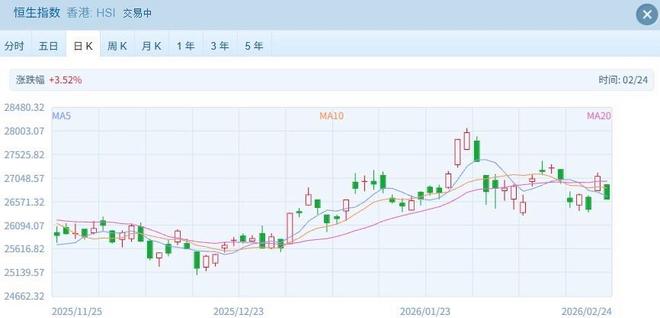
免责声明:本文内容与数据仅供参考,不构成投资建议,使用前请核实。据此操作,风险自担。 个股表现上,恒基地产、万州国际、中国石油股份领涨恒指成分股;泡泡玛特、瀚森制药、阿里健康领 跌恒指成分股。万州国际盘中还创出历史新高。 恒生科技指数表现更弱,开盘报5330.26点,下跌1.02%,盘中持续走低,截至9时38分,报5255.02点, 跌幅扩大至2.42%。 板块表现上,大多数板块下跌,其中信息科技、软件服务板块领跌;石油天然气板块逆势上涨。 今日(2月24日),港股开盘后呈现震荡走弱态势,受隔夜美股大幅回调拖累,主要股指集体低开,随 后持续下探,市场呈现结构性分化格局。截至9时38分,恒生指数与恒生科技指数均出现明显下跌,部 分板块逆势异动,个股表现分化显著。 指数方面,恒生指数开盘报26913.68点,下跌0.62%,随后震荡下行,截至9时38分,报26682.85点,跌 幅扩大至1.47%。 ...
科技经济v.s.地产经济:有何不同?
Orient Securities· 2026-02-24 00:25
Group 1: Economic Transition - The shift from real estate economy to technology economy involves significant changes in industrial structure, development models, and institutional reforms, impacting key macroeconomic variables such as production, inflation, employment, fiscal policy, and monetary policy[2]. - By 2025, the contribution of new quality productivity industries to total output has surpassed that of the real estate construction chain, indicating a need for macroeconomic research to focus more on new quality productivity[11]. - The traditional development model driven by urbanization and population growth is transitioning to one focused on stock optimization and quality improvement due to slowing urbanization[8]. Group 2: Industrial Structure and Macroeconomic Features - The industrial structure has shifted from a real estate and construction-centric model to one centered around new quality productivity, which includes emerging manufacturing and certain service sectors[12]. - New quality productivity industries are expected to have a greater impact on total output than the real estate construction chain by 2025, reflecting their higher efficiency and growth potential[20]. - The inflation impact from new quality productivity industries is weaker compared to upstream factors like commodities and real estate, indicating a limited ability to drive PPI increases[25]. Group 3: Employment and Development Models - The labor compensation in new quality productivity sectors is lower than in traditional industries, which may create pressure on income and employment, necessitating a focus on developing service consumption to mitigate these effects[31]. - The transition from a cost advantage to a quality advantage in the labor force is evident, as the number of highly educated graduates continues to rise, supporting productivity growth in manufacturing[41]. Group 4: Institutional Mechanisms and Macro Control - The macro control mechanisms need to adapt to support the technology economy, moving away from real estate dependency and enhancing the role of direct financing systems[54]. - The fiscal and tax systems must evolve to accommodate new business models and support emerging industries, with a focus on expanding local tax sources and creating a tax system that aligns with new economic realities[56].
节后,主线是AI科技吗?
Sou Hu Cai Jing· 2026-02-20 03:07
大年初三,终于不用喝酒了!说几句掏心窝的观点。 整个春节,AI概念又火了,明确自己观点,我依旧看好人工智能是主线,要不然也不会重新布局恒科,节前连恒医都又建仓了,它们都是人工智能逻辑, 科技目前只有一条主线,就是人工智能,就像前几年是新能源。 1、白酒,大多数人不要参与。 不过,地产消费能源这些,可能会在今年反转,后面还有2~3年的行情。说白了,投资的成长性是股价的位置,并不是业绩,因为业绩好的科技公司已经10 倍了…… 问问自己,如果你也年少有为,你想不想买豪车载着心爱的姑娘兜风。大年初二,你想不想开着豪车,提着茅台、拉菲、和天下等去岳父母家拜年。 快乐消费,情绪消费有时候比物质的本身更重要,不要说面子,人赚钱是为了什么,如果只是满足温饱的生存,刚需,性价比,你不用那么拼! 2、消费,本来就是没办法交流的事情。 消费股的逻辑其实就是消费的逻辑,你的认知与消费能力,决定你的参与的逻辑,我不觉得普通散户远离地产消费能源这些是错,毕竟科技股的机会更多, 股票的数量更多。 无论什么筹码都是有人赚有人赔,你觉得没有行情的白酒地产,去年也有朋友在里面赚了几十点,别人做自己擅长的筹码,其他并不关心。你觉得你的工作 不行, ...

红利指数进化史:规则优化,如何提升红利长期回报? | 螺丝钉带你读书
银行螺丝钉· 2026-02-14 13:40
大家好,我是银行螺丝钉,欢迎来到这期的螺丝钉带你读书。 「螺丝钉带你读书」也陪伴大家度过了三百多期,为大家讲解了很多有趣、经典的书籍和故事,比如《三十几岁,财务自由》、《如何读一本 书》、《战胜拖延症》等等。 还为大家详细介绍了几位投资大师:股神巴菲特、他的好搭档查理·芒格和指数基金之父约翰·博格。分享了他们的人生经历、投资生涯和投资的 理念。 大家可以点击下面链接查看部分螺丝钉带你读书合集: 《 世界读书日,螺丝钉送你121本私藏经典好书 》 往期回顾 第一篇:《 红利策略,在A股有效吗:《红利指数基金投资指南》告诉你 》 第二篇:《 红利指数,最适合的投资方式:低估买入,持股收息 》 第三篇:《 红利指数盈利靠什么?三大收益来源全解析 》 红利指数的收益来源之一:规则优化 关于新书的详细介绍,可以点击查看文章: 《红利指 数基金投资指南》新书来了&新书福利 前几篇,咱们介绍了近年来,红利指数发展迅速的原因,以及最适合的投资方式:低估买入,持股收息。 也介绍了红利指数的三大核心收益来源: 盈利增长、估值提升和分红收益。 除此之外,红利指数还有一个收益来源:规则优化。 规则优化的两个方面 红利指数的规则优化, ...

关注下游扩消费活动开展
Hua Tai Qi Huo· 2026-02-13 08:16
Report Summary 1. Report Industry Investment Rating No information provided. 2. Core Viewpoints - The National Development and Reform Commission, the Financial Regulatory Administration, and the Civil Aviation Administration of China have issued an implementation opinion on promoting the high - quality development of low - altitude insurance. By 2027, a preliminary mandatory insurance system for unmanned aerial vehicle liability will be established, and by 2030, the policy framework for low - altitude insurance will basically take shape [1]. - The National Film Administration and the Ministry of Commerce have organized a "Film +" consumption comprehensive pilot program to boost consumption and promote the transformation of the film industry into a diversified consumption ecosystem [1]. 3. Summary by Industry Level Upstream - Black commodities are at low prices [1]. - Egg prices have declined [1]. - Building material prices have dropped [1]. Midstream - The operating rates of PX and urea remain high [2]. - The coal consumption of power plants has increased [2]. - The production of pork products has increased [2]. Downstream - The sales of commercial housing in first - and second - tier cities have seasonally declined [2]. - The number of domestic flights has remained high and stable [2]. 4. Key Industry Price Indicators | Industry | Indicator | Value (as of 2/9) | YoY | | --- | --- | --- | --- | | Agriculture | Spot price of corn | 2271.4 yuan/ton | 0.00% | | | Spot price of eggs | 7.1 yuan/kg | - 12.96% | | | Spot price of palm oil | 8972.0 yuan/ton | - 0.47% | | | Spot price of cotton | 15986.0 yuan/ton | - 0.65% | | | Average wholesale price of pork | 18.3 yuan/kg | - 0.76% | | Non - ferrous metals | Spot price of copper | 101646.7 yuan/ton | 0.79% | | | Spot price of zinc | 24656.0 yuan/ton | - 1.26% | | | Spot price of aluminum | 23406.7 yuan/ton | 1.90% | | | Spot price of nickel | 138650.0 yuan/ton | - 0.20% | | | Spot price of aluminum | 16506.3 yuan/ton | 0.08% | | | Spot price of rebar | 3170.0 yuan/ton | - 0.61% | | Ferrous metals | Spot price of iron ore | 786.9 yuan/ton | - 2.25% | | | Spot price of wire rod | 3367.5 yuan/ton | - 0.96% | | | Spot price of glass | 13.3 yuan/square meter | 0.15% | | Non - metals | Spot price of natural rubber | 16125.0 yuan/ton | 0.62% | | | China Plastic City Price Index | 786.7 | - 0.56% | | | Spot price of WTI crude oil | 63.6 dollars/barrel | - 2.55% | | Energy | Spot price of Brent crude oil | 68.1 dollars/barrel | - 1.83% | | | Spot price of liquefied natural gas | 3620.0 yuan/ton | 0.39% | | | Coal price | 799.0 yuan/ton | - 0.50% | | | Spot price of PTA | 5144.3 yuan/ton | - 0.57% | | Chemical | Spot price of polyethylene | 6800.0 yuan/ton | - 3.20% | | | Spot price of urea | 1765.0 yuan/ton | - 0.70% | | | Spot price of soda ash | 1201.4 yuan/ton | - 0.12% | | Real estate | National cement price index | 131.7 | - 0.79% | | | Building materials composite index | | - 0.43% | | | National concrete price index | 89.8 | - 0.42% | [36]