宠物经济

Search documents
不生孩子的韩国年轻人,花几千元送狗上学?
36氪· 2026-01-28 13:35
以下文章来源于九行Travel ,作者吃卜宝 九行Travel . 做一只有文化的小狗。 文 | 吃卜宝 编辑 | 曾宝气 来源| 九行Travel(ID:jiuxing_neweekly) 封面来源 | pexels 在小书包里装上零食、保健品、衣服、玩具、防丢名牌,再等待幼儿园的老师来接上学。在韩国,这是很多"家长"早上的固定环节。 只不过,上幼儿园的不是人类幼崽,而是小狗。 在今天的韩国,人类幼儿园逐渐倒闭,但狗狗幼儿园正在崛起,几乎每个社区都有一个或多个这样的特殊 幼儿园。 "送狗上学",已经成了很多养宠家庭的选择。 首尔江南区某狗狗幼儿园课表。(图/受访者供图) 在生育率持续低迷的韩国,宠物在人们心中占据越来越重要的位置,宠物幼儿园也比想象中更卷。 在首尔江南区,很多狗狗在幼儿园里不仅可以得到很好 的照顾,还能学习各种社会化技能,美甲、占卜、泡温泉,样样不落。 送宠物入学是一种怎样的体验?韩国社区里涌现的狗狗幼儿园,究竟有什么特别之处?不愿意生娃的韩国人,为什么沉迷于送狗上学?带着这些疑问,我们 和在韩的"家长"聊了聊。 新周刊旗下文旅生活媒体,与你『行遍九州,探索世界』。 在首尔的狗狗幼儿园 比人 ...


2026年中国新消费趋势白皮书
Sou Hu Cai Jing· 2026-01-27 13:11
Core Insights - The report titled "2026 China New Consumption Trend White Paper" indicates that the new consumption market in China is driven by three main forces: self-centered consumer behavior, innovative product supply value, and globalization of market boundaries [1][7][17] - The core sectors identified include the Emotional Economy sector (projected to reach 23,077.7 billion yuan by 2024), the Quality Life sector (with the elderly care industry expected to reach 16.1 trillion yuan by 2025), and the Smart Technology sector (with the AI industry projected to reach 10,457 billion yuan by 2025) [1][7][19] - Key trends for 2026 include the shift of lower-tier markets towards value dividends, the emergence of "AI+" for personalized services, accelerated virtual and physical integration, mainstream sustainable consumption, and the globalization of brand ecosystems [1][7][19] Market Dynamics - The new consumption market is characterized by emotional resonance and value recognition as core drivers, with decision-making becoming increasingly practical and emotionally driven [7][17] - The market is transitioning from a focus on scale expansion to structural adaptation, as indicated by the Ministry of Industry and Information Technology's new policy framework aimed at enhancing the adaptability of supply and demand [15][17] - The demographic and income growth in China is creating a strong market expansion and driving force, with urban-rural development becoming more balanced [9][12] Sector Analysis - The Emotional Economy sector focuses on consumer emotional needs, shifting from traditional functional value to emotional value, where consumers are willing to pay for products that provide emotional resonance and psychological comfort [25][31] - The Quality Life sector encompasses various core types, including the elderly economy, health consumption, and new-style tea drinks, reflecting a growing demand for quality living [19][23] - The Smart Technology sector includes innovations such as AI terminals, service robots, and digital humans, indicating a strong momentum in technological advancements [7][19]

跨境出海周度市场观察-20260125
Ai Rui Zi Xun· 2026-01-25 03:01
Industry Trends - In 2026, companies will focus on localized operations and technology-driven overseas warehouse systems, particularly in the U.S. market, enhancing operational efficiency through "micro-headquarters" that integrate marketing, customer service, and supply chain[1] - By 2025, 44% of Chinese companies have developed detailed plans for the Middle East, with 40% achieving profitability, indicating a shift from rapid expansion to meticulous cultivation in this market[2] - AI is reshaping marketing strategies, with over 70% penetration in influencer marketing and precise targeting, significantly improving brand exposure and sales[4] - The Chinese robotics industry is transitioning from product export to brand globalization, with a 54.9% increase in industrial robot exports in the first three quarters of 2025[4] Brand Dynamics - Alibaba's AliExpress aims to enhance brand globalization through overseas warehouse services, targeting a tenfold increase in GMV for participating merchants[13] - Pop Mart's overseas revenue surged from 137 million yuan to 5.593 billion yuan in four years, attributed to a shift from a distributor model to direct sales and the implementation of a cloud ERP system[14] - Jitu Express reported a 300 billion package volume in 2025, with overseas business accounting for nearly 30% of total operations, driven by a 67.8% growth in Southeast Asia[16] - The pet brand Vetreska achieved over $30 million in sales in two years by targeting North American middle-class consumers and utilizing localized marketing strategies[18]



艾媒咨询:2026年中国新消费趋势白皮书
Sou Hu Cai Jing· 2026-01-23 12:47
Core Insights - The report highlights the structural upgrade of China's new consumption market driven by demographic changes, income levels, policy guidance, and technological innovation, transitioning from scale expansion to structural adaptation [1][3]. Group 1: Market Characteristics - The new consumption market is characterized by three core tracks: emotional economy, quality of life, and smart technology, reflecting profound changes in consumption logic and market structure [2][3]. - The emotional economy focuses on fulfilling emotional needs, with market size expected to reach 23,077.7 billion yuan by 2024 and double by 2029 [2]. - The quality of life track emphasizes health, comfort, and spiritual satisfaction, with the silver economy shifting from "elderly care" to "enjoying old age" [2][3]. - The smart technology track leverages AI and big data, with applications in AI terminals, service robots, and smart connected vehicles, becoming a key engine for consumption upgrade [2][3]. Group 2: Consumption Trends - Five major trends are anticipated for 2026: the shift from population dividends to value dividends in lower-tier markets, the integration of "AI+" services for personalized living, the acceleration of virtual and physical integration, sustainable consumption throughout the supply chain, and the globalization of brand ecosystems [3][9]. - Consumer motivations are evolving from functional satisfaction to emotional resonance and value recognition, with a dual decision-making logic of "extreme practicality" and "emotional premium" [2][9]. - The market structure is becoming more layered, with vertical communities emerging as the core soil for brand growth [2][9]. Group 3: Policy and Economic Context - The transition from "scale expansion" to "structural adaptation" is marked by a new policy framework aimed at enhancing the adaptability of consumer goods supply and demand, promoting consumption's contribution to economic growth [17][19]. - The government has set quantitative targets for optimizing supply structures, including three trillion-level fields and ten hundred-billion-level hotspots, to foster a healthy interaction between supply and demand [18][19].

宠物经济有多火?有人开宠物缝纫教室月入5万
Sou Hu Cai Jing· 2026-01-20 07:02
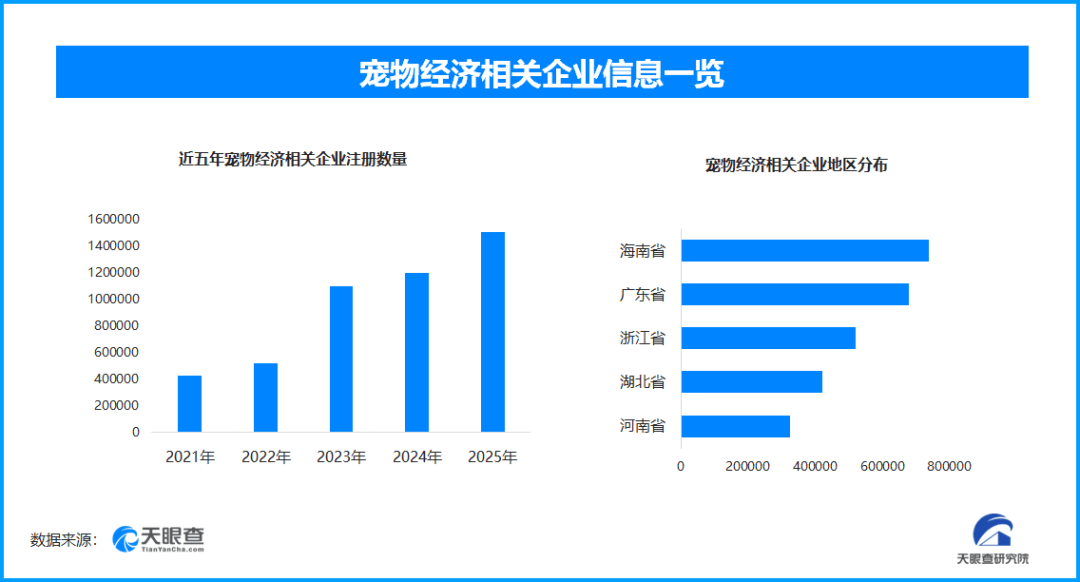
Group 1 - The pet economy reflects the growth of emotional consumption demand among the public, providing new employment opportunities for young people [1][2] - A notable example is a 1998-born entrepreneur in Hangzhou who opened a "Xuan Cat Sewing Shop," attracting 70-80 students monthly for pet sewing courses, generating over 50,000 yuan in monthly revenue [1] - The demand for pet clothing is evolving from aesthetics to functionality, with Douyin e-commerce data indicating an 85% year-on-year increase in daily transaction volume for pet apparel in 2025 [1] Group 2 - As of now, there are over 5.388 million pet economy-related enterprises in China, with more than 1.511 million new registrations expected in 2025 [2] - The registration of pet economy-related enterprises has shown a consistent annual growth trend over the past five years, projected to peak in 2025 [2] - The leading regions for pet economy enterprises are Hainan, Guangdong, and Zhejiang, with over 739,000, 679,000, and 521,000 enterprises respectively [2]
“降温”稳节奏不改趋势 五大主线锚定2026年投资方向
Zhong Guo Zheng Quan Bao· 2026-01-19 21:11
Group 1 - The A-share market has shown strong performance at the beginning of 2026, driven by a combination of market trends, seasonal factors, and recovery in overseas markets [1][2] - Recent market fluctuations are attributed to the implementation of counter-cyclical adjustment policies and profit-taking in popular sectors, which are considered healthy adjustments that do not alter the overall upward trend [1][2] - The macroeconomic environment is expected to support five key investment themes for the year: the artificial intelligence industry chain, high-dividend assets, anti-involution sectors, domestic demand expansion, and resource sectors [1][5] Group 2 - The spring market rally is historically supported by liquidity and valuation drivers, typically lasting around 57 days, with the current phase still in its early stages [2] - Positive performance in overseas markets, particularly in Japan and South Korea, has significantly boosted investor sentiment in the A-share market [2] - Recent adjustments in the A-share market, including changes in financing margin ratios, are aimed at curbing excessive leverage and maintaining a stable upward trend [2][3] Group 3 - Investment strategies must adapt to changing market conditions, emphasizing the importance of position management and avoiding excessive leverage [3][4] - Investors are encouraged to develop independent judgment capabilities to avoid speculative traps and focus on fundamental research [3][4] - The market is transitioning from a speculative phase to one driven by fundamentals, with a focus on true technological growth and value [3][4] Group 4 - Four strategic recommendations for the pre-Spring Festival period include maintaining moderate positions, adopting a barbell strategy for asset allocation, focusing on specific technology sectors, and enhancing individual stock fundamental research [4] - The artificial intelligence industry chain is expected to shift towards application opportunities in 2026, with a focus on sectors like media and computing [5] - High-dividend assets remain a stable investment choice, with sectors such as white goods, banking, and utilities providing low volatility and steady returns [5] Group 5 - The anti-involution sector is entering a phase driven by fundamentals, with industries like coal, steel, and lithium batteries expected to see improved performance due to industry consolidation [5] - The expansion of domestic demand should focus on new consumption areas such as health, sports, and travel, which are expected to benefit from policy support [5] - Resource sectors, particularly strategic and industrial metals, are anticipated to experience valuation recovery in 2026, presenting potential investment opportunities [5][6]
A股分析师前瞻:后市指数行情依旧值得期待,结构上更关注业绩线
Xuan Gu Bao· 2026-01-18 14:42
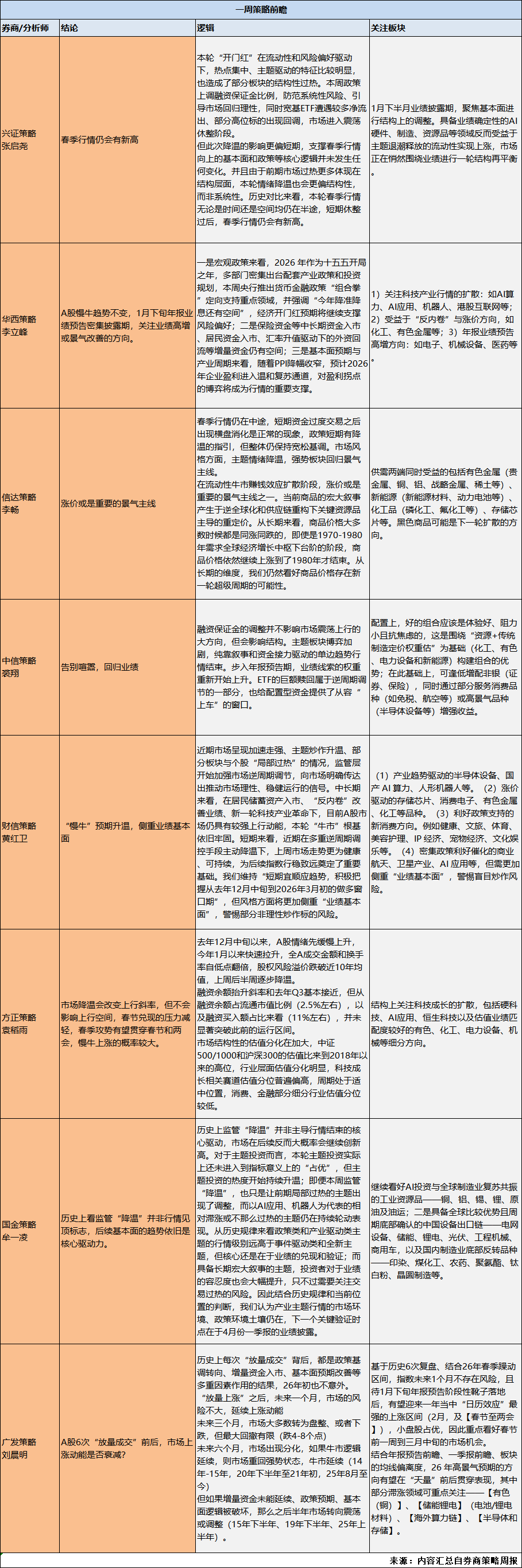
Core Viewpoint - The current market sentiment is driven by liquidity and risk appetite, leading to a concentration of hot sectors and thematic investments, which has resulted in structural overheating in some areas [1][2] Group 1: Market Trends - The recent "opening red" market rally is characterized by significant liquidity and heightened risk preferences, with a clear focus on thematic investments [1][2] - The adjustment of financing margin ratios aims to prevent systemic risks and guide the market back to rationality, while broad-based ETFs have experienced significant net outflows, indicating a market entering a phase of consolidation [1][2] - Historical comparisons suggest that the current spring market rally is still in its early stages, with potential for new highs following a short-term correction [1][2] Group 2: Sector Focus - Analysts emphasize that the upcoming earnings reporting period will shift focus back to performance indicators, particularly in sectors expected to show high growth or improved conditions, such as electronics, machinery, and pharmaceuticals [1][2] - The adjustment in financing margins is not expected to impact the overall upward trend of the market but will affect sector dynamics, with increased competition among thematic sectors [2][3] - The focus on sectors benefiting from the "anti-involution" trend and price increases includes chemicals and non-ferrous metals, with a particular emphasis on high-growth areas in the upcoming earnings forecasts [2][3] Group 3: Investment Strategies - The market is expected to maintain a "slow bull" trend, with a focus on performance fundamentals as the primary driver of investment decisions, while cautioning against irrational speculative activities [2][3] - The anticipated earnings reports in late January are expected to catalyze significant market movements, particularly in sectors with strong performance indicators [2][3] - The overall market sentiment remains positive, with expectations of continued upward momentum despite short-term fluctuations, driven by fundamental improvements and policy support [2][3]
财信证券宏观策略周报(1.19-1.23):“慢牛”预期升温,侧重业绩基本面-20260118
Caixin Securities· 2026-01-18 13:18
Group 1 - The market is showing signs of strengthening, with increased thematic speculation and some sectors and stocks becoming "locally overheated," prompting regulatory measures to enhance counter-cyclical adjustments [4][7] - The A-share market has strong upward momentum due to factors such as increased household savings entering the market, improved performance from "anti-involution" efforts, and a new wave of technological industrial revolution [4][7] - The report maintains a "short-term trend-following" strategy, emphasizing the importance of focusing on performance fundamentals while being cautious of irrational speculation risks [4][7] Group 2 - Investment opportunities are identified in sectors driven by industrial trends such as semiconductor equipment, domestic AI computing, and humanoid robots [4][7] - Price-driven sectors such as storage chips, consumer electronics, non-ferrous metals, and chemicals are highlighted as potential areas for investment [4][7] - New consumption directions supported by favorable policies, including health, cultural tourism, sports, beauty care, IP economy, pet economy, and cultural entertainment, are recommended for attention [4][7] Group 3 - The report notes that the China Securities Regulatory Commission emphasizes timely counter-cyclical adjustments and strict enforcement against excessive speculation to promote stable market operations [4][7] - The People's Bank of China has introduced eight policy measures to support economic structural transformation, including lowering interest rates on various structural monetary policy tools [8][9] - December's social financing data exceeded expectations, with new social financing of 22,075 billion yuan, although the structure still requires optimization [10] Group 4 - December's import and export data showed positive performance, with exports increasing by 6.6% year-on-year, driven by seasonal demand and global AI investment trends [11] - The report indicates that there is a potential "rush to export" in the first quarter of 2026 due to adjustments in export tax rebate policies, although this may partially preempt demand in the second quarter [11] Group 5 - The report highlights the importance of monitoring employment performance and the independence of the Federal Reserve as key factors influencing the Fed's interest rate path [12][13] - The report concludes that recent counter-cyclical measures have laid a solid foundation for stable market performance moving forward, with a focus on sectors such as non-ferrous metals and technology growth [4][7]
马田街道重磅!4万㎡宠悦星乐园1月下旬启幕——100只萌犬免费入园 重点文商旅项目打造全国宠物经济标杆
Xin Lang Cai Jing· 2026-01-17 09:29
Core Insights - The article highlights the upcoming launch of the Pet Joy Star Park, a pet-friendly urban space aimed at addressing the challenges faced by pet-owning families in urban areas, while also promoting the integration of culture, commerce, and tourism [1][2]. Group 1: Project Overview - Pet Joy Star Park is located near Minghu Park and covers approximately 40,000 square meters, designed as a "third space" for pet-friendly urban living, set to open its outdoor area in late January [1]. - The park will feature a variety of activities including pet socialization, ecological leisure, educational programs, and themed commercial spaces, filling a gap in the local pet-friendly market [1][2]. Group 2: Strategic Development - The project is part of a broader strategy by the Matian Street to develop a composite model that integrates pet parks, ecological leisure, and industrial resources, leveraging nearby Minghu Park and Minghu Zhigu [2]. - The park aims to redefine the relationship between people, pets, and urban environments, creating a one-stop destination for pet-friendly leisure and contributing to regional economic growth [2]. Group 3: Facility Features - The park's outdoor area exceeds 30,000 square meters, divided into four functional zones, including a 12,000 square meter pet activity area, an 8,000 square meter themed event space, a 2,000 square meter interactive social area, and a 10,000 square meter public service area [3]. - The indoor section, approximately 8,100 square meters, will include diverse facilities such as a cat-themed space, a pet hospital, a pet-friendly restaurant, and a smart boarding hotel, aiming to provide comprehensive services for pet owners [3]. Group 4: Market Advantages - Pet Joy Star Park benefits from favorable policies, including support from the Ministry of Housing and Urban-Rural Development for pet-friendly city initiatives, and is positioned within Shenzhen's urban renewal framework [4]. - The park addresses the emotional needs of pet-owning families, catering to over 80% of the national pet population, and is strategically located near major transportation routes to attract visitors from Shenzhen and surrounding areas [4]. Group 5: Partnership and Community Engagement - The park is initiating a global recruitment campaign for quality brands and partners across five categories, including pet medical services, high-end grooming products, and innovative pet-themed experiences [5]. - A promotional event offering free experiences for 100 lucky dogs is underway, encouraging community engagement and raising awareness ahead of the park's opening [8].

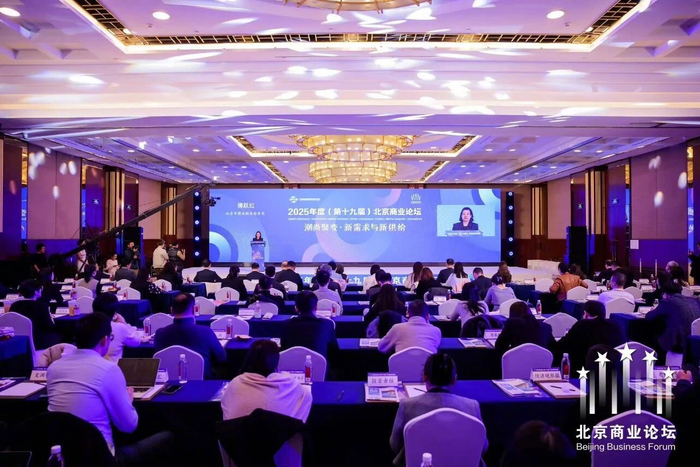
谁将成为下一个万亿级消费增长点?北京这场论坛重磅“剧透”
Bei Jing Shang Bao· 2026-01-16 15:21
Core Insights - The integration of traditional and fashionable elements is crucial for revitalizing consumption and fostering growth highlights in the current macroeconomic context [2][4][30] - The 2025 Beijing Commercial Forum focused on the theme "Fashion Fusion: New Demand and New Supply," bringing together representatives from various sectors to discuss fashion consumption and trends [2][4] Macro Overview - Fashion consumption is a key driver of urban vitality and consumption growth in Beijing, supported by a rich cultural foundation and innovative momentum [4] - Policies such as the "Beijing Fashion Consumption Expansion Action Plan" and the "Beijing Fashion Industry High-Quality Development Implementation Plan (2025-2027)" are being implemented to support the integration of fashion consumption and lifestyle [4] Expert Insights - The "14th Five-Year Plan" anticipates the emergence of numerous consumption growth points, particularly in quality enhancement, service expansion, green health, and digital innovation, with fashion consumption expected to become a trillion-level growth point [6] - Fashion consumption transcends clothing and accessories, driven by innovation and cultural resonance, representing a significant trend in consumer behavior [6] Strategic Cooperation - A strategic partnership was established between the Beijing Top Ten Commercial Brands Committee and Ningbo Bank Beijing Branch to explore financial services that meet the needs of the consumption sector [8][10] Case Studies - The HERE Dream Island Group aims to connect diverse cultures through trendy products, emphasizing the importance of original design and consumer interaction in physical stores [12] - The Dajixiang project has achieved a 98% occupancy rate and over 1 million visitors in seven months, showcasing the successful integration of culture and commerce [14] Market Trends - The pet industry in Beijing shows significant growth potential, with a current market penetration of approximately 12%, compared to over 50% in developed countries [20] - Yonghui Supermarket is undergoing a comprehensive transformation to enhance customer experience, achieving an 80% SKU turnover rate and introducing over 30 new convenience services [22] Cultural Integration - The revival of intangible cultural heritage, such as shadow puppetry, is being commercialized through innovative partnerships and digital engagement, reaching over 65 billion views on social media [24] Consumer Behavior - The rise of emotional consumption among younger demographics emphasizes the importance of emotional value and cultural connection in product design [16] - The concept of "trendiness" is becoming a critical factor in consumer engagement, with products that resonate emotionally and socially gaining popularity [28][30] Annual Survey - The "2025 Beijing Commercial Development Blue Book" highlights the dynamic interaction between new demand and supply, emphasizing the role of fashion consumption in shaping future commercial landscapes [30][33]