轻工制造

Search documents
渤海证券研究所晨会纪要(2026.02.25)-20260225
BOHAI SECURITIES· 2026-02-25 00:24
证券分析师 022-28451618 SAC NO:S1150511010016 cuijian@bhzq.com 晨会纪要(2026/02/25) 崔健 渤海证券研究所晨会纪要(2026.02.25) 固定收益研究 成交规模微增,信用利差多数收窄——信用债周报 行业研究 美国关税政策再生变,对华关税迎边际下降——轻工制造&纺织服饰行业周 报 证 券 研 究 报 告 晨 会 纪 要 请务必阅读正文之后的声明 渤海证券股份有限公司具备证券投资咨询业务资格 1 of 5 晨会纪要(2026/02/25) 固定收益研究 成交规模微增,信用利差多数收窄——信用债周报 李济安(证券分析师,SAC NO:S1150522060001) 王哲语(证券分析师,SAC NO:S1150524070001) 1、核心观点 本期(2 月 9 日至 2 月 15 日)交易商协会公布的发行指导利率多数下行,整体变化幅度为-4 BP 至 0 BP。 本期信用债发行规模环比下降,企业债保持零发行,其余品种发行金额减少;信用债净融资额环比减少, 企业债净融资额增加,其余品种净融资额减少,企业债、短期融资券净融资额为负,其余品种净融资额为 正 ...
中金:轻工零售美妆行业叙事逻辑从“扩容”进一步转向“提质” 关注三条主线
智通财经网· 2026-02-24 00:13
2026年分行业展望:①美妆医美:中金公司判断2026板块增长更多来自供给侧驱动,如PDRN等成分创 新和功能升级带来的结构性机会,格局上国货龙头份额仍有望继续提升。②潮玩零售:中金公司判断潮 玩品类仍将在全球范围内持续高景气,龙头持续的品类和产品创新、IP深度运营、渠道迭代升级有望创 造新的增长机遇,同时出海仍方兴未艾。③轻工制造:我们判断行业需求弱复苏但存在结构性机会,看 好具备产能优势、品牌优势的出口型企业,和抓住产业变革机会布局新业务焕发成长新动能的企业。 2026投资策略围绕三条主线:一是坚守对情绪及悦己消费的长期布局,如潮玩、美妆个护、新型烟草 等;二是关注新技术催化下的产业革命和投资机会,如AI+等板块;三是积极布局刺激政策托底和基本 面反转型机会,对传统板块可能带来提振。 智通财经APP获悉,中金公司发布研究报告称,展望2026年,伴随着消费者对情绪、功能价值的持续追 求,产业供给升级和消费政策的配套支持,轻工零售美妆行业叙事逻辑从"扩容"进一步转向"提质",投 资应坚守三大方向:情绪消费、基本面反转和新技术催化下的产业变革。 2026年趋势研判:供给提质,需求升级。①需求端:中金公司梳理轻工 ...
多个重要指数涨幅超50%!农历蛇年A股完美收官,马年如何走?
天天基金网· 2026-02-15 07:30
Core Viewpoint - The A-share market in the lunar year of the Snake has shown a strong performance, with major indices experiencing significant increases, indicating a bullish trend in the market [3][5]. Market Performance - The A-share market recorded a cumulative increase of 25.58% for the Shanghai Composite Index, 38.84% for the Shenzhen Component Index, and a remarkable 58.73% for the ChiNext Index during the trading period from February 5, 2025, to February 13, 2026 [3]. - The CSI 2000 Index, which includes 2000 smaller-cap stocks, saw a cumulative increase of 50.39%, while the CSI 500 and CSI 1000 indices rose by 48.49% and 40.35%, respectively [3]. Sector Performance - The performance across various sectors was generally positive, with the non-ferrous metals sector leading with a cumulative increase of over 100%. The defense and military industry followed with an increase of nearly 80% [5]. - Other sectors such as telecommunications, electrical equipment, electronics, machinery, construction materials, basic chemicals, light industry manufacturing, and construction decoration also performed well, each with cumulative increases exceeding 50% [5]. - The banking sector lagged behind, with a cumulative increase of less than 10%, while sectors like food and beverage, non-bank financials, transportation, social services, and retail showed relatively weak performance [5]. Individual Stock Performance - Over 4600 A-shares increased in value during the trading period, accounting for nearly 90% of all A-shares, with more than 700 stocks doubling in value [7]. - Notable stocks that saw increases exceeding 500% include Upwind New Materials, Tianpu Co., and others, while stocks like *ST Aowei and *ST Yanshi experienced declines exceeding 50%, highlighting structural risks even in a bullish market [8]. Future Outlook - The market is expected to maintain a positive long-term trend due to reasonable valuations, ongoing supportive policies, and a solidifying macroeconomic recovery [8]. - Looking ahead to the Year of the Horse, it is anticipated that the A-share market will gradually stabilize and recover, with recommendations for investors to adopt a balanced and rational investment strategy focusing on fundamentally strong assets and growth sectors [9][10].


平均两天换一个“老板”!上市公司控股权变更潮涌
证券时报· 2026-02-12 12:55
Core Viewpoint - The article highlights a significant trend in the A-share market, where there has been a surge in control changes among listed companies, reflecting increased market activity and strategic repositioning by various stakeholders [2][12]. Group 1: Control Changes in Listed Companies - Since 2025, at least 150 listed companies have announced plans for control changes, averaging one company every two days [2][3]. - As of 2026, over 60 companies have reported progress on control changes, indicating a continuation of this trend [2]. - The majority of control changes are occurring in traditional industries such as chemicals, textiles, and consumer goods, with acquirers including individuals, state-owned enterprises, and investment firms [2][5]. Group 2: Industry Distribution of Control Changes - The distribution of control changes shows that traditional industries dominate, with 12.77% of changes in the oil and petrochemical sector, and significant activity in environmental services, construction, and light manufacturing [5][7]. - Other sectors like agriculture, textiles, and real estate also show notable percentages of control changes, indicating a broad impact across various industries [5][7]. Group 3: Market Capitalization of Companies Involved - A significant portion of companies undergoing control changes are small-cap firms, with 169 companies having a market capitalization below 10 billion yuan, accounting for nearly 80% of the total [8][9]. - Companies with a market cap below 5 billion yuan represent 47.44%, while those between 5 billion and 10 billion yuan make up 31.16% [9][10]. Group 4: Motivations Behind Control Changes - The motivations for these control changes include financial distress among original controlling shareholders, strategic shifts in traditional industries, and pressures from debt [12][14]. - The trend is also driven by the need for new capital and resources to enhance company governance and operational efficiency [11][12]. Group 5: Types of Acquirers - The acquirers in these control changes are primarily state-owned enterprises, industrial capital, and limited partnership firms, with state-owned entities frequently taking over to optimize industrial layouts and stabilize the market [14]. - Industrial capital is also a significant player, often seeking to enhance synergies and expand into new business areas [14].



北交所日报:节前观望情绪趋浓,关注AI、商业航天主线催化-20260211
Western Securities· 2026-02-11 12:45
Investment Rating - The report suggests a focus on sectors such as AI applications and commercial aerospace, indicating a positive outlook for these areas [4]. Core Insights - The A-share market on February 10 saw a trading volume of 19.33 billion yuan, a decrease of 1.56 billion yuan from the previous trading day, with the North Exchange 50 Index closing at 1532.17, down 0.61% [2][8]. - The report highlights that AI applications have become a dominant theme in the market, with significant gains in related sectors such as media and technology [4]. - The report anticipates that the North Exchange, as a hub for innovative small and medium enterprises, will benefit from a dual drive of technology and policy improvements, particularly in AI applications and high-end manufacturing [4]. Summary by Sections Market Review - On February 10, the North Exchange A-share trading volume reached 19.33 billion yuan, down 1.56 billion yuan from the previous day, with the North Exchange 50 Index closing at 1532.17, a decline of 0.61% [2][8]. - Among 293 companies listed on the North Exchange, 43 saw gains, 6 remained flat, and 244 experienced declines [19]. Important News - Five departments are enhancing the integration of low-altitude equipment and information communication, promoting the adaptation of 5G/5G RedCap modules with low-altitude aircraft [3][22]. - The central bank will continue to implement a moderately loose monetary policy, aiming to maintain financial market stability [23]. Key Company Announcements - Tongxin Transmission reported a revenue of 150.81 million yuan for 2025, a year-on-year increase of 13.19%, with a net profit of 27.43 million yuan, up 19.73% [24]. - Huami New Materials announced a revenue of 43.69 million yuan, a 6.44% increase year-on-year, with a net profit of 4.29 million yuan, up 10.86% [26].
银河证券北交所日报-20260211
Yin He Zheng Quan· 2026-02-11 10:12
Core Insights - The overall performance of the Beijing Stock Exchange (BSE) on February 11, 2026, showed a decline of 0.44% for the BSE 50 index, closing at 1,525.49 points, while the specialized and innovative index increased by 0.08% to 2,552.04 points [3][4] - The total market capitalization of the BSE reached 9,295.01 billion, with a circulating market value of 5,724.27 billion, indicating a decrease in trading activity compared to the previous week [3][4] - The average price-to-earnings (P/E) ratio for BSE-listed companies was reported at 47.24 times, which is higher than the P/E ratios of the STAR Market (77.90 times) and the ChiNext (45.77 times) [3][11] Market Performance - On February 11, 2026, the BSE recorded a total trading volume of 169.50 billion with 6.51 million shares traded, reflecting a decrease from the previous week's average daily trading volume of 204.84 billion [3][4] - The industry performance was mixed, with the top gainers being non-ferrous metals (1.2%), social services (1.0%), and textiles and apparel (0.5%), while the largest declines were seen in media (-5.7%), telecommunications (-2.0%), and food and beverage (-1.3%) [3][4] Stock Performance - Among the 293 listed companies on the BSE, 73 experienced an increase in stock price, 9 remained flat, and 211 saw a decline. The top gainers included Minshida (+8.44%), Gebijia (+8.05%), and Lingge Technology (+7.58%) [3][8] - Conversely, the largest declines were noted in Kaide Quartz (-7.40%), Optech (-6.05%), and Aide Technology (-5.75%) [3][9] Valuation Insights - The average P/E ratio for the non-ferrous metals sector was the highest at 124.4 times, followed by telecommunications at 91.9 times and food and beverage at 82.7 times [3][11] - The valuation of BSE-listed companies has shown a slight decrease compared to the previous trading day, indicating a potential shift in market sentiment [3][11]
浙江正特股价震荡下行,2025年业绩预计扭亏为盈
Jing Ji Guan Cha Wang· 2026-02-11 05:04
Core Viewpoint - Zhejiang Zhengte's stock price has shown a downward trend over the past seven trading days, with a current price of 53.60 yuan, reflecting a daily decline of 0.20% [1] Group 1: Stock Performance - As of February 11, 2026, the stock price has decreased by 0.52% over the past five days, but has increased by 8.50% year-to-date [1] - On February 11, 2026, there was a net outflow of 56.37 million yuan from institutional investors, while retail investors saw a net inflow of 56.31 million yuan, indicating low overall trading activity [1] - The fluctuations in stock price are primarily influenced by market sentiment and sector performance, with the light manufacturing sector showing a decline of 0.36% during the same period [1] Group 2: Financial Performance - The company released its 2025 annual performance forecast on January 27, 2026, expecting a net profit attributable to shareholders of 34 million to 40 million yuan, marking a turnaround from previous losses [2] - The improvement in performance is attributed to product structure optimization, expansion of core customers, and refined operations [2] - Forecasts indicate a year-on-year net profit growth rate of 786.64% and a revenue growth rate of 34.01% for 2025, reflecting market recognition of the fundamental recovery [2] - However, the net profit for the third quarter of 2025 is still projected to be a loss, necessitating attention to the sustainability of profits in subsequent quarters [2] Group 3: Institutional Insights - Huachuang Securities reports that Zhejiang Zhengte's star product, the star canopy, has become a core growth driver, with potential for transformation into a platform brand through channel expansion and product diversification [3] - The latest institutional target price is set at 55.47 yuan, indicating a potential upside of 3.28% from the current stock price, with a neutral rating [3] - Predictions for 2026 suggest a year-on-year net profit growth of 55.21%, highlighting long-term growth potential, although the coverage frequency of the research report is low and market attention is moderate [3]
金融工程日报:沪指迎6连阳,AI应用表现强势-20260210
Guoxin Securities· 2026-02-10 13:52
- The report does not contain any quantitative models or factors for analysis[1][2][3][4][5][6][7][8][9][10][11][12][13][14][15][16][17][18][19][20][21][22][23][24][25][26][27][28][29][30][31][32][33][34][35][36][37][38][39][40][41][42]


渤海证券研究所晨会纪要(2026.02.10)-20260210
BOHAI SECURITIES· 2026-02-10 00:30
Macro and Strategy Research - Long-term care insurance (referred to as "long-term care insurance") is designed to mitigate the financial risks associated with long-term disabilities, providing economic security or service payments to individuals requiring ongoing personal care and medical assistance. There are three models in practice: social insurance, commercial insurance, and care allowances. To address the medical care needs arising from an aging population, China's long-term care insurance system has been piloted in 49 cities, transitioning from a "pilot" phase to a "promotion" phase during the 14th Five-Year Plan period [2][4]. - Japan's long-term care insurance was implemented in 2000, mandating that individuals over 40 must enroll. Funding is shared equally between public funds (taxes) and insurance premiums. Care service costs are generally covered 90% by the insurance, with individuals responsible for 10%, and some high-income groups covering 20-30%. The application process for care services follows a detailed recognition process, ensuring that public resources are prioritized for those in greatest need. As of April 2024, approximately 6.7% of the insured population utilizes care services, indicating that the insurance primarily addresses the low-frequency, high-risk care needs of the elderly [3]. - Currently, China's long-term care insurance system is still in the "pilot" stage, with only 0.8% of beneficiaries among participants as of 2024. Under the directive to "promote long-term care insurance" during the 14th Five-Year Plan, provinces like Hainan, Yunnan, and Hebei have released implementation plans. The insured groups include employees, retirees, flexible workers, and unemployed rural residents, with payment ratios of approximately 70% for employees and around 50% for non-employed rural residents [4]. - In comparison, there are notable differences between China's long-term care insurance and Japan's system in terms of funding sources, insured groups, benefit systems, and protected populations. Japan's long-term care insurance has undergone eight rounds of reforms, emphasizing a "prevention-first" approach, which can help control costs and establish community prevention and intervention systems for mild disabilities, serving as a significant reference for China's long-term care insurance system [5]. Fund Research - The public fund market saw a total scale exceeding 280 billion yuan, with the equity market experiencing a downturn. During the week from February 2 to February 6, 2026, all major equity indices declined, with the largest drop being 5.76% in the STAR 50 index. Among 31 primary industries, 18 saw gains, with the top five performing sectors being food and beverage, beauty care, electrical equipment, comprehensive, and transportation [6][8]. - The average decline for equity funds was 2.27%, with only 18.81% achieving positive returns. Fixed-income plus funds fell by an average of 0.23%, with 40.77% showing positive returns. Pure bond funds increased by 0.08%, with a remarkable 98.70% positive return rate. The average decline for pension target funds was 0.73%, with only 3.52% achieving positive returns. QDII funds also saw an average decline of 2.54%, with 13.95% showing positive returns [8]. - The ETF market experienced a net inflow of 14.899 billion yuan, with only cross-border ETFs achieving net inflows of 21.624 billion yuan. The average daily trading volume in the ETF market reached 619.629 billion yuan, with an average turnover rate of 9.49% [8]. Industry Research - The report highlights the importance of the upcoming Spring Festival consumption, with a focus on the potential recovery of valuations in the home furnishing sector. Nine departments have jointly issued a document to create a festive consumption atmosphere during the Spring Festival [10][13]. - From February 2 to February 6, the light industry manufacturing sector outperformed the CSI 300 index by 2.29 percentage points, while the textile and apparel sector outperformed by 2.66 percentage points [10]. - The Ministry of Commerce and other departments have launched the "2026 'Happy Shopping Spring' Special Activity Plan," which will take place from February 15 to 23, aiming to stimulate consumption through innovative cross-sector collaborations and incentives to enhance consumer participation. This policy is expected to positively impact the consumption of home appliances and home decoration products during the implementation period [13].



A股风格之辩:成长不只科创!
Hua Er Jie Jian Wen· 2026-02-09 08:27
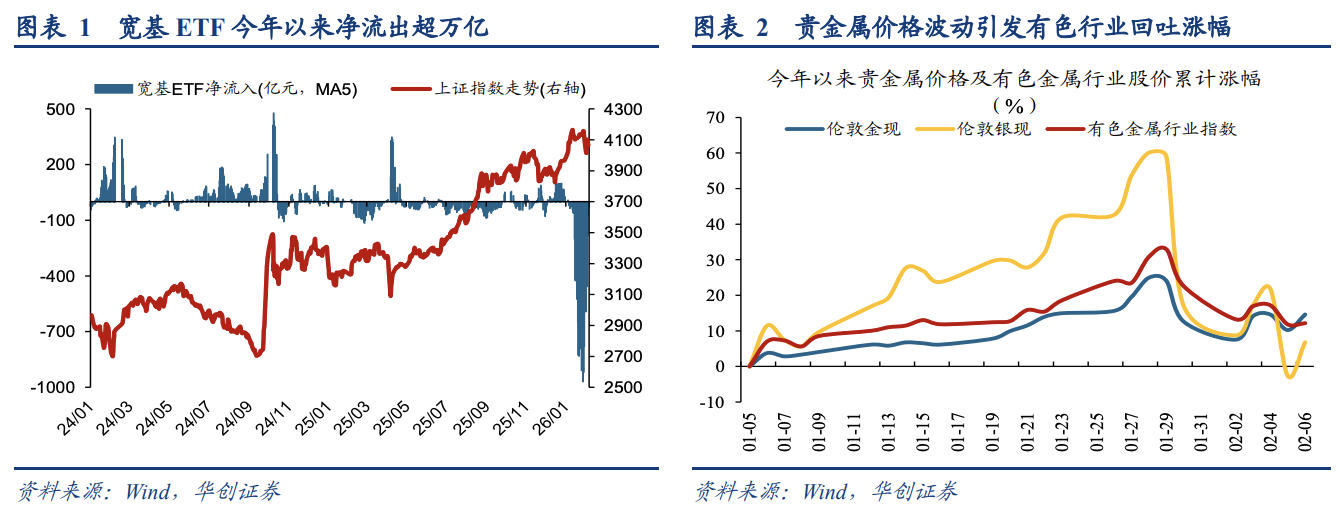
剩余流动性趋缓背景下,大盘股将跑赢小盘股;全年维度看,科技+顺周期仍是配置主线。对投资者而言,当前时点应把握中长线配置机会,重新审视"成 长"的定义边界。 调整到位信号明确,微观流动性冲击快速出清 市场经历了一轮猛烈但短暂的调整。据华创数据,宽基ETF今年以来累计净流出1.02万亿元,杠杆资金过去5个交易日净流出582亿元,创下去年4月以来新 高。贵金属价格暴跌引发有色金属板块回吐涨幅,叠加监管层上调融资保证金比例释放降温信号,市场风险偏好受到明显抑制。 市场短期剧烈调整后,配置窗口已经打开。在牛市背景下,微观流动性冲击已出清,关注顺周期与地产链的困境反转。 据追风交易台,华创证券2月8日发布的策略周报显示,本轮回撤或已到位——2月2日跌停公司达130家创新高,杠杆资金5日净流出582亿元,市场温度回落 至去年11月水平。 更关键的是投资风格正在发生深刻变化:成长股将优于价值股,但成长机会不再局限于科创板块,顺周期和地产链的困境反转同样值得关注; 但多个指标显示调整已经充分。从投资者情绪看,上证指数在4000点附近的市场温度已接近去年11月的3800点水平;2月2日跌停公司达130家,超过去年11 月21日的 ...