
钴矿

Search documents
智通港股早知道 | 美联储如期降息25基点但内部分歧加剧 刚果(金)设定新的钴出口条件
智通财经网· 2025-12-11 00:04
Group 1 - The Federal Reserve has lowered interest rates by 25 basis points for the third consecutive time this year, now setting the federal funds rate at a range of 3.5%-3.75% [1] - The Federal Open Market Committee (FOMC) voted 9 to 3 in favor of the rate cut, indicating increasing internal divisions regarding future policy direction [1] - The Fed announced a liquidity management measure, starting December 12, to purchase $40 billion in Treasury securities monthly to rebuild bank reserves that have significantly declined during the balance sheet reduction [1] Group 2 - The international silver price has reached a new historical high, with spot silver rising by 1.88% to $61.81 per ounce, and COMEX silver futures increasing by 2.24% to $62.20 per ounce [2] - Major U.S. stock indices saw gains, with the Dow Jones Industrial Average up by 497.46 points (1.05%), the S&P 500 up by 46.17 points (0.67%), and the Nasdaq Composite up by 77.67 points (0.33%) [2] - Notable increases were observed in large tech stocks, with Qualcomm rising over 3%, and several storage concept stocks reaching new highs, including Western Digital up over 7% [2] Group 3 - Glencore has not commented on reports suggesting it may become the first company to export cobalt under the new quota system in the Democratic Republic of Congo [3] - The new quota system allows Glencore to ship its first batch of cobalt after paying a 10% royalty fee, while another company, China Molybdenum, is also preparing for exports [3] Group 4 - Samsung SDI has signed a contract for lithium iron phosphate (LFP) battery orders worth over 2 trillion KRW (approximately $13.6 billion) with an unnamed U.S. energy infrastructure company [4] - The contract involves the delivery of LFP battery cells for a battery energy storage system solution, marking a significant shift from ternary batteries to LFP batteries for Korean battery manufacturers [4] Group 5 - The Democratic Republic of Congo has implemented stricter cobalt export regulations, introducing mandatory quota checks and prepayment of royalties, which may complicate the newly launched export quota system [5] - This policy is expected to impact the global cobalt supply rhythm in the short term [5] Group 6 - Quark AI glasses are currently out of stock on major e-commerce platforms, with a shipping delay extended to 45 days due to limited production capacity [6] - The company is working on increasing production to meet the high demand, which has already exceeded its future capacity for the next 45 days [6] Group 7 - Hainan Airport has completed the overseas investment procedures for acquiring a controlling stake in Meilan Airport, with a transaction value of 2.339 billion CNY [7] - The company plans to proceed with a comprehensive buyout offer for all issued domestic shares and H-shares following the completion of the share transfer [7] Group 8 - Lens Technology plans to acquire 100% of PMG International Co., Ltd., a liquid cooling and server cabinet company, to expand into AI computing infrastructure [8] - The specific transaction amount and terms will be determined after due diligence and negotiations [8] Group 9 - Sunny Optical Technology reported a total shipment of 12.634 million vehicle lenses in November, a year-on-year increase of 69.4% [9] - The company also reported a shipment of approximately 119 million mobile phone lenses, reflecting a year-on-year growth of 7.5% [9] Group 10 - Shanghai Pharmaceuticals has received approval from the National Medical Products Administration for the marketing application of its drug SPH3127 [11] - The approval allows the company to proceed with the commercialization of this product in China [11] Group 11 - Gilead Sciences has had its new drug application for ASC40, a first-in-class FASN inhibitor for treating moderate to severe acne, accepted by the National Medical Products Administration [12] - This marks a significant step in the development of innovative treatments in the dermatology sector [12] Group 12 - China National Heavy Duty Truck Corporation is benefiting from a significant increase in domestic heavy truck sales, with November sales reaching approximately 100,000 units, a year-on-year growth of about 46% [13] - The company is on track to meet its annual sales target of 300,000 units and plans to maintain a cautious capital expenditure strategy from 2025 to 2027 [14]
刚果(金)设定新的钴出口条件
Zhong Guo Neng Yuan Wang· 2025-12-09 09:27
Core Viewpoint - The Democratic Republic of Congo (DRC) has implemented new conditions for cobalt exporters to enhance control over this critical battery mineral, complicating the existing quota system [1][2]. Group 1: New Export Regulations - The DRC government requires mining companies to prepay 10% of the mining rights fee within 48 hours and obtain a compliance certificate, among other conditions [1]. - A quota system has replaced a months-long export ban, aiming to increase national revenue and strengthen regulation over cobalt, which accounts for over 70% of global production [1][6]. Group 2: Export Process and Compliance - The Ministry of Mines and the Ministry of Finance issued a notification detailing the export process, including mandatory quota verification, joint sampling, bulk weighing, and packaging [2]. - Exporters must submit a list of certificates from multiple agencies along with the Quota Verification Certificate (AVQ) and pay the mining rights fee before customs clearance [3][4]. Group 3: Export Quotas and Market Impact - The DRC has set a cobalt export quota of 18,125 tons for Q4 2025, with plans to export 96,600 tons annually starting in 2026 [6]. - Cobalt prices have risen from $16 per pound in August to $24 per pound currently, following a low of $10 per pound during the export ban [8]. Group 4: Industry Uncertainty - Industry executives express concerns over the new conditions, particularly regarding the clarity of the 10% rights fee in relation to previous exports [8]. - Analysts indicate that the unpredictable export policies and last-minute fee requirements may lead to fluctuations in exports and prices [8].
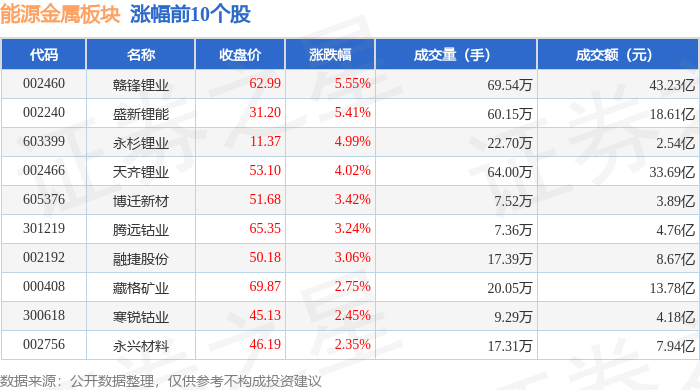
能源金属板块12月8日涨2.94%,赣锋锂业领涨,主力资金净流入5.75亿元
Zheng Xing Xing Ye Ri Bao· 2025-12-08 09:04
Core Viewpoint - The energy metals sector experienced a significant increase of 2.94% on December 8, with Ganfeng Lithium leading the gains [1] Group 1: Market Performance - The Shanghai Composite Index closed at 3924.08, up 0.54%, while the Shenzhen Component Index closed at 13329.99, up 1.39% [1] - Ganfeng Lithium's stock price rose by 5.55% to 62.99, with a trading volume of 695,400 shares and a transaction value of 4.32 billion [1] - Other notable performers included Shengxin Lithium Energy, which increased by 5.41% to 31.20, and Tianqi Lithium, which rose by 4.02% to 53.10 [1] Group 2: Capital Flow - The energy metals sector saw a net inflow of 575 million from institutional investors, while retail investors experienced a net outflow of 710 million [1] - Ganfeng Lithium attracted a net inflow of 3.67 billion from institutional investors, but faced a net outflow of 1.19 billion from retail investors [2] - Shengxin Lithium Energy had a net inflow of 178 million from institutional investors, with a net outflow of 1.84 billion from retail investors [2]





鹏欣资源:氢氧化钴是提升锂电池能量密度的核心成分,钴业务营收激增897.59%
Quan Jing Wang· 2025-10-31 01:02
Core Insights - The cobalt business of Pengxin Resources reported significant growth in the first three quarters of 2025, with sales revenue of cobalt hydroxide reaching 245 million yuan, a year-on-year increase of 897.59%, which was a key driver for the company's turnaround [1] - The surge in cobalt sales is attributed to the essential role of cobalt in the new energy sector and the company's strong resource reserves and cost control [1] - The rebound in cobalt prices due to the recovery in new energy demand in 2025, along with a reversal of inventory impairment of 225 million yuan, directly activated the performance elasticity of the cobalt business [1] Resource Reserves - Pengxin Resources controls over 200,000 tons of cobalt resources globally, with a potential reserve of 100,000 tons in the Congo (Kinshasa) 1078 block and an equity reserve of 10,600 tons from the Australian Clean TeQ project, leading the industry in scale [1] - The Congo (Kinshasa) base has established a cobalt hydroxide production line with a designed capacity of 3,000 tons per year, with plans to expand to 7,000 tons per year in the second phase, indicating clear future growth potential [1] Cost Management - The company has built a competitive barrier through low-cost operations, with a complete cost of cobalt products at approximately 3,200 USD per ton, which is 15 percentile points below the global cost curve and 20% lower than peers like Huayou Cobalt [2] - A partnership with the local government to establish a cobalt ore trading center is expected to yield 15%-20% of export quotas in 2025, giving the company a competitive edge under the quota system in Congo (Kinshasa) [2] Future Prospects - With the Clean TeQ project in Australia expected to commence production in 2025, adding 2,000 tons per year of cobalt capacity, and the continuous expansion of the new energy industry demand, Pengxin Resources' cobalt business is poised to further unleash performance potential [2] - The cobalt business is expected to become a crucial support for the company's strategic focus on "gold + copper + cobalt" [2]

钴锂新能源市场、价格周度分析
Xin Lang Cai Jing· 2025-10-21 09:36
Lithium Market - Lithium carbonate prices have shown an upward trend this week, with prices for battery-grade lithium carbonate at 73,500-74,500 CNY/ton, averaging 74,000 CNY/ton, an increase of 650 CNY/ton from the previous working day [2] - The overall sentiment in the lithium market is better than before, with tight supply of spot lithium ore and frequent inquiries from downstream lithium salt manufacturers for raw material reserves [1][2] Cobalt Market - Electrolytic cobalt prices have rapidly increased, driven by tight raw material inventories at smelting enterprises and a shift in trade quotes from premium to parity or slight discounts [4] - Cobalt intermediate prices remain strong, with a slight increase in imports, but actual transactions are still limited due to strong pricing from upstream suppliers [5] - Cobalt salt prices, including cobalt sulfate and cobalt chloride, have stabilized, with cobalt sulfate prices around 91,000-93,000 CNY/ton, while cobalt chloride prices are expected to rise due to supply constraints [6][7][14] Nickel Market - Battery-grade nickel sulfate prices remain stable, with the index price at 28,421 CNY/ton, as supply remains tight and demand from downstream manufacturers increases [8] - The overall nickel salt supply is expected to remain tight, with potential for price increases in the future [8] Precursor and Material Market - The price of ternary precursors continues to rise, supported by tight supply of nickel sulfate and cobalt sulfate, while some smaller precursor manufacturers have suspended quotes due to procurement difficulties [9][10] - Ternary materials prices are also on the rise, driven by increasing costs of raw materials, with demand from the domestic power market remaining strong [10] Iron Phosphate Market - Iron phosphate prices are stable with strong demand from the energy storage and power sectors, leading to upward pressure on prices [13] - The overall demand for iron phosphate is expected to maintain a growth rate of over 5% in October [11][13] Separator Market - The separator market is experiencing structural price increases, particularly for wet separators, due to high demand in the energy storage market and limited new capacity [17] - Major separator manufacturers are nearing full capacity, leading to a tight supply situation [17] Electrolyte Market - Electrolyte prices are stable, but cost pressures are increasing due to rising prices of lithium hexafluorophosphate and other additives [18] - Demand for electrolytes is expected to rise as projects in the pure electric heavy truck sector continue to progress [18] Sodium Battery Market - The sodium battery industry is focusing on balancing mass production with technology optimization and cost control, with expectations for moderate recovery in October [20] Recycling Market - Prices for cobalt and nickel salts are rising, while lithium carbonate prices have slightly decreased, leading to mixed market conditions for recycled materials [21]
刚果(金)持续搅动全球钴矿江湖,中国何以制衡与破局|深度
24潮· 2025-10-19 23:06
Core Viewpoint - The article discusses the significant impact of the Democratic Republic of the Congo (DRC) on the global cobalt supply chain, particularly in light of recent export restrictions and quota management policies aimed at stabilizing cobalt prices amid a supply surplus and declining demand growth [2][9][18]. Group 1: Cobalt Market Dynamics - The DRC is the largest cobalt supplier globally, accounting for 75.86% of the world's production, and its policy changes are reshaping the global energy landscape [2][12]. - In February 2023, the DRC government imposed a four-month cobalt export ban due to plummeting prices, marking a significant intervention in the cobalt market [2][9]. - The DRC's Strategic Mineral Regulatory Bureau announced an end to the export ban on October 16, 2023, implementing an annual export quota system to manage supply [3][4]. Group 2: Export Quota Details - For the remainder of 2025, the DRC's export limit is set at 18,125 tons, with monthly allocations of 3,625 tons in October, 7,250 tons in November, and 7,250 tons in December [3][4]. - The annual quota for 2026-2027 is fixed at 96,600 tons, with 87,000 tons designated as "basic quota" and 9,600 tons as "strategic quota" for key national projects [3][4]. Group 3: Impact on Cobalt Prices - Following the DRC's export restrictions, cobalt prices surged, with increases of 185% for cobalt intermediates, 107% for MB cobalt, and 123% for metallic cobalt from February 24 to October 9, 2023 [8][9]. - The DRC's policies aim to reduce global inventory levels to a month's demand, as prolonged supply surpluses have led to a 60% price drop from 2022 highs, severely impacting the DRC's revenue [8][12]. Group 4: Supply and Demand Trends - Global cobalt production is projected to increase by 21.8% in 2024, reaching 290,000 tons, with the DRC's output expected to grow by 25.7% to 220,000 tons [12][14]. - However, demand growth is slowing, with a projected 14% increase in global cobalt consumption in 2024, primarily driven by electric vehicles and consumer electronics [14][15]. Group 5: Strategic Implications - The DRC's control over cobalt supply is a response to international market fluctuations and domestic economic pressures, emphasizing the need for resource-rich countries to assert pricing power [8][18]. - The ongoing competition for cobalt resources reflects broader geopolitical tensions and the strategic importance of securing supply chains for green energy technologies [18][37]. Group 6: Future Outlook - The DRC's new quota policy is expected to tighten the cobalt supply balance, potentially leading to a structural adjustment in the global cobalt supply chain [36][38]. - The increasing reliance on cobalt recycling and alternative sources, such as Indonesian nickel-cobalt projects, is seen as a critical strategy for mitigating supply risks [54][41].


天风证券晨会集萃-20251016
Tianfeng Securities· 2025-10-16 00:14
Group 1: Dairy Industry Insights - The report indicates that despite short-term support for milk prices due to holiday consumption, the trend of capacity reduction in dairy companies continues, and the peak of milk prices is expected to be reached soon [3] - The report highlights a significant decline in beef exports from the US to mainland China, which fell by 46% year-on-year in the first seven months of 2025, creating favorable conditions for price increases [3] - The recovery in culling cow prices is anticipated to directly improve the performance of dairy companies, with a long-term trend of narrowing losses in culling cows expected to persist [3] Group 2: Cobalt Market Analysis - The report discusses the recent quota distribution for cobalt from the Democratic Republic of Congo, with a total quota of 96,600 tons, which is significantly lower than last year's export volume, indicating a potential supply shortage [23][26] - Current inventory levels are critical, with an estimated four months of inventory in the supply chain, which could lead to increased prices as demand rises [26] - The report suggests focusing on companies less affected by Congolese policies, such as Huayou Cobalt and Luoyang Molybdenum, which are expected to benefit from the recent quota announcements [27] Group 3: Automotive Sector Overview - The report covers Futec Technology as a leading supplier of high-voltage power systems for electric vehicles, with a strong customer base including major automotive brands [20][21] - The company is expected to see significant revenue growth, with projected revenues of 2.996 billion, 3.608 billion, and 4.272 billion yuan from 2025 to 2027 [22] - The automotive power supply industry is characterized by trends towards higher voltage, integration, and diversification of functions, positioning Futec Technology favorably for future growth [21] Group 4: Construction and Steel Industry - Honglu Steel Structure reported a year-on-year increase in new orders, with a total of 22.267 billion yuan in new contracts signed in the first three quarters of 2025, indicating a positive outlook for Q4 production [10] - The report emphasizes the potential for improved profit margins due to rising steel prices, which could enhance the company's net profit per ton significantly [10] - The company has invested in advanced welding technology, which is expected to improve production efficiency and reduce costs [10]
刚果配额落地对钴产业链的影响
2025-10-15 14:57
Summary of Key Points from the Conference Call on Cobalt Industry Industry Overview - The conference call discusses the impact of new cobalt export policies in the Democratic Republic of the Congo (DRC) on the cobalt supply chain and market dynamics [1][2][9]. Core Insights and Arguments - **Logistics and Supply Chain Impact**: The new export policy has significantly extended the logistics cycle to approximately four months due to prepayment fees, customs documentation, and sample inspections, leading to a sharp decline in cobalt imports to China by May 2025 [1][2][3]. - **Cobalt Export Quota**: The DRC's strategic cobalt export quota is set at 9,600 tons, accounting for nearly 10% of total exports. The distribution of this quota remains uncertain, with expectations that it will not be directly allocated to the U.S. due to the DRC's need to maintain fiscal revenue [1][6]. - **Supply Increase from New Smelter**: The new smelter by Huayou Cobalt in the DRC is expected to add 5,000 tons of electrolytic cobalt annually, but stricter controls on semi-finished product exports may hinder global cobalt circulation [1][7]. - **U.S. Strategic Reserves**: The U.S. plans to stockpile 1,500 tons of cobalt annually starting in 2026, with approximately 77,000 tons of nickel-cobalt materials imported in the first half of the year, indicating a strategic reserve intention [1][7][10]. - **Chinese Market Dynamics**: China's cobalt inventory is being consumed, with expectations of reduced consumption due to import disruptions starting in September, potentially lasting until the end of Q1 2026 [1][7][12]. - **Indonesian Supply Limitations**: While the MHP project in Indonesia will increase supply, it is expected to only contribute about 90,000 tons by 2028, leaving a monthly shortfall of 1,000 to 2,000 tons, exacerbating inventory reduction pressures in China [1][12]. - **Price Projections**: Short-term cobalt prices may reach peak levels seen in 2022, with conservative estimates around 400,000 CNY/ton and aggressive predictions up to 500,000 CNY/ton, although excessively high prices could lead to material substitution [2][14][22][23]. Additional Important Insights - **Regulatory Compliance Challenges**: New regulations require companies to prepay fees and submit extensive documentation, increasing operational difficulties for Chinese enterprises [3][4][5]. - **Market Sentiment and Risks**: The current market is characterized by tight supply and strong demand, with potential price volatility due to speculative trading and profit-taking behaviors [25]. - **Long-term Supply Outlook**: The global cobalt market is expected to remain in a state of tight balance or shortage over the next few years, with an estimated annual shortfall of at least 20,000 tons [24]. This summary encapsulates the critical aspects of the cobalt industry as discussed in the conference call, highlighting the implications of regulatory changes, market dynamics, and future projections.
天风证券:刚果(金)配额已出 重视钴短中期逻辑强化
智通财经网· 2025-10-15 08:01
Core Viewpoint - The recent quota policy introduced by the Democratic Republic of Congo (DRC) is expected to lead to a short-term price increase for cobalt due to low inventory levels and a tight supply-demand balance, with a long-term positive outlook for cobalt prices [1][3]. Quota Policy Summary - The total quota for cobalt exports is set at 96,600 tons, with a base quota remaining unchanged at 87,000 tons [1]. - Major companies receiving quotas include: - Luoyang Molybdenum: 36% share, annual quota of 31,200 tons - Glencore: 22% share, annual quota of 18,800 tons - Eurasian Resources: 12% share, annual quota of 10,000 tons - EGC (local DRC company): 6.5% share, annual quota of 5,640 tons - Northern Mining: 5.5% share, annual quota of 4,800 tons - Shengton Mining: 2% share, annual quota of 1,680 tons - Huayou Cobalt: 1.24% share, annual quota of 1,080 tons [1][2]. Market Outlook - The quota of 96,600 tons represents a 56% decrease compared to last year's export volume of nearly 220,000 tons, indicating a tighter supply situation [3]. - Current inventory levels are critical, with approximately four months of supply across the industry chain, which could lead to increased supply tension if any segment holds excess stock [3]. - Recent price increases for cobalt products have been significant, with prices for cobalt sulfate, lithium cobalt oxide, and cobalt metal rising by 40%, 38%, and 29% respectively from September 22 to October 13 [3]. Investment Recommendations - Companies not significantly affected by DRC policies, such as Huayou Cobalt (603799.SH) and Liqin Resources (02245), are recommended for investment [4]. - Luoyang Molybdenum (603993.SH, 03993) is highlighted as a low-cost supplier with reduced uncertainty following the quota announcement [4].

券商晨会精华 | 现在是把握券商板块战略性修复机会的关键时期
智通财经网· 2025-10-15 00:44
Market Overview - The market experienced fluctuations with the ChiNext Index and the Sci-Tech Innovation 50 Index both dropping over 4% during the session. The total trading volume in the Shanghai and Shenzhen markets reached 2.58 trillion, an increase of 221.5 billion compared to the previous trading day. The Shanghai Composite Index fell by 0.62%, the Shenzhen Component Index dropped by 2.54%, and the ChiNext Index decreased by 3.99% [1]. Brokerage Sector Insights - Huatai Securities emphasized that now is a critical period to seize strategic repair opportunities in the brokerage sector, driven by multiple factors including policy, capital, performance, and valuation. The capital market is undergoing profound reforms, transitioning into a new phase of co-development in investment and financing. The low interest rate environment is accelerating the migration of institutional and retail funds to the equity market, continuously bringing in incremental capital. With market expansion and increased activity, brokerage firms are seeing improvements in their business performance and profitability. However, the sector's valuation remains relatively low, making this an opportune time for strategic investments [2]. Cobalt and Rare Earths Strategy - CITIC Securities highlighted the importance of strategic allocation opportunities in cobalt and rare earths. The details of the cobalt export quotas from the Democratic Republic of Congo have been finalized, with major companies like Luoyang Molybdenum, Glencore, and Eurasian Resources holding the top three quota shares at 35.9%, 27.3%, and 21.6% respectively. The total quota for 2026 and 2027 is set at 96,600 tons, which includes 87,000 tons of basic quotas and 9,600 tons of strategic quotas. Under this quota system, only about 44% of production can be exported, resulting in a reduction of over 100,000 tons. Based on estimates of 270,000 tons supply and 230,000 tons demand in 2024, the market is expected to shift from a surplus of about 70,000 tons to a shortage of about 30,000 tons, potentially driving cobalt prices higher. Additionally, the Ministry of Commerce has reinforced export controls on rare earths, further solidifying their strategic importance [3]. North Exchange Long-term Value - Galaxy Securities pointed out that the North Exchange sector possesses long-term investment value. With the introduction of the specialized and innovative index, steady progress in new stock issuances, and the realization of more merger and acquisition projects, the trading activity and market attention towards the North Exchange are expected to remain high. For investment strategies in the second half of 2025, two main directions are recommended: 1) Focus on new productive forces in the North Exchange, particularly in emerging industries such as artificial intelligence, commercial aerospace, low-altitude economy, and new consumption, where companies have "scarce" attributes in the A-share market; 2) Conduct bottom-up selection based on financial indicators, focusing on companies with high performance growth, strong R&D investment, significant capacity release potential, and strong growth prospects [4].


