珠宝

Search documents
消费领域的“超额捕手”!富国基金周文波:也能欣赏“老登股”,但投资心态不“老登”
聪明投资者· 2026-01-12 12:14
Core Viewpoint - The article emphasizes the importance of understanding consumer behavior and market trends, particularly focusing on the potential of the Z generation in the consumption market, as demonstrated by the performance of the fund managed by Zhou Wenbo, which has outperformed its peers in recent years [2][3]. Group 1: Investment Strategy - Zhou Wenbo adopts an investment philosophy of "bottom-up, maintaining integrity while being innovative," focusing on companies with strong performance and long-term growth potential, while also seeking opportunities that can yield significant changes and excess returns [4][9]. - A four-layer investment framework is established, which includes "good business, good company, growth stage, and reasonable valuation," allowing for the identification of investment opportunities in both traditional and new consumption trends [4][5]. Group 2: Market Insights - Zhou Wenbo identifies three categories of store-based businesses based on their sales per square meter (坪效): those below 20,000 yuan are generally mediocre; those between 20,000 and 30,000 yuan may have growth potential depending on their expansion stage; and those above 30,000 yuan are likely to be excellent businesses worth significant attention [5][21][22]. - The current consumption sector, despite experiencing adjustments, still presents opportunities, particularly in traditional consumption sectors with low valuations and new consumption areas like trendy toys, beauty products, and jewelry retail, which continue to show growth potential [5][24]. Group 3: Future Opportunities - The investment opportunities in 2025 are expected to be primarily driven by new consumption, while traditional consumption leaders may remain relatively flat due to market conditions [27]. - There is a belief that as the market stabilizes, traditional consumption companies, which currently have dividend yields of 4%-7%, could see positive returns if the overall environment improves [28]. Group 4: Consumer Behavior and Research - Zhou Wenbo emphasizes the importance of grassroots research and staying curious about new trends, which helps in identifying investment opportunities and validating existing judgments [29][30]. - The article highlights the significance of understanding the logic behind consumer behavior, particularly in the context of the Z generation, and the need to avoid a stagnant mindset when approaching investment in consumer stocks [31][32].


外媒关注2026开年中国消费市场新趋势——中国消费迎来“开门红”
Ren Min Ri Bao· 2026-01-12 06:51
Core Insights - The Chinese consumer market is experiencing a significant transformation, moving from quantity to quality, which presents substantial opportunities for global markets [1][2][6] Group 1: Consumer Trends - During the New Year holiday, 142 million domestic trips were made in China, with total spending reaching 84.789 billion yuan, indicating strong consumer activity [1] - The "ice and snow tourism" has become a key driver of winter consumption, with record visitor numbers to ski resorts and hot springs [2] - The shopping preferences of travelers to China are evolving, with a shift towards high-tech products and cultural items, reflecting the diversity and quality of Chinese products [2][3] Group 2: Policy Support - China's 14th Five-Year Plan emphasizes promoting consumption as a key strategy for balanced economic growth [5] - The Central Economic Work Conference highlighted the implementation of proactive fiscal policies to stimulate consumption and investment in 2026 [4] - Recent policies aim to enhance consumer confidence through measures like consumption subsidies and improved social security systems [5][6] Group 3: Economic Resilience - The retail sales of consumer goods in China increased by 4% year-on-year in the first eleven months of 2025, showcasing the steady recovery of consumer demand [6] - The focus on domestic consumption is expected to drive sustainable economic growth, shifting the emphasis from investment and exports to services and consumption [5][6] - The resilience of the Chinese economy is further supported by targeted measures to expand domestic demand and enhance social security [6] Group 4: Global Market Opportunities - Global brands are encouraged to adapt their strategies to align with the evolving preferences of Chinese consumers, particularly in terms of value and local tastes [7] - There is significant potential for investment in China's smaller cities, where daily consumer spending shows remarkable resilience [7] - The younger generation in China is increasingly spending on experiences, such as travel and cultural events, presenting opportunities for service-oriented businesses [7]
莫迪破防了,美财长一句话,让印度颜面尽失,还没资格与中国比较
Sou Hu Cai Jing· 2026-01-12 05:43
Group 1 - The U.S. imposed a 25% tariff on Indian goods starting August 1, raising the total tariff rate to 50%, which is the most severe action against a trade partner in recent years [1][3] - The Indian textile, jewelry, and footwear export sectors are expected to be the most affected, with many orders being canceled, leading to significant challenges for factory owners and workers [3] - U.S.-India trade negotiations have been ongoing since 2024, but progress has been slow due to persistent disagreements, with the U.S. seeking more market access and lower tariffs while India sets up non-tariff barriers [4][6] Group 2 - Indian Prime Minister Modi has publicly stated that he will not compromise domestic interests to appease the U.S., emphasizing national sovereignty and development [8] - Modi's recent overtures towards China, including visits by defense and foreign ministers, are seen as a strategic move to balance relations amid U.S. pressure [9][11] - Observers note that India's diplomatic strategy of trying to please both the U.S. and China may lead to being marginalized in the evolving global landscape, as it struggles to find a stable position between major powers [12][14]

国际论道丨中国消费迎来“开门红”
Ren Min Ri Bao Hai Wai Ban· 2026-01-12 04:24
Core Insights - The Chinese consumer market is experiencing a significant transformation, moving from quantity to quality, driven by various factors including government policies and changing consumer preferences [1][4][6] Group 1: Consumer Activity - During the New Year holiday, 142 million domestic trips were made in China, with total spending reaching 84.789 billion yuan [1] - Hainan's duty-free sales on January 1 reached 251 million yuan, a year-on-year increase of 93.8% [2] - The rise of "China Shopping" reflects a shift in foreign tourists' purchasing habits towards high-tech products and cultural items [2][3] Group 2: Policy Support - The Chinese government is implementing a series of policies aimed at boosting consumption, including a more proactive fiscal policy and specific actions to stimulate consumer spending [4][5] - The "14th Five-Year Plan" emphasizes the importance of consumption in achieving balanced economic growth [5] Group 3: Economic Resilience - China's consumer market growth indicates a recovery in demand and an ongoing optimization of the economic structure, enhancing internal momentum and resilience [6] - Retail sales of consumer goods increased by 4% year-on-year in the first eleven months of 2025, showcasing the effectiveness of consumption-boosting measures [6] Group 4: Global Opportunities - Global companies and investors are encouraged to adapt to the evolving Chinese market, particularly in retail and service sectors, where local preferences are becoming increasingly important [7] - There is a notable opportunity in smaller Chinese cities, where daily consumer spending shows remarkable resilience, presenting long-term investment potential [7]
“心价比”时代的礼赠革新:可复美×潮宏基跨界礼盒的商业之道
Jin Rong Jie· 2026-01-12 01:47
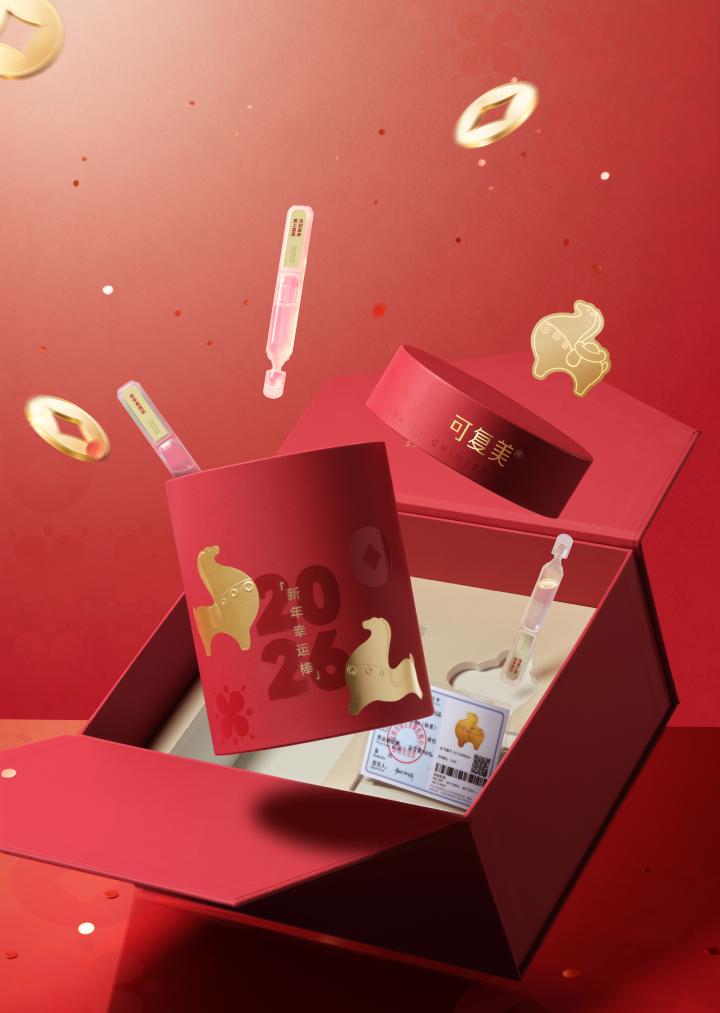
Core Insights - The consumer market in 2026 shows a clear trend towards "value for money," where consumers prioritize emotional value, practicality, and preservation over mere functionality [1] - The collaboration between skincare brand Kefu Mei and jewelry brand Chao Hong Ji has resulted in a customized New Year gift box that combines functional skincare with emotional and collectible gold jewelry [1][3] Group 1: Product Innovation - The gift box features 60 Kefu Mei collagen sticks, each with different blessings, and a gold horse-shaped ornament from Chao Hong Ji, symbolizing good fortune and prosperity [1][4] - This is the first time Kefu Mei has integrated functional skincare products with emotionally valuable gold jewelry, targeting the light luxury consumer segment and the gift market [1][4] Group 2: Strategic Significance - The choice to incorporate gold is based on a deep understanding of the current economic environment and consumer psychology, as gold serves as a "hard currency" that provides value stability and anti-inflation properties [3] - This strategy transcends traditional holiday marketing, offering a dual financial and emotional value proposition for Kefu Mei's skincare products [3] Group 3: Brand Collaboration - Chao Hong Ji's craftsmanship and brand reputation provide strong quality assurance for Kefu Mei, enhancing the emotional significance of the gift box [4] - The gold ornament embodies traditional cultural values, transforming the functional aspect of the collagen sticks into a heartfelt wish for enduring friendship and well-being [4] Group 4: Marketing Strategy - The emotional TV commercial featuring Li Jiaqi and his mother deepens the emotional connection, elevating the product from a mere skincare tool to a medium of intergenerational love [6] - This marketing approach not only enhances the emotional attributes of the product but also resonates with the cultural phenomenon of "young people managing the New Year" [6] Group 5: Commercial Value Logic - The combination of collagen sticks and gold jewelry reflects a complementary value logic, addressing consumer concerns about practicality and emotional significance in gift-giving [8][9] - The design of 60 collagen sticks ensures high usage frequency, while the gold ornament adds asset value, creating a dual certainty of utility and emotional connection for gift-givers [9] Group 6: Market Segmentation - Kefu Mei's innovative practice has successfully opened a new niche market that bridges beauty, light luxury jewelry, and gifting, characterized by high certainty in expressing intentions [10] - This collaboration creates a threefold value unit of "daily usability," "emotional significance," and "asset value," addressing the utility anxiety in gift-giving scenarios [10] Group 7: Industry Implications - The trend of consumer upgrading indicates that purely functional products can no longer meet diverse consumer needs, necessitating cross-industry collaboration and scene innovation for value breakthroughs [11] - Kefu Mei's approach demonstrates that functional brands can expand emotional and cultural value while maintaining professionalism, potentially defining the next consumer paradigm [11]

中国消费迎来“开门红”
Ren Min Ri Bao Hai Wai Ban· 2026-01-12 01:07
Core Insights - The Chinese consumer market is experiencing a significant transformation, moving from quantity to quality, driven by various factors including government policies and changing consumer preferences [1][4][6] Group 1: Consumer Activity - During the New Year holiday, 142 million domestic trips were made in China, with total spending reaching 84.789 billion yuan, indicating strong consumer activity [1] - Hainan's duty-free sales on January 1 reached 251 million yuan, a year-on-year increase of 93.8%, showcasing the appeal of winter tourism and shopping [2] - The rise of "China Shopping" reflects a shift in purchasing trends, with consumers increasingly buying high-tech products and cultural items rather than traditional goods [2][3] Group 2: Policy Support - The Chinese government is implementing a series of policies aimed at stimulating consumption, including a more proactive fiscal policy and specific actions to boost consumer spending [4][5] - The "14th Five-Year Plan" emphasizes promoting consumption as a key driver for balanced economic growth, highlighting the importance of consumer spending in the overall economy [5][6] Group 3: Economic Resilience - China's consumer market is not only recovering but also showing signs of structural optimization and enhanced internal momentum, contributing to economic resilience [6] - Retail sales of consumer goods increased by 4% year-on-year in the first eleven months of 2025, indicating a steady expansion of market demand [6] Group 4: Global Opportunities - Global companies and investors are encouraged to adapt to the evolving Chinese market, particularly in retail and service sectors, to capitalize on the growing consumer base [7] - There is a notable shift in consumer preferences towards local products and experiences, presenting new opportunities for foreign brands to tailor their strategies to meet local demands [7]
中国消费迎来“开门红”(国际论道)
Ren Min Ri Bao Hai Wai Ban· 2026-01-11 23:07
Core Insights - The Chinese consumer market is experiencing a significant transformation, moving from quantity to quality, driven by increased consumer confidence and diverse product offerings [8][9][12] - The New Year holiday saw 142 million domestic trips and total spending of 84.789 billion yuan, indicating robust consumer activity [8][12] - Policies aimed at boosting consumption, such as subsidies and financial support, are expected to sustain economic growth and enhance consumer spending [11][12][13] Consumer Activity - During the New Year holiday, ice and snow tourism became a major driver of winter consumption, with record visitor numbers to ski resorts and hot springs [9][10] - Hainan's duty-free sales reached 251 million yuan on January 1, a 93.8% year-on-year increase, highlighting the appeal of warm-weather destinations [9][10] - The rise of "China Shopping" reflects a shift in foreign tourists' purchasing preferences towards high-tech products and cultural items [9][10] Policy Support - The Chinese government is implementing a series of policies to stimulate consumption, including a more proactive fiscal policy and specific actions to boost consumer spending [11][12] - The Central Economic Work Conference emphasized the need for targeted actions to enhance consumption and investment, indicating a commitment to maintaining high growth rates [11][12] - Recent notifications from financial authorities aim to strengthen the collaboration between commerce and finance to further stimulate consumer spending [11][12] Economic Resilience - China's consumer market is showing signs of resilience, with retail sales of consumer goods increasing by 4% year-on-year in the first eleven months of 2025 [13][20] - The focus is shifting from investment and exports to services and consumption, indicating a structural change in the economy [12][20] - The government's measures to enhance social security and provide financial support are expected to improve mid-term growth prospects [13][20] Global Opportunities - International brands are encouraged to adapt their strategies to align with the evolving preferences of Chinese consumers, particularly in terms of value and local tastes [14][20] - The consumption vitality in China's smaller cities presents new investment opportunities for global investors [14][20] - The younger generation's increasing spending on experiential services, such as travel and cultural events, indicates a growing market for service-oriented businesses [14][20]

文玩玉石的陪逛买手,在直播和现实之中求生存
36氪· 2026-01-11 02:08
Core Viewpoint - The article discusses the emergence and challenges of a new profession called "shopping assistants," who bridge the gap between source markets and consumers, driven by information asymmetry in the market [4][5][6]. Group 1: Emergence of Shopping Assistants - Shopping assistants have become a vital part of the sourcing process, especially in markets like Guangdong's jade market and Yiwu's wholesale market, as they help consumers navigate the complexities of pricing and product quality [5][6]. - This profession arose from the growing information gap in the market, particularly with the rise of live-streaming e-commerce, where consumers seek to find deals directly from source markets [5][6]. Group 2: Role and Functionality - Shopping assistants typically have a background in the industry and leverage their knowledge to negotiate prices on behalf of clients, acting as intermediaries between buyers and sellers [7][8]. - They earn commissions based on the savings they secure for clients, often facing a dual role that creates tension between serving clients and maintaining relationships with sellers [7][8]. Group 3: Personal Experiences - The article shares personal stories of shopping assistants like Wen Hui, who successfully negotiates prices for clients while ensuring they avoid overpaying for products [8][14]. - Wen Hui's experience highlights the importance of local knowledge and trust in building a client base, as her background in the industry allows her to effectively serve customers [13][14]. Group 4: Income and Challenges - Shopping assistants can earn significant income, with some reporting monthly earnings of up to 30,000 yuan, which is considered high in their local context [21][22]. - Despite the potential for high earnings, shopping assistants face challenges such as physical demands, market pressures, and the need to constantly update their knowledge of market trends [22][28]. Group 5: Industry Dynamics and Competition - The profession is facing increasing competition from MCN agencies and live-streaming influencers, who are also targeting the same consumer base, complicating the landscape for individual shopping assistants [42][43]. - The article notes that the rise of these competitors has led to a dilution of the shopping assistants' unique value proposition, as consumers may confuse their services with those of influencers or intermediaries [46][49]. Group 6: Future Outlook - There is uncertainty about the long-term viability of the shopping assistant model, as the industry grapples with the shrinking information gap and increasing competition [38][56]. - Shopping assistants are encouraged to adapt by enhancing their online presence and content creation to attract clients, but this requires significant time and effort [40][41].
喜娜AI速递:昨夜今晨财经热点要闻|2026年1月11日
Sou Hu Cai Jing· 2026-01-10 22:21
Group 1 - China's application for over 200,000 satellite frequency resources to the International Telecommunication Union (ITU) indicates a strategic move to enhance its commercial space industry and compete with SpaceX [2] - Foreign investment in Chinese assets is increasing, with JPMorgan heavily investing in companies like CATL and Innovent Biologics, reflecting confidence in China's economic recovery and the attractiveness of tech stocks [2] - The price surge in storage chips is impacting downstream consumer electronics, leading to price increases from major PC manufacturers and a downward revision of shipment expectations for smartphones and laptops [2] Group 2 - Over 40 banks have issued announcements for large-denomination time deposits, with a clear trend towards shorter maturities and declining interest rates, influenced by factors such as net interest margin pressure and monetary policy [3] - The State Council's investigation into the competitive landscape of food delivery platforms aims to address issues of excessive competition and promote fair practices within the industry [3] - The Ministry of Finance announced the cancellation of VAT export rebates for solar products starting April 1, 2026, which is expected to help eliminate low-quality competition and promote healthy industry development [3] Group 3 - Xiaomi's CEO Lei Jun announced that the Xiaomi SU7 is the only electric sedan to surpass the Tesla Model 3, with ambitious delivery targets set for 2025 and 2026 [4] - Jewelry brands are raising gold prices, with significant increases noted, and analysts predict continued upward movement in gold prices due to geopolitical tensions [5] - Tianpu Co. is under regulatory investigation for stock price manipulation following its ownership change and unclear statements regarding AI business plans, with a stock resumption scheduled [5]



和田玉大师马瑞:跨界创新践行者,解锁传统工艺多元可能
Xin Lang Cai Jing· 2026-01-10 10:15
Core Perspective - The article highlights the innovative cross-disciplinary approach of jade carving master Ma Rui, who integrates traditional craftsmanship with modern commercial and educational practices, demonstrating that traditional heritage can align with contemporary society and provide a model for diverse development for contemporary artists [1][9]. Group 1: Cross-Industry Collaborations - Ma Rui's exploration of cross-industry collaborations is exemplified by his partnerships with commercial brands, such as the collaboration with Nokia's VERTU to create a custom phone named after NBA star Yao Ming, incorporating jade carving elements into the design, enhancing cultural value and aesthetic appreciation [3][6]. - Another collaboration with GAC Toyota's Camry illustrates the shared values of craftsmanship, where Ma Rui's pursuit of precision in jade carving aligns with the brand's commitment to quality, promoting a shared philosophy of "craftsmanship creates quality goods" [3][4]. Group 2: Educational Contributions - In the educational sector, Ma Rui serves as a guest lecturer at Shanghai Jiao Tong University and Shanghai Vocational School of Arts, integrating the concept of "moral education" into craft education, emphasizing the importance of nurturing young talent in traditional craftsmanship [6][7]. - He focuses on practical skills such as jade selection, carving, and polishing while fostering students' innovative thinking and cultural literacy, believing that education is fundamental to the living inheritance of traditional crafts [6][7]. Group 3: Academic Research and Theoretical Contributions - Ma Rui's dual focus on academic research and artistic practice is evident in his role as vice president of the Shanghai Gemstone Industry Association, where he translates practical experiences into theoretical frameworks, such as his upcoming publication on jade art, which aims to fill gaps in contemporary jade carving theory [7][9]. - His proposed "three-dimensional evaluation system" for jade carving places equal importance on material, craftsmanship, and philosophical value, showcasing the direct influence of theoretical research on practical artistry [9].