债券

Search documents
宏观量化经济指数周报:债券增值税或推动资金增配实体经济资产-20250803
Soochow Securities· 2025-08-03 13:34
Economic Indicators - The weekly ECI supply index is at 50.07%, down 0.03 percentage points from last week, while the demand index is at 49.92%, down 0.01 percentage points[1] - In July, the ECI supply index averaged 50.11%, down 0.05 percentage points from June, and the demand index averaged 49.92%, down 0.01 percentage points[1] - The real estate market saw a 18.6% year-on-year decline in sales area for new homes in 30 major cities, totaling 6.49 million square meters in July[1] Bond Market and Tax Adjustments - The ELI index is at -0.72%, up 0.09 percentage points from last week, indicating a slight recovery in liquidity for the real economy[1] - The adjustment of the bond value-added tax may lead to increased allocation of funds to non-financial corporate bonds and other real economy assets[1] - The People's Bank of China plans to expand the issuance of technology innovation bonds in the third quarter, focusing on structural monetary policy tools[1] Market Trends and Risks - The export index remains resilient, with port cargo throughput maintaining high levels, although there are concerns about the impact of new tariffs on re-export trade[1] - The report highlights risks including uncertainties in U.S. tariff policies and the sustainability of improvements in the real estate market[1]
国债等债券利息收入需征收增值税,影响几何?个人投资者需缴税吗?
Bei Jing Shang Bao· 2025-08-03 12:51
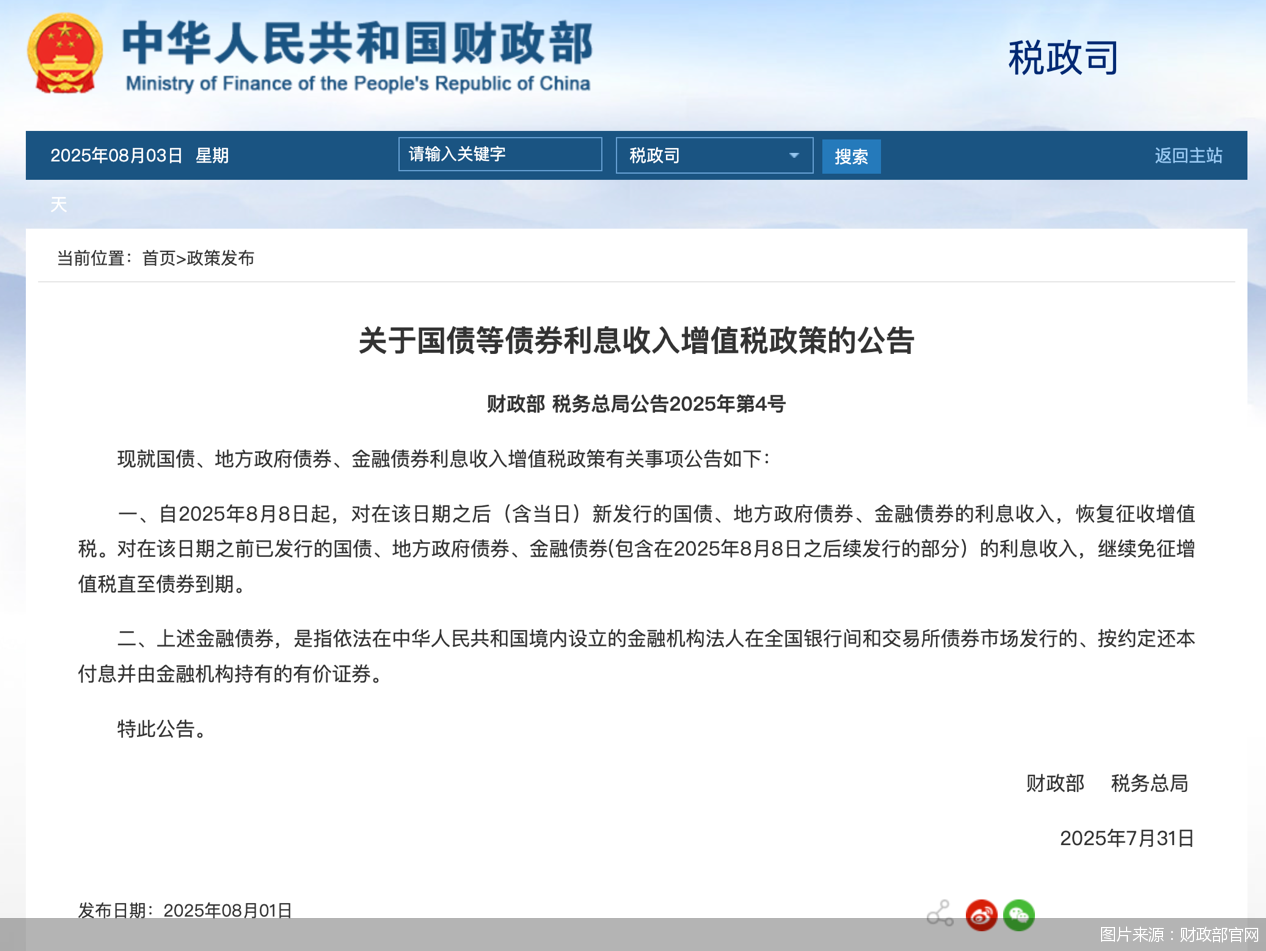
Core Viewpoint - The Ministry of Finance and the State Taxation Administration announced a policy change regarding the value-added tax (VAT) on interest income from newly issued government bonds, local government bonds, and financial bonds, effective from August 8, 2025, which will end the previous tax exemption for these interest incomes [1][4][5]. Group 1: Policy Changes - The new policy will restore VAT on interest income from newly issued government bonds, local government bonds, and financial bonds starting from August 8, 2025 [1][4]. - Previously, interest income from these bonds was exempt from taxes to attract investment and expand the bond market [4][5]. - The policy will adopt a "new and old distinction" approach, meaning that bonds issued before August 8, 2025, will continue to be exempt from VAT until maturity [5][6]. Group 2: Market Impact - Analysts suggest that the policy change will lead to a short-term decline in interest rates and create a pricing disparity between new and old bonds [1][6]. - The restoration of VAT is expected to increase the cost of new bond issuances, while existing bonds will retain a tax advantage, potentially leading to a preference for older bonds among investors [7][8]. - The change aims to prevent excessive capital accumulation in interest rate bonds and enhance fiscal revenue, thereby alleviating fiscal pressure [5][6]. Group 3: Investor Considerations - Individual investors will remain exempt from personal income tax on interest income from government bonds, despite the VAT restoration [8][9]. - The overall market environment remains challenging, with ongoing asset scarcity and potential disruptions to the previous bull market trend due to policy shifts and external economic influences [9].

固收周度点评:活跃老券的迁徙启动-20250803
Tianfeng Securities· 2025-08-03 11:42
Report Industry Investment Rating No relevant content provided. Core View of the Report The bond market has not formed a trend - based market, and it is expected to return to a volatile state after short - term emotional fluctuations. To obtain excess returns in the volatile market, one can first seek assets with relative volatility and liquidity on the curve, and then look for individual bonds with relative value. Currently, 30 - year Treasury bonds are recommended [25]. Summary by Relevant Catalogs This Week's Bond Market Review - This week, the bond market fluctuated sharply. The first half of the week saw a cycle of repair - decline - repair around the performance of the commodity and equity markets and the "anti - involution" policy expectations. The second half was initially stabilizing but was hit by a sharp volatility at the end of Friday due to tax policy changes. However, the 10 - year Treasury yield remained in a narrow range of 1.70% - 1.75% [1][9]. - From 25th July to 1st August, the yields of 1 - year, 5 - year, 10 - year, and 30 - year Treasury bonds decreased by 1.0BP, 3.6BP, 2.7BP, and 2.3BP respectively [11]. Next Week's Key Bond Market Concerns - A sudden change in the tax system for Treasury bonds occurred on Friday night. Next week, the bond market will first price this event. "New bonds" refer to those issued on or after 8th August with new codes, while "old bonds" are those existing before this date, including active and non - active ones [18]. - Next week, the focus is on the allocation desks' scramble for active old bonds. Old bonds may be more popular among allocation desks due to tax advantages. Non - active bonds are already concentrated in allocation desks with limited liquidity, so it is expected that allocation desks will target active old bonds. Trading desks may sell at this time and wait to trade new bonds later. Also, trading desks may increase purchases of short - term credit bonds and certificates of deposit in the short term [2][19]. - Bond yields are expected to quickly price the scramble behavior next week. The spread between new and old bonds is expected to be smaller than the static calculation result. Old bonds will have a liquidity discount after being held by allocation desks, and some institutions are insensitive to tax rates [2][20]. Next - Stage Strategy Considerations - The bond market is in a volatile state and has not shown a trend reversal. To gain excess returns, one can first find assets with relative volatility and liquidity on the curve and then look for individual bonds with relative value. Currently, 30 - year Treasury bonds are recommended [25]. - The ultra - long end of the curve has volatility and opportunities. In the second quarter, ultra - long bonds created relative volatility in a "sideways" market. They are more sensitive to short - term factors. Since the second quarter, the intraday amplitude of the 30 - year Treasury active bond was higher than that of the 10 - year Treasury active bond on 60 out of 84 trading days [25]. - After the bond market adjustment in mid - to - late July, the spread of ultra - long - end interest - rate bonds has widened. As of 1st August, the 30 - year - 10 - year Treasury spread was 24BP, at the 90% percentile in the past year [34]. - In August, there will be issuance disturbances for ultra - long bonds. After the issuance of the 50 - year special Treasury bond on 1st August, 3 more ultra - long special Treasury bonds are to be issued. With the expected reduction of the预定 interest rate in September and the possible scramble for old bonds by insurance companies after the tax reform, the allocation demand for ultra - long bonds is expected to be strong [4][36]. - During the issuance of ultra - long bonds, the relative value of individual bonds will change. If the issuance scale of "25 Special Treasury 05" on 8th August remains the same as the previous two issues, its scale will reach 24.9 billion yuan. It may become the second - most active bond, and the yields of the three bonds are expected to converge, with the yield of "25 Special Treasury 02" possibly decreasing by about 2BP [5][37].
利率债市场周度复盘:政治局会议增量有限,增值税调整带动下“抢老券”-20250803
Huachuang Securities· 2025-08-03 11:28
1. Report Industry Investment Rating No relevant content provided. 2. Core View of the Report In the last week of July, with the central bank's support, funds smoothly crossed the month. The outcome of the Sino-US talks was in line with expectations, and the Politburo meeting mainly focused on advancing existing policies. The equity market fluctuated weakly, and the bond market shifted towards recovery. On Friday, the VAT policies for treasury bonds, local government bonds, and financial bonds were adjusted, and the yield of the 10-year active treasury bond fell below 1.7%. Throughout the week, the yield of the 1-year active treasury bond dropped by 1.75BP to 1.3600%, the yield of the 10-year active treasury bond decreased by 3.75BP to 1.6950%, and the yield of the 30-year treasury bond declined by 4.45BP to 1.9030% [3][6][7]. 3. Summary According to the Table of Contents (1) Interest Rate Bond Market Review: Limited Increment from the Politburo Meeting, "Old Bond Rush" Driven by VAT Adjustment - **Overall Situation**: In the last week of July, with the central bank's support, funds smoothly crossed the month. The Sino-US talks had no unexpected results, and the Politburo meeting mainly advanced existing policies. The equity market fluctuated weakly, and the bond market recovered. After the bond VAT adjustment policy was announced on Friday, the yield of the 10-year active treasury bond fell below 1.7% [3][6][7]. - **Daily Performance**: - **July 28th**: The central bank net injected 3251 billion yuan. The bond market continued the recovery trend, and the yields of major treasury bonds decreased by 1.5 - 2.5BP [7][10][11]. - **July 29th**: The central bank net injected 2344 billion yuan. Affected by the Sino-US talks and Politburo meeting expectations, the equity market strengthened, and the yields of medium - and long - term treasury bonds over 5 years increased by 3 - 4BP [7][12]. - **July 30th**: The central bank net injected 1585 billion yuan. The Politburo meeting did not mention "anti - involution" and real estate policies much. The equity market rebounded, and the yields of major treasury bonds decreased by 2 - 4BP [7][13]. - **July 31st**: The central bank net withdrew 478 billion yuan in the morning. Due to factors such as the PMI data being lower than expected and the weakening of the equity market, the bond market performed strongly, and the yields of major treasury bonds decreased by 1 - 2BP [7][14]. - **August 1st**: The central bank net withdrew 6633 billion yuan in the morning. The equity market continued to correct. After the bond VAT adjustment policy was announced in the evening, the yield of the 10-year treasury bond first rose and then fell, closing at 1.6950% [7][15][16]. (2) Funding Situation: The Central Bank Conducted Net OMO Injections Near the Month - End, and the Funding Situation was Balanced and Loose The central bank net injected 69 billion yuan this week. The funding sentiment index was generally below 50. The cross - month funding situation was stable and loose. The issuance price of 1-year national and joint - stock bank certificates of deposit dropped to 1.6250%, and the weekly average of DR007 was 1.53% [1][7]. (3) Primary Issuance: Net Financing of Treasury Bonds, Policy Financial Bonds, and Interbank Certificates of Deposit Increased, while Net Financing of Local Government Bonds Decreased No specific data on the increase and decrease of net financing are provided in the text, but it is mentioned that the net financing of treasury bonds, policy financial bonds, and interbank certificates of deposit increased, and the net financing of local government bonds decreased [24]. (4) Benchmark Changes: The Term Spreads of Treasury Bonds and China Development Bank Bonds Both Narrowed - **Yield Curve Changes**: The yields of short - term treasury bonds dropped by 1.01BP, and the yields of short - term China Development Bank bonds decreased by 2.52BP. The yields of long - term treasury bonds declined by 2.65BP, and the yields of long - term China Development Bank bonds fell by 4.64BP [19]. - **Absolute Level of Term Spreads**: The 10Y - 1Y spread of treasury bonds narrowed by 1.64BP to 33.25BP, and the 10Y - 1Y spread of China Development Bank bonds narrowed by 2.12BP to 26.45BP [19].
宏观量化经济指数周报20250803:债券增值税或推动资金增配实体经济资产-20250803
Soochow Securities· 2025-08-03 10:36
Economic Indicators - The weekly ECI supply index is at 50.07%, down 0.03 percentage points from last week, while the demand index is at 49.92%, down 0.01 percentage points[6] - The monthly ECI supply index for July is at 50.11%, down 0.05 percentage points from June, and the demand index is at 49.92%, down 0.01 percentage points[7] - In July, the sales area of commercial housing in 30 major cities recorded 6.49 million square meters, a year-on-year decline of 18.6%, widening from June's 8.4%[6] Bond Market and Tax Adjustments - The ELI index as of August 3, 2025, is -0.72%, up 0.09 percentage points from last week, indicating a slight recovery in liquidity for the real economy[10] - The adjustment of the bond value-added tax may lead to increased allocation of funds to non-financial corporate bonds and other real economy assets[12] - The People's Bank of China plans to expand the issuance of technology innovation bonds, which may compress the yield spread of direct financing tools for the real economy[12] Industrial Production and Consumption - The operating rate for full steel tires is 61.08%, down 3.94 percentage points from the previous week, while the operating rate for semi-steel tires is 74.45%, down 1.42 percentage points[15] - The average daily sales of passenger cars for the week ending July 27 is 66,611 units, a year-on-year increase of 1,244 units, with total retail sales for July at 1.445 million units, up 9.0% year-on-year[20] Export and Inflation Trends - The export container freight index for Shanghai is at 1,550.74 points, down 41.85 points from the previous week, indicating a decline in export shipping costs[31] - The average wholesale price of pork is 20.55 yuan/kg, down 0.17 yuan/kg from the previous week, while the price of 28 monitored vegetables is 4.42 yuan/kg, up 0.03 yuan/kg[36]
债市机构行为周报(7月第5周):增值税恢复后,债市交易面三个推演-20250803
Huaan Securities· 2025-08-03 07:51
1. Report Industry Investment Rating No relevant content provided. 2. Report's Core View - The resumption of VAT collection on treasury bonds, local government bonds, and financial bonds is expected to have a neutral impact on the bond market. The relatively low VAT rate and its application only to interest income limit the direct impact on the bond market [3][5][6]. 3. Summary by Directory 3.1 This Week's Institutional Behavior Review - **Yield Curve**: Yields on treasury bonds and China Development Bank bonds generally declined. Treasury bond yields decreased across various tenors, with the 1Y yield down 1bp, 3Y down 3bp, etc. China Development Bank bond yields also dropped, such as the 1Y yield down about 2bp and 3Y down 4bp [18]. - **Term Spread**: The spread between treasury bonds and China Development Bank bonds increased. For treasury bonds, the short - term spread was differentiated, and the long - term spread narrowed. For China Development Bank bonds, the spread increased, and the term spread generally narrowed [19][20][21]. 3.2 Bond Market Leverage and Funding Situation - **Leverage Ratio**: It dropped to 107.46%. From July 28 to August 1, 2025, the leverage ratio fluctuated upward during the week. As of August 1, it was about 107.46%, up 0.7pct from the previous Friday and 0.66pct from Monday [22]. - **Pledged Repurchase**: The average daily turnover of pledged repurchase this week was 6.6 trillion yuan, with an average daily overnight proportion of 86.77%. The average daily turnover decreased by 1.05 trillion yuan compared to last week [27]. - **Funding Situation**: Bank funding supply fluctuated upward. Large state - owned banks and policy banks had a net funding supply of 4.38 trillion yuan on August 1. The main fund - borrowing party was funds, and the money - market fund's funding supply fluctuated downward [33]. 3.3 Duration of Medium - and Long - Term Bond Funds - **Median Duration**: It dropped to 2.83 years. On August 1, the median duration (ex - leverage) was 2.83 years, down 0.05 years from the previous Friday; the median duration (including leverage) was 3.18 years, down 0.06 years from the previous Friday [47]. - **Interest - Rate Bond Fund Duration**: It dropped to 3.88 years. The median duration of interest - rate bond funds (including leverage) decreased to 3.88 years, down 0.06 years from the previous Friday [49][52]. 3.4 Category Strategy Comparison - **China - US Yield Spread**: The short - term spread narrowed, and the long - term spread widened. The 1Y spread narrowed by 1bp, 2Y by 4bp, etc., while the 7Y spread widened by 2bp, 10Y by about 4bp, and 30Y by 5bp [54]. - **Implied Tax Rate**: It generally narrowed. As of August 1, the 1Y spread between China Development Bank bonds and treasury bonds narrowed by 2bp, 3Y by about 1bp, etc. [57]. 3.5 Bond Lending Balance Changes - On August 1, the lending concentration of active and second - active 10Y treasury bonds, active 10Y China Development Bank bonds, and active 30Y treasury bonds trended upward, while that of the second - active 10Y China Development Bank bonds trended downward. All institutions showed an upward trend [58].
周观:如何评估国债等品种征收增值税对债市影响
Soochow Securities· 2025-08-03 05:34
Group 1: Report Industry Investment Rating - No information provided in the given content Group 2: Core Viewpoints of the Report - The yield of the 10-year active treasury bond decreased from 1.7325% last Friday to 1.695%, with a weekly change of -3.75bp. The bond yield showed a pattern of "first rising then falling," corresponding to the "first rising then falling" of the Shanghai Composite Index, indicating an obvious stock-bond seesaw effect [1][11] - Starting from August 8, the interest income of newly issued treasury bonds, local government bonds, and financial bonds will be subject to value-added tax again. This policy change has short-term and long-term impacts on the bond market. In the short term, it is beneficial for old bonds, while in the long term, it is bearish for the bond market [14][15] - The probability of the Fed cutting interest rates in September is as high as 89.8%, mainly due to the weakening of the US labor market, with the number of newly added non-farm payrolls reaching the lowest point in 2025 and the unemployment rate rising [21][22] Group 3: Summary According to the Directory 1. One-week Viewpoints - **Yield Changes of 10-year Treasury Bonds**: The yield of the 10-year active treasury bond decreased by 3.75bp this week. The yield showed different trends on each trading day due to various factors such as commodity futures, stock markets, policy announcements, and economic data [1][11] - **Impact of Bond VAT Policy**: Starting from August 8, newly issued bonds will be subject to VAT, while old bonds and their subsequent issuances will continue to be exempt. In the short term, it is beneficial for old bonds, and in the long term, it is bearish for the bond market [14][15] - **Possibility of Fed Interest Rate Cut**: Considering the US economic data and labor market conditions, the probability of the Fed cutting interest rates in September is as high as 89.8% [21][22] 2. Domestic and Overseas Data Summary - **Liquidity Tracking**: The total net injection of the open market operation from July 28 to August 1 was -6433 billion yuan. The money market interest rates showed different degrees of decline [33][35] - **Domestic and Overseas Macroeconomic Data Tracking**: The total commercial housing transaction area showed signs of recovery. Steel prices and LME non-ferrous metal futures official prices declined. Overseas, US bond yields generally increased, and the US dollar index, commodities, and stock markets showed different trends [50][57][71] 3. One-week Review of Local Bonds - **Primary Market Issuance Overview**: A total of 70 local bonds were issued in the primary market this week, with an issuance amount of 337.175 billion yuan, a repayment amount of 94.638 billion yuan, and a net financing amount of 242.536 billion yuan. The top three provinces in terms of issuance amount were Sichuan, Anhui, and Yunnan [82][83] - **Secondary Market Overview**: The stock of local bonds this week was 52.53 trillion yuan, with a trading volume of 36.6108 billion yuan and a turnover rate of 0.69%. The top three provinces with active trading were Sichuan, Shandong, and Anhui [95] - **Local Bond Issuance Plan for this Month**: The local bond issuance plan shows the planned issuance amount of each province on different dates [102][103] 4. One-week Review of the Credit Bond Market - **Primary Market Issuance Overview**: A total of 215 credit bonds were issued in the primary market this week, with a total issuance amount of 179.211 billion yuan, a total repayment amount of 165.838 billion yuan, and a net financing amount of 13.372 billion yuan. The net financing amount decreased by 41.542 billion yuan compared with last week [104] - **Issuance Interest Rates**: The issuance interest rates of different types of bonds showed different degrees of changes, with the issuance interest rate of short-term financing increasing by 20.50bp, and the issuance interest rates of medium-term notes, enterprise bonds, and corporate bonds showing varying degrees of decline [120] - **Secondary Market Transaction Overview**: The total turnover of credit bonds this week was 558.558 billion yuan, with different trading volumes for different ratings and bond types [120] - **Yield to Maturity**: The yields to maturity of different types of bonds showed different trends, with the yields of short-term financing and medium-term notes showing mixed trends, and the yields of enterprise bonds and urban investment bonds generally rising [121][124][125] - **Credit Spreads**: The credit spreads of short-term financing and medium-term notes generally narrowed, while the credit spreads of enterprise bonds and urban investment bonds showed different trends [126][129][135] - **Grade Spreads**: The grade spreads of short-term financing and medium-term notes generally narrowed, the grade spreads of enterprise bonds generally widened, and the grade spreads of urban investment bonds generally narrowed [139][143][147]
对个人投资者基本没有影响
Shen Zhen Shang Bao· 2025-08-03 00:21
Group 1 - The core viewpoint of the article is that the adjustment of the value-added tax (VAT) exemption policy on interest income from government bonds, local government bonds, and financial bonds is necessary due to the maturity of China's bond market, with a focus on maintaining market stability and investor interests [1][2] - The new policy will continue to exempt VAT on interest income from bonds issued before August 8, 2025, while new bonds issued after this date will be subject to VAT, ensuring that existing investors are not adversely affected [1][2] - Experts believe that the impact of this policy adjustment on the market will be limited, as the majority of bond investments are made by institutions, and individual investors will not be significantly affected due to existing VAT exemptions for small-scale taxpayers [2] Group 2 - The adjustment aims to reduce tax burden discrepancies among different types of bonds, enhancing the pricing benchmark role of the government bond yield curve, which is expected to promote the healthy development of the bond and financial markets [2]
“坏消息就是坏消息”,美国就业数据打破华尔街对经济乐观的幻象
Feng Huang Wang· 2025-08-03 00:08
Group 1 - The confidence in the U.S. economy supporting the market is wavering due to weak employment growth data and new tariffs imposed by President Trump [1][2] - The U.S. non-farm payrolls increased by only 73,000 in July, significantly below the economists' forecast of 100,000, with prior months' data being revised downwards [1] - The new tariffs have raised the average tax rate on U.S. imports to 15%, the highest level since the 1930s, contributing to increased market volatility [3] Group 2 - The weak employment data has led to a significant increase in traders' bets on Federal Reserve rate cuts, rising from 40% to 91% [2] - The Cboe Volatility Index (VIX) has surged above 20, indicating heightened market volatility for the first time since early April [3] - The combination of weak employment data and tariff uncertainty presents new challenges for the market, reminding investors of potential risks ahead [4]
基金研究周报: A股整体回调,微盘股逆势走强(7.28-8.1)
Wind万得· 2025-08-02 22:28
Market Overview - The A-share market experienced a correction from July 28 to August 1, with major indices like the Shanghai 50, CSI 300, and STAR 50 declining by 1.48%, 1.75%, and 1.65% respectively, indicating significant pressure on undervalued blue-chip and technology sectors [1] - The only highlight was the rise of the Wind Micro-Stock Index, which increased by 1.09%, while the Wind Double Innovation Index recorded a positive return of 0.12% [1] - The Shanghai Composite Index rose by 1.67%, the Shenzhen Index by 2.33%, and the ChiNext Index by 2.76% during the week [1] Industry Performance - The average decline of Wind's first-level industry indices was 1.44%, with only 19% of sectors achieving positive returns [1] - The healthcare, telecommunications, and media sectors performed relatively well, with increases of 2.95%, 2.54%, and 1.13% respectively [1] - Conversely, real estate, non-ferrous metals, and coal sectors saw significant declines of 3.43%, 4.62%, and 4.67% respectively [1] Fund Issuance - A total of 28 funds were issued last week, including 19 equity funds, 6 mixed funds, and 3 bond funds, with a total issuance of 12.833 billion units [14] Global Asset Review - The global equity markets showed mixed performance, with the Nasdaq index slightly up by 0.07%, while the Dow Jones and S&P 500 fell by 1.72% and 0.77% respectively [3] - European markets were generally weak, with the French CAC40 and German DAX down by 0.80% and 0.63% respectively, while the UK FTSE 100 saw a slight increase of 0.14% [3] - Asian markets mostly declined, with the Nikkei 225, Korean Composite Index, and Hang Seng Index down by 1.58%, 2.40%, and 3.47% respectively [3] Domestic Fund Market Review - The Wind All-Base Index fell by 0.36% last week, with the ordinary equity fund index down by 0.38% and the mixed equity fund index down by 0.39% [2][6] - The bond fund index saw a slight increase of 0.04% [2] - The performance of various fund categories showed that the ordinary equity fund index had a year-to-date return of 14.48% [6] Bond Market Review - The stock-bond "teeter-totter" effect continued, with the national bond futures index (CFFEX 10-year) rising by 0.22% [11] - Short-term funding spreads showed little change compared to the previous week, while medium to long-term rates remained low [11]