
黑色金属

Search documents
国家统计局:11月中旬流通领域重要生产资料市场30种产品价格上涨
智通财经网· 2025-11-24 02:48
Core Insights - The National Bureau of Statistics reported on November 24, 2025, that there were significant price changes in the market for important production materials in circulation as of mid-November 2025, with 30 products experiencing price increases, 17 seeing declines, and 3 remaining stable [1][2]. Price Changes Summary - **Black Metals**: - Rebar (Φ20mm, HRB400E) rose to 3139.0 CNY, up by 20.5 CNY (0.7%) - Wire rod (Φ8-10mm, HPB300) increased to 3282.6 CNY, up by 10.9 CNY (0.3%) - Ordinary medium plate (20mm, Q235) decreased to 3393.7 CNY, down by 18.1 CNY (-0.5%) [3]. - **Non-ferrous Metals**: - Electrolytic copper (1) reached 86636.3 CNY, up by 427.1 CNY (0.5%) - Aluminum ingot (A00) increased to 21660.0 CNY, up by 241.7 CNY (1.1%) - Zinc ingot (0) fell to 22483.8 CNY, down by 32.9 CNY (-0.1%) [3]. - **Chemical Products**: - Sulfuric acid (98%) rose to 866.9 CNY, up by 81.6 CNY (10.4%) - Caustic soda (liquid, 32%) decreased to 846.0 CNY, down by 12.1 CNY (-1.4%) - Methanol (first grade) fell to 2038.5 CNY, down by 35.9 CNY (-1.7%) [3]. - **Petroleum and Natural Gas**: - Liquefied natural gas (LNG) decreased to 4268.1 CNY, down by 55.8 CNY (-1.3%) - Gasoline (95 National VI) rose to 8050.6 CNY, up by 50.3 CNY (0.6%) - Diesel (0 National VI) increased to 6910.0 CNY, up by 115.4 CNY (1.7%) [3]. - **Coal**: - Anthracite (washed lump) remained stable at 950.3 CNY, up by 0.8 CNY (0.1%) - Shanxi mixed coal (5000 kcal) rose to 736.1 CNY, up by 32.9 CNY (4.7%) [4]. - **Non-metallic Building Materials**: - Ordinary Portland cement (P.O 42.5 bagged) decreased to 345.2 CNY, down by 9.8 CNY (-2.8%) - Float glass (4.8/5mm) fell to 1175.9 CNY, down by 24.7 CNY (-2.1%) [4]. - **Agricultural Products**: - Rice (Japonica) reached 3913.3 CNY, up by 3.6 CNY (0.1%) - Cotton (white cotton grade three) decreased to 14448.8 CNY, down by 37.0 CNY (-0.3%) [4]. - **Agricultural Production Materials**: - Compound fertilizer (potassium sulfate compound fertilizer, NPK content 45%) rose to 3216.0 CNY, up by 67.3 CNY (2.1%) [4]. - **Forest Products**: - Natural rubber (standard rubber SCRWF) increased to 14800.0 CNY, up by 323.6 CNY (2.2%) - Pulp (imported needle pulp) reached 5572.4 CNY, up by 52.4 CNY (0.9%) [4].

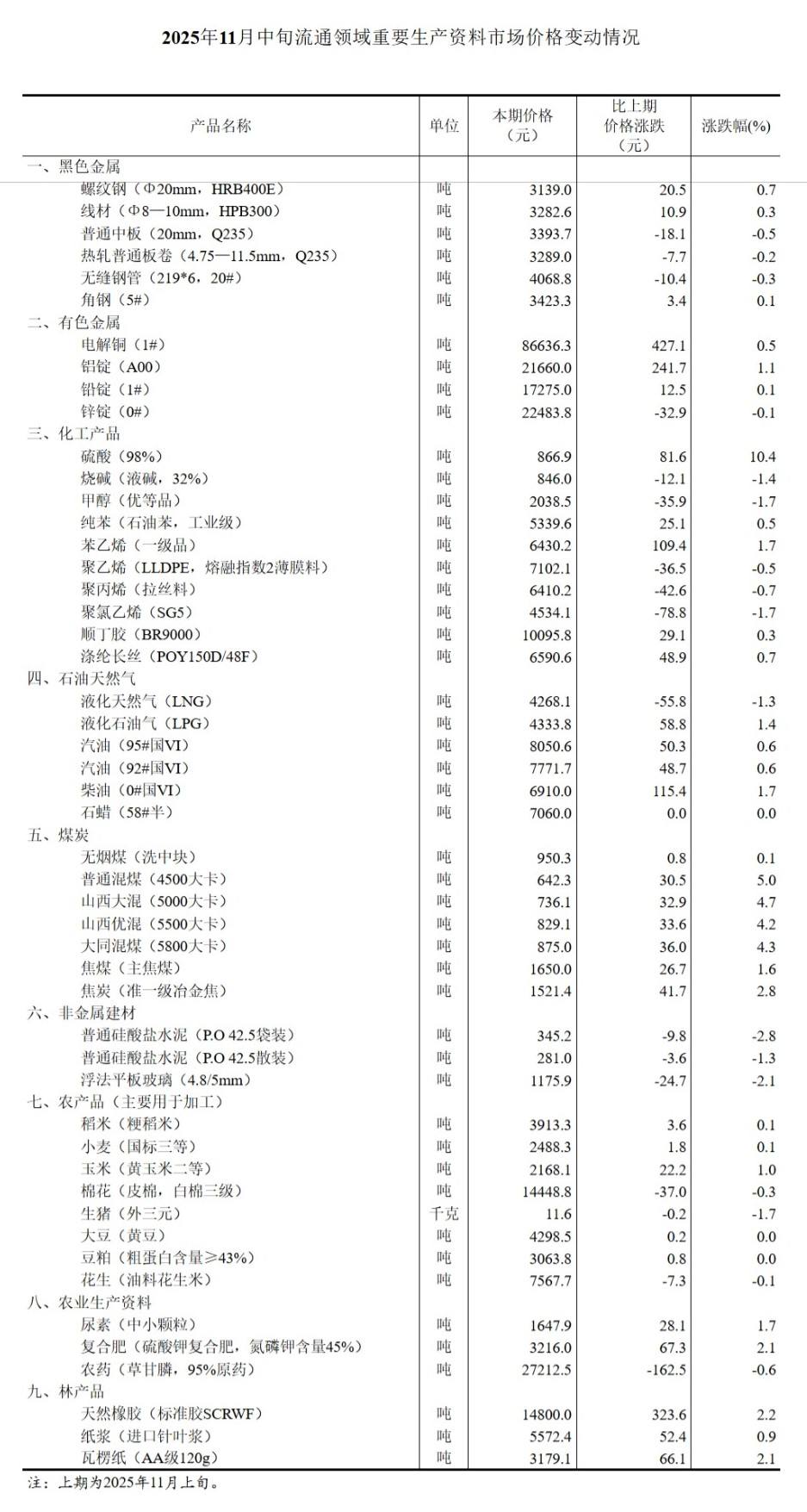
2025年11月中旬流通领域重要生产资料市场价格变动情况
Guo Jia Tong Ji Ju· 2025-11-24 01:30
Core Viewpoint - The monitoring of market prices for 50 important production materials across nine categories shows a mixed trend, with 30 products experiencing price increases, 17 seeing declines, and 3 remaining stable in mid-November 2025 compared to early November 2025 [2][3]. Group 1: Price Changes in Major Categories - In the black metal category, rebar prices increased by 20.5 yuan per ton (0.7%), while ordinary medium plates decreased by 18.1 yuan per ton (-0.5%) [4]. - In the non-ferrous metals category, electrolytic copper rose by 427.1 yuan per ton (0.5%), while zinc ingots fell by 32.9 yuan per ton (-0.1%) [4]. - Chemical products saw significant price fluctuations, with sulfuric acid increasing by 81.6 yuan per ton (10.4%) and methanol decreasing by 35.9 yuan per ton (-1.7%) [4]. Group 2: Energy and Coal Prices - In the petroleum and natural gas sector, liquefied natural gas prices dropped by 55.8 yuan per ton (-1.3%), while gasoline prices increased by 50.3 yuan per ton (0.6%) [4]. - Coal prices showed an upward trend, with ordinary mixed coal increasing by 30.5 yuan per ton (5.0%) and Shanxi premium mixed coal rising by 33.6 yuan per ton (4.2%) [4]. Group 3: Agricultural Products and Inputs - Among agricultural products, corn prices rose by 22.2 yuan per ton (1.0%), while cotton prices fell by 37.0 yuan per ton (-0.3%) [5]. - In agricultural production materials, urea prices increased by 28.1 yuan per ton (1.7%), and compound fertilizer prices rose by 67.3 yuan per ton (2.1%) [5]. Group 4: Monitoring Methodology - The price monitoring encompasses a wide range of products across 31 provinces, involving over 2000 wholesalers and dealers, ensuring comprehensive coverage of the market [8][9]. - The methodology includes on-site price collection, telephone inquiries, and electronic communications to ensure accurate data [9].
如何看待近期涨价领域拥挤度偏高的情况
Guohai Securities· 2025-11-23 03:03
Group 1 - The report highlights that since October 2025, price increases have gained attention, particularly in the fields of new energy, AI, and certain black, non-ferrous, and chemical products, with many areas experiencing transaction congestion close to historically high levels [4][10][12] - Historical cases indicate that price increases driven solely by sentiment or expectations typically reach a peak when congestion levels hit 90-100%, leading to a phase of adjustment, and subsequent rebounds are unlikely to surpass previous highs without additional supporting logic [14][16] - For price increases to break previous highs after an adjustment, they usually require new incremental logic support, such as a shift from expectation to reality in economic verification or the emergence of new catalysts [14][16] Group 2 - The report identifies two main areas where price increases are likely to continue: industrial metals, driven by global economic recovery expectations and supply constraints, and the AI chain, which remains a direction with confirmed economic prospects and potential incremental catalysts [51][52] - Strong sectors often reach a stage of congestion bottom when sentiment (transaction share) declines to 50-70% of previous highs, presenting a good buying opportunity [52] - The report suggests monitoring the TMT sector's transaction share to determine when it returns to the 20-25% range, indicating a potential buying point, while the Hang Seng Technology sector should be observed for a return to the 30-35% range [60][66] Group 3 - The report discusses the historical adjustment patterns of major technology sectors, noting that the average adjustment period is around 40 trading days, with an average absolute decline of approximately 15% [71][72] - The current adjustment in major technology sectors has seen declines of 15-20%, nearing historical averages, but the adjustment duration has been shorter than the historical average, suggesting a need for patience [71][72] - The report recommends continuing to allocate resources according to calendar effects, particularly in banking and white goods, while observing potential shifts in growth styles as economic data is released [71][72]
黑色金属日报-20251121
Guo Tou Qi Huo· 2025-11-21 11:09
Report Investment Ratings - The operation ratings for various products are as follows: Threaded steel is rated with three stars (★★★), hot-rolled coil with three white stars (☆☆☆), iron ore with three white stars (☆☆☆), coke with three red stars (★★★), coking coal with one red star (★☆☆), silicon manganese with one red star (★☆☆), and ferrosilicon with one red star (★☆☆) [1]. Core Views - The overall situation of the steel industry is complex. The demand is still pessimistic, the cost side is weak, and the market is under pressure. The iron ore market is expected to be volatile, and the coke and coking coal markets are likely to be weak. The silicon manganese market has a downward shift in the bottom support expectation, while the ferrosilicon market has relatively strong bottom support [2][3][4]. Summary by Product Steel - Today's steel market is mainly volatile. The demand for rebar and hot-rolled coils has improved, but the downstream's ability to absorb is insufficient, and steel mills continue to lose money. The possibility of further blast furnace production cuts is high, and the supply pressure is gradually easing. The overall domestic demand is still weak, and the export of steel has declined from its high level. The demand expectation is still pessimistic, and the market is under pressure, but there is still some support in the downward shift of the oscillation range [2]. Iron Ore - The iron ore market is oscillating today. The global shipment is strong, and the domestic port inventory is still in an accumulative trend. The demand for steel has rebounded, but it has entered the off-season, and steel mills' profitability is poor. The iron ore fundamentals are marginally looser, and the market is expected to be mainly oscillating [3]. Coke - The coke price declined today. The coking profit is average, and the daily production is slightly decreasing. The inventory has slightly increased, and the downstream's procurement is on a small scale as needed. The overall supply of carbon elements is abundant, and the downstream's demand for raw materials is still resilient, but the steel mills' profit is average, and they have a strong desire to lower the price of raw materials. The coke market is expected to be weak and oscillating [4]. Coking Coal - The coking coal price declined today. The production of coking coal mines has slightly decreased, and the spot auction transactions are average. The overall supply of carbon elements is abundant, and the downstream's demand for raw materials is still resilient, but the steel mills' profit is average, and they have a strong desire to lower the price of raw materials. The coking coal market is expected to be weak and oscillating [5]. Silicon Manganese - The silicon manganese price oscillated downward today. The market expects an increase in coal mine supply guarantee, which may lead to a decline in power costs and chemical coke prices. The demand for iron water has rebounded to a high level, but the production of silicon manganese is still at a relatively high level, and the inventory is slowly increasing. The bottom support expectation has shifted downward [6]. Ferrosilicon - The ferrosilicon price oscillated upward today. The market expects an increase in coal mine supply guarantee, which may lead to a decline in power costs and semi-coke prices. The demand for iron water has rebounded to a high level, and the export demand has increased to about 40,000 tons. The overall demand is still resilient, and the inventory is continuously decreasing. The bottom support is relatively strong [7].
黑色商品日报-20251121
Guang Da Qi Huo· 2025-11-21 05:05
黑色商品日报 黑色商品日报(2025 年 11 月 21 日) 一、研究观点 | 品种 | 点评 | 观点 | | --- | --- | --- | | 钢材 | 螺纹钢:昨天螺纹盘面震荡下跌,截止日盘螺纹 2601 合约收盘价格为 3050 元/吨,较上一交易收盘价格 下跌 20 元/吨,跌幅为 0.65%,持仓减少 5.78 万手。现货价格下跌,成交降至低位,唐山地区迁安普方坯 | 窄幅整理 | | | 价格下跌 30 元/吨至 2940 元/吨,杭州市场中天螺纹价格下跌 10 元/吨至 3150 元/吨,全国建材成交量 | | | | 8.45 万吨。据我的钢铁数据,本周全国螺纹产量环比回升 7.96 万吨至 207.96 万吨,同比减少 25.86 万吨; | | | | 社库环比回落 15.73 万吨至 400.02 万吨,同比增加 103.63 万吨;厂库环比回落 7.1 万吨至 153.32 万吨,同 | | | | 比增加 4.6 万吨;螺纹表需环比回升 14.42 万吨至 230.79 吨,同比减少 3.41 万吨。螺纹产量低位回升,库 | | | | 存降幅继续扩大,表需回升,供需数据表 ...
铜冠金源期货商品日报-20251121
Tong Guan Jin Yuan Qi Huo· 2025-11-21 03:23
1. Report Industry Investment Rating No information provided in the report. 2. Core Views of the Report - Overseas, the US September non - farm data was mixed, with the unemployment rate rising to 4.4%, and the market's expectation of a December rate cut was further dampened. The Fed's internal differences persisted, and the overall tone was hawkish. The risk appetite was generally weak. Domestically, the A - share market fell across the board with shrinking trading volume, and the bond market showed a differentiated trend [2][3]. - For precious metals, the strong non - farm employment data and the strengthening of the US dollar index and the cooling of the Fed's rate - cut expectation put double pressure on the prices of gold and silver, and they were in a stage of adjustment [4][5]. - For copper, the rebound of the US dollar index led to an adjustment of copper prices. The macro situation and industrial fundamentals jointly affected the market, and it was expected that the short - term adjustment would continue [6][7]. - For aluminum, the strong non - farm data in the US weakened the possibility of a December rate cut by the Fed, and the aluminum price was suppressed. Although the social inventory of aluminum ingots decreased significantly this week, it was difficult to sustain the continuous decline, and the Shanghai aluminum would fluctuate and consolidate [8][9]. - For other metals such as zinc, lead, tin, etc., they were all affected by factors such as macro data, supply - demand fundamentals, and policy expectations, showing different price trends such as wide - range fluctuations and shocks [12][16][18]. - For industrial products such as industrial silicon, soda ash, glass, and steel products, they were affected by factors such as production, inventory, and market demand, and their prices generally showed a trend of shock [19][25][27]. - For agricultural products such as soybean meal, palm oil, etc., they were affected by factors such as international trade, production progress, and policy expectations, and their prices fluctuated [30][34]. 3. Summary According to Relevant Catalogs 3.1 Macro - Overseas: The US added 119,000 non - farm jobs in September, significantly exceeding expectations, but the unemployment rate rose to 4.4%, reaching a four - year high. The August data was revised downward to negative growth. The economic data failed to eliminate the uncertainty of the December FOMC. Multiple Fed officials focused on financial stability and high - valuation risks, with a generally hawkish tone. The market currently priced the probability of no rate cut in December at about 60%. The stock market had a sharp intraday reversal, the US dollar index fluctuated around 100, the 10 - year US Treasury yield declined, and gold, copper, and oil slightly closed down [2]. - Domestic: The A - share market opened higher and closed lower, with the trading volume of the two markets shrinking to 1.72 trillion. The ChiNext and STAR Market led the decline. The debt market showed a differentiated trend. The long - term interest rate rose, and the short - term interest rate declined. There was a risk of a phased correction in the A - share market, and the debt market might fluctuate strongly in the short term [3]. 3.2 Precious Metals - On Thursday, international precious metal futures prices slightly corrected. The strengthening of the US dollar index and the cooling of the Fed's rate - cut expectation put double pressure on precious metal prices. The Fed's October meeting minutes showed increased differences among policymakers on a December rate cut. The US September non - farm employment data was strong, but the unemployment rate rose unexpectedly. The probability of a December rate cut was low. The US Department of Labor will combine and release the October and November employment data on December 16. It was maintained that the prices of gold and silver were in a stage of adjustment [4][5]. 3.3 Copper - On Thursday, the main contract of Shanghai copper fluctuated weakly, and LME copper adjusted downward. The spot market trading of electrolytic copper cooled down, and the downstream mainly made rigid purchases due to high prices. The LME inventory rose to 158,000 tons. The September non - farm employment data in the US exceeded expectations, which further suppressed the expectation of a December rate cut. The WBMS data showed a shortage of 81,000 tons of global refined copper supply in September, and China's imports of refined copper in October decreased by 22.1% year - on - year. It was expected that the copper price would continue to adjust in the short term [6][7]. 3.4 Aluminum - On Thursday, the main contract of Shanghai aluminum closed at 21,550 yuan/ton, down 0.12%. The LME aluminum closed at $2,806.5/ton, down 0.28%. The strong non - farm growth in the US in September weakened the possibility of a December rate cut by the Fed, and the US dollar index rebounded strongly, putting pressure on the aluminum price. The social inventory of aluminum ingots decreased significantly this week, mainly because the downstream's enthusiasm for purchasing at low prices increased due to the decline in the absolute price. However, it was difficult to sustain the continuous decline as consumption entered the off - season. The Shanghai aluminum would fluctuate and consolidate [8][9]. 3.5 Alumina - On Thursday, the main contract of alumina futures closed at 2,737 yuan/ton, up 0.18%. The overall supply of alumina was still in excess, the tender purchase price of upstream electrolytic aluminum plants continued to decline, driving the spot price down. The market was dominated by a bearish atmosphere and continued to operate weakly [10]. 3.6 Cast Aluminum - On Thursday, the main contract of cast aluminum alloy futures closed at 20,810 yuan/ton, down 0.12%. The cost of cast aluminum was affected by the tight supply of scrap aluminum, and the demand side still had resilience. The rigid demand procurement would support the price at the bottom, and the price of ADC12 might stabilize and fluctuate in the short term [11]. 3.7 Zinc - On Thursday, the main contract of Shanghai zinc fluctuated horizontally during the day and opened higher at night. The inventory of zinc ingots decreased. The import volume of zinc ore and refined zinc in October decreased compared with the previous month. The LME inventory increased since early November, and the risk of a short squeeze decreased. The zinc price lacked a trend and maintained a wide - range fluctuation [12][13][14]. 3.8 Lead - On Thursday, the main contract of Shanghai lead fluctuated weakly. The import volume of lead concentrate in October decreased compared with the previous month. The social inventory decreased slightly this week. After the delivery of the current - month contract, the domestic social inventory first increased and then decreased, and the absolute inventory was still low. The supply in some regions was tight, but the demand was difficult to boost. It was expected that the lead price would maintain a shock - adjustment trend in the short term [15][16]. 3.9 Tin - On Thursday, the main contract of Shanghai tin fluctuated weakly during the day and opened slightly higher at night. The overseas tin mine复产 was slow, the domestic tin ore import volume in October still had a large year - on - year decline, and the raw material gap still existed, which restricted the release of refined tin production. The performance of NVIDIA exceeded expectations, and the AI demand still had room for imagination. However, in the short term, the Fed was likely to keep the interest rate unchanged in December, and the tin price would maintain a high - level wide - range fluctuation [17][18]. 3.10 Industrial Silicon - On Thursday, industrial silicon fluctuated narrowly. The supply side was affected by the decline in production in the southwest region during the dry season, and the supply margin decreased. The demand side was affected by factors such as the weakening of the market sentiment of polysilicon and the over - supply of battery cells. The market sentiment was repeated, and it was expected that the industrial silicon price would fluctuate within a range in the short term [19][20]. 3.11 Carbonate Lithium - On Thursday, the price of carbonate lithium fluctuated widely, and the spot price rose. The exchange introduced a position - limit policy, which suppressed the bullish sentiment. The downstream purchasing was mainly for rigid demand, and the consumption still had an increase. The fundamental situation had not shown signs of weakness, but the bullish sentiment was cautious, and the lithium price might fluctuate widely [21][22]. 3.12 Nickel - On Thursday, the nickel price was weak. The Fed officials' hawkish remarks dampened the expectation of a December rate cut. The cost of nickel ore remained high, squeezing the upstream profit. The demand for nickel sulfate entered the off - season, and the price declined. It was expected that the nickel price would fluctuate at a low level, and attention should be paid to the strength of cost support [23][24]. 3.13 Soda Ash and Glass - On Thursday, the main contract of soda ash fluctuated, and the main contract of glass fluctuated weakly. The production of soda ash decreased, the opening rate declined, but the shipment volume increased, driving the inventory to decrease. The glass fundamentals were relatively weak, with the upstream opening rate decreasing and the enterprise inventory still accumulating. There were rumors that the real - estate industry might receive policy support, and it was expected that the prices would fluctuate at a low level [25][26]. 3.14 Steel Products (Screw and Coil) - On Thursday, steel futures fluctuated. The output and apparent demand of the five major steel products increased, and the inventory decline widened. However, the downstream steel entered the consumption off - season, the outdoor construction decreased, and the supply pressure of hot - rolled coils remained high. It was expected that the steel price would fluctuate [27]. 3.15 Iron Ore - On Thursday, iron - ore futures fluctuated. The supply of iron ore was under pressure, and the demand side had a short - term recovery in iron - water production, but the medium - term production - reduction expectation remained unchanged. It was expected that the iron - ore price would fluctuate under pressure [28]. 3.16 Coking Coal and Coke - On Thursday, coking coal and coke futures fluctuated weakly. The coking profit rebounded significantly this week, the demand for coking coal was restricted, and the mine production capacity utilization rate increased. It was expected that the prices would fluctuate weakly [29]. 3.17 Soybean Meal and Rapeseed Meal - On Thursday, soybean - meal and rapeseed - meal futures declined. China continued to purchase US soybeans, and the planting progress of Brazilian soybeans was lagging. The external - market price declined, and the import - cost support weakened. It was expected that the short - term soybean - meal price would fluctuate [30][31]. 3.18 Palm Oil - On Thursday, palm - oil futures declined. The US non - farm data was contradictory, the international oil price declined, the export demand of Malaysian palm oil in the first 20 days of November decreased, and the sentiment of the US biodiesel policy cooled down. It was expected that the palm - oil price would fluctuate in the short term [32][34].
黑色建材日报-20251121
Wu Kuang Qi Huo· 2025-11-21 02:20
Report Industry Investment Rating - Not provided in the given content Core Viewpoints - The steel demand has officially entered the off - season, with high inventory pressure on hot - rolled coils. In the short term, prices are likely to continue weak and volatile, but with policy implementation and macro - environment improvement, steel demand may have a marginal inflection point [2]. - For the black sector, compared with short - selling, the cost - effectiveness of finding positions to rebound may be higher. The subsequent price increase depends on whether stimulus policies are introduced and their intensity [10]. - Industrial silicon may present a situation of "weak supply and demand" and is expected to operate in a volatile manner. Polysilicon is still in a tug - of - war between reality and expectation, and its price will fluctuate widely within the range [13][16]. - The glass industry's fundamentals continue to be weak, and the soda ash market lacks a clear direction and is expected to continue to oscillate at a low level [19][21]. Summary by Categories Steel (Rebar and Hot - Rolled Coil) Market Information - Rebar: The closing price of the main contract was 3050 yuan/ton, down 20 yuan/ton (- 0.65%) from the previous trading day. The registered warehouse receipts decreased by 54306 tons, and the main contract's open interest decreased by 57810 lots. The spot prices in Tianjin and Shanghai decreased by 10 yuan/ton [1]. - Hot - rolled coil: The closing price of the main contract was 3267 yuan/ton, down 10 yuan/ton (- 0.30%) from the previous trading day. The registered warehouse receipts decreased by 4179 tons, and the main contract's open interest decreased by 44323 lots. The spot prices in Lecong and Shanghai decreased by 10 yuan/ton [1]. Strategy Views - Rebar: Supply and demand both decreased, inventory continued to decline, and the overall performance was neutral. - Hot - rolled coil: Terminal demand continued to rise, production declined slightly, but the inventory level was still high. In the short term, prices are likely to weaken, but steel demand may improve with policy implementation [2]. Iron Ore Market Information - The main contract (I2601) closed at 788.50 yuan/ton, with a change of - 0.38% (- 3.00), and the open interest decreased by 3421 lots to 47.75 million lots. The weighted open interest was 93.23 million lots. The spot price of PB powder at Qingdao Port was 790 yuan/wet ton, with a basis of 51.54 yuan/ton and a basis rate of 6.14% [4]. Strategy Views - Supply: Overseas iron ore shipments increased significantly. Demand: The average daily molten iron output decreased, and the number of blast furnace overhauls was more than that of restarts. Inventory: Port inventory decreased slightly, and steel mill inventory decreased. In the short term, iron ore is expected to operate within a volatile range [5]. Manganese Silicon and Ferrosilicon Market Information - Manganese silicon: The main contract (SM601) closed down 0.50% at 5614 yuan/ton. The spot price in Tianjin was 5650 yuan/ton, with a conversion to the physical delivery price of 5840 yuan/ton, a premium of 226 yuan/ton over the futures price. - Ferrosilicon: The main contract (SF603) closed down 1.05% at 5446 yuan/ton. The spot price in Tianjin was 5500 yuan/ton, a premium of 54 yuan/ton over the futures price [7][8]. Strategy Views - As the time approaches December, the impact of macro - expectations on sentiment and prices is expected to be positive. It is recommended to pay attention to the inflection point of market sentiment and corresponding price changes. For manganese silicon, pay attention to the manganese ore end; for ferrosilicon, the cost - effectiveness of operation is low [9][10]. Industrial Silicon and Polysilicon Market Information - Industrial silicon: The closing price of the main contract (SI2601) was 9075 yuan/ton, down 3.35% (- 315). The weighted contract's open interest decreased by 28315 lots to 442628 lots. The spot price of 553 in East China remained unchanged, and the basis was 275 yuan/ton; the price of 421 increased by 50 yuan/ton, and the basis was - 75 yuan/ton [12]. - Polysilicon: The closing price of the main contract (PS2601) was 52450 yuan/ton, down 3.98% (- 2175). The weighted contract's open interest increased by 4824 lots to 238398 lots. The average spot prices of N - type granular silicon, N - type dense material, and N - type re -投料 remained unchanged, and the basis was - 150 yuan/ton [15]. Strategy Views - Industrial silicon: It may present a "weak supply and demand" situation and is expected to operate in a volatile manner. - Polysilicon: It is still in a tug - of - war between reality and expectation. The supply - demand pattern may improve marginally, but the short - term de - stocking range is limited, and the price will fluctuate widely within the range [13][16]. Glass and Soda Ash Market Information - Glass: The main contract closed at 989 yuan/ton, down 1.98% (- 20). The inventory of float glass sample enterprises increased by 5.60 million cases (+ 0.09%). The top 20 long - position holders reduced their positions by 16374 lots, and the top 20 short - position holders reduced their positions by 13285 lots [18]. - Soda ash: The main contract closed at 1158 yuan/ton, down 2.03% (- 24). The inventory of soda ash sample enterprises decreased by 6.29 million tons (- 0.09%), including a decrease of 1.98 million tons in heavy - soda ash inventory and 4.31 million tons in light - soda ash inventory. The top 20 long - position holders reduced their positions by 974 lots, and the top 20 short - position holders reduced their positions by 15205 lots [20]. Strategy Views - Glass: The market lacks positive factors, supply is relatively abundant, demand is weak, inventory is high, and the industry fundamentals continue to be weak. - Soda ash: The supply - side capacity fluctuates little, the terminal glass price is weak, and the market is expected to continue to oscillate at a low level [19][21].
综合晨报-20251121
Guo Tou Qi Huo· 2025-11-21 02:18
Group 1: Energy - The international oil price fell overnight, with the Brent 01 contract down 0.8%. The geopolitical risk premium of the Russia-Ukraine conflict was suppressed, and the oil price rebound due to geopolitical factors was limited. The market is expected to be weak and volatile [1] - Low-sulfur fuel oil is stronger than high-sulfur fuel oil. The low-sulfur market is supported by supply disruptions and strong diesel cracking, while the high-sulfur market is expected to face supply increases in the medium term [21] - The cost support for asphalt is weakening, and the demand is expected to decline seasonally. The market sentiment is bearish [22] - The expected import cost of liquefied petroleum gas (LPG) is rising in December. The demand from both the chemical and combustion sectors is improving, and the LPG market is expected to be strong [23] Group 2: Metals - Precious metals are oscillating at a high level. The employment data is mixed, and the Fed officials' statements are divided. The possibility of the Fed keeping interest rates unchanged in December is high. Attention should be paid to the directional breakthrough on the technical side [2] - Copper prices fell overnight due to a stronger dollar and weak demand. Short positions can be held with a stop-loss at 87,000 yuan [3] - Aluminum prices fluctuated narrowly. The Fed's interest rate cut prospects are uncertain, and the aluminum market may continue to adjust. Attention should be paid to the support of the middle Bollinger Band [4] - Zinc prices are expected to oscillate in the range of 22,200 - 23,000 yuan/ton. The inventory structure is gradually being repaired, and there is still profit potential for cross-market arbitrage [7] - Lead prices are supported by low inventory levels, but the external market is under pressure due to high inventory. The import window for aluminum ingots may open, and the upward momentum of aluminum prices is insufficient [8] - Nickel prices are weakening. The macro risk is increasing, and the support from the upstream price rebound is weakening. The inventory of nickel and stainless steel is increasing [9] - Tin prices are oscillating. The environmental rectification in Malaysia has limited impact on the market. The import of tin concentrate in China has improved slightly, but the resumption of supply from Myanmar is not strong. Short positions can be held with a stop-loss at 295,000 yuan [10] - Lithium carbonate prices are strengthening. The downstream demand is strong, and the inventory is decreasing. The technical analysis shows a range breakthrough, and a buy-on-dip strategy can be adopted [11] - Polycrystalline silicon prices are falling. The photovoltaic demand is weak, and the actual supply-demand improvement is limited. The price is expected to oscillate in the short term [12] - Industrial silicon prices are undergoing a technical correction. The downstream demand for polycrystalline silicon and organic silicon is expected to improve, which may boost the price [13] Group 3: Building Materials - Steel prices rebounded at night. The demand for rebar and hot-rolled coils is improving, but the supply pressure is gradually easing. Attention should be paid to the environmental protection restrictions in Tangshan [14] - Iron ore prices are oscillating. The supply is strong, and the demand is weak. The market is expected to be range-bound in the short term [15] - Coke and coking coal prices are expected to be weak and oscillating. The supply of carbon elements is abundant, and the downstream demand is stable, but the steel mills' profit is average, and the pressure on raw material prices is high [16][17] - Manganese silicon and silicon iron prices are falling. The market expects coal supply to increase, which may lower the cost. The demand is stable, but the supply is high, and the bottom support may weaken [18][19] Group 4: Chemicals - Urea prices are oscillating narrowly. The Indian tender results will affect the market sentiment. The agricultural demand is weakening, but the industrial demand is improving, and the inventory is decreasing [24] - Methanol prices are in a weak position. The overseas supply is high, and the demand is expected to decline. The market is expected to remain weak in the short term [25] - Pure benzene prices are rebounding, but the sustainability is uncertain. The supply pressure is easing, and the demand is expected to improve, but the export to the US faces challenges [26] - Styrene prices are supported by cost and supply reduction. The demand from the European market is strong [27] - Polypropylene, polyethylene, and propylene prices are expected to be weak. The supply is high, and the demand is low, and the supply-demand contradiction is increasing [28] - PVC and caustic soda prices are falling. The cost support is weakening, and the demand is insufficient. Attention should be paid to the cost changes and profit margins [29] - PX and PTA prices are oscillating. The supply from overseas may be affected, and the demand is weakening. The market is cautiously bullish [30] - Ethylene glycol prices are expected to be bearish. The supply is increasing, and the demand is weakening. A short strategy can be adopted [31] - Short fiber and bottle chip prices are under pressure. The demand is weakening, and the prices are expected to follow the raw material prices [32] Group 5: Agricultural Products - Soybean and soybean meal prices are oscillating. The US soybean planting area is expected to increase, and the impact of La Nina on South American soybean production needs to be monitored. A buy-on-dip strategy can be considered after the correction [36] - Soybean oil and palm oil prices are affected by the US biodiesel policy. The palm oil price may have bottomed out [37] - Rapeseed and rapeseed oil prices are under pressure. The import volume has decreased, and the demand is weak. A bearish strategy is recommended [38] - Corn prices are oscillating. The supply is increasing, and the demand is improving. The Dalian corn futures 01 contract may continue to decline [40] - Hog prices are at a low level. The futures market is trading on the potential supply pressure in the future. The pig price may form a double bottom in the first half of next year [41] - Egg prices are rebounding strongly. The spot price is stable. Attention should be paid to whether the previous price decline has ended [42] - Cotton prices are range-bound. The US cotton export sales are increasing, but the domestic demand is average. The Zhengzhou cotton futures are expected to be range-bound in the short term [43] - Sugar prices are oscillating. The international market supply is sufficient, and the domestic market is focusing on the new season's production estimate. The production in Guangxi is expected to be good [43] - Apple prices are oscillating at a high level. The short-term price is strong due to low inventory, but the long-term inventory pressure may exist. Attention should be paid to the inventory reduction [44] Group 6: Others - The container shipping index (European line) is expected to be stable in early December and may improve in late December. The 02 contract may be slightly discounted compared to the 12 contract, and the far-month contracts are expected to be low and oscillating [20] - Wood prices are oscillating. The low inventory supports the price, and a wait-and-see strategy is recommended [45] - Pulp prices are falling. The supply is abundant, and the demand is weak. The market is expected to remain weak in the short term [46] - Stock index futures are falling. The A-share market is volatile, and the external market is uncertain. A wait-and-see strategy is recommended, and attention can be paid to stable, consumer, and cyclical sectors [47] - Treasury bond futures are falling. The market is trading lightly, and the structure is differentiated. The change in market risk preference may bring new opportunities [48]
广金期货商品日报11.20 商品涨跌与资金图谱
Xin Lang Cai Jing· 2025-11-21 01:13
Core Insights - The report provides a comprehensive overview of the performance of various futures contracts across different sectors, highlighting price changes and trends over multiple time frames. Group 1: Financial and Precious Metals - The Shanghai Composite 300 futures decreased by 0.69%, with a year-to-date increase of 19.81% [8] - The SHFE gold futures rose by 0.22%, while the year-to-date increase stands at 48.84% [8] - The SHFE silver futures increased by 0.75%, with a year-to-date increase of 58.85% [8] Group 2: Nonferrous Metals and New Energy Materials - SHFE copper futures rose by 0.19%, with a year-to-date increase of 16.92% [9] - SHFE aluminum futures decreased by 0.05%, with a year-to-date increase of 9.10% [9] - GFEX lithium carbonate futures increased by 0.84%, with a year-to-date increase of 28.12% [9] Group 3: Black Commodities - SHFE rebar futures fell by 1.01%, with a year-to-date decrease of 11.67% [10] - DCE iron ore futures decreased by 0.32%, with a year-to-date increase of 8.21% [10] - DCE coking coal futures dropped by 3.17%, with a year-to-date decrease of 18.57% [10] Group 4: Agricultural Products - DCE soybean meal futures decreased by 0.46%, with a year-to-date increase of 3.83% [11] - CZCE apple futures increased by 1.26%, with a year-to-date increase of 36.24% [11] - DCE live hog futures fell by 1.00%, with a year-to-date decrease of 21.55% [11] Group 5: Energy and Chemicals - INE crude oil futures decreased by 1.66%, with a year-to-date decrease of 6.97% [12] - DCE ethylene glycol futures fell by 2.05%, with a year-to-date decrease of 21.88% [12] - CZCE soda ash futures dropped by 2.93%, with a year-to-date decrease of 26.95% [12]

黑色商品日报-20251120
Guang Da Qi Huo· 2025-11-20 05:09
1. Report Industry Investment Rating No relevant content provided. 2. Core Views of the Report - The steel market is in a situation of weak supply and demand. The production of building materials continues to decline, the inventory decline has widened, and the apparent demand has decreased. The Mongolian government's proposal to increase coal exports to China may lead to an increase in coal supply, which has an impact on the overall black commodities. The short - term rebar futures market is expected to be in a narrow - range consolidation [1]. - The iron ore market shows that supply is increasing, demand is facing pressure as the loss range of steel mills expands, and inventory is rising. In the short term, ore prices will show a volatile trend [1]. - The coking coal market has limited supply growth, and downstream procurement has become more cautious after the end of the phased replenishment. The short - term coking coal futures market is expected to be in a wide - range shock [1]. - The coke market has improved supply as coke enterprises' production enthusiasm has increased after price increases, and demand has slightly improved with the resumption of production of steel mills. However, due to the off - season in the terminal market and poor profitability of steel mills, the short - term coke futures market is expected to be in a wide - range shock [1]. - The manganese - silicon market has cost support, but production has declined, demand from steel procurement is limited, and inventory has reached a new high. The short - term market is expected to be in a wide - range shock, and attention should be paid to market sentiment and production in major producing areas [1]. - The silicon - iron market has cost support, but production has decreased due to large losses, and terminal demand is weak. It is expected to fluctuate with the overall black market in the short term, and attention should be paid to production cuts in major producing areas and market sentiment [1][3]. 3. Summary by Directory 3.1 Research Views Steel - The rebar futures contract 2601 closed at 3070 yuan/ton, down 20 yuan/ton or 0.65% from the previous trading day, with a decrease of 24,300 lots in positions. Spot prices were stable with a slight decline, and trading volume decreased. National building material production, social inventory, factory inventory, and apparent demand all declined. It is expected to be in a narrow - range consolidation [1]. Iron Ore - The main iron ore futures contract i2601 closed at 791.5 yuan/ton, down 0.5 yuan/ton or 0.06% from the previous trading day, with 250,000 lots traded and an increase of 10,000 lots in positions. Supply increased, demand (iron - water production increased but steel - mill losses expanded), and inventory increased. Short - term ore prices will show a volatile trend [1]. Coking Coal - The coking coal futures contract 2601 closed at 1139.5 yuan/ton, down 19.5 yuan/ton or 1.68% from the previous trading day, with a decrease of 21,093 lots in positions. Spot prices decreased. Supply growth was limited, and downstream procurement became more cautious. It is expected to be in a wide - range shock [1]. Coke - The coke futures contract 2601 closed at 1639 yuan/ton, down 10.5 yuan/ton or 0.64% from the previous trading day, with a decrease of 592 lots in positions. Spot prices were stable. Supply improved, and demand slightly increased, but the short - term market is expected to be in a wide - range shock [1]. Manganese - Silicon - The manganese - silicon futures price weakened, with the main contract closing at 5642 yuan/ton, down 1.16% from the previous day, and an increase of 31,861 lots in positions. Cost has support, production has declined, demand is limited, and inventory has reached a new high. It is expected to be in a wide - range shock [1]. Silicon - Iron - The silicon - iron futures price weakened, with the main contract closing at 5462 yuan/ton, down 0.44% from the previous day, and a decrease of 417 lots in positions. Production has decreased due to losses, demand is weak, and cost has support. It is expected to fluctuate with the overall black market [1][3]. 3.2 Daily Data Monitoring - **Contract Spreads**: For example, the 1 - 5 month spread of rebar was - 46.0, up 3.0; the 1 - 5 month spread of iron ore was 36.5, up 2.0 [4]. - **Basis**: The basis of the 01 rebar contract was 150.0, up 10.0; the basis of the 01 iron ore contract was 52.9, up 0.5 [4]. - **Profit and Spreads**: The rebar futures profit was - 98.5, down 13.9; the spread between hot - rolled coil and rebar was 207.0, up 11.0 [4]. 3.3 Chart Analysis - **Main Contract Prices**: Charts show the historical closing prices of main contracts for rebar, hot - rolled coil, iron ore, coke, coking coal, manganese - silicon, and silicon - iron from 2020 to 2025 [5][6][7][8][9][10][14]. - **Main Contract Basis**: Charts show the historical basis of main contracts for various black commodities from 2022 - 2026 [15][16][17][18][20][21][22][23]. - **Inter - period Contract Spreads**: Charts show the historical spreads of different contract periods for various black commodities from 2020 - 2026 [24][25][27][31][33][34][37][38]. - **Inter - variety Contract Spreads**: Charts show the historical spreads between different varieties such as the spread between hot - rolled coil and rebar, the ratio of rebar to iron ore, etc. from 2020 - 2025 [42][43][44][45][47]. - **Rebar Profits**: Charts show the historical profits of rebar main contracts including futures profit, long - process profit, and short - process profit from 2020 - 2025 [46][48][49][51][52]. 3.4 Black Research Team Introduction - Qiu Yuecheng is the assistant director of the Everbright Futures Research Institute and the director of black research, with nearly 20 years of experience in the steel industry [54]. - Zhang Xiaojin is the director of resource product research at the Everbright Futures Research Institute, with rich experience in the black industry [54]. - Liu Xi is a black researcher at the Everbright Futures Research Institute, good at fundamental supply - demand analysis based on industrial chain data [54]. - Zhang Chunjie is a black researcher at the Everbright Futures Research Institute, with experience in combining financial theory with industrial operations [55].