
保险

Search documents
从农大走出的百亿私募掌门人,“万倍叔”王文的“价值狩猎”之路 | 走近中国私募创始人
私募排排网· 2026-03-27 03:32
Core Viewpoint - The article highlights the journey and investment philosophy of Wang Wen, the founder of Dayou Investment, who transformed an initial capital of 40,000 yuan into over 10 billion yuan in returns over 30 years, showcasing the evolution of China's private equity industry and the significance of deep value investing [2][26]. Group 1: Background and Early Career - Wang Wen graduated from China Agricultural University in 1990, which laid a solid foundation for his economic theories [4]. - After graduation, he worked at the Ministry of Agriculture, participating in drafting the first Agricultural Law and conducting extensive field research, enhancing his understanding of macro policies [4][5]. Group 2: Investment Milestones - Wang's investment career began in 1993 when he borrowed funds to enter the A-share market, marking the start of his journey in finance [5][10]. - Significant milestones include: - 1995: Transitioned from the Ministry of Agriculture to the financial sector, working for various investment firms [11]. - 1995-1997: Invested in Sichuan Changhong, turning 40,000 yuan into 400,000 yuan, marking his first major success [12]. - 1999-2004: Focused on B-shares, particularly Guangdong Electric B, achieving a fivefold return [19]. - 2004-2012: Invested in Yitai B, resulting in a total return of 100 times [22]. - 2013-2014: Invested in Guotou Electric, realizing a profit of 1 time as the company transitioned to profitability [24]. - 2013-2021: Long-term investment in Kweichow Moutai, achieving a cumulative return of 360.10% [25]. Group 3: Investment Philosophy - Wang's investment philosophy is encapsulated in the principle of "two highs and one low," focusing on companies with high cash flow, high dividends, and low valuations [31]. - He emphasizes the importance of thorough research before making investment decisions, advocating for a hands-on approach to understanding companies [32]. - Industry cycles play a crucial role in identifying investment opportunities, with a focus on sectors in an upward trend [34]. Group 4: Latest Insights and Market Outlook - In a recent investment strategy meeting, Wang expressed optimism for the 2026 market, predicting a continuation of the bull market and a potential for valuation recovery [36]. - He highlighted financial sectors, particularly insurance, banks, and brokerages, as key areas for investment [37][38][40]. - Wang's investment themes include "wealth, health, and enjoyment," focusing on internet companies, pharmaceuticals, and new consumer sectors [41][42]. Group 5: Investment Mindset - Wang advises investors to maintain a long-term perspective and not be swayed by market fluctuations or trends, emphasizing the importance of sticking to fundamental values [45][46]. - He warns against the distractions of market hype and encourages a focus on sustainable investment practices [47].


石油危机下东盟艰难应对:环球市场动态2026年3月27日
citic securities· 2026-03-27 03:31
Market Overview - Global stock markets remain under pressure due to the uncertain situation between the US and Iran, with the S&P 500 down 1.74% and the Nasdaq down 2.38%[3] - The Dow Jones Industrial Average closed at 45,960.1, reflecting a decline of 1.0%[7] - European markets also fell, with the Stoxx Europe 600 index down approximately 1.1%, erasing its gains for the year[8] Oil and Commodities - Oil prices surged, with WTI crude oil rising 4.6% to $94.48 per barrel and Brent crude up 5.7% to $108.01 per barrel[29] - The US dollar index peaked at 100, reflecting market panic amid stalled negotiations[4] - Gold prices fell by 2.9%, settling at $4,376.11 per ounce, while copper prices dropped 1.4%[29] ASEAN Impact - The ongoing Iran conflict has significantly disrupted energy transport to ASEAN countries, particularly affecting Singapore, the Philippines, and Thailand due to their high dependence on energy imports[5] - Malaysia, as a net energy exporter, is better positioned to cope with these disruptions[5] Fixed Income Market - US Treasury yields rose, with the 2-year yield approaching 4% and the 10-year yield exceeding 4.4%[4] - The auction of 7-year US Treasuries showed weak demand, with a bid-to-cover ratio of 2.43, below the average of 2.46[32] Asian Market Performance - The KOSPI index in South Korea fell 3.2%, while Hong Kong's Hang Seng Index dropped 1.89%[22] - A-shares also declined, with the Shanghai Composite Index down 1.09%[17] Corporate Highlights - Huazhu Group reported better-than-expected Q4 earnings, with a revenue increase of 2.0% year-on-year, driven by franchise expansion[8] - China Mobile's service revenue grew by 0.7% year-on-year, but overall performance remains weak compared to peers[15] Inflation and Monetary Policy - The OECD has significantly raised inflation forecasts for major economies, indicating potential tightening of monetary policies in the Philippines and Singapore[5] - The Philippine central bank is expected to raise interest rates by 25 basis points by mid-2026 due to rising inflation risks[25]
中国太平去年净利润同比增超220%,每股派息1.23港元
Nan Fang Du Shi Bao· 2026-03-27 03:23
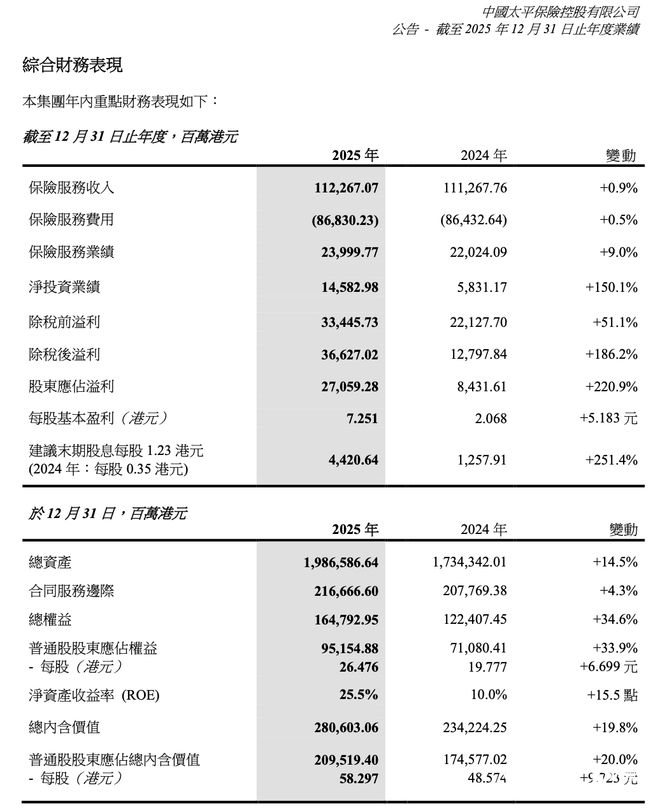
Core Insights - China Taiping's total assets exceeded HKD 1.9 trillion in 2025, with a net asset increase of 34.6% year-on-year, and a significant rise in shareholder profit by 220.9% [1][2][3] Financial Performance - Total assets reached HKD 1,986.59 billion, up 14.5% from 2024 [2] - Net profit attributable to shareholders was HKD 27.06 billion, a 220.9% increase [2] - Basic earnings per share rose to HKD 7.251, an increase of HKD 5.183 [2] - Proposed final dividend per share is HKD 1.23, up 251.4% from the previous year [2] Insurance Business - Life insurance net profit was HKD 34.59 billion, a 229.2% increase, driven by higher insurance service performance and net investment results [3][4] - Original premium income for life insurance reached HKD 20.14 billion, a 2.8% increase [3] - The proportion of participating insurance premiums in long-term insurance exceeded 86% [3][4] Investment Performance - Total investment assets reached HKD 1.74 trillion, an 11.6% increase [6] - Total investment income was HKD 668.26 billion, a 0.4% increase, with net investment income at HKD 529.72 billion, up 5.2% [6] - Dividend income increased by 29.4% to HKD 69.45 billion, attributed to a higher proportion of high-dividend stocks [6] Strategic Initiatives - The company aims to enhance its capabilities in talent, risk control, customer service, and technology over the next decade [1] - The focus for 2026 includes diversifying product lines and managing interest rate risks effectively [4][5] - The company plans to leverage its insurance funds as a stabilizing force in the capital market [7]

中国太保:NBV增速边际抬升,净利润稳健增长-20260327
Guolian Minsheng Securities· 2026-03-27 02:50
Investment Rating - The report maintains a "Buy" rating for both A-shares and H-shares of the company [5] Core Insights - The company achieved a net profit of 53.505 billion yuan in 2025, representing a year-on-year increase of 19.0%. The operating profit was 36.523 billion yuan, up 6.1% year-on-year. The new business value (NBV) reached 18.609 billion yuan, growing by 40.1% year-on-year [1][2] - The improvement in NBV growth is primarily attributed to strong performance in new single premiums from the agent channel in Q4 2025, which saw a year-on-year increase of 106.4% [2] - The company's solvency and asset quality remain robust, with an embedded value (EV) of 465.479 billion yuan at the end of 2025, reflecting a 10.2% increase from the end of 2024 [2] Financial Performance Summary - The company reported total revenue of 435.156 billion yuan for 2025, with a projected growth rate of 7.7% [4] - The net profit forecast for 2026 is 59.681 billion yuan, with expected growth rates of 11.5%, followed by 65.317 billion yuan in 2027 and 70.942 billion yuan in 2028 [4] - The company's return on equity (ROE) and investment returns are stable, with annualized net, total, and comprehensive investment returns of 3.4%, 5.7%, and 6.1% respectively [11]

宝城期货资讯早班车-20260327
Bao Cheng Qi Huo· 2026-03-27 02:47
1. Report Industry Investment Rating No relevant content available. 2. Core Viewpoints of the Report - The OECD expects the global economic growth rate to be 2.9% in 2026 and rise slightly to 3% in 2027. The US economic growth rate is expected to slow from 2% in 2026 to 1.7% in 2027, and the inflation rate in the US this year will reach 4.2%, much higher than the Fed's expectation. The eurozone economic growth rate is expected to drop to 0.8% in 2026 and rebound to 1.2% in 2027. The uncertainty in the Middle East situation poses a test to global economic resilience. If energy prices remain high for a long time, it will significantly increase corporate costs, push up the inflation level, and drag down the global economic growth outlook [5][18]. - The Chinese government's work report in 2026 sets an annual economic growth target range of 4.5% - 5% and requires efforts to achieve better results in actual work. The overall labor productivity needs to be higher than the GDP growth rate, and R & D investment is used to drive the improvement of total factor productivity to offset the decline of the demographic dividend. The urbanization rate target is raised to 71.0%, with the focus shifting to quality improvement, and domestic demand potential is released through citizenization. It is expected that the 10 - year Treasury bond yield will tend to fluctuate within a narrow range at a low level due to the downward - shifting growth target, and the growth of labor productivity provides a lower - bound support through the wage - inflation spiral [26]. 3. Summary by Relevant Catalogs 3.1 Macro Data Quick View - GDP in Q4 2025 grew by 4.5% year - on - year, down from 4.8% in the previous quarter and 5.4% in the same period last year [1]. - In February 2026, the manufacturing PMI was 49.0%, down from 49.2% in the previous month and 50.2% in the same period last year; the non - manufacturing PMI for business activities was 49.5%, the same as the previous month but down from 50.4% in the same period last year [1]. - In February 2026, the monthly value of social financing scale was 2385.5 billion yuan, down from 2492.6 billion yuan in the previous month but up from 2233.1 billion yuan in the same period last year [1]. - In February 2026, M0, M1, and M2 increased by 14.1%, 5.9%, and 9.0% year - on - year respectively, higher than the previous month and the same period last year. The new RMB loans of financial institutions in February 2026 were 900 billion yuan, up from 390 billion yuan in the previous month but down from 1010 billion yuan in the same period last year [1]. - In February 2026, CPI increased by 1.3% year - on - year, up from 0.7% in the previous month and - 0.7% in the same period last year; PPI decreased by 0.9% year - on - year, an improvement from - 2.2% in the previous month and the same period last year [1]. - In February 2026, the cumulative year - on - year growth rate of fixed - asset investment was 1.8%, up from - 2.6% in the previous period but down from 4.1% in the same period last year; the cumulative year - on - year growth rate of total retail sales of consumer goods was 2.8%, down from 4.0% in the previous period and the same period last year [1]. - In February 2026, the monthly export amount increased by 39.6% year - on - year, up from 5.9% in the previous month and - 3.1% in the same period last year; the monthly import amount increased by 13.8% year - on - year, up from 1.9% in the previous month and 1.6% in the same period last year [1]. 3.2 Commodity Investment Reference 3.2.1 Comprehensive - The Ministry of Commerce will promote the implementation of policies to stimulate inbound consumption and expand service exports. It is expected that China's foreign trade will maintain a stable and positive trend, and efforts will be made to attract foreign investment [2]. - The Shanghai International Energy Exchange has set trading limits and margin ratios for the EC2703 contract of the container shipping index (European line) futures [2]. - On March 26, 34 domestic commodity varieties had positive basis, and 35 had negative basis. Among them, Shanghai tin, Shanghai nickel, and Zhengzhou cotton had the largest basis, while apples, strong wheat, and common wheat had the smallest basis [3]. - US President Trump will visit China from May 14 to 15, 2026, and the two sides are in communication about this [3][16]. - Trump postponed the strike on Iranian energy facilities by 10 days to 8 p.m. on April 6, 2026, US Eastern Time. Iran responded to the US cease - fire proposal with four conditions [4][16]. - The US Department of Defense is formulating a so - called "final blow" military option against Iran, and Iran has organized over one million people for ground combat and warned of opening a new front [5][16]. 3.2.2 Metals - In the two weeks after the Iran war, the Turkish central bank sold and swapped about 60 tons of gold, putting downward pressure on gold prices. The Turkish gold reserve decreased by 6 tons in the week of March 13 and 52.4 tons in the week of March 20 [6]. - In January 2026, there was a surplus of 17,000 tons in the global refined copper market [6]. - On March 25, the inventory of aluminum, zinc, tin, copper, nickel, lead decreased, while the inventory of aluminum alloy and cobalt remained stable [6]. - As of the week of March 20, Russia's central bank gold and foreign exchange reserves were 776.8 billion US dollars, down from 803.2 billion US dollars in the previous period [7]. - In February, Hong Kong's gold exports to the Chinese mainland were 63.818 metric tons, up from 36.544 metric tons in January [7]. - On March 25, the price of battery - grade lithium carbonate rose by 4960 yuan to 152,500 yuan per ton, rising for two consecutive days [8]. 3.2.3 Coal, Coke, Steel, and Minerals - In February 2026, China exported 783.8 tons of steel, a month - on - month increase of 1.1%, and the export average price was 729 US dollars per ton, a month - on - month increase of 6.7% [9]. - The Indian steel ministry is seeking help from the petroleum ministry to deal with the liquefied petroleum gas shortage in steel mills [9]. - A new large - scale light rare - earth mine was discovered in Sichuan, with an additional rare - earth resource amount of 966.6 million tons in the Maoniuping mining area [9]. 3.2.4 Energy and Chemicals - The fuel surcharge for domestic airline tickets will increase on April 5, 2026 [10]. - The BASF (Guangdong) integrated base has been fully put into operation, with 18 sets of equipment, 32 production lines, and more than 70 products [10]. - As of the week of March 20, the US natural gas inventory was 182.9 billion cubic feet, a decrease of 5.4 billion cubic feet from the previous week, an increase of 9 billion cubic feet from the same period last year, and an increase of 1.4 billion cubic feet from the five - year average [11]. - The Trump administration is reported to be studying the economic impact of oil prices soaring to 200 US dollars per barrel, but the White House denies this [11]. - Due to the blockade of the Strait of Hormuz, Iraq has to cut oil production, and the output of its southern main oil fields has dropped by 80% to about 800,000 barrels per day [11]. - Two major Russian oil shipping ports in the Baltic Sea were attacked by Ukrainian drones, and about 40% of Russia's crude oil export capacity has been suspended [12]. - Barclays Bank warns that if the blockade of the Strait of Hormuz lasts for more than a few weeks, the global oil market may lose up to 14 million barrels of supply per day [12]. - The US diesel market shows signs of supply shortage, and the average diesel price in California has exceeded the historical high [12]. 3.2.5 Agricultural Products - As of March 25, 2026, the import of Australian beef has reached 50% of the annual quota, and a 55% tariff will be imposed thereafter [13]. - The domestic pig price is expected to remain low in the first half of 2026 and may strengthen around July. The supply of standard pigs will be concentrated from March to July 2026, and the market is in a situation of strong supply and weak demand [13][14]. - The EU Commission predicts that the available output of EU common wheat in the 2026/27 season will be 125.9 million tons, down from 134.2 million tons in the 2025/26 season [14]. 3.3 Financial News Compilation 3.3.1 Open Market - On March 26, the central bank conducted 224 billion yuan of 7 - day reverse repurchase operations, with a net investment of 211 billion yuan [15]. 3.3.2 Key News - Trump will visit China from May 14 to 15, 2026, and the two sides are in communication [3][16]. - Trump postponed the strike on Iranian energy facilities, and Iran responded to the US cease - fire proposal [4][16]. - The US Department of Defense is formulating a military option against Iran, and Iran has made preparations for ground combat [5][16]. - The central budget in 2026 has added 49 specific projects, and the disclosure of departmental budgets and budget performance targets has been strengthened [17]. - Eight departments including the National Healthcare Security Administration have issued a plan to establish a long - term care insurance system, with a total premium rate of about 0.3% [17]. - The OECD released an economic outlook report, predicting global and regional economic growth rates and warning of the impact of the Middle East situation on the global economy [5][18]. - The State Administration for Market Regulation held a symposium on fair competition among enterprises and will strengthen antitrust supervision and support enterprises to expand overseas markets [18]. - The South Korean Ministry of Finance will repurchase 5 trillion won of national bonds in two batches to stabilize the bond market [19]. - There are major events in the bond market, including new defaults, changes in controlling shareholders, mergers, and bond redemptions [19]. - Credit rating agencies have made ratings and rating adjustments for some domestic and foreign entities [19]. 3.3.3 Bond Market Summary - The inter - bank bond market in China has warmed up, with the yields of major interest - rate bonds falling, and the bond futures rising. The money market is generally loose, and the short - term interest rates show different trends [20][21][22]. - The exchange bond market has mixed performance, with some bonds rising and some falling [20]. - The convertible bond index has fallen, with some convertible bonds rising and some falling [20][21]. - The yields of European and US bonds have generally risen [23][24]. 3.3.4 Foreign Exchange Market Express - The on - shore RMB against the US dollar closed down on March 26, and the RMB central parity rate against the US dollar was depreciated. The US dollar index rose, and non - US currencies generally fell [25]. 3.3.5 Research Report Highlights - CITIC Securities believes that the government work report in 2026 has set an economic growth target, and the 10 - year Treasury bond yield is expected to fluctuate at a low level [26]. 3.3.6 Today's Reminders - On March 27, 179 bonds will be listed, 134 bonds will be issued, 163 bonds will be paid, and 320 bonds will pay principal and interest [27]. 3.4 Stock Market Key News - The A - share market fell with shrinking trading volume. The battery industry chain rose, while insurance stocks and some technology - related sectors fell [28]. - The Hong Kong stock market fell, with the Hang Seng Index and the Hang Seng Technology Index both dropping significantly. Consumer and technology stocks were hit hard, and southbound funds had a net inflow [28].
信达国际控股港股晨报-20260327
Xin Da Guo Ji Kong Gu· 2026-03-27 02:47
Market Overview - The Hang Seng Index is expected to rise towards 25,700 points due to easing geopolitical tensions and a decline in oil prices, which alleviates inflation concerns [2] - The market is also reacting positively to the resumption of shipping by certain Chinese companies in the Middle East, which stabilizes investor sentiment [2] - However, geopolitical uncertainties may persist, and corporate earnings are likely to face challenges from rising commodity prices and shipping costs [2] Sector Focus - The AI sector is anticipated to perform well as AI models undergo intensive upgrades, driving rapid growth in the semiconductor industry [3] Economic Indicators - China's industrial profits for February and the US Michigan Consumer Sentiment Index for March are key market focuses [4] Macro Developments - China is reportedly considering relaxing restrictions on bank ownership ratios to widen financing channels for commercial banks affected by economic slowdown [5] - The US Federal Reserve maintained interest rates, reflecting a cautious stance amid strong economic data and geopolitical tensions [6] Corporate News - China Ping An reported a 6.5% increase in profits last year, meeting expectations [6] - Meituan reported an adjusted loss of 18.6 billion yuan, which was below expectations, while revenue increased by 8.08% to 364.85 billion yuan [11] - Semiconductor company SMIC reported a 39% increase in profits, with revenue rising by 16.15% [11] - Huahong Semiconductor's revenue increased by 19.9%, but net profit fell by 5.6% [11]
中国平安(601318):利润稳健增长,减值压力下降
HTSC· 2026-03-27 02:43
Investment Rating - The investment rating for the company is "Buy" and it is maintained [7] Core Views - The company reported a net profit of RMB 134.8 billion for 2025, representing a year-on-year growth of 6.5%, which aligns with expectations [1] - The operating profit after tax (OPAT) reached RMB 134.4 billion, showing a year-on-year increase of 10.3%, slightly exceeding expectations [1] - The total investment return rate is estimated at 4.6%, although this may be offset by one-time factors [1] - Non-loan impairments decreased significantly to RMB 19.7 billion from RMB 36.5 billion in the previous year, indicating improved asset quality in the asset management sector [1] - The new business value (NBV) for life insurance grew by 29%, indicating strong growth momentum [2] - The comprehensive cost ratio (COR) for property insurance improved to 96.8%, reflecting better underwriting performance [3] - The company is expected to maintain strong NBV growth in 2026, with a target price of RMB 76 and HKD 75 [5] Summary by Sections Life Insurance - The NBV for life and health insurance increased by 29.3%, with a significant improvement in profit margins [2] - The new business value profit margin reached 28.5%, up by 5.8 percentage points year-on-year [2] - The individual insurance channel saw a 10.4% increase in NBV, while the bancassurance channel experienced a remarkable growth of 138% [2] - The company anticipates a 30% growth in NBV for life and health insurance in 2026 [2] Property Insurance - Property insurance premium income grew by 6.6%, with auto insurance premiums increasing by 3.2% [3] - The COR improved by 1.5 percentage points to 96.8%, with loss and expense ratios also showing improvements [3] - The company expects a COR of 96.5% for property insurance in 2026 [3] Investment Performance - The net investment return rate for insurance funds was 3.7%, a slight decrease of 0.1 percentage points year-on-year [4] - The total investment return rate is estimated to have increased slightly, while the comprehensive investment return rate rose by 0.5 percentage points to 6.3% [4] - The company's net assets exceeded RMB 1 trillion, growing by 7.7% year-on-year [4] Profit Forecast and Valuation - The net profit for the banking business decreased by 4.2% year-on-year due to a decline in net interest margins and non-interest income [5] - EPS forecasts for 2026, 2027, and 2028 have been slightly adjusted downwards to RMB 7.30, RMB 7.55, and RMB 7.72 respectively [5] - The target price based on DCF remains unchanged at RMB 76 and HKD 75, maintaining a "Buy" rating [5]

中国平安归母营运利润同比增长10.3%
Zhong Guo Jing Ying Bao· 2026-03-27 02:37
Core Viewpoint - In 2025, China Ping An reported a revenue of 1,050.506 billion yuan, marking a 2.1% year-on-year increase, with significant growth in operating profit and net profit attributable to shareholders [2] Financial Performance - The operating profit attributable to shareholders reached 134.415 billion yuan, up 10.3% year-on-year [2] - The net profit attributable to shareholders after deducting non-recurring items was 143.773 billion yuan, reflecting a 22.5% year-on-year increase [2] - By the end of 2025, the investment portfolio of insurance funds grew to 6.49 trillion yuan, a 13.2% increase from the beginning of the year [2] - The comprehensive investment return rate for the investment portfolio was 6.3%, an increase of 0.5 percentage points year-on-year [2] Business Segments - In the life and health insurance sector, the new business value was 36.897 billion yuan, a 29.3% increase year-on-year [2] - The new business value rate (based on standard premiums) was 28.5%, up 5.8 percentage points year-on-year [2] - The new business value from the agent channel grew by 10.4%, with per capita new business value increasing by 17.2% [2] - The new business value from the bank insurance channel surged by 138.0%, with contributions from this channel and community financial services increasing by 12.1 percentage points year-on-year [2] Property and Casualty Insurance - The original insurance premium income for property and casualty insurance was 343.168 billion yuan, a 6.6% year-on-year increase [3] - Insurance service income reached 338.912 billion yuan, reflecting a 3.3% year-on-year growth [3] - The overall combined cost ratio improved to 96.8%, a 1.5 percentage point optimization year-on-year [3] Strategic Initiatives - China Ping An has achieved 100% coverage in cooperation with top hospitals and tertiary hospitals in the country [3] - The AI + real doctor service covers 100% of individual clients, and a one-click payment service is available in 77,000 pharmacies nationwide [3] - Over 240,000 clients have qualified for home care services, and high-quality elderly care community projects have been launched in five cities [3] Future Outlook - The Chairman of China Ping An, Ma Mingzhe, stated that 2026 marks the beginning of the "14th Five-Year Plan," with a positive long-term economic outlook [4] - The demand for health, medical, and elderly care services is expected to rise, leading to new opportunities for the "comprehensive finance + medical and elderly care" service system [4]
中泰国际每日晨讯-20260327
ZHONGTAI INTERNATIONAL SECURITIES· 2026-03-27 02:33
Market Overview - On March 26, the Hang Seng Index fell by 479 points (1.9%) to close at 24,856, dropping below the 25,000 mark[1] - The Hang Seng Tech Index decreased by 161 points (3.2%) to close at 4,761[1] - Total market turnover shrank to HKD 261.7 billion from HKD 350.9 billion the previous day[1] Geopolitical Impact - Iran rejected the U.S. ceasefire proposal, leading to increased market volatility and rising oil prices[1] - U.S. stock markets also showed weakness, with the Dow Jones down 469 points (1.0%) to 45,960, and the Nasdaq down 521 points (2.3%) to 21,408[2] Automotive Sector - In the first two months of the year, China's automobile exports reached 1.55 million units, a year-on-year increase of 61%[3] - Exports of new energy vehicles (NEVs) totaled 670,000 units, up 88% year-on-year[3] - In February alone, NEV exports surged by 120% year-on-year, reaching 320,000 units[4] Industry Performance - The automotive sector experienced a significant pullback, with most stocks declining, except for a few like SOTY and Leap Motor, which rose by 1.3%-1.4%[4] - The renewable energy sector saw a general decline, with stocks like Xinyi Solar and LONGi Green Energy dropping by 3.4%-4.1%[4] - Pharmaceutical stocks also fell, with CSPC Pharmaceutical reporting a 10.4% decline in revenue to HKD 26.01 billion for 2025[4]
广发证券给予“买入”:中国太平(00966)净利大增221%,分红翻3.5倍,估值仍被低估?
智通财经网· 2026-03-27 02:20
Core Viewpoint - China Pacific Insurance (00966) reported an unexpectedly strong annual report, with a 220.9% year-on-year increase in net profit attributable to shareholders for 2025 and a more than 250% increase in per-share dividend from HKD 0.35 to HKD 1.23 [1] Group 1: Financial Performance - The company significantly increased its dividend level, exceeding market expectations, reflecting management's confidence in future business growth and solvency [1] - Investment business profits grew by 150% year-on-year, while underwriting financial losses narrowed by 14%, leading to a notable improvement in investment performance [1] - Tax optimization led to a reduction in the tax rate from 42.2% to -9.5%, resulting in a substantial release of tax-exempt income [1] Group 2: Value Metrics - New business value (NBV) increased by 5.3%, with the new business value rate rising to 21.3% [1] - Embedded value (EV) grew by 19.8%, outpacing industry peers, with the positive contribution from investment deviations increasing from 1.1% to 8.6% [1] - The company's net assets increased by 33.9%, indicating continuous improvement in the balance sheet [1]
