金融

Search documents
精准务实绘就北京高质量发展新图景
Xin Lang Cai Jing· 2026-02-10 21:07
一座城市迈向现代化的过程,就是精准务实推动经济社会发展的过程。这不是一句口号,而是立足城市 资源禀赋和基础条件,通过精心培育创新生态,用心解决人民群众最关心最直接最现实的利益问题,不 断完善城市功能,最终营造舒适便利的生活空间与山青水绿的生态空间,这需要久久为功的坚持。从强 化科技创新与产业创新协同,到激活城市存量资源潜力,再到优化城市开放环境和服务,每个领域的进 步,都在丰富着城市高质量发展的内涵。找准城市功能定位,尊重规律、因地制宜;做精创新发展"新 引擎","减""增"并举,协同推进;摸实市民的急难愁盼,逐个破解民生痛点,城市发展的根基方能稳 固,民生福祉才能持续增进。 "十五五"时期,是北京基本实现社会主义现代化目标的关键攻坚阶段,既需要夯实基础、全面发力,也 需要应对复杂挑战。当前,北京虽具备更雄厚的发展根基、更优越的区位条件,但外部环境的不确定性 显著增加,内需不足、结构失衡、内生动力亟待培育等诸多问题仍待破解。作为大国首都,北京肩负 着"率先基本实现社会主义现代化取得决定性进展"的历史使命,压力前所未有,机遇前所未有。在此背 景下,精准务实推动经济社会发展,是北京破解发展难题的必然路径。 这将是 ...
纽约联储:第四季度汽车贷款、信用卡贷款和房屋净值信贷额度贷款的违约转移率保持稳定。
Jin Rong Jie· 2026-02-10 16:19
Core Insights - The New York Federal Reserve reported that the default transition rates for auto loans, credit card loans, and home equity lines of credit remained stable in the fourth quarter [1] Group 1 - The stability in default transition rates indicates a consistent credit environment for consumers [1] - Auto loans, credit card loans, and home equity lines of credit are key indicators of consumer financial health [1] - The data suggests that there are no significant shifts in consumer credit risk at this time [1]
宏观经济信用观察:增长目标顺利实现,结构转型持续深化
Lian He Zi Xin· 2026-02-10 11:36
Economic Performance - In 2025, China's GDP reached 140.19 trillion yuan, growing by 5.0% year-on-year, achieving the annual growth target[10] - The quarterly GDP growth rate showed a decline from 5.4% in Q1 to 4.5% in Q4, primarily due to high base effects and policy timing[10] - The contribution of consumption to GDP growth was 2.6 percentage points, accounting for 52% of the total, an increase from 47% in 2024[11] Investment Trends - Total fixed asset investment was 48.52 trillion yuan, down 3.8% year-on-year, with infrastructure and real estate investments declining significantly[20] - Manufacturing investment grew by only 0.6%, indicating a slowdown in growth momentum[20] - Infrastructure investment (excluding electricity) decreased by 2.2%, reflecting deeper issues in traditional infrastructure financing[21] Export and Trade - Total goods import and export volume reached 6.35 trillion USD, a 3.2% increase, with exports at 3.77 trillion USD, growing by 5.5%[27] - High-tech product exports rose by 13.2%, contributing 2.4 percentage points to overall export growth[27] - ASEAN became the largest export market for China, with significant growth in exports to non-US markets[27] Price and Employment - CPI remained flat year-on-year, while PPI decreased by 2.6%, indicating low inflation and ongoing deflationary pressures[30][31] - The average urban unemployment rate was 5.2%, slightly below the target of 5.5%, with seasonal fluctuations observed throughout the year[42] Credit and Financing - Social financing increased by 35.6 trillion yuan, with a year-on-year growth of 8.3%[45] - Government bond financing rose significantly, while household loans decreased by 2.3 trillion yuan, indicating a shift in financing dynamics[45]
智通港股通活跃成交|2月10日
智通财经网· 2026-02-10 11:01
沪港通(南向)十大活跃成交公司 智通财经APP获悉,2026年2月10日当天,腾讯控股(00700)、阿里巴巴-W(09988)、长飞光纤光缆 (06869)位居沪港通(南向)成交额前3位,成交额分别为52.29 亿元、26.52 亿元、20.61 亿元;腾讯控 股(00700)、阿里巴巴-W(09988)、长飞光纤光缆(06869) 位居深港通(南向)成交额前3位,成交额分别 为42.37 亿元、21.69 亿元、12.08 亿元。 | 公司名称 | 成交金额 | 净买入额 | | --- | --- | --- | | 腾讯控股(00700) | 42.37 亿元 | -6.49 亿元 | | 阿里巴巴-W(09988) | 21.69 亿元 | -2.70 亿元 | | 长飞光纤光缆(06869) | 12.08 亿元 | +4.08 亿元 | | 中芯国际(00981) | 11.61 亿元 | -1.74 亿元 | | 泡泡玛特(09992) | 11.07 亿元 | -1.51 亿元 | | 美团-W(03690) | 10.28 亿元 | +1.83 亿元 | | 快手-W(01024) | 9 ...



宏观经济信用观察(二零二五年年报):增长目标顺利实现 结构转型持续深化
联合资信评估· 2026-02-10 10:25
Economic Performance - In 2025, China's GDP reached 140.19 trillion yuan, growing by 5.0% year-on-year, achieving the annual growth target[10] - The quarterly GDP growth rate showed a decline from 5.4% in Q4 2024 to 4.5% in Q4 2025, primarily due to high base effects and policy timing[10] - Consumption contributed 2.6 percentage points to GDP growth, with a contribution rate of 52%, up from 47% in 2024[11] Investment Trends - Total fixed asset investment was 48.52 trillion yuan, down 3.8% year-on-year, with infrastructure and real estate investments declining significantly[20] - Manufacturing investment grew by only 0.6%, indicating a slowdown in growth momentum[20] - Infrastructure investment (excluding electricity) decreased by 2.2%, reflecting deeper local government debt issues[21] Export and Import Dynamics - Total goods trade reached 6.35 trillion USD, a 3.2% increase, with exports at 3.77 trillion USD, growing by 5.5%[27] - High-tech product exports rose by 13.2%, contributing 2.4 percentage points to overall export growth[27] - The diversification of export markets has strengthened, with ASEAN becoming the largest export market for three consecutive years[27] Price and Employment - CPI remained flat year-on-year, while PPI decreased by 2.6%, indicating low inflation and ongoing deflationary pressures[30][31] - The average urban unemployment rate was 5.2%, slightly below the target of 5.5%, with seasonal fluctuations observed throughout the year[42] Credit and Financing - Social financing increased by 35.6 trillion yuan, with a year-on-year growth of 8.3%[45] - Government bond financing rose by 2.5 trillion yuan, while household loans decreased by 2.3 trillion yuan, indicating a shift in financing dynamics[45]
【笔记20260210— 向天再借一百年】
债券笔记· 2026-02-10 10:06
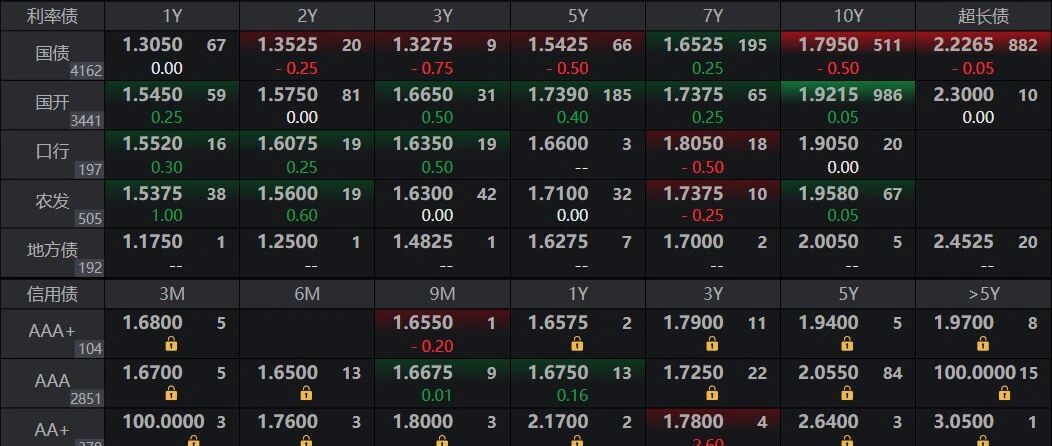
Core Viewpoint - The article emphasizes the importance of adapting to market conditions rather than predicting them, suggesting strategies for different market environments: shorting in bear markets, going long in bull markets, and remaining neutral during fluctuations [1] Group 1: Market Conditions - The market is currently experiencing a slight upward adjustment, with funds showing a trend of tightening to loosening, as indicated by the central bank's operations [3] - The central bank conducted a 7-day reverse repurchase operation of 461.4 billion yuan, with 105.5 billion yuan maturing today, resulting in a net injection of 399.5 billion yuan [3] - The interbank funding rates have seen a slight increase, with DR001 around 1.37% and DR007 around 1.56% [3] Group 2: Bond Market - The bond market is experiencing a quiet trading period ahead of the holiday, with the 10-year government bond yield fluctuating around 1.80% [5] - The sentiment in the bond market remains stable, with the yield on the 10-year government bond opening flat and then slightly decreasing to around 1.795% [5] Group 3: Corporate Developments - Google plans to issue a 100-year bond, drawing comparisons to Motorola's historical issuance, which preceded its decline [5] - ByteDance is referred to as the "largest short seller of Hang Seng Technology," as six of the top ten component stocks face competition from ByteDance, indicating the competitive pressure in the AI sector [5]

百利好晚盘分析:非农即将揭晓 黄金宽幅震荡
Sou Hu Cai Jing· 2026-02-10 09:48
Gold Sector - Trump's nomination of Waller as the next Federal Reserve Chair is expected to drive a 15% economic growth in the U.S., indicating a shift in monetary policy focus [2] - Central banks in Asia have increased gold purchases for 15 consecutive months, raising total reserves to 74.19 million ounces, reflecting a strategy to mitigate risks in an uncertain global economic environment [2] - Analysts suggest that if interest rates are cut twice this year, gold prices could rise further [2] - Technically, gold is experiencing wide fluctuations, with a critical support level at $4,985; a drop below this could lead to a deeper correction towards $4,845 [2] Oil Sector - The EU has imposed new sanctions on Russia, banning services that support Russian seaborne oil exports, aiming to limit Russia's energy revenue [3] - Russia's oil production in the previous month was 9.28 million barrels per day, a decrease of 46,000 barrels from December, and 300,000 barrels below its OPEC+ quota [3] - Technically, after reaching $66.45, oil prices are in a corrective phase, with potential upward movement towards the $73-$74 range if the upward trend resumes; key support is at $63 [3] Dollar Index - The IMF reported an 8.1% decline in the Bloomberg Dollar Index against a basket of 10 major currencies over the past year, marking the largest drop since 2017 [4] - Concerns about dollar depreciation have increased due to Trump's tariff policies and deteriorating U.S. fiscal policies [4] - Analysts predict that Waller's potential acceleration of balance sheet reduction could raise long-term yields, impacting economic growth and financial stability [4] - Technically, the dollar index has broken below the 96-100.20 range but rebounded from a low of 95.49; resistance is at 98, with support between 96.10-96.30 [4] Nikkei 225 - The Nikkei 225 index is in a bullish trend, having reached a high of 58,569, with strong upward momentum; a pullback was followed by renewed gains, indicating a high probability of further increases [6] Copper Sector - Copper prices have stabilized after a significant drop at the end of last month, with fluctuations around the $5.64 support level; a breakout above $6.05 could signal a continuation of the bullish trend, while a drop below $5.55 may indicate a larger correction [7] Market Overview - IMF President Georgieva stated that short-term exchange rate fluctuations should not be overreacted to [8] - Federal Reserve's Bostic noted growing skepticism regarding confidence in the dollar [8] - The U.S. Maritime Administration has warned vessels to stay clear of Iranian waters [8]

民银资本(01141.HK)购买本金总额1000万美元票据
Ge Long Hui· 2026-02-10 09:06
Core Viewpoint - Minyin Capital (01141.HK) has announced the purchase of a total principal amount of 10 million USD (approximately 78.06 million HKD) of notes issued by Sumitomo Mitsui Trust Holdings, Inc. [1] Group 1 - The purchase was made by Minyin Investment (Hong Kong), a wholly-owned subsidiary of the company, in the over-the-counter market [1] - The total consideration for the notes was approximately 10.34 million USD (around 80.71 million HKD) [1] - The notes are part of a larger issuance of 1.25 billion USD with a coupon rate of 6.450% [1]
港股市场策略周报2026.02.02-2026.02.08-20260210
Zhe Shang Guo Ji Jin Rong Kong Gu· 2026-02-10 08:36
港股市场策略周报 港股市场策略周报 - 投资要点 l 港股市场表现回顾: n 除中小盘外,本周港股主要指数普遍下跌。本周恒生综指/恒生指数/恒生科技分别-3.22%/-3.02%/-6.51%。本周市 场一级行业板块中4个行业上涨、8个行业下跌,资讯科技业、原材料业、非必需性消费跌幅居前,分别下跌7.8%、 6.22%、4.55%。本周整体情况为:中小盘表现占优,其余风格的股指均有不同程度的下跌,其中恒生科技跌幅最深。 n 截至本周末,恒生综指的5年PE(TTM)估值分位点为88.51%,估值水平接近5年均值向上两个标准差。 l 港股市场宏观环境: 2 2026.02.02-2026.02.08 | 分析师: | 刘景锋 | | --- | --- | | 中央编号: | BXJ117 | | 联系电话: | 852-6222 4563 | | 邮箱: | liujingfeng@cnzsqh.hk | 1 n 基本面:2026年中央一号文件公布,强调确保国家粮食安全,发展农业新质生产力,实施"常态化精准帮扶"机制。 n 资金面:美联储3月维持利率不变的概率超8成;美国ISM PMI重返扩张区间;南向资金净流 ...
金价突然暴跌,贝森特却将矛头直指中国,指责交易“失序”
Sou Hu Cai Jing· 2026-02-10 06:16
Group 1 - The article discusses a significant drop in international gold prices, which fell sharply after nearing a historical high of $5,600, resulting in the evaporation of trillions of dollars in market value within hours [1][4] - U.S. Treasury Secretary Besant blamed China for the market turmoil, claiming that disorderly trading by Chinese investors disrupted the global precious metals market [8][10] - The article suggests that the extreme volatility in gold and silver prices is not merely a market reaction but rather a politically motivated intervention by the U.S. to maintain dollar hegemony [10][12] Group 2 - Data from the World Gold Council indicates that global central banks have net purchased over 1,000 tons of gold for three consecutive years, with China's central bank increasing its reserves to over 2,300 tons [14][34] - The article highlights a broader trend of countries repatriating gold reserves, with nations like Germany and Poland also participating in this "gold repatriation movement" [25] - The narrative emphasizes that the U.S. is losing its absolute pricing power over gold, as evidenced by the need for administrative measures to stabilize the market [12][36] Group 3 - The article posits that the current financial landscape is characterized by a separation of pricing power and ownership, where the prices set by Wall Street are increasingly disconnected from the physical assets held by global central banks [36][41] - It argues that the ongoing volatility in gold prices serves as a warning signal about the weakening of the once-mythologized dollar system, indicating a shift towards a new financial order based on tangible assets [39][43] - The conclusion suggests that the rise in gold prices reflects a growing distrust in the dollar's credibility, with a new financial order centered around physical assets rapidly taking shape [43]