新消费

Search documents
浦银国际:盈利将成为下阶段行情主导力量 关注AI和出海主线
Zhi Tong Cai Jing· 2025-10-03 03:48
Core Viewpoint - The upcoming market trends will be driven by improving corporate earnings, with a focus on AI and overseas expansion as key investment themes [1][2]. Group 1: Market Trends - The liquidity-driven market rally is expected to continue into the fourth quarter, supported by anticipated interest rate cuts from the Federal Reserve and positive sentiment from potential U.S.-China meetings at the APEC summit [2][4]. - In September, external risks eased, leading to a rebound in Chinese stocks listed abroad, with the MSCI China Index rising by 6.1% and the Nasdaq Golden Dragon China Index increasing by 7.8% [3]. - The Hong Kong stock market is projected to perform well in the fourth quarter due to reduced uncertainties from U.S.-China trade negotiations and strong inflows from foreign and southbound capital [4]. Group 2: Earnings Outlook - Corporate earnings are expected to become the main driving force for the market, with major Chinese stock indices' earnings growth projected to reach double digits next year [5]. - After significant downward adjustments, earnings expectations for the MSCI China Index and the Hang Seng Index have stabilized, indicating that previous negative impacts have been accounted for [5]. Group 3: Investment Strategy - The investment strategy should focus on AI and overseas expansion, as these areas are likely to yield better returns amidst the ongoing market rotation [2][6]. - Recent market behavior shows a rotation of funds from crowded sectors like new consumption and innovative pharmaceuticals to undervalued technology sectors related to AI, indicating a shift in investor sentiment [6].
港股新消费概念股多数下跌
Mei Ri Jing Ji Xin Wen· 2025-10-02 04:05
Group 1 - The core viewpoint of the article indicates that most new consumption concept stocks in the Hong Kong market experienced declines on October 2, with specific companies like Pop Mart (09992.HK) dropping over 4%, Miniso (09896.HK) down by 3%, and Hou Shang Ayi (02589.HK) falling nearly 1% [1] Group 2 - Pop Mart (09992.HK) saw a decline of more than 4% [1] - Miniso (09896.HK) experienced a decrease of 3% [1] - Hou Shang Ayi (02589.HK) fell nearly 1% [1]

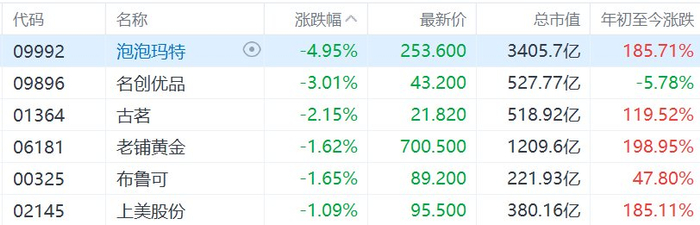
港股新消费概念股普跌,名创优品跌3%
Ge Long Hui A P P· 2025-10-02 03:53
Group 1 - The Hong Kong stock market saw a decline in new consumption concept stocks, with notable drops in companies such as Pop Mart, Miniso, and Gu Ming [1] - Pop Mart experienced a decline of 4.95%, with a latest price of 253.600 and a total market capitalization of 340.57 billion, while year-to-date growth stands at 185.71% [2] - Miniso's stock fell by 3.01%, with a latest price of 43.200 and a market cap of 52.777 billion, reflecting a year-to-date decline of 5.78% [2] Group 2 - Gu Ming's stock decreased by 2.15%, with a latest price of 21.820 and a market cap of 51.892 billion, showing a year-to-date increase of 119.52% [2] - Lao Pu Gold saw a drop of 1.62%, with a latest price of 700.500 and a market cap of 120.96 billion, while year-to-date growth is at 198.95% [2] - Bluco's stock fell by 1.65%, with a latest price of 89.200 and a market cap of 22.193 billion, reflecting a year-to-date increase of 47.80% [2]

牛文文:现在是政策市场,创业要懂得爬国家的梯子
创业家· 2025-09-30 10:07
Core Viewpoint - The article emphasizes the importance of aligning with national policies for entrepreneurs, outlining a five-step ladder for small and medium-sized enterprises (SMEs) to climb towards innovation and growth in the current market environment [3][4][5][6]. Group 1: Five Steps for SMEs - Step 1: "Small Innovation" - Focus on innovative SMEs that excel in product, technology, management, and business model innovation, targeting niche markets with strong growth potential [3]. - Step 2: "Small Technology" - Refers to technology-driven SMEs that engage in scientific research and development, achieving sustainable growth through the transformation of intellectual property into high-tech products or services [4]. - Step 3: "Specialized and Innovative" - Describes SMEs that are specialized, refined, and distinctive, focusing on niche markets with unique professional technologies [5]. - Step 4: "Little Giants" - Represents the top performers among the "specialized and innovative" SMEs [6]. - Step 5: "IPO on Beijing Stock Exchange" - Highlights the importance of going public on the Beijing Stock Exchange, which is designed to support innovative SMEs, with government subsidies available at each step of the ladder [6]. Group 2: Investment Opportunities - The article notes that the recent AI boom has led global investors to recognize the undervaluation of Chinese assets, prompting a surge of new consumer companies to list in Hong Kong [7]. - Companies like Mixue Ice City have seen significant market capitalization growth, becoming leaders in the new consumer sector [8]. - Other brands that survived the pandemic, such as HuShang Ayi and Bawang Tea, are also exploring listings in Hong Kong or the US [9]. Group 3: Entrepreneurial Insights - Entrepreneurs are advised to secure funding before consensus peaks, continue fundraising during peak consensus, and focus on development when consensus wanes [11][12]. - The article stresses the importance of maintaining confidence during industry downturns, as opportunities often arise when others are pessimistic [13][14]. - The principle of "winners take all" is highlighted as a consistent theme in entrepreneurship and the development of China's economy and innovation over the past two decades [15]. Group 4: Upcoming Events - The article promotes a three-day immersive course on product innovation and brand expansion, featuring industry experts from Japan and China, aimed at helping entrepreneurs navigate the current market landscape [16][20][21].

巨星传奇股东将股票由民银证券转入国泰君安(香港) 转仓市值5.35亿港元
智通财经网· 2025-09-30 00:37
Group 1 - The core point of the article highlights the transfer of shares of Giant Legend (06683) from Min Yin Securities to Guotai Junan (Hong Kong), with a market value of HKD 535 million, representing 5.58% of the total shares [1] Group 2 - For the first half of 2025, Giant Legend reported revenue of RMB 354 million, reflecting a year-on-year growth of 33% [1] - The new consumption business generated revenue of RMB 211 million, showing a significant increase of 91.5% year-on-year [1] - The IP creation and operation business contributed RMB 144 million in revenue [1] - The gross profit for the period was RMB 156 million, resulting in a gross margin of 44% [1] - The net profit for the period was RMB 8.07 million, with basic earnings per share of RMB 0.01 [1]
巨星传奇(06683)股东将股票由民银证券转入国泰君安(香港) 转仓市值5.35亿港元
智通财经网· 2025-09-30 00:34
Core Viewpoint - The recent transfer of shares from Min Yin Securities to Guotai Junan (Hong Kong) indicates a strategic shift in shareholder interests for Giant Star Legend, with a market value of HKD 535 million, representing 5.58% of the company [1] Financial Performance - For the first half of 2025, Giant Star Legend reported revenue of RMB 354 million, reflecting a year-on-year growth of 33% [1] - The new consumption business generated revenue of RMB 211 million, showing a significant increase of 91.5% year-on-year [1] - Revenue from IP creation and operation business amounted to RMB 144 million [1] - The gross profit for the period was RMB 156 million, resulting in a gross margin of 44% [1] - The net profit for the period was RMB 8.07 million, with basic earnings per share of RMB 0.01 [1]
新消费迸发新动能 基金经理深挖潜力赛道
Zheng Quan Shi Bao· 2025-09-29 18:08
Group 1 - The core viewpoint of the articles highlights the rising momentum in the national cultural and tourism market as the "Double Festival" approaches, with diverse new consumption scenarios and unique activities driving consumer engagement [1] - New consumption trends are reshaping market dynamics and consumer behavior, with personalization, self-fulfillment, and health becoming mainstream preferences, leading to a focus on emotional value, cultural identity, and social attributes rather than just product functionality [1] - The new consumption wave is becoming a focal point for fund managers, with a number of them achieving significant returns by investing in potential new consumption targets, indicating a growing interest in this sector [1] Group 2 - Fund managers emphasize that while the overall growth of the consumption industry is stable, there are significant structural opportunities, particularly in the new consumption sector, supported by favorable macroeconomic conditions [2] - The essence of new consumption is identified as growth stocks within the consumption industry, with a shift in growth sources due to factors like the rise of the younger generation and the influence of social media [2] - Investment strategies are focused on companies that can address the evolving needs of young consumers, either through strong product offerings or differentiated services and experiences [2] Group 3 - Fund managers are concentrating on new consumption enterprises that demonstrate continuous breakthroughs, with a positive outlook on companies achieving success in cultural consumption and other sectors [3] - There is a focus on identifying companies that can tap into the potential of the new generation of consumers, particularly in media, internet, and food and beverage industries [3] - The importance of domestic demand has been highlighted, with a long-term positive attitude towards the consumption sector despite recent challenges, indicating a strategic focus on fundamentally strong and reasonably valued targets in the new consumption direction [3]

港股主要指数冲高后有所回落 恒指跌0.13% 科指涨0.89%
Xin Hua Cai Jing· 2025-09-25 10:10
Market Overview - The Hong Kong stock market opened mixed on September 25, with the Hang Seng Index rising initially but closing down 0.13% at 26,484.68 points. The Hang Seng Tech Index increased by 0.89% to 6,379.19 points, while the National Enterprises Index rose slightly by 0.01% to 9,444.22 points [1] - The Hang Seng Index reached a high of 26,640.53 points during the day before retreating, with a total turnover exceeding 314.8 billion HKD. The southbound trading (Hong Kong Stock Connect) saw a net inflow of over 11 billion HKD [1] Sector Performance - Most sectors experienced declines, with notable increases in biopharmaceuticals, new energy vehicles, and wind power stocks. Conversely, sectors such as real estate, gold, banking, insurance, brokerage, gas, and coal saw significant declines [1] Individual Stock Movements - Notable stock movements included: - Delin Holdings up 11.65% - Hang Seng Bank down 3.13% - Yimai Sunshine up 14.08% - Huilyang Technology up 4.11% - Goldwind Technology up 5.25% - ZTE Corporation up 4.80% - Cloudtop New Medicine up 4.48% - Zhenjiu Lidu down 4.13% - Jingji Group surged 160.53% - Zijin Mining up 5.13% - Chery Automobile up 3.80% - JD Group up 3.46% - China Everbright Holdings up 25.89% - Yunfeng Financial down 6.60% [1] Top Traded Stocks - The top three traded stocks included: - Alibaba down 1.15% with a turnover exceeding 30 billion HKD - Xiaomi Group up 4.48% with a turnover exceeding 19.3 billion HKD - Tencent Holdings up 0.23% with a turnover exceeding 11.3 billion HKD [2]



认知决定结果:当“老登股”失宠时,别在犹豫中成为最后的接盘侠
雪球· 2025-09-25 08:08
Core Viewpoint - The article discusses the anxiety among investors in undervalued, high-dividend stocks due to continuous declines in stock prices, leading to doubts about the companies' fundamentals. This situation is contrasted with the rising technology stocks, indicating a significant capital migration towards tech, driven by macro narratives and profit effects, rendering individual fundamentals less relevant [3][4]. Group 1: Painful Roots - Investors adhering to traditional value investing are experiencing extreme discomfort as they watch AI and tech stocks soar while their stable, cash-flowing holdings underperform and even decline [4]. - The contrasting performance between tech stocks and traditional value stocks leads to feelings of loss and self-doubt among investors [4]. Group 2: Cognitive Stratification - The article outlines four cognitive levels of investors regarding market trends: 1. Those who cannot see the trend and remain immersed in value investing, potentially missing out on tech gains [8]. 2. Those who see the trend but are unwilling to act due to risk aversion or fear of high valuations, leading to missed opportunities [8]. 3. Early adopters who embrace the tech narrative and participate in the trend, becoming winners [8]. 4. Latecomers who, driven by fear of missing out, buy into tech stocks at high prices, often at the end of a rally [8]. Group 3: Key Decisions - The most dangerous strategy in the current market is hesitation, which can lead to poor investment choices [9]. - Investors must either embrace the trend early or choose not to participate based on their risk assessments, maintaining a calm mindset [10]. - Late adopters risk buying into a market that has already peaked, becoming the last buyers in a narrative that is losing momentum [11]. Group 4: Conclusion - The article emphasizes the importance of staying within one's cognitive circle and making clear investment choices, whether embracing trends or sticking to value investing [12][14]. - Investors should accept the potential for missing out on opportunities due to their cognitive boundaries while focusing on strategies that align with their understanding of the market [15].

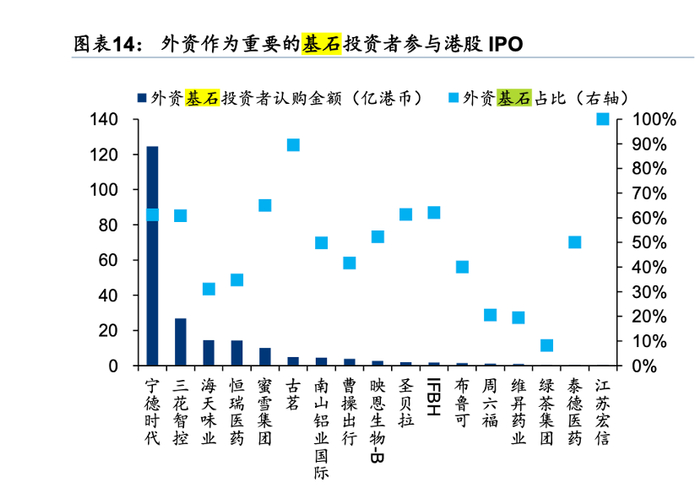
七成浮盈、最高回报超10倍,机构溢价争抢港股IPO基石份额
第一财经网· 2025-09-24 07:53
Core Insights - The core viewpoint of the articles is the significant shift in the Hong Kong IPO market, where cornerstone investments have surged from being overlooked to highly sought after, driven by substantial returns on investment [1][10]. Group 1: Market Dynamics - The planned subscription amount for cornerstone investors was initially set at 40% of the IPO issuance, but demand has exceeded this by over three times, indicating a strong interest in cornerstone investments [1][3]. - Since 2025, the participation of cornerstone investors in Hong Kong IPOs has increased dramatically, with an average of 5.35 cornerstone investors per company, up nearly 290% from 1.37 last year [1][2]. - Major IPOs, such as that of Ningde Times, attracted up to 23 cornerstone investors, highlighting the trend of large-scale capital inflow into significant projects [2]. Group 2: Investor Composition - The number of cornerstone investors has risen to 289 this year, with a notable increase from professional investment institutions and listed companies [4][8]. - In 2025, 93 investment institutions contributed a total of 302.06 million HKD, accounting for approximately 66.82% of the cornerstone investment total, marking them as the dominant force in the market [5][8]. - Foreign capital has played a crucial role, with foreign investors accounting for over 210 million HKD in cornerstone investments, representing half of the total [8]. Group 3: Investment Returns - Over 77% of cornerstone investors are currently in profit, with some projects yielding returns exceeding ten times the initial investment [1][10]. - Notable examples include the investment in Lao Pu Gold, which saw a price increase of 166% from the IPO price, resulting in a paper profit of over 4.5 billion HKD for Tencent [10]. - The highest returns have been observed in innovative pharmaceutical companies, with some stocks increasing over tenfold since their IPO [11][12]. Group 4: Sector Performance - The pharmaceutical sector has shown the highest returns, with companies like Yaojie Ankang-B seeing a price increase of over 1155.51% [11][12]. - Other sectors, including technology and consumer goods, have also performed well, with companies like Mixue Group and Gu Ming seeing stock prices rise over 100% [11][12].