运营商

Search documents
中信建投通信三季报综述:收入利润增速提升 算力板块亮眼 机构持仓创新高
智通财经网· 2025-11-05 00:02
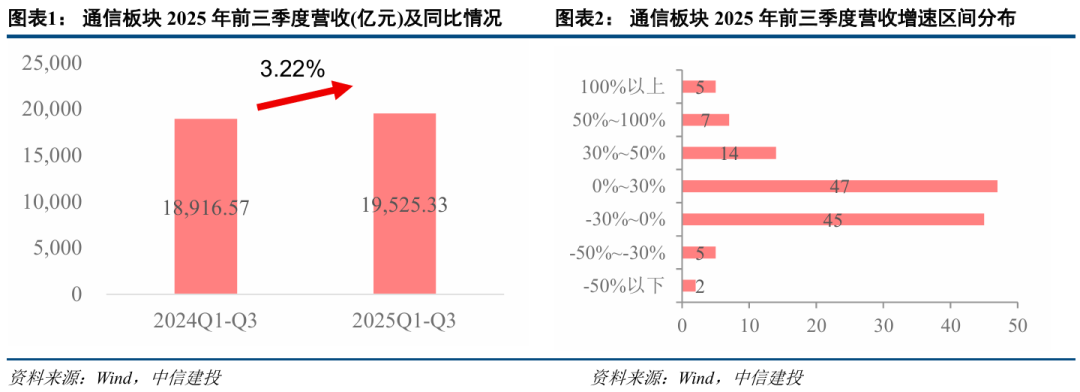
Core Insights - The communication sector is experiencing stable revenue growth and improved profitability, with significant contributions from the AI computing segment [1][3][4] Group 1: Communication Sector Performance - In the first three quarters of 2025, the A-share communication sector achieved a total revenue of 19,525.33 billion yuan, representing a year-on-year growth of 3.22% [1] - The net profit attributable to shareholders in the same period was 1,937.62 billion yuan, with a year-on-year growth of 8.80%, indicating that profit growth outpaced revenue growth [3] - The overall gross margin for the communication sector remained stable at 28.90%, while the net profit margin improved to 10.58%, up 0.56 percentage points year-on-year [4] Group 2: Quarterly Performance - In Q3 2025, the communication sector's revenue reached 6,305 billion yuan, showing a year-on-year increase of 3.7% and an improvement in growth rate compared to Q3 2024 [7] - The net profit for Q3 2025 was 564 billion yuan, reflecting a year-on-year growth of 11.68% [10] - The gross margin for Q3 2025 was 28.00%, down 0.41 percentage points year-on-year, while the net profit margin increased to 9.52%, up 0.70 percentage points year-on-year [14] Group 3: Subsector Analysis - The light module and optical device sector showed the best performance in the first three quarters of 2025, with a revenue of 662 billion yuan, marking a year-on-year growth of 65% [17] - The net profit growth leaders in the same period were the light module/optical device sector (169.4 billion yuan, up 123%) and the connector sector (8.2 billion yuan, up 62%) [21] - Conversely, the military communication and smart card sectors experienced significant declines, with net profits dropping by 194% and 102% respectively [21] Group 4: Major Operators' Performance - The three major telecom operators collectively reported a revenue of 14,846 billion yuan in the first three quarters of 2025, with a year-on-year growth of 0.57% [29] - Their combined net profit reached 1,661 billion yuan, reflecting a year-on-year increase of 4.3% [35] - In Q3 2025, the operators achieved a total revenue of 4,692 billion yuan, with a year-on-year growth of 1.1% [37] Group 5: Investment Trends - Public fund holdings in the communication sector reached a historical high of 6.87% in Q3 2025, with a market value of 3,038.68 billion yuan [43] - The PE-TTM for the communication sector stood at 43.41, indicating high market expectations for the AI computing segment [43] - The capital expenditure of major North American CSPs is accelerating, with a total of 1,133 billion USD in Q3 2025, reflecting a year-on-year growth of 75% [49][50]


通信行业2025年11月投资策略暨25Q3财报总结:美持续加大AI投入,算力基础设施高景气度延续
Guoxin Securities· 2025-11-02 12:10
Group 1: Market Overview - In October, the communication sector experienced a decline of 0.45%, aligning closely with the overall market performance, ranking 20th among 31 primary industries [12][17] - The communication industry’s price-to-earnings (PE) ratio was 23.2, indicating a recovery from historical lows, while the price-to-book (PB) ratio was 2.4, reflecting a return to historical median levels [17][22] Group 2: Fund Holdings Analysis - As of Q3 2025, the market value of funds heavily invested in the communication sector reached 288.6 billion yuan, accounting for 7.14% of total fund holdings, with a quarter-on-quarter increase of 3.2 percentage points [30][34] - The concentration of fund holdings in the top ten communication stocks increased, with these stocks representing 99% of the total market value in the communication sector [34][40] Group 3: Financial Performance - In the first three quarters of 2025, the communication industry (excluding operators) saw a revenue growth of 19.57% and a net profit growth of 33.69% [2][42] - For Q3 2025 alone, non-operator communication companies reported total revenues of 185.1 billion yuan, a year-on-year increase of 19.47%, and net profits of 16.7 billion yuan, reflecting a significant growth of 47.4% [2][42] Group 4: Subsector Performance - The growth rates for revenue in the first three quarters of 2025 were led by the optical module, optical device/chip, and liquid cooling sectors, with growth rates of 63.5%, 37.1%, and 36.4% respectively [44] - Notably, the optical module sector achieved a profit growth rate of 125.7%, while AIDC and optical devices/chips also showed significant profit increases of 117.7% and 93.9% respectively [44] Group 5: Investment Recommendations - Continuous attention is recommended for the development of AI computing infrastructure, particularly in sectors such as optical devices, communication equipment, and liquid cooling [4] - The three major operators remain important assets for dividend configuration, with stable operations and increasing dividend payouts [4]






原中国联通董事长转任中国移动,两位董事长共同关注点是AI
Di Yi Cai Jing· 2025-10-28 10:39
Group 1 - The core point of the news is the leadership change at China Mobile, with Chen Zhongyue appointed as the new Chairman and Party Secretary, replacing Yang Jie [1] - The adjustment of leadership among the three major telecom operators is common, with Yang Jie previously serving as Chairman of China Telecom before moving to China Mobile in 2019, and Chen Zhongyue transitioning from China Unicom to China Mobile [1] - In Q3 2025, China Mobile reported nearly 800 billion yuan in revenue and 115.4 billion yuan in net profit, maintaining its position as the leading operator in the industry, with net profit being 3.7 times that of China Telecom and 13.1 times that of China Unicom [1] Group 2 - Both outgoing and incoming chairmen have emphasized the importance of AI in their recent speeches, with Yang Jie highlighting the need to seize opportunities in the digital intelligence era and focus on "AI+" as a strategic point [2] - China Unicom also expressed intentions to closely collaborate with partners to promote innovation across various technology fields and create a new ecosystem for AI infrastructure and industry [2]

港股开盘 | 恒指高开0.31% 科网股多数上涨
智通财经网· 2025-10-14 01:30
Group 1 - The Hang Seng Index opened up by 0.31%, while the Hang Seng Tech Index rose by 0.56%. Most tech stocks increased, with SMIC rising over 2%, and JD Group and Alibaba both up over 1% [1] - China Galaxy's strategy suggests that short-term escalation in US-China trade tensions has led to a decline in investor risk appetite, resulting in a valuation correction for Hong Kong stocks. However, domestic policies aimed at stabilizing growth and medium to long-term measures to support the stock market are expected to gradually stabilize investor sentiment [1] - Current valuations of Hong Kong stocks are at a historically high level, and the market is anticipated to experience wide fluctuations in the future [1] Group 2 - The Guotai Junan overseas strategy team reported that foreign capital dominates most sub-sectors in the Hong Kong stock market, particularly in the internet, finance, and most consumer sectors. Conversely, southbound capital has significant influence in a few sectors such as telecommunications, coal and petrochemicals, military, and semiconductors, with notable pricing power in the semiconductor, broad consumer, and broad dividend sectors over the past two years [1]
港股开盘 | 恒指低开2.5% 科网股多数下跌
智通财经网· 2025-10-13 01:35
Market Overview - The Hang Seng Index opened down 2.5%, while the Hang Seng Tech Index fell by 2.43%. Major tech stocks, including Xiaomi and Alibaba, saw declines of over 4% and 3% respectively [1]. Short-term Market Sentiment - Huatai Securities indicated that the key to short-term trading direction lies in whether market sentiment has reached an extreme level. Their constructed sentiment indicator suggests there is still room for further release. The evolving path of trade friction over the next couple of weeks is expected to have high variance, leading to continued volatility. Tactical advice includes moderate defense and recommending high-quality cash flow assets in Hong Kong, with "TACO" trades to be executed in batches [1]. Medium to Long-term Outlook - China Galaxy Strategy believes that the escalation of Sino-U.S. trade friction has led to a decrease in investor risk appetite, resulting in a valuation correction for Hong Kong stocks. However, with domestic policies supporting stable growth and medium to long-term measures to stabilize the stock market, investor sentiment is expected to gradually stabilize. Currently, Hong Kong stock valuations are at a historically high level, and the market is anticipated to experience wide fluctuations [1]. Foreign Investment Dynamics - The Guotai Junan overseas strategy team reported that foreign capital dominates most sub-sectors in the Hong Kong stock market, particularly in the internet, finance, and most consumer sectors. Conversely, the southbound investment has gained significant pricing power in a few sectors such as telecommunications, coal, petrochemicals, military, and semiconductors over the past two years [1].


国泰海通 · 晨报1013|宏观、策略、海外策略、固收
国泰海通证券研究· 2025-10-12 13:40
Macro Perspective - The recent trade tensions initiated by the Trump administration are not expected to have a significant negative impact on the market, as the real drivers of asset performance are domestic economic and policy developments [4][5] - Historical context shows that previous tariff disputes led to temporary market reactions, but the U.S. government often softens its stance due to economic realities, suggesting that current tariff uncertainties may also be manageable [5][6] Investment Strategy - The current external shocks present a buying opportunity for Chinese markets, as the trade disputes are seen as disturbances rather than a trend reversal [10] - Unlike previous trade conflicts, the current situation has clearer boundaries regarding risks, and domestic financial stability is more assured, making it a favorable time to increase investments in quality assets [11][12] Industry Comparison - The investment focus should remain on emerging technologies, with sectors like AI, semiconductors, and financials showing strong potential for growth [13] - The financial sector, after adjustments, is expected to provide stable returns, with recommendations for stocks in brokerage, banking, and insurance [13] Overseas Strategy - There has been a notable increase in southbound capital inflows into Hong Kong stocks, while foreign capital outflows have slowed, indicating a shift in market dynamics [16] - Southbound investments are diversifying across various sectors, while foreign investments remain concentrated in technology and finance [16] Fixed Income Analysis - The bond market is expected to experience limited upward movement in interest rates, with a stable outlook for October, despite ongoing trade tensions [20][21] - The current environment suggests a potential for slight declines in bond yields, but overall, the bond market is likely to remain stable [20][21]

国泰海通海外:南向流入港股提速 外资偏好科技
智通财经网· 2025-10-12 09:08
Core Viewpoint - Southbound capital inflow into Hong Kong stocks has accelerated, with a cumulative net inflow of HKD 395.2 billion in Q3, an increase compared to Q2 [1][2] Flow Perspective - In Q3, southbound funds continued to flow into Hong Kong stocks, with a cumulative net inflow of HKD 395.2 billion, which is an increase from Q2 [2] - The outflow of foreign capital has slowed down, with a cumulative net outflow of HKD 66.4 billion in Q3, marking a decrease in outflow for three consecutive quarters [2] - The proportion of southbound holdings in Hong Kong stocks has reached a new high, with the Hong Kong Stock Connect holding amount rising from 20.7% at the end of Q2 to 21.8% at the end of Q3 [2] Industry Perspective - In Q3, the main inflows from southbound funds were into consumer discretionary, non-bank financials, and pharmaceuticals, while software and hardware saw net outflows in Q2 [3] - Foreign capital dominates most sub-sectors in Hong Kong stocks, particularly in the internet, finance, and most consumer sectors [3] - Southbound funds have gained significant pricing power in sectors such as semiconductors, general consumption, and general dividends over the past two years [3]

当下如何看港股红利资产
2025-09-22 00:59
Summary of the Conference Call on Hong Kong Dividend Assets Industry Overview - The focus is on Hong Kong dividend assets, which are primarily mature companies with stable financial structures relying on internal financing rather than debt [1][3]. Key Points and Arguments 1. **Characteristics of Hong Kong Dividend Assets**: - High dividend levels: The overall dividend yield of Hong Kong dividend assets is significantly higher than the market average, with companies exhibiting stable cash flows and high operating cash flow as a percentage of revenue [3]. - Robust financial structure: These companies are in a mature stage, with low net debt to EBITDA ratios and low capital expenditure to depreciation ratios, indicating a low willingness for expansion [3]. - Composition differences: Unlike A-shares, which are dominated by financial sectors, Hong Kong dividend assets include unique assets such as the three major telecom operators and commercial real estate [1][3]. - Valuation advantage: Hong Kong's overall cash dividend ratio is higher than that of A-shares, with lower PE and PB ratios in sectors like banking, petrochemicals, and coal [1][3]. - Higher proportion of high-yield stocks: Approximately 40% of stocks in Hong Kong have a dividend yield of 5% or more, compared to only 16% in A-shares [1][3]. 2. **Investment Logic Differences**: - Both markets exhibit defensive characteristics in weak environments and tend to follow trends in bull markets, but they have different performance in low or rising phases [4]. - Taxation differences: A-shares allow for tax exemptions on dividends after one year of holding, while Hong Kong imposes a 20% tax on individual investors and public funds [5]. - Sensitivity to U.S. Treasury rates: Hong Kong dividend assets are more sensitive to U.S. Treasury rates, potentially serving as substitutes during periods of declining rates, with greater upside elasticity compared to A-shares [5][6]. 3. **Market Environment and Future Outlook**: - In the current market, Hong Kong dividend assets are expected to outperform due to their higher cost-performance ratio compared to A-shares, even after accounting for the 20% dividend tax [2][7]. - As the year-end approaches and overseas liquidity shifts, there is an anticipated increase in demand for dividend assets, particularly as the Federal Reserve may enter a rate-cutting cycle [7]. - Long-term, the regulatory environment is enhancing dividend policies, leading to increased dividend enthusiasm in both markets, with Hong Kong dividend assets expected to maintain their relative performance advantage in a low-interest-rate environment [7][9]. Other Important Insights - The probability of the Hang Seng High Dividend Index achieving positive excess returns exceeds 82% during significant downturns in the Hong Kong market, highlighting its defensive attributes [1][5]. - The overall financial attributes of both markets are similar, but Hong Kong's asset composition is more diversified, providing a better cost-performance ratio [8][9].
华龙证券:通信行业业绩稳健增长 关注AI快速发展带来的行业计划
智通财经网· 2025-09-18 02:01
Core Insights - The optical module industry is experiencing strong performance driven by the rapid development of AI technology, leading to sustained growth in demand for optical modules [1] - The three major telecom operators have stable industry revenues and improved cost control capabilities, with AI also boosting cloud revenue [1] - The rapid development of commercial aerospace in China is expected to create opportunities in the satellite internet sector [1] Telecom Industry - In the first half of 2025, 92 tracked telecom companies achieved total revenue of 12,959.45 billion yuan, a year-on-year increase of 3.16% [1] - The net profit attributable to shareholders reached 1,372.77 billion yuan, up 7.79% year-on-year [1] - The industry gross margin was 29.46%, an increase of 0.07 percentage points year-on-year, while the net profit margin was 10.59%, up 0.45 percentage points year-on-year [1] Operators - The three major operators generated revenue of 10,133.93 billion yuan in the first half of 2025, a year-on-year growth of 0.33% [2] - Their net profit attributable to shareholders was 1,136.01 billion yuan, reflecting a year-on-year increase of 5.14% [2] - Cloud business revenue for the three operators reached 151 billion yuan in the first half of 2025 [2] Optical Communication - The optical communication sector is benefiting from the growth in AI technology and increasing computing power demand, leading to stable growth in demand for high-speed optical devices [2] - Eleven tracked optical communication companies achieved total revenue of 449.95 billion yuan in the first half of 2025, a year-on-year increase of 33.44% [2] - The net profit attributable to shareholders for these companies was 96.76 billion yuan, up 124.91% year-on-year [2] Satellite Internet - Ten tracked satellite internet companies reported total revenue of 125.90 billion yuan in the first half of 2025, a year-on-year decline of 5.77% [3] - The net profit attributable to shareholders was 3.27 billion yuan, down 56.59% year-on-year [3] - The government report emphasizes the safe and healthy development of commercial aerospace, indicating a new phase of large-scale application [3] Communication Equipment Manufacturers - Eleven tracked communication network equipment and device companies achieved total revenue of 915.79 billion yuan in the first half of 2025, a year-on-year increase of 16.27% [3] - The net profit attributable to shareholders was 60.31 billion yuan, reflecting a year-on-year decline of 1.77% [3] - The rapid development of AI is expected to create additional demand for these companies [3]
基金研究周报:全球权益共振,黄金续创新高(9.8-9.12)
Sou Hu Cai Jing· 2025-09-14 13:31
Market Overview - The A-share market showed structural activity driven by policy expectations and technology themes, with the Wind All A index rising by 2.12% from September 8 to September 12, and the Sci-Tech 50 leading with a 5.48% increase, indicating strong market preference for technology growth sectors [1] - The Shanghai Composite Index increased by 1.52%, the Shenzhen Index by 2.65%, and the ChiNext Index by 2.10% during the same period [1] - The communication sector performed notably due to increased demand for optical devices and higher capital expenditures from operators, while the pharmaceutical and biotechnology sector declined by 0.64%, reflecting market concerns over deepening centralized procurement policies and risks in innovative drug development [1] Industry Performance - The average increase of Wind's first-level industry indices was 2.05%, with 90% of the Wind Top 100 concept indices rising [1][12] - All sectors except for biomedicine saw positive performance, with communication, agriculture, forestry, animal husbandry, and fishery, and electronics sectors rising by 5.24%, 5.00%, and 4.93% respectively [1][12] - The real estate, machinery, and construction materials sectors experienced slight increases, while the oil, petrochemical, and coal sectors lagged, with increases of only 0.30% and 0.16% respectively [1][12] Fund Issuance - A total of 39 funds were issued last week, including 18 equity funds, 13 mixed funds, 5 bond funds, and 3 FOF funds, with a total issuance of 21.794 billion units [2][14] Fund Performance - The Wind All Fund Index rose by 1.17%, with the ordinary equity fund index increasing by 2.13% and the mixed equity fund index by 2.40%, while the bond fund index fell by 0.06% [2][8]