
钴矿

Search documents
刚果钴配额制生效在即,钴价进入结构性上行周期
高工锂电· 2025-10-13 11:26
Core Viewpoint - The Democratic Republic of Congo (DRC) has implemented a quota system for cobalt exports, transitioning from an export ban to a regulated quota management system, significantly impacting global cobalt supply and pricing dynamics [3][6][18]. Summary by Sections Export Quota Details - The DRC government announced cobalt export quotas, ending an eight-month export ban, with annual quotas set at 96,600 tons for 2026 and 2027, and a remaining quarterly export limit of 18,100 tons for 2025 [3]. - Export quotas are allocated to mining companies and government-controlled platforms, excluding smelters from direct quotas [3][4]. Resource Concentration - Six mining companies and platforms control nearly 80% of the export quotas, with major allocations to companies like Luoyang Molybdenum (31,200 tons) and Glencore (13,300 tons) [4][5]. - The concentration of quotas enhances the bargaining power of these entities, as only they possess the rights to export [6]. Export Regulations - The new regulations impose strict conditions on quota transferability and require prepayment of mining rights fees, increasing operational and financial pressures on companies [7][9]. - The complexity of the new export process may lead to uncertainties in the supply chain, affecting the overall export rhythm [8][9]. Price Dynamics - The DRC's quota system is expected to shift the pricing mechanism from demand-driven to supply-driven, with domestic cobalt prices rising significantly from 169,000 CNY/ton to approximately 340,000 CNY/ton [13][14]. - The tightening of supply due to the loss of direct export rights for smelters may lead to increased procurement costs for smaller clients [14]. Industry Response - The domestic lithium battery industry is adapting by securing long-term contracts with quota holders, exploring new supply channels, and advancing cobalt-free battery technologies [16][17]. - The anticipated reduction in cobalt supply by 67,000 tons globally due to the quota system is prompting a shift in market dynamics [15][19]. Long-term Implications - The DRC's quota system is seen as a strategic move to redistribute global cobalt profits and enhance local processing capabilities, potentially leading to a more competitive landscape in the cobalt market [18][19].

粤开市场日报-20251013
Yuekai Securities· 2025-10-13 07:47
Market Overview - The A-share market saw a majority of major indices decline today, with the Shanghai Composite Index down by 0.19% closing at 3889.50 points, the Shenzhen Component down by 0.93% at 13231.47 points, and the ChiNext Index down by 1.11% at 3078.76 points. The STAR 50 Index, however, increased by 1.40% to 1473.02 points. Overall, there were 1682 stocks that rose while 3628 stocks fell, with a total trading volume of 23547 billion yuan, a decrease of 1609 billion yuan from the previous trading day [1][2]. Industry Performance - Among the 31 first-level industries, only a few sectors such as non-ferrous metals, environmental protection, steel, national defense and military industry, banking, and computing saw gains, with respective increases of 3.35%, 1.65%, 1.49%, 0.86%, 0.74%, and 0.22%. Conversely, the automotive, home appliances, beauty care, media, and pharmaceutical industries experienced the largest declines, with decreases of 2.33%, 1.74%, 1.58%, 1.54%, and 1.47% respectively [1][2]. Concept Sectors - The leading concept sectors in terms of gains today included rare earths, rare earth permanent magnets, photoresists, semiconductor silicon wafers, rare metals, SMIC, lithium battery electrolytes, wafer industry, small metals, operating systems, semiconductor materials, gold and jewelry, continuous boards, pre-increase, and cobalt mines [2][11].
中信建投证券:重视钴和稀土的战略配置机遇
Xin Hua Cai Jing· 2025-10-13 02:32
Group 1: Cobalt Export Quotas - The details of cobalt export quotas from the Democratic Republic of Congo have been finalized, with the top three companies being Luoyang Molybdenum, Jiana Co., and Eurasian Resources, holding shares of 35.9%, 27.3%, and 21.6% respectively [1] - The total quota for 2026 and 2027 is set at 96,600 tons, which includes a basic quota of 87,000 tons allocated to various production companies and a strategic quota of 9,600 tons [1] - Under this quota system, only about 44% of the production can be exported, resulting in a reduction of over 100,000 tons [1] Group 2: Cobalt Market Dynamics - Based on estimates for 2024, with a supply of 270,000 tons and demand of 230,000 tons, the market is expected to shift from a surplus of approximately 70,000 tons to a shortage of about 30,000 tons, potentially driving cobalt prices higher [1] Group 3: Rare Earth Export Controls - The Ministry of Commerce has issued four documents to strengthen export controls on rare earths, adding five categories of medium and heavy rare earths to the export control list [1] - The strategic position of rare earths is further reinforced, with expectations of increased overseas stockpiling actions, which may lead to further price increases for rare earths [1] - China's control over the entire rare earth industry chain, from mining to recycling, is expected to complicate the establishment of independent overseas rare earth supply chains, extending the time required and enhancing China's competitive advantage in rare earths [1]

美关税威胁再起,流动性冲击下铜铝价格回落 | 投研报告
Zhong Guo Neng Yuan Wang· 2025-10-13 02:07
Group 1: Copper Market - The threat of US tariffs has resurfaced, causing a liquidity shock that led to a decline in copper prices, but the long-term upward trend remains intact [2][3] - Recent disturbances in the supply of copper from the world's second-largest copper mine and expectations of US Federal Reserve rate cuts previously pushed LME copper prices to $11,000 per ton and Shanghai copper prices to over ¥88,000 per ton [2][3] - On November 1, 2025, the US will impose an additional 100% tariff on all goods imported from China, which has heightened market risk aversion and led to significant liquidation of long positions, resulting in a 4.5% drop in both Shanghai and LME copper prices [2][3] Group 2: Aluminum Market - The aluminum market is also experiencing a decline due to the renewed threat of US tariffs and liquidity shocks [3] - The price of alumina has decreased by 0.68% to ¥2,930 per ton, while the main futures contract for alumina fell by 4.62% to ¥2,806 per ton [3] - Domestic electrolytic aluminum inventory has increased by 10.15% to 651,000 tons, but the demand season is expected to lead to a destocking cycle, with potential price recovery once liquidity shocks ease [3] Group 3: Lithium Market - Lithium prices are expected to rebound from the bottom as demand enters a destocking cycle during the peak season [4][5] - The price of lithium carbonate remains stable at ¥73,600 per ton, while lithium spodumene has decreased by 2.21% to $839 per ton [4][5] - The production of lithium carbonate has increased by 0.6% to 20,600 tons, and inventory has decreased by 1.5% to 134,800 tons [4][5] Group 4: Cobalt Market - The Democratic Republic of the Congo (DRC) will implement a cobalt export quota system, which is expected to accelerate price increases [6] - The price of cobalt has risen by 4.19% to $19.90 per pound, and domestic cobalt prices have increased by 2.87% to ¥359,000 per ton [6] - The DRC's cobalt export quota for the period from October 16, 2025, to December 31, 2025, is set at 18,100 tons, which is expected to significantly narrow the surplus and potentially lead to a shortage [6]
智通港股早知道 | 刚果(金)钴出口配额落地 高通因涉嫌违反反垄断法被立案调查
Zhi Tong Cai Jing· 2025-10-12 23:14
Group 1: Cobalt Export Quota in Congo - The Democratic Republic of Congo (DRC) has announced a cobalt export quota, effective from October 16, aimed at strengthening resource sovereignty and signaling a shift from a surplus to a shortage in the cobalt market, leading to a systematic increase in price levels [1] - The DRC's Strategic Mineral Market Regulatory Authority stated that miners will be allowed to export slightly over 18,000 tons of cobalt for the remainder of this year, with annual export limits of 96,600 tons for 2026 and 2027, which is less than half of last year's production [1] - The quota distribution includes major companies such as Luoyang Molybdenum, which received a quota of 31,200 tons (32.3%), exceeding some prior expectations [1] Group 2: Future Cobalt Supply and Demand - Institutions predict a cobalt supply gap in the next two years, with global supply expected to be 290,000 tons in 2024 (DRC 220,000 tons + Indonesia 28,000 tons) against a demand of 185,000 tons, resulting in a surplus of 105,000 tons; by 2026, supply is projected to drop to 180,000 tons (DRC 96,600 tons + Indonesia 40,000 tons) while demand will rise to 200,000 tons, leading to a shortfall of 20,000 tons [2] Group 3: Market Trends and Stock Performance - The Nasdaq China Golden Dragon Index fell by 6.1%, with major U.S. stock indices also experiencing significant declines, indicating a bearish trend in the market [3] - Notable declines were observed in large tech stocks, with companies like Broadcom and Tesla dropping nearly 6% and 5.06% respectively, reflecting broader market challenges [3] Group 4: Rare Earth Prices - Baotou Steel and Northern Rare Earth announced an increase in rare earth concentrate prices for Q4 2025, with a projected 37.13% increase compared to Q3 [7] Group 5: Company Announcements - China Energy Construction signed three new energy EPC contracts worth approximately 27.45 billion USD (about 195.54 billion RMB) with Saudi companies [11] - Smoore International reported a record high quarterly revenue of approximately 4.1968 billion RMB, a year-on-year increase of about 27.2% [12] - Kelun-Biotech's TROP2ADC drug received approval for a new indication, expanding its market potential in treating specific lung cancer cases [13] - Zhaojin Mining reported a net profit of approximately 2.117 billion RMB for the first three quarters of 2025, a year-on-year increase of 140.43% [14]
刚果金政府发布钴出口配额的获取、分配和执行条件,继续推荐关注钴资源标的
HUAXI Securities· 2025-10-12 14:36
Investment Rating - Industry rating: Recommended [4] Core Insights - The Democratic Republic of Congo (DRC) government has issued conditions for obtaining and distributing cobalt export quotas, effective from October 16, 2025 [1][2] - The DRC is expected to contribute 76% of global cobalt production in 2024, with a projected reduction in export supply over the next two years [10][11] - The report highlights potential supply shortages in the cobalt market due to various companies facing operational challenges [8][10] Summary by Sections Export Quota Details - The basic export quotas for cobalt in 2025 are set at 3,625 tons for October, and 7,250 tons for both November and December [2] - Quotas are allocated based on historical export volumes from January 1, 2022, to December 31, 2024, with specific exclusions for certain companies [2][3] Company-Specific Quotas - Key companies and their basic export quotas for Q4 2025 include: - Luoyang Molybdenum: 6,650 tons - Glencore: 3,925 tons - Eurasian Resources: 2,125 tons - Gecamines: 1,475 tons [6][16] - The 2026 quotas for these companies are projected to be significantly higher, indicating a potential increase in production capacity [7] Supply and Demand Dynamics - The report anticipates a supply gap of approximately 25,500 tons in 2027, driven by increasing global demand for cobalt, particularly in electric vehicles [12][13] - The DRC's export supply is expected to decrease significantly, with a projected reduction of 12,340 tons over the next two years [11][12] Investment Recommendations - The report recommends focusing on companies such as: - Luoyang Molybdenum, which will hold a significant share of the DRC's export quotas - Huayou Cobalt, with substantial production capacity in Indonesia - Other companies like Likin Resources and Greeenmei, which are expanding their nickel and cobalt production capabilities [15]



沪指十年后重上3900点,结构性行情能走多远?
Sou Hu Cai Jing· 2025-10-09 17:47
Core Insights - The Shanghai Composite Index (SHCI) has surpassed the 3900-point mark for the first time since August 2015, marking a significant milestone after a ten-year wait [1][3][4] - The A-share market has shown strong performance this year, with all three major indices posting five consecutive months of gains, and the ChiNext Index achieving a quarterly increase of over 50%, the second-best in history [5][6] Market Performance - On October 9, the SHCI opened at 3898.31 points and quickly broke through the 3900-point threshold, closing at 3905.52 points with a gain of 0.63% [1][7] - The Shenzhen Component Index and the ChiNext Index also saw gains of over 1%, with total trading volume exceeding 1.13 trillion yuan [8] Sector Analysis - Leading sectors included storage chips, electrolyte solutions, and cobalt mining, indicating a structural rise in the market rather than a broad-based increase [9] - There is a noted divergence in capital flow, with domestic main funds net selling 37.91 billion yuan on the last trading day before the holiday, suggesting ongoing market discrepancies [11] Technical Analysis - The SHCI is approaching the upper boundary of a high-level consolidation range, and failure to effectively break through could lead to a pullback [10][12] - Historical patterns suggest that breakthroughs at key levels often require support from financial stocks, particularly the securities sector [11][16] Future Outlook - Analysts have mixed views on the market's trajectory, with some indicating that the 3900-point area may serve as a strong resistance zone [12] - Positive factors include an upcoming important meeting scheduled for October 20-23, which may reduce the likelihood of a rapid decline in the index [15]
有色金属接棒 护送A股征伐4000点
Jing Ji Guan Cha Bao· 2025-10-09 10:55
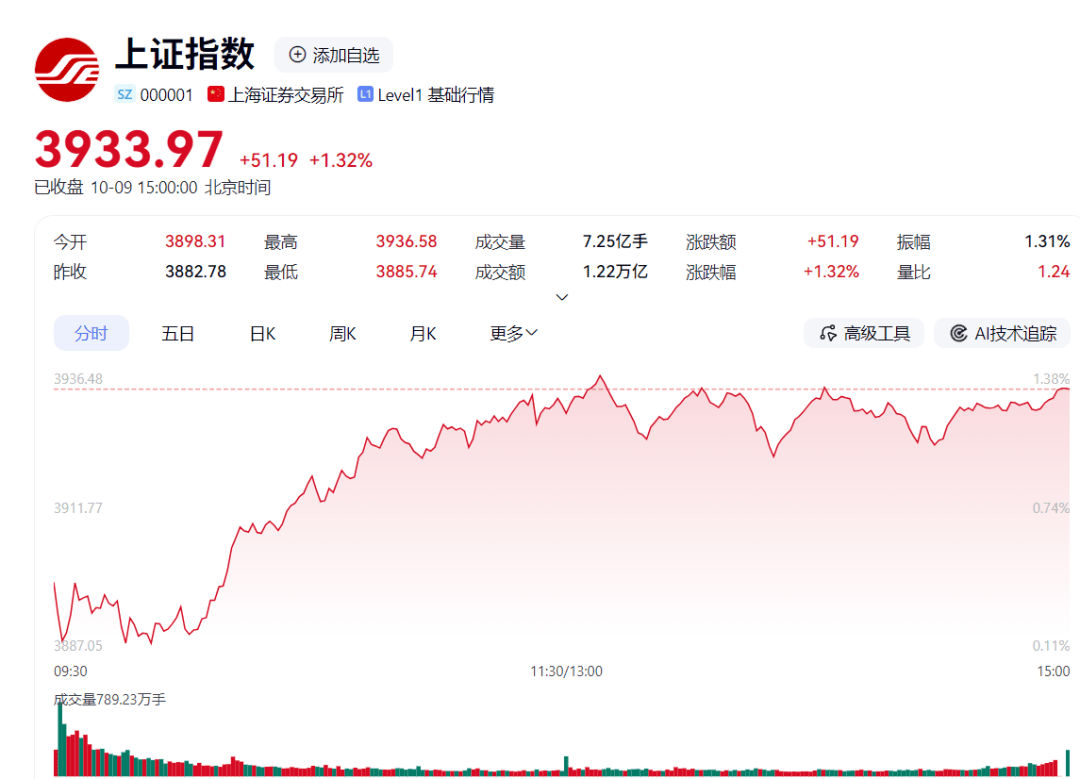
Market Overview - On October 9, the A-share market opened strongly after the holiday, with all three major indices rising. The Shanghai Composite Index increased by 1.32% to close at 3933.97 points, marking the highest level since August 2015 [2] - The Shenzhen Component Index rose by 1.47% to 13725.56 points, and the ChiNext Index increased by 0.73% to 3261.82 points, both reaching new highs since February 2022 [2] Sector Performance - The non-ferrous metals sector has been the standout performer in the A-share market, with a year-to-date increase of 77.56%, outperforming hardware equipment (59.07%) and semiconductors (58.74%) [2] - On October 9, the non-ferrous metals, hardware equipment, and semiconductor stocks saw significant gains, with the non-ferrous metals sector rising by 6.67% [6] Notable Stocks - Key stocks in the non-ferrous metals sector, such as Western Superconducting (688122.SH), Northern Rare Earth (600111.SH), and Luoyang Molybdenum (603993.SH), hit the daily limit up [6] - Gold stocks also performed well, with companies like Shandong Gold (600547.SH) and Zhongjin Gold (600589.SH) reaching historical highs [6] Global Influences - International gold prices surged past $4000 per ounce, contributing to the rise in domestic gold prices, which reached 1160 yuan per gram [6] - The recent increase in prices for various non-ferrous metals, including copper, tin, cobalt, zinc, and aluminum, was noted during the holiday period [7] Future Outlook - Analysts predict a "shaking upward" trend for the market in October, with expectations of continued inflow of capital and a stable upward trajectory for indices [8] - The upcoming Fourth Plenary Session is anticipated to influence market sentiment positively, while the third-quarter earnings reports are expected to show a rebound in profitability across most sectors [8][9]

港股午评|恒生指数早盘涨0.04% 上海电气大涨超15%
智通财经网· 2025-10-09 04:06
Group 1 - Hong Kong's Hang Seng Index rose by 0.04%, gaining 11 points to close at 26,840 points, while the Hang Seng Tech Index increased by 0.63% [1] - Shanghai Electric (02727) surged by 15.72%, with its A-shares hitting the daily limit, driven by positive developments in the controllable nuclear fusion sector [1] - Huahong Semiconductor (01347) climbed 6.75%, reaching a new high as domestic supply chain localization accelerates, with local foundry demand expected to expand rapidly [1] - Jiangxi Copper (00358) increased by 11%, being a leading copper smelting company in China, with a potential resumption of production at a copper mine owned by First Quantum [1] - Luoyang Molybdenum (03993) rose by 8%, as cobalt prices surged over 11% in the previous two days due to strict export controls in the Democratic Republic of Congo [1] - Hang Seng Bank (00011) jumped 26% following HSBC's recommendation to privatize the bank [1] - Solar stocks saw gains in early trading, with prices in the photovoltaic industry chain continuing to rise in September, particularly in upstream sectors [1] - High-speed rail infrastructure stocks led the gains, with record railway investment progress and the initiation of the "14th Five-Year" railway development planning [1] Group 2 - ZTE Corporation (00763) saw both A and H shares rise, with the overseas debut of its Co-Sight super intelligent system indicating positive growth potential in the enterprise AI market [2] Group 3 - Mixue Group (02097) rose 8.96% despite market trends, making a forward-looking investment in fresh beer brand Fulu, expanding its "tea + coffee + fresh beer" portfolio [3] - The Hang Seng Biotechnology Index fell by 3.52%, with several constituent stocks like Innovent Biologics (09969) and Sino Biopharmaceutical (01177) experiencing declines of over 6% [3] - Smoore International (06969) dropped over 9%, having fallen more than 30% from its yearly high, with UBS projecting lower earnings than market consensus [3]

力勤资源再涨超4% 钴价远期中枢有较强支撑 机构强调刚果金后续出口指标分配不确定性
Zhi Tong Cai Jing· 2025-10-01 02:43
Group 1 - The Democratic Republic of Congo (DRC) has extended its cobalt export suspension until October 15, 2025, which may impact market expectations and inventory depletion rates in the short term [2] - The uncertainty surrounding the allocation of future cobalt quotas in the DRC and the limited incremental supply from Indonesia's MHP in 2024 is highlighted, indicating that even significant increases in production may not compensate for the shortfall caused by the DRC's quota policy [2] - According to customs data, China's cobalt intermediate imports from June to August were 19,000 tons, 13,800 tons, and 5,200 tons, reflecting significant month-over-month declines of -61.62%, -27.26%, and -62.05% respectively [2] Group 2 - It is projected that global effective cobalt supply will decrease by 34% from 282,000 tons to 185,000 tons in 2025 due to the DRC's export suspension lasting seven months, with further extensions potentially exacerbating raw material shortages [2] - The tightening supply situation is expected to lead to a continued rise in cobalt prices in the short term, with strong support for long-term price stability due to the DRC government's clear stance on cobalt supply management [2] - The stock price of Liqin Resources (02245) has increased by over 50% in the month, with a current price of 22.14 HKD, reflecting a rise of 4.43% and a trading volume of 338 million HKD [3]