服务业

Search documents
推进“三新”试点 打造消费创新发展新高地
Zheng Quan Ri Bao Wang· 2025-12-20 03:56
Core Viewpoint - The Ministry of Commerce and the Ministry of Finance have initiated a pilot program for new consumption formats, models, and scenarios to stimulate innovation and enhance consumer spending in 50 cities across China, aiming to create a new high ground for consumption innovation and elevate consumer capabilities [1][2]. Group 1: Pilot Program Details - The pilot program, referred to as the "Three New" pilot, will focus on three main areas: improving the first-release economic service system, innovating diversified service consumption scenarios, and supporting collaborations between quality consumption resources and well-known IPs [1]. - The implementation period for the pilot program is set for two years, with specific roles assigned to different types of cities based on their characteristics and capabilities [1][2]. Group 2: Expected Outcomes - The pilot program is expected to address issues such as the insufficient supply of high-quality consumption and the need to stimulate innovation in the consumption sector, focusing on supply-side improvements to better meet the needs of the population [2]. - Anticipated positive impacts include better satisfaction of consumer needs through supply innovation, enhanced vitality in the consumption sector, and increased job creation through the service industry [2]. Group 3: Recommendations for Implementation - It is recommended that a collaborative support system be established, with provincial-level coordination and dynamic tracking to ensure effective implementation of the pilot program [3]. - Pilot cities should clarify project lists, monitor progress, and effectively manage both fiscal and social funds to ensure successful execution of the program [3].
国资委提出推动央企深化拓展“AI ”专项行动,超前谋划4大领域
Huan Qiu Wang· 2025-12-20 01:18
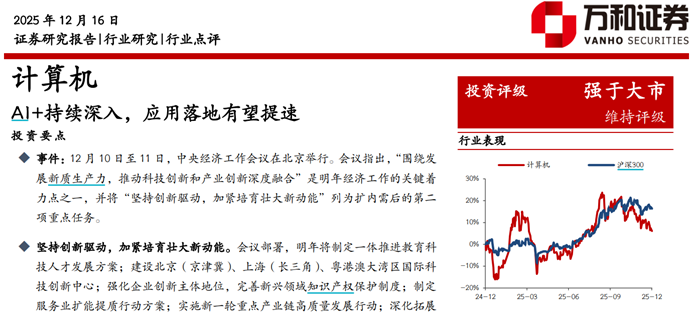
Group 1 - The State-owned Assets Supervision and Administration Commission (SASAC) plans to guide central enterprises in deepening and expanding AI initiatives during the 14th Five-Year Plan, focusing on key areas such as new energy, new energy vehicles, new materials, aerospace, and low-altitude economy, while also planning for advanced fields like quantum technology, embodied intelligence, biomanufacturing, and 6G [1] - The Central Economic Work Conference highlighted that integrating technological innovation with industrial innovation is a key focus for economic work in the coming year, with an emphasis on innovation-driven growth and nurturing new economic drivers as a priority task following domestic demand expansion [1][3] Group 2 - Wanhe Securities noted an increasing urgency in cultivating new economic drivers, as the emphasis has shifted from merely proposing the development of new drivers to a more structured approach that balances the cultivation of new and the updating of old drivers, driven by external pressures and internal challenges [3] - The report anticipates that as the AI+ initiative progresses, AI is expected to accelerate its transformation into productivity across various sectors including industry, agriculture, and services, with a significant impact on total factor productivity by 2026, driven by both funding and policy support [3]

广东发布前11月经济数据 规上工业增加值同比增长3.2%
Nan Fang Du Shi Bao· 2025-12-20 00:24
Economic Overview - Guangdong's economy has shown overall stability in 2023, with the industrial added value of above-scale enterprises growing by 3.2% year-on-year from January to November, and manufacturing increasing by 3.4% [1][2] - The automotive manufacturing sector has experienced a significant growth of 9.9%, with an increase of 0.4 percentage points compared to the previous ten months [1][2] Industrial Production - The industrial added value growth is supported by key sectors, with the computer, communication, and other electronic equipment manufacturing growing by 7.1%, and electrical machinery and equipment manufacturing by 5.2% [2] - High-tech product output has maintained double-digit growth, with civilian drones, industrial robots, servers, and 3D printing equipment increasing by 41.2%, 32.8%, 36.9%, and 44.1% respectively [2] Service Sector Performance - The revenue of above-scale service industries increased by 6.9% year-on-year from January to October, with strong support from information transmission, software, and IT services, which grew by 9.4% [3] - The transportation market has remained stable, with freight volume holding steady at 34.73 million tons year-on-year, and cargo turnover increasing by 9.0% [3] Fixed Asset Investment - Fixed asset investment has decreased by 15.7% year-on-year from January to November, while investment in equipment and tools has grown by 0.8%, accounting for 16.1% of total investment [4] - Investment in modern service industries has seen rapid growth, with internet and related services investment increasing by 86.6% [4] Consumer Market - The total retail sales of consumer goods increased by 2.5% year-on-year from January to November, with urban consumption growing by 2.7% and rural consumption by 0.6% [5][6] - Sales of certain upgraded products have seen rapid growth, with retail sales of cultural and office supplies and communication equipment increasing by 13.8% and 19.7% respectively [6]
城乡居民如何实现增收?丨落实会议部署 问答中国经济
Zheng Quan Shi Bao· 2025-12-20 00:15
Group 1 - The central economic work conference emphasizes expanding domestic demand as the primary task for the upcoming year, highlighting the urgency of boosting consumer spending, particularly among residents [1] - Policies such as the trade-in program for consumer goods, increased fiscal investment in people's livelihoods, and financial incentives for loans are expected to support the enhancement of resident consumption [1] - To fundamentally boost consumption, it is essential to continue promoting income growth among residents, thereby solidifying their consumption capacity and confidence [1] Group 2 - Employment stability is crucial for income stability, with wage income being the largest component of residents' income. The focus on employment is vital for the broader "income increase" plan [2] - Policies should favor the service sector, remove unnecessary barriers, and enhance human capital investment to improve residents' skills and enable them to seek higher-paying jobs [2] - Encouraging listed companies to increase cash dividends can significantly enhance residents' property income, which has a greater impact on consumption than other income types [2] Group 3 - Improving income distribution can be achieved through tax adjustments and transfer payments, with the latter being more effective in reducing income disparities [3] - Enhanced public services, such as education and healthcare, can significantly support consumer confidence and willingness to spend [3] - Recent policies include cash subsidies for families with young children and waiving fees for public kindergarten, indicating a push towards direct benefits for residents [3] Group 4 - The social security system, particularly the pension system, has notable shortcomings that need reform to bridge the gaps in funding and benefits between different demographics [4] - The "14th Five-Year Plan" suggests optimizing drug procurement and improving insurance policies to enhance social security's role in income distribution [4] - Consumer spending is not merely an economic tool but a fundamental aspect of residents' lives, reflecting their needs and aspirations for a better quality of life [4]

上海财大校长刘元春直言:不是老百姓不花钱,是钱没到他们手上!
Sou Hu Cai Jing· 2025-12-19 18:07
Core Viewpoint - The global economy has shown unexpected resilience in 2025, with trade volumes increasing despite initial pessimistic forecasts due to trade tensions and inflation concerns [2][4][6]. Group 1: Economic Performance - By the end of 2025, China's total import and export volume reached 37.31 trillion yuan, reflecting a 3.6% increase compared to the previous year [6]. - China's share in global trade rose to approximately 15%, indicating a strengthening position in the international market [11]. Group 2: Trade Dynamics - China has shifted its trade focus towards emerging markets such as ASEAN, Africa, and Latin America, which have shown greater demand elasticity, thus supporting trade growth [8][11]. - The adjustment in trade strategy is not merely a replacement but has resulted in new growth increments [11]. Group 3: Technological Advancements - The release of the R1 model by DeepSeek signifies China's capability to advance in technology, challenging the dominance of a few countries in the field of large models [13]. - International investment institutions, including Goldman Sachs, are reassessing Chinese assets based on technological progress, influenced by the contrasting economic conditions between the U.S. and China [13][15]. Group 4: Consumer Behavior - Domestic consumption accounts for less than 40% of GDP, significantly lower than the global average of 55%, indicating weak internal demand [17]. - The income distribution structure in China is imbalanced, with households receiving only 60.6% of national income, which is below the global average, affecting consumer spending [19][21]. Group 5: Policy Recommendations - Short-term measures like trade-in programs have temporarily boosted sales but are not sustainable for long-term structural change [23]. - A focus on improving income distribution mechanisms is essential, particularly for workers in small and medium enterprises, to enhance consumer spending capacity [23][25].


四川发布专项工作方案:聚焦七类主体精准发力 促进全社会加大研发投入
Quan Jing Wang· 2025-12-19 07:01
近日,四川省政府办公厅印发《促进全社会加大研发投入工作方案》(以下简称《工作方案》),明确了 未来促进全社会加大研发投入的总体目标、工作重点、政策举措和推进机制。 《工作方案》还提出财政资金奖补情形,建立研发投入工作统筹机制、重点单位联系服务机制、研发投 入统计监测制度、研发投入评价制度等,确保各项工作扎实推进。 为实现这一目标,《工作方案》将聚焦四川规模以上工业企业、规模以上服务业企业、高等级资质建筑 业企业、国有企业、高校、科研院所、医疗卫生机构等七类主体精准发力,加大研发投入。 《工作方案》提出,到2027年"政产学研用金"协同发力的多元化科技投入格局基本形成,全社会研发投 入强度达到2.5%。到2030年,科技创新投入规模稳步提高、结构不断优化,企业研发经费支出占比持 续提升,全社会研发投入强度达到2.8%。 ...
朱光耀:与中国合作,就是与市场、机遇和盈利合作
Zhong Guo Jing Ji Wang· 2025-12-19 03:19
朱光耀认为,未来中国应从推动要素市场开放,向规则、规制、管理标准等更深层次延伸,加快与 国际通行标准接轨;应更主动参与全球中间产品与大宗原材料的采购,提升我国在全球市场上的话语 权;此外,还须在基础科学领域加大投入,积极学习国际经验,力争实现更多"从0到1"的原始创新突 破。 (责任编辑:王治强 HF013) 中国经济网北京12月19日讯(记者 朱晓航)财政部原副部长朱光耀在做客中国经济网《深谈》节 目时表示,"十五五"期间,中国开放的市场、领先的技术以及强大的工业制造能力,都将继续为全球带 来发展机遇。 【免责声明】本文仅代表作者本人观点,与和讯网无关。和讯网站对文中陈述、观点判断保持中立,不对所包含内容 的准确性、可靠性或完整性提供任何明示或暗示的保证。请读者仅作参考,并请自行承担全部责任。邮箱: news_center@staff.hexun.com 朱光耀说,中国制造业拥有全产业链优势,在技术工人标准等方面为中国和世界工业发展创造了良 好条件。他还表示,中国的市场是开放的,其中制造业已完全开放,服务业的负面清单也在不断缩减。 美国华尔街近期不断调高对中国人工智能领域的投资预期,正是看中了中国庞大的应用 ...
【异动股】港股涨幅榜前十,智汇矿业(02546.HK)涨135.48%,滉达富控股(01348.HK)涨21.21%
Jin Rong Jie· 2025-12-19 02:25
Core Viewpoint - The Hong Kong stock market has shown significant gains, with several companies experiencing notable increases in their stock prices on December 19, 2023 [1][2]. Group 1: Stock Performance - Zhihui Mining (02546.HK) saw the highest increase, rising by 135.48% to a price of 10.62 [1][2]. - Huan Da Fu Holdings (01348.HK) increased by 21.21%, reaching a price of 0.24 [1][2]. - Likou Health Life (02370.HK) experienced a rise of 14.12%, with its stock priced at 0.48 [1][2]. - Ocean Group (01991.HK) rose by 14.08%, with a current price of 0.81 [1][2]. - CHI HO DEV (08423.HK) increased by 13.04%, priced at 0.0526 [1][2]. - Huameilele (08429.HK) saw an increase of 11.29%, with a stock price of 0.0697 [1][2]. - Chunli Medical (01858.HK) rose by 7.31%, reaching a price of 16.45 [1][2]. - Saint Tang Holdings (08305.HK) increased by 7.04%, with a stock price of 0.38 [1][2]. - Star Tai Chain Group (00399.HK) saw a rise of 6.38%, priced at 0.1 [1][2]. - Southern Double Short Coinbase (07311.HK) increased by 6.09%, with a current price of 13.06 [1][2].
美国11月核心CPI同比涨2.6%,创2021年以来最低增速,通胀降温信号显现
Zhi Tong Cai Jing· 2025-12-18 14:24
Core Insights - The core Consumer Price Index (CPI) for November increased by 2.6% year-over-year, down from 3% two months prior, indicating a slowdown in inflationary pressures [1] - The overall CPI for November rose by 2.7% year-over-year, marking the slowest potential inflation growth since early 2021 [1] - The report reflects a complex situation due to the government shutdown, which hindered data collection for October and limited the ability to assess broader inflation indicators [1][2] Inflation Trends - Core CPI increased by 0.2% month-over-month, primarily influenced by declines in hotel accommodations, entertainment, and clothing costs, while prices for household goods and personal care products rose [1] - Excluding food and energy, commodity prices rose by 1.4% year-over-year, slightly down from 1.5% in August and September [3] - New car prices increased by 0.2%, following a slight increase of 0.1% the previous month, while the growth rate for used car prices has slowed [4] Federal Reserve Considerations - The CPI report's impact on Federal Reserve policymakers remains uncertain, as they continue to have differing views on interest rate direction for the upcoming year [2] - Federal Reserve Chairman Jerome Powell noted that the CPI data may have been distorted due to the government shutdown, which affected data collection [2] - Powell anticipates that commodity inflation will peak in the first quarter, assuming no new significant tariff measures are introduced [5] Housing and Services Impact - Service prices, excluding energy, rose by 3% year-over-year, with airline tickets and hotel accommodation prices decreasing compared to the previous year [5] - Housing costs, a major driver of inflation, increased by 3% year-over-year, representing the smallest increase in over four years [5] - The CPI relies on extensive field visits to collect prices from thousands of goods, with about 60% of the sample gathered through in-person visits [5]
超117万人被裁!
商业洞察· 2025-12-18 09:23
Core Viewpoint - The article discusses the alarming rise in layoffs in the U.S. job market, with over 1.17 million employees laid off by November 2025, a 54% increase from the previous year, drawing parallels to the 2008-2009 financial crisis [4][5]. Group 1: Causes of Layoffs - The primary cause of layoffs is attributed to the efficiency revolution led by the DOGE department, resulting in 293,753 federal employees and contractors losing their jobs, with an additional 20,976 in the private and non-profit sectors, an eightfold increase compared to 2024 [15]. - The macroeconomic environment, characterized by high costs and tariffs, is also a significant factor, as many companies face debt repayment pressures from loans taken during the low-interest period of 2020-2021 [18][19]. - Companies, particularly those owned by private equity, are cutting jobs at a rate 1.5 times higher than publicly traded firms due to high leverage costs and cash flow constraints [21][22]. Group 2: Impact on Various Industries - The retail sector is the hardest hit, with a significant drop in consumer confidence and companies like Target and Starbucks announcing substantial layoffs due to decreased sales [27][28]. - The service industry has seen a 64% increase in layoffs, with UPS cutting 14,000 management positions to improve efficiency [30][31]. - The food industry has also been affected, with 34,165 job losses throughout the year, particularly in beef processing due to rising costs [32][33]. Group 3: Technology and Management Changes - The technology sector has contributed significantly to layoffs, with 35% of the total layoffs coming from this industry, primarily affecting middle management roles [46][47]. - A new corporate mantra has emerged: "Every employee generates revenue," leading to layoffs becoming a normalized management tool rather than a crisis response [51]. - Companies like Amazon and IBM have reported increased profits while simultaneously announcing significant layoffs, indicating a trend where cost-cutting measures are prioritized over workforce stability [53][54]. Group 4: Future Implications - The trend of layoffs is expected to continue, with predictions that the technology sector will see a peak in cost-cutting benefits by 2026, potentially reducing operational costs significantly [58]. - However, the loss of middle management, which often holds critical technical knowledge, could extend product development cycles and hinder innovation [62][71]. - The article warns that excessive cost-cutting may erode the foundation of innovation within the technology sector, leading to long-term negative consequences [72].