食品饮料

Search documents
春节后,飞天茅台价格不降反升?消费ETF(159928)、港股通消费ETF汇添富(159268)双双再度回调!机构:春节餐饮消费回暖
Xin Lang Cai Jing· 2026-02-26 09:34
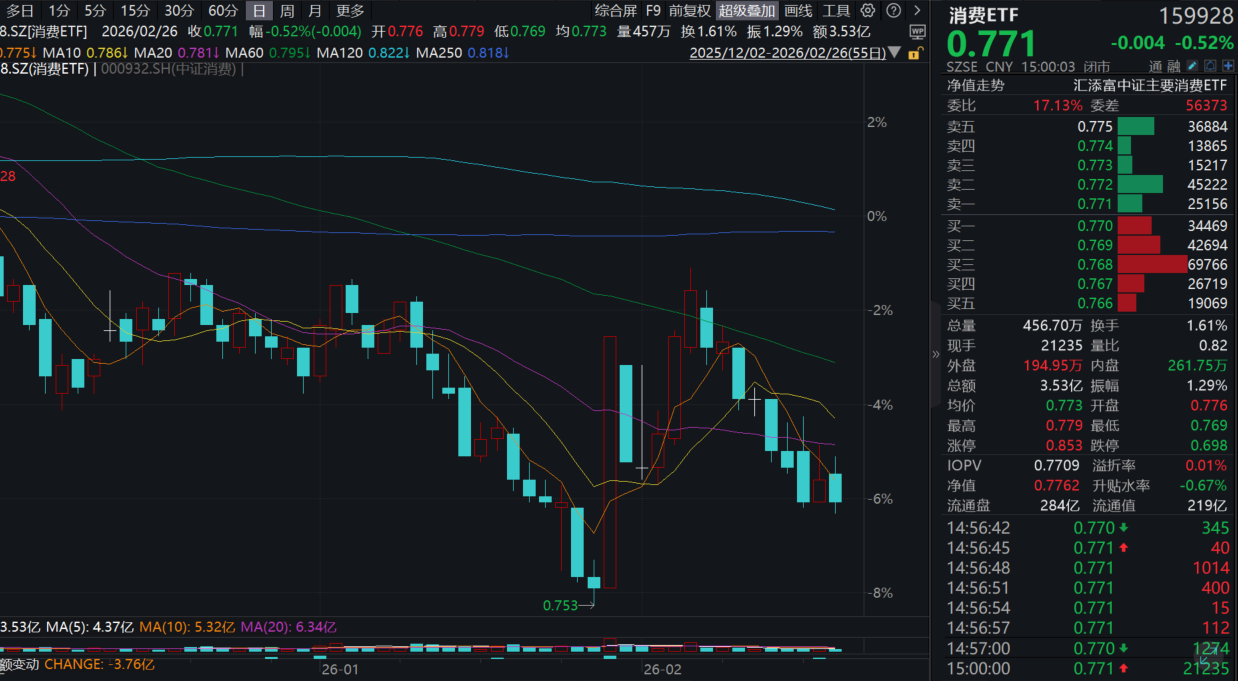
Group 1 - The A-share market is experiencing a narrow consolidation, with the leading consumption ETF (159928) declining by 0.52% and a total trading volume exceeding 350 million yuan, while net inflows over the past 60 days have surpassed 2.1 billion yuan [1] - The Shanghai government has introduced new real estate policies, reducing the social security requirement for non-local residents to purchase homes within the outer ring from 3 years to 1 year, and allowing families with a residence permit for 5 years to buy one property without social security [3] - During the recent Spring Festival, there were reports of shortages of premium liquor, with some distributors indicating that they could not meet demand, leading to an increase in prices instead of the usual post-holiday decline [3] Group 2 - The Spring Festival has seen a significant recovery in restaurant consumption, with key retail and restaurant enterprises reporting a daily sales increase of 5.7% year-on-year, and foot traffic in 78 key pedestrian streets rising by 6.7% [5] - The demand for dining experiences during the holiday surged, with Meituan's New Year's Eve dinner reservations increasing by 105% and Douyin's group purchases rising by 185%, indicating strong consumer vitality [5] - The frozen food and seasoning sectors are benefiting from the recovery in restaurant consumption, with B-end product sales increasing due to the resurgence of dining scenes during the Spring Festival [6] Group 3 - The overall consumption trend during the Spring Festival aligns with expectations, showing a division between material and service consumption, with emotional consumption demonstrating resilience [7] - The consumption ETF (159928) is characterized by its essential and domestic demand attributes, showing significant profitability resilience across economic cycles, with the top ten constituent stocks accounting for over 68.55% of the index [8] - The restaurant supply chain is expected to see improvements in inventory and sales, driven by the strong performance of downstream dining consumption, which is likely to enhance the profitability of leading companies in the sector [6][7]







放弃传统广告?联合利华 CEO 宣判「大品牌传播时代终结」
Jing Ji Guan Cha Bao· 2026-02-26 08:48
Core Viewpoint - The era of traditional big brand advertising is over, and brands must now rely on a multitude of smaller voices to build influence in a fragmented media environment [1][2] Group 1: New Marketing Model - Unilever's CEO, Fernando Fernandez, introduced the "social-first demand model," emphasizing collaboration with a large number of content creators to enhance brand presence [1][3] - The company collaborates with approximately 180,000 content creators in its Beauty & Wellbeing division, and nearly 300,000 at the group level, leveraging AI to double posting frequency and improve content production [1][3] - The marketing strategy has shifted from producing a few major ads to a continuous flow of diverse content, reflecting the need for brands to adapt to changing consumer behaviors and media landscapes [1][2] Group 2: Implementation and Success - The Dove brand exemplifies the successful application of this model, with content output in the U.S. increasing threefold and creator partnerships also doubling over the past two years [3][4] - This approach has led to stable community interactions on social platforms, supporting business growth for brands that prioritize values and authentic expression [3][4] Group 3: Strategic Risks - Unilever's challenge lies in applying a strategy that has proven effective for specific categories, like personal care, to its diverse portfolio of 400 brands, which may not all benefit from a content-driven approach [4][5] - The risk of adopting a one-size-fits-all strategy could lead to ineffective marketing for brands that do not align with the social-first model [5][8] Group 4: Marketing Balance - Despite the shift towards social media, Unilever continues to allocate 16% of its revenue, approximately $9 billion, to traditional brand and marketing efforts, indicating that social-first does not equate to the death of brand advertising [6][7] - The company still invests significantly in large-scale advertising, such as sponsoring major events like the FIFA World Cup, which emphasizes the importance of broad reach in brand communication [6][7] Group 5: Strategic Flexibility - The real challenge for Unilever is not whether to engage in social media, but rather to exhibit strategic patience and organizational flexibility to allow each of its 400 brands to find their unique growth paths [8][9] - A successful marketing strategy should not enforce a uniform approach across all brands but should allow for diverse growth strategies tailored to individual brand needs [8][9]

品牌传播模式的转型与挑战:联合利华的社交优先战略
Jing Ji Guan Cha Wang· 2026-02-26 08:42
Core Insights - The era of relying on large budgets for annual advertising campaigns to define brands is over, as highlighted by Unilever's CEO Fernando Fernandez at the New York Consumer Analyst Group conference [1] - The shift towards a "social-first demand model" is being fully promoted within Unilever, emphasizing the need for brands to create resonance through numerous small and dispersed touchpoints in a fragmented media environment [1][2] - Traditional marketing methods are criticized as "lazy marketing," and modern marketing requires continuous content production and rapid market response [1][2] Group 1: Social-First Strategy - Unilever's U.S. President, Hirish Patel, exemplified the "social-first" approach using the Dove brand, which has tripled its content output and creator collaborations in the U.S. over the past two years [2] - The strategy is summarized as "sow—ignite—amplify," starting with community engagement on platforms like Reddit, followed by topic ignition on TikTok, and finally integrating online and offline channels for business growth [2] - Unilever plans to increase social media investment from 30% to 50%, aiming to replace traditional centralized advertising with distributed expressions from thousands of creators [2][3] Group 2: Challenges and Limitations - The challenge lies in applying the successful Dove model across Unilever's diverse portfolio of over 400 brands, as not all brands may fit the "social-first" strategy [2][4] - Many products, especially in food and household cleaning, lack the social engagement potential, which could lead to resource misallocation if all brands are forced into a "social-first" framework [4] - Despite increasing social media investment, Unilever still allocates about 16% of its revenue (up to $9 billion) to traditional brand and marketing activities, indicating a continued reliance on traditional media [4][5] Group 3: Marketing Dynamics - The shift to a "social-first" strategy does not eliminate the need for traditional mass media, which remains crucial for reaching new customers and achieving brand growth [5][6] - Historical patterns show that previous strategies, like the push for social missions, faced challenges when applied uniformly across brands, suggesting a risk of oversimplification in the current "social-first" approach [6][7] - The essence of effective brand management lies in allowing different brands within the same group to pursue distinct growth paths based on their unique characteristics and market relationships [6][7] Group 4: Strategic Outlook - The transition to a social-first model is a strategic upgrade for Unilever, responding to significant changes in the media landscape while injecting urgency and innovation into the company [6][7] - The real challenge for Unilever is not whether to adopt social strategies, but rather to maintain strategic patience and organizational flexibility to allow each brand to find its optimal growth path [7] - A successful brand communication strategy in a fragmented era requires a diverse, adaptable, and differentiated approach rather than a one-size-fits-all solution [7]
“乐购新春”消费补贴、以旧换新置换补贴等政策持续发力,聚焦港股通消费ETF华夏(513230)布局窗口
Mei Ri Jing Ji Xin Wen· 2026-02-26 08:22
Group 1 - The core viewpoint of the news highlights the positive impact of the "zero tariff" policy on imported goods for Hainan's residents during the Spring Festival, leading to an expected retail sales total of 3.49 billion yuan, a year-on-year increase of 2.6% [1] - During the Spring Festival holiday, the total sales of duty-free shops reached 1.206 billion yuan, reflecting a year-on-year growth of 12.7% [1] - The consumption structure shows a recovery trend, particularly in the catering sector, driven by extended holiday periods and various consumer subsidies, which have positively influenced dining and travel data [1] Group 2 - The food and beverage ETF (515170) tracks the China Securities Index for the food sector, covering leading companies in liquor, dairy, condiments, beer, and soft drinks [2] - The consumption ETF (510630) follows the main consumption industry index, providing balanced coverage of sub-sectors such as liquor, dairy, condiments, soft drinks, and beer [2] - The tourism ETF (562510) tracks the detailed tourism index, focusing on service consumption, including duty-free, airlines, and hotel dining sectors [2]
开年以来港股IPO市场火爆,募资总额同比大增10倍
Shen Zhen Shang Bao· 2026-02-26 06:44
Group 1 - The Hong Kong IPO market has shown a strong performance in 2026, with 24 companies listed by February 26, raising a total of 892.26 million HKD, a significant increase of over 10 times compared to the same period last year [1][2] - The surge in IPO activity is attributed to multiple factors, including policy benefits, financing needs, and global expansion, with the Hong Kong Stock Exchange (HKEX) implementing reforms to lower barriers for technology companies [2][3] - Emerging industries, particularly in sectors like semiconductors, software services, and pharmaceuticals, have become the main contributors to the IPO market, with the top five sectors by fundraising amount being semiconductors, food and beverage, software services, machinery, and consumer discretionary [2][3] Group 2 - Among the listed companies, Muyuan Foods raised the highest amount at 106.84 million HKD, followed by Dongpeng Beverage at 101.41 million HKD, and Lianqi Technology at 80.99 million HKD [3] - The "A+H" listing model continues to play a significant role, with 10 new stocks adopting this model, accounting for over 40% of the IPOs in the early part of 2026 [3] - The market is expanding to include international companies, with over 10 foreign firms, primarily from Southeast Asia, in the queue for listing, enhancing Hong Kong's position as a capital hub connecting China and the global market [3][4]


课堂到上市企业: 湖工学子的“新春职场成长课”
Chang Jiang Shang Bao· 2026-02-26 06:33
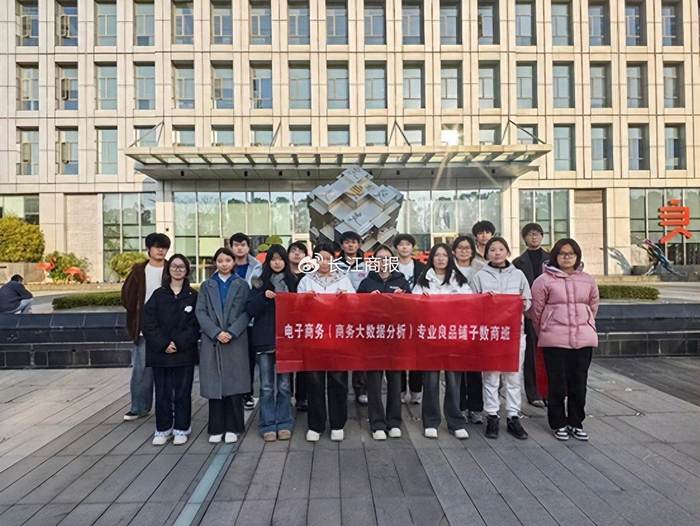
Core Insights - The article highlights the practical training experience of students from Hubei University of Technology during their winter break, emphasizing the importance of hands-on learning in the e-commerce sector [1][2]. Group 1: Student Experience - A team of 40 students, led by Wang Xinxin, engaged in a paid internship at the headquarters of a listed company, Liangpinpuzi, from January 8 to February 13, foregoing their winter holiday to gain practical experience [1][2]. - The internship involved mastering various operational systems and customer service skills, with students facing challenges such as high-pressure work environments and the need for effective team coordination [2][4]. Group 2: Educational Reform - Hubei University of Technology has implemented a short-term practical education reform since 2014, allowing students to participate in practical activities during winter and summer breaks, which has become a distinctive feature of the university's talent cultivation [5][6]. - The short-term practice program includes a "two-three-seven" model, covering social practice, internships, and technological innovation, and has evolved over 12 years to enhance student skills and career readiness [5][6]. Group 3: Industry Collaboration - The collaboration between the university and companies like Liangpinpuzi is crucial for providing students with targeted practical platforms and mentorship, ensuring a direct connection between classroom learning and workplace requirements [6]. - Over 408,000 student participations in short-term practices have been recorded, with a satisfaction rate exceeding 90% among graduates, indicating the effectiveness of the program in preparing students for their careers [6].

长城基金汪立:关注内需价值、新兴科技、大金融三大方向
Xin Lang Cai Jing· 2026-02-26 04:48
Core Viewpoint - The A-share market is expected to stabilize and rebound, supported by multiple positive factors including declining risk-free rates, comprehensive domestic demand policies, and improving export expectations [1][4]. Group 1: Market Conditions - The A-share market welcomed a "good start" with all three major indices opening higher on the first trading day after the holiday [1][4]. - Factors supporting the market include a decline in risk-free rates and ongoing capital market reforms, which create a favorable liquidity environment for A-shares [1][4]. - Domestic demand policies are being prioritized, with expectations for traditional domestic demand sectors to gradually improve, supported by both policy and fundamental factors [1][4]. Group 2: Economic Outlook - The outlook for China's economy in 2026 is expected to improve significantly, driven by breakthroughs in domestic new technology industries and accelerated globalization [1][4]. - The focus of economic work is shifting towards domestic demand, with expectations of recovery in consumption, rising prices, and stabilization in the real estate sector [1][4]. Group 3: Investment Strategies - Emerging technology is identified as a key investment theme, with value stocks also expected to see a resurgence [1][4]. - Specific sectors to focus on include consumer services, food and beverage, and building materials within the domestic demand space, as well as internet, media, computing, robotics, electronics, and military industries in the emerging technology sector [2][5]. - The financial sector, particularly brokerage and insurance, is highlighted as a stabilizing force in the market, benefiting from the ongoing growth in wealth management demand [2][6].
运动赛道分化加剧:始祖鸟们狂奔,耐克们承压丨消费参考
2 1 Shi Ji Jing Ji Bao Dao· 2026-02-26 04:45
Core Insights - The outdoor sports market is experiencing increasing polarization, with companies like Amer Sports showing significant growth while others like Li Ning and Anta are struggling [1][3][5]. Financial Performance - Amer Sports reported a 27% year-on-year revenue increase to $6.566 billion for the fiscal year ending December 31, 2025, with adjusted net profit rising to $545 million from $236 million in 2024 [1][2]. - In Q4 2025, Amer Sports' revenue grew by 28% to $2.101 billion, with adjusted net profit reaching $176 million, up from $90 million in the same quarter of 2024 [2]. - The Greater China region was a key growth driver for Amer Sports, with annual revenue increasing by 43.4% to $1.86 billion, and Q4 growth reaching 41.8% [2]. Market Comparison - In contrast, Li Ning's sales in Q4 2025 showed a low single-digit decline across all channels, with offline retail and wholesale channels experiencing mid-single-digit declines [3]. - Anta's main brand retail revenue also saw a low single-digit decline, while Nike's sales in China dropped by 16% to $1.423 billion [4]. Market Dynamics - The disparity in performance between Amer Sports and its competitors may be attributed to the resilience of the high-end consumer market, represented by brands like Arc'teryx, compared to the mid-range market [5]. - The outdoor sports market is perceived to have substantial growth potential, prompting increased investments from competitors like Nike and Li Ning in this segment [6][7].

运动赛道分化加剧:始祖鸟们狂奔 耐克们承压丨消费参考
2 1 Shi Ji Jing Ji Bao Dao· 2026-02-26 04:43
Group 1: Performance of Amer Sports - Amer Sports reported a revenue increase of 27% to $6.566 billion for the fiscal year ending December 31, 2025, with adjusted net profit rising to $545 million from $236 million in 2024 [1] - In Q4 2025, Amer Sports' revenue grew by 28% to $2.101 billion, with adjusted net profit reaching $176 million compared to $90 million in the same period of 2024 [1] - The Greater China region was a significant growth driver, with annual revenue increasing by 43.4% to $1.86 billion and Q4 growth reaching 41.8% [1] Group 2: Comparison with Competitors - In contrast, Li Ning's sales in Q4 2025 showed a low single-digit decline across all channels, with offline channels experiencing a mid-single-digit decline [2] - Anta's main brand retail revenue also saw a low single-digit decline, while Nike's sales in China dropped by 16% to $1.423 billion [2] - The performance disparity may indicate that the high-end market, represented by brands like Arc'teryx, is more resilient compared to the mid-range market [3] Group 3: Market Trends and Competition - The outdoor sports market is perceived to have significant growth potential, prompting brands like Nike and Li Ning to increase their investments in this sector [4] - The competitive landscape in the domestic outdoor market is expected to intensify as major brands expand their presence [5]




中国必选消费品2月价格报告:高端白酒批价环比回升,液态奶与调味品折扣减小
Haitong Securities International· 2026-02-26 03:03
Investment Rating - The investment rating for the consumer staples sector in China is "Outperform" for multiple companies including Moutai, Wuliangye, and others [1]. Core Insights - Premium baijiu wholesale prices have rebounded month-on-month, while discounts on liquid milk and condiments have narrowed [1][11]. - The report highlights the resilience of consumer stocks amidst a volatile market, emphasizing their value [3]. Summary by Relevant Sections Baijiu Pricing - Moutai's wholesale prices for Feitian (case and single bottle) are 1700 and 1650 yuan respectively, with month-on-month increases of +100 and +70 yuan. Year-to-date changes are +100 and +60 yuan, but year-on-year changes are -530 and -560 yuan [10][40]. - Wuliangye's eighth-generation price remains stable at 830 yuan, with a year-to-date increase of +10 yuan and a year-on-year decrease of -105 yuan [4][40]. - Luzhou Laojiao's Guojiao 1573 price is 870 yuan, up by +20 yuan month-on-month and +20 yuan year-to-date, with a year-on-year increase of +10 yuan [4][40]. - Other notable prices include Shanxi Fenjiu and various products from Yanghe and Gujing Gongjiu, showing mixed trends in pricing [10][40]. Discounts on Consumer Products - Discounts on liquid milk products have decreased from an average of 62.8% to 61.4% and from 63.4% to 61.7% for median values [19][37]. - Discounts on condiments have also narrowed from 87.1% to 85.0% (average) and from 88.2% to 84.9% (median) [19][37]. - Conversely, discounts on convenience foods have slightly increased, with average discounts moving from 94.8% to 94.6% [20][37]. - Beer, soft drinks, and infant formula discounts have remained stable, with slight variations in average and median rates [21][38].