
创新药

Search documents
ETF日报:随着反内卷政策的实质性落地以及AI算力对能源需求的拉动 光伏行业有望迎来“量利齐升”的修复周期
Xin Lang Cai Jing· 2026-02-02 23:19
Market Overview - The A-share market experienced a significant decline, with the Shanghai Composite Index dropping 2.48% to 4015.75 points and the Shenzhen Component Index falling 2.69% to 13824.35 points, as trading volume reached 2.6 trillion yuan, slightly lower than the previous day [1] - The market sentiment was negatively impacted by the nomination of Kevin Warsh as the next Federal Reserve Chairman, raising concerns about prolonged high interest rates and a notable drop in risk appetite [1] Pharmaceutical and Biotech Sector - The pharmaceutical and biotech sector demonstrated strong capital attraction, with the Guotai Innovation Drug ETF (589720) seeing a net inflow of 667 million yuan over ten consecutive trading days [3][4] - Key mergers and acquisitions, such as China Biopharmaceutical's acquisition of Hejia Biotech for 1.2 billion yuan and Rongchang Biopharmaceutical's exclusive licensing agreement with AbbVie worth up to 650 million USD, have boosted market confidence and highlighted the global competitiveness of Chinese pharmaceutical companies [3][4] - The investment logic in the pharmaceutical sector is supported by "innovation realization" and "valuation recovery," as domestic innovative drugs enter a commercialization and internationalization phase [3][4] Solar Energy Sector - The solar energy sector saw a strong performance, with the solar industry index rising over 2% before retreating, driven by Tesla CEO Elon Musk's proposal for a "space solar" project [5][6] - The sector is transitioning from a "post-decline rebound" to a deeper "supply-demand pattern reshaping," with significant potential for Chinese solar companies due to their advantages in equipment and core material supply [5][6] - The solar industry has faced intense price competition, leading to significant losses for major players, but recent policies aimed at reducing competition and clearing out outdated capacity are expected to enhance market concentration and improve the profitability of leading firms [5][6] Electric Grid Sector - The electric grid sector is experiencing robust domestic demand, with transformer factories in regions like Guangdong and Jiangsu operating at full capacity, and significant investments expected from the State Grid Corporation [7][8] - Major electric grid equipment companies reported impressive earnings, with projected revenues of 21.205 billion yuan, a 37.18% increase year-on-year, and net profits of 3.163 billion yuan, up 54.35% from the previous year [7][8] - The global energy transition is driving demand for electric grid construction, particularly in underdeveloped regions, presenting substantial growth opportunities for domestic electric grid companies [7][8] Precious Metals Sector - The precious metals sector, particularly gold, is undergoing significant volatility, with COMEX gold prices dropping below 4500 [9][10] - Concerns over monetary policy tightening following Warsh's nomination have led to market sell-offs, exacerbated by high leverage and profit-taking after previous price surges [9][10] - Despite short-term adjustments, long-term support for gold prices remains due to expectations of Federal Reserve rate cuts and ongoing geopolitical tensions [9][10]

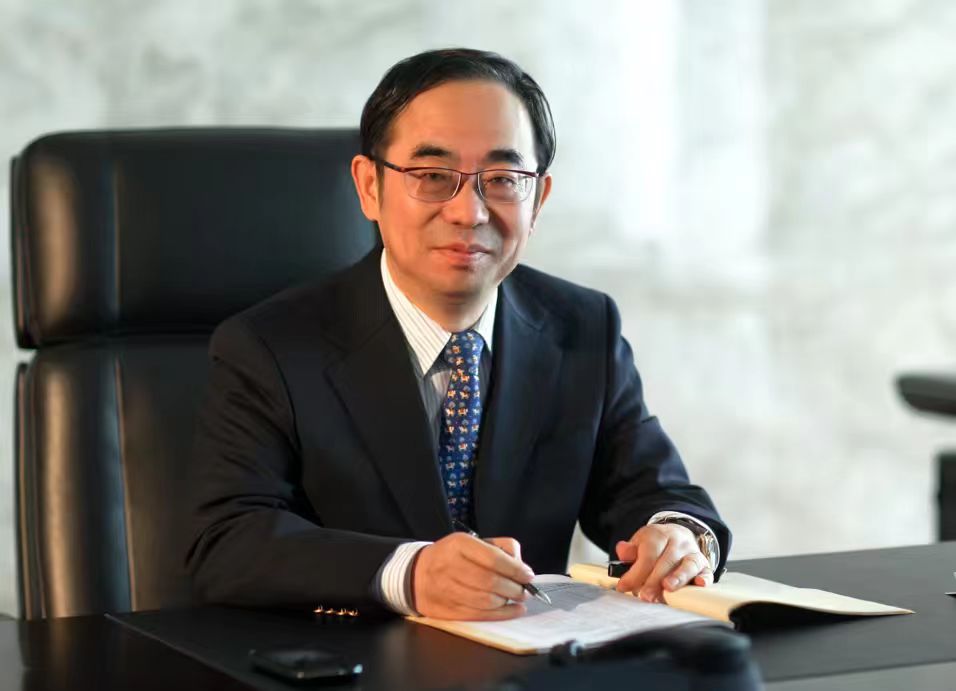
恒瑞医药孙飘扬:向新生长 逐梦前行|生物医药大健康2026思享汇
Jin Rong Jie· 2026-02-02 11:03
恒瑞医药董事长 孙飘扬 作为国内创新药龙头企业,恒瑞医药面对医药行业技术创新与同质化竞争并存的复杂局面,2025年在创新研发与国际拓展方面取得关键 突破,全年获批7款1类创新药,创新药上市总数达24款,并成功实现"A+H"双资本平台布局。2026年,恒瑞医药董事长孙飘扬表 示:"要持续加大研发投入,聚焦肿瘤、自免、代谢疾病等重点领域,进一步构筑'新、特、快'产品核心优势,深化ADC、双抗等技术平 台建设,催生更多差异化创新成果,解决未获满足的临床需求。"同时通过强化全球临床布局与商业化能力,系统推动中国创新药在国 际市场的价值实现,以可持续的创新生态助力健康中国建设。 背景介绍: 当2025年的日历翻至末页,生物医药产业正站在一个特殊的历史节点——这既是"十四五"的收官沉淀之年,更是"十五五"宏伟蓝图的启 航之时。这一年,技术狂飙与商业理性的碰撞、全球化布局与本土化深耕的平衡、"创新驱动"向"价值驱动"的范式转型,共同勾勒出 2025年的行业主线。2026年,产业如何跨越技术周期与资本周期的双重考验,在"健康中国"战略与全球创新格局双轨并行中,探寻可持 续增长路径?思享启发思想,"生物医药大健康2026思享汇 ...

告别“裸泳”,港股开启创新药IPO盛宴
Sou Hu Cai Jing· 2026-02-02 10:17
Core Insights - The Hong Kong stock market is experiencing a new wave of IPOs for innovative drug companies, marking a shift from the previous hype-driven valuations to a more rational, results-oriented approach [1][4] - The current IPO participants are more diverse, including biotech firms and those pursuing dual listings or spin-offs [1][4] Group 1: IPO Activity - As of January, seven innovative drug companies have submitted IPO applications to the Hong Kong Stock Exchange, including companies like Boryung Biopharma and Xiansheng Zaiming [5] - Two companies, Precision Medical and Rebio Biotech, have successfully listed, raising over 4 billion yuan in total [6] - The choice of Hong Kong for listing is influenced by the fact that many companies are still in the loss-making stage, aligning with the HKEX's 18A/18C rules for unprofitable tech firms [6] Group 2: Financial Performance and Valuation - DiZhe Pharmaceutical, which is already listed on the STAR Market, aims for a dual listing and has a market cap exceeding 25 billion yuan, with a revenue of 586 million yuan in the first three quarters of 2025, reflecting a growth of over 70% [6] - Despite significant revenue growth, DiZhe reported a net loss of 580 million yuan, indicating ongoing challenges in profitability and cash flow [6] - Other companies like Zailing Biotech and Yinuo Micro have also attracted significant investments, with post-financing valuations of 3.41 billion yuan and 485 million USD, respectively [7] Group 3: Market Evolution - The previous IPO wave from 2018 to 2021 was characterized by speculative investments, leading to a high failure rate among newly listed companies, with a 15% and nearly 80% failure rate in 2020 and 2021, respectively [8][9] - The current IPO landscape shows a shift towards companies with more advanced clinical data and a focus on technology platforms, moving away from mere story-driven valuations [11] - The new IPOs are primarily backed by teams with international experience and robust ownership structures, enhancing their appeal to investors [12] Group 4: Unique Listing Strategies - This round of IPOs includes unique strategies such as dual listings and spin-offs, exemplified by DiZhe Pharmaceutical and Xiansheng Zaiming [13][14] - DiZhe has seen significant insider selling during its fundraising period, indicating a mix of personal financial needs and tax considerations [13] - Xiansheng Zaiming is in a high-investment phase, with over 1.5 billion yuan allocated for R&D in 2023 and 2024, reflecting a post-financing valuation exceeding 8.5 billion yuan [14]
盘点:成都1月重要投融资事件及产业环境数据汇总
Sou Hu Cai Jing· 2026-02-02 10:05
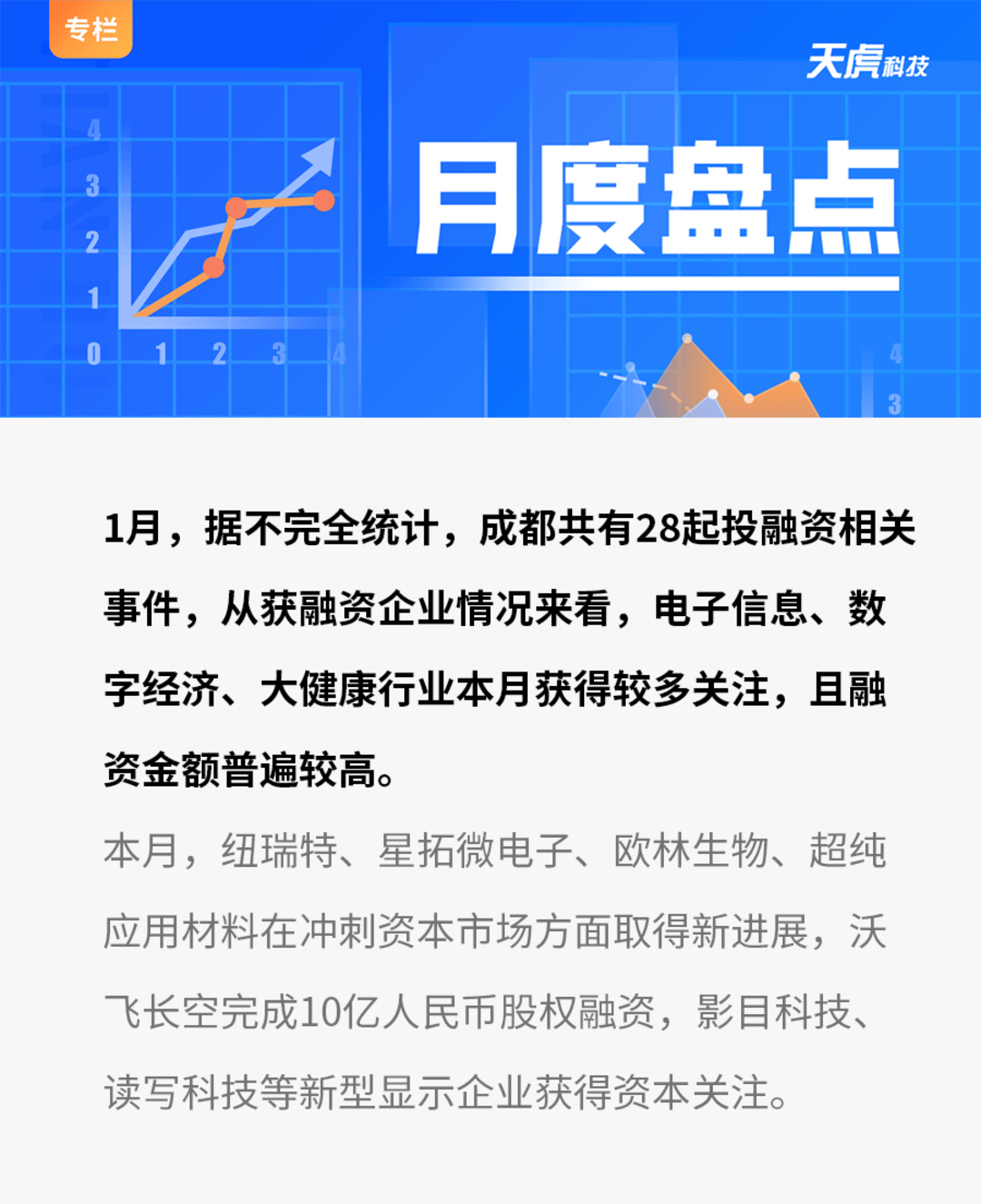
Core Insights - In January, Chengdu recorded 28 investment events related to technology innovation and entrepreneurship, with data sourced from public disclosures and institutional information [2] Group 1: Investment Events - Chengdu Yongzhi Technology completed an undisclosed equity financing round, focusing on intelligent computing infrastructure technology [5] - Chengdu Dianke Guoxin Technology completed an undisclosed equity financing round, specializing in microwave and millimeter-wave integrated circuits [6] - Chengdu Tiancheng Electric Technology completed an undisclosed equity financing round, focusing on miniaturized and low-cost millimeter-wave micro-systems [7] - Chengdu Xingtuo Microelectronics completed a C round financing of several hundred million RMB, aimed at high-performance interconnect chip development [9] - Chengdu Huayuan Technology completed a C1 round financing, becoming a notable player in the AI+AR smart glasses sector with nearly 500 million RMB raised over the past year [12] - Chengdu Weirui Network Technology completed approximately 100 million RMB in A round financing, focusing on high-end CT tube development [23] Group 2: Industry Focus - The electronic information sector was the most active, with 10 investment events, while the health sector followed closely with 9 events, indicating a strong interest in these industries [4] - 35% of the financed projects were related to the electronic information industry ecosystem, while 32% were linked to the health industry ecosystem [4] Group 3: Company Developments - Chengdu NiuRuiTe Medical Technology initiated IPO counseling, focusing on medical isotopes and drug innovation [30] - Chengdu Xingtuo Microelectronics completed IPO counseling registration, specializing in interconnect chip solutions [31] - Chengdu Olin Biotechnology submitted listing materials to the Hong Kong Stock Exchange, focusing on human vaccine development [32] - Chengdu Super Pure Application Materials' IPO application was accepted, aiming to raise 1.124 billion RMB for semiconductor equipment [33] - Chengdu Xinyi Technology is set to be acquired by Blue Arrow Electronics, with a valuation of up to 675 million RMB [34]
金鹰基金:外围扰动引发市场情绪回落 短期震荡为后续主线重聚提供条件
Xin Lang Cai Jing· 2026-02-02 09:41
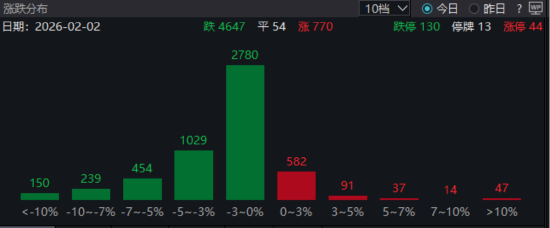
Market Overview - All three major indices closed lower, with the Shanghai Composite Index down 2.48% to 4015 points and the ChiNext Index down 2.46%. The Hang Seng Index also saw a significant decline, closing down 2.92% [1][8] - Trading volume in the two markets decreased, remaining around 2.6 trillion [1][8] - Among the 31 primary industries, all except food and beverage and banking sectors experienced declines, with 4647 out of over 5300 stocks falling, indicating poor profitability [1][8] External Factors - The precious metals market experienced a sharp decline, impacting market sentiment and contributing to the A-share market's pullback. This was influenced by the nomination of Kevin Warsh as the next Federal Reserve Chairman, who advocates for a "balance sheet reduction + interest rate cut" policy [2][9] - Following Warsh's announcement, the US dollar index rose while gold and silver prices plummeted, with silver dropping 26%, marking its largest historical decline, and gold falling 9%, the worst single-day performance in nearly a decade [2][9] Internal Dynamics - Since mid-December, the index has risen rapidly due to improved liquidity and risk appetite, moving from around 3800 points to near 4200 points. This led to structural opportunities and accelerated sector rotation [3][10] - As uncertainty increased, market sensitivity heightened, prompting a shift from "increasing positions" to "realizing profits and reducing exposure," resulting in a net outflow of funds and overall market pressure [3][11] Future Outlook - The market is expected to focus on signs of economic recovery and the unfolding of the spring market, with a potential "second wave" of spring activity anticipated in February [4][11] - Historical data suggests a higher success rate for A-shares in February, particularly for small-cap growth stocks, which typically perform well in the week leading up to the Spring Festival [4][11] Sector Allocation - A balanced approach is recommended to navigate rapid rotations, with a focus on technology sectors supported by performance, such as AI applications, overseas computing power, storage, and wind energy storage [5][12] - For value investments, attention should be given to upstream commodities, which may benefit from geopolitical adjustments and potential mid-term recovery in manufacturing and real estate sectors [6][12]
创新药ETF国泰(517110)回调近3%,中国原料药企业竞争优势有望继续强化,回调或可布局
Mei Ri Jing Ji Xin Wen· 2026-02-02 08:17
Core Viewpoint - The recent decline of nearly 3% in the Cathay Innovation Drug ETF (517110) presents a potential opportunity for investment in Chinese raw material pharmaceutical companies, which are expected to strengthen their competitive advantages [1]. Industry Summary - China's pharmaceutical and healthcare product export value is projected to grow by 3.14% by 2025, with a slight decrease of 0.27% in the export value of Western medicine raw materials [1]. - The stability in raw material drug exports reflects the competitiveness of China's raw material pharmaceutical industry amidst global trade changes and internal price competition [1]. - The outlook for 2026 indicates continued uncertainty in raw material trade, driven by price competition and advancements in synthetic biology and new production technologies that lower unit costs [1]. - Upgrades in technology are enhancing the global competitiveness of Chinese raw material pharmaceutical companies [1]. - A trend of supply clearing is ongoing, with some product prices continuing to decline; however, the potential for significant further price drops is limited compared to historical averages [1]. - Price competition pressures are beginning to impact the profits of leading companies [1]. - The competitive advantages of Chinese raw material pharmaceutical companies are expected to strengthen by 2026, with some product prices having likely bottomed out, leading to potential price recovery due to changes in competitive dynamics and production capacity utilization [1]. Company Summary - The Cathay Innovation Drug ETF (517110) tracks the SHS Innovation Drug Index (931409), which focuses on publicly listed companies engaged in the research, production, and sales of innovative drugs in the Shanghai, Shenzhen, and Hong Kong markets [1].
一家上海大模型公司, B+ 轮融了50亿丨投融周报
投中网· 2026-02-02 07:33
Key Insights - The article highlights the ongoing investment trends in various sectors, particularly in hard technology and healthcare, with significant funding rounds reported for several companies [4][5][26][27]. Group 1: Hard Technology - The semiconductor sector remains a hot investment area, with韬润半导体 completing a new round of financing worth several hundred million yuan, led by熙诚金睿 and supported by multiple institutions [4][16]. - 润芯微科技, a provider of smart base solutions, announced nearly 400 million yuan in B+ round financing, with participation from various state-owned and industrial capital [4][22]. - 中茵微电子 secured several hundred million yuan in C round financing, led by京投公司 and other investors [11]. Group 2: Healthcare - 新景智源, focused on TCR-T immunotherapy for solid tumors, completed over 200 million yuan in B round financing, led by杏泽资本 and a well-known industrial fund [4][26]. - 纽欧申医药, specializing in CNS treatments, raised several million dollars in A+ round financing, led by礼来亚洲基金 [4][28]. - 弼领生物 raised over 200 million yuan in B round financing, with participation from宏诚投资 and other investors [4][27]. Group 3: Internet and AI - Mindverse, a Personal Intelligence company, completed a Pre-A round financing exceeding 20 million USD, led by蚂蚁集团 and supported by红杉中国 [5][33]. - ThetaWave AI, an AI content company, secured several million USD in Pre-A round financing, with investments from BAI Capital and高瓴创投 [5][35]. -阶跃星辰, a startup in the large model space, completed over 5 billion yuan in B+ round financing, with participation from various institutional investors [32]. Group 4: Other Notable Financing -挪瓦咖啡 completed a C round financing worth several hundred million yuan, with investments from multiple prominent institutions [7]. -英汉思动力 announced consecutive financing rounds exceeding 100 million yuan, led by红杉中国 and other investors [8]. -DeepWay raised 1.177 billion yuan in Pre-IPO financing, led by普华资本 and supported by various investors [15].

港股科技ETF(513020)回调超4%,AI需求指引持续好转利好港股科技板块,回调或可布局
Mei Ri Jing Ji Xin Wen· 2026-02-02 06:57
Group 1 - The core viewpoint of the article highlights that the Hong Kong technology ETF (513020) has experienced a pullback of over 4%, but the ongoing improvement in AI demand guidance is favorable for the Hong Kong technology sector, suggesting that this pullback may present a buying opportunity [1] - According to Zhongtai Securities, AI concept stocks are performing actively due to advancements in chips, indicating the sustained attractiveness of AI as a long-term driving force [1] - The Hong Kong technology ETF tracks the Hong Kong Stock Connect Technology Index (931573), which encompasses core assets in sectors such as internet, semiconductors, innovative pharmaceuticals, and new energy vehicles, reflecting the diversified characteristics of the technology industry and the overall performance of core technology companies in the Hong Kong market [1] Group 2 - The Hong Kong Stock Connect Technology Index has a higher allocation in new energy vehicles, innovative pharmaceuticals, and semiconductors compared to the Hang Seng Technology Index, and from the base date at the end of 2014 to the end of 2025, it has achieved a cumulative return of 224.25%, outperforming the Hang Seng Technology Index (83.87%) by over 140% [1] - The long-term performance of the Hong Kong Stock Connect Technology Index has surpassed that of similar indices, including the Hang Seng Technology Index, the Shanghai-Hong Kong-Shenzhen Internet Index, and the Hang Seng Healthcare Index [1]
港股主题基金,密集申报!“科技牛”将向港股辐射?
券商中国· 2026-02-02 02:53
Core Viewpoint - The Hong Kong stock market, represented by the Hang Seng Index, has shown a significant upward trend, breaking through last year's peak and reaching a four-year high, indicating a positive market sentiment and potential investment opportunities [1]. Group 1: Fund Activity and Market Sentiment - Multiple public funds are actively launching Hong Kong-themed products, reflecting a strong bullish sentiment towards Hong Kong stocks. The valuation advantage and "cost-performance" ratio are key factors driving fund managers' optimism [2][3]. - In 2026, 39 Hong Kong-themed funds have been registered, including ETFs and actively managed products focusing on sectors like technology, consumer goods, and healthcare [3]. - Recent fund launches have seen high demand, with several funds closing their subscriptions early due to overwhelming interest, indicating a strong appetite for Hong Kong equities [4]. Group 2: Market Dynamics and Comparisons with A-shares - Despite a 27% increase in the Hang Seng Index in 2025, the market experienced volatility, with significant fluctuations throughout the year. The current low valuation levels present a compelling investment opportunity [5][6]. - The disparity between Hong Kong and A-share markets is attributed to differing market focuses, with A-shares benefiting from sectors like AI and semiconductors, while Hong Kong's strengths lie in internet, biotech, and high-dividend financials [6]. - The liquidity environment is also a factor, with A-shares enjoying robust domestic liquidity, while Hong Kong's market relies more on global capital flows, which have been less favorable recently [6]. Group 3: Future Outlook and Structural Changes - The recent strengthening of the offshore RMB and the global shift towards non-USD assets are expected to enhance the attractiveness of Hong Kong stocks to foreign investors, potentially increasing capital inflows [7]. - The market structure in Hong Kong is shifting from a focus on financials and real estate to "hard technology, biotech, and new consumption," aligning with national policy directions and creating new investment opportunities [7][8]. - The current market is transitioning from broad-based gains to a more quality-driven, structural market, with significant opportunities in sectors like innovative pharmaceuticals and semiconductors [7].

中国手术机器人行业近况更新
2026-02-02 02:22
Summary of Key Points from Conference Call Records Industry Overview - **Surgical Robot Industry**: The Chinese surgical robot industry is experiencing rapid development, supported by national policies and capital investment. Key technological advancements include remote operation, miniaturization, and AI assistance. The market for laparoscopic surgical robots is projected to reach 40.543 billion yuan by 2033, with a CAGR of 28.7% from 2024 to 2033 [doc id='21'][doc id='19']. Core Insights and Arguments - **Investment Opportunities in Innovative Drugs and CRO**: Despite past challenges, investment activity in innovative drugs and Contract Research Organizations (CRO) is expected to rise significantly. Business development (BD) amounts are anticipated to reach new highs, with companies like Rongchuang and Shiyao achieving attractive upfront payment ratios [doc id='3'][doc id='4']. - **Medical Device Sector Recovery**: The medical device sector is nearing the end of its inventory destocking phase, with performance expected to improve gradually in 2026. The resumption of procurement rhythms and an increase in bidding volumes are noted trends [doc id='5']. - **IVD Sector Outlook**: The In Vitro Diagnostics (IVD) sector is expected to face pressure in 2025, but conditions are projected to improve in 2026 as pricing pressures ease and policies are fully implemented [doc id='8'][doc id='9']. - **Traditional Chinese Medicine (TCM) Recovery**: The TCM sector is anticipated to bottom out in Q2 2026, with a potential recovery in 2027 driven by policy support and demand resurgence [doc id='10']. Additional Important Insights - **AI Medical and Brain-Computer Interface Technologies**: AI in healthcare is crucial for enhancing productivity, though its commercialization path remains uncertain. The brain-computer interface sector shows promise but also faces commercialization challenges [doc id='6']. - **CRO Sector Performance**: The CRO sector is showing strong order and operational performance, with companies like Kanglong Huacheng making significant progress in commercial production [doc id='11']. - **Market Dynamics for Surgical Robots**: The market for surgical robots is transitioning from an introduction phase to a growth phase, with increasing sales but slower revenue growth, indicating a structural transformation [doc id='19']. - **Regulatory Developments**: The National Medical Insurance Administration's guidelines are expected to accelerate the clinical application of surgical robots by establishing legitimate billing items [doc id='19']. Company-Specific Highlights - **Shiyao Group and AstraZeneca Collaboration**: The collaboration in the weight loss and metabolism field has set historical highs for upfront payments and total package amounts, although the overall sentiment in the sector remains subdued [doc id='7']. - **Kanglong Huacheng's Growth**: The company is expected to see a significant increase in order retention rates with the launch of its Shaoxing Phase II project, enhancing its competitive position in the CRO market [doc id='12']. - **Emerging Companies**: Companies like Tianyu and Starly are projected to enter performance inflection points this year, with significant growth potential in the raw material pharmaceutical sector [doc id='13'][doc id='14']. This summary encapsulates the key points from the conference call records, highlighting the current state and future outlook of various sectors within the healthcare and pharmaceutical industries in China.
