
金融市场

Search documents
标普500指数跌0.38%,道指跌267点跌幅0.6%,纳指跌84点跌幅0.4%;费城半导体指数几乎完全回吐日内稍早涨幅。白宫国家经济委员会主任凯文·哈塞特宣称,大量协议的接近达成,只是在等待(美国总统特朗普)敲定关税税率而已。
news flash· 2025-07-29 19:51
Market Performance - The S&P 500 index fell by 0.38% [1] - The Dow Jones Industrial Average decreased by 267 points, a decline of 0.6% [1] - The Nasdaq Composite dropped by 84 points, down 0.4% [1] - The Philadelphia Semiconductor Index nearly completely reversed earlier gains [1] Economic Commentary - Kevin Hassett, Director of the White House National Economic Council, stated that a large number of agreements are close to being finalized, pending the determination of tariff rates by President Trump [1]
债市周历
Shang Hai Zheng Quan Bao· 2025-07-29 17:53
Core Viewpoint - The data indicates a significant variation in the issuance of government bonds and credit bonds over the specified dates, reflecting market conditions and investor sentiment [1] Group 1: Government Bond Issuance - On July 30, 20 government bonds were issued totaling 103.4 billion yuan, while on July 31, only 2 bonds were issued amounting to 438.0 billion yuan, and on August 1, 2 bonds were issued for 1800.0 billion yuan [1] Group 2: Credit Bond Issuance - The issuance of credit bonds showed a decline from 35 bonds worth 151.9 billion yuan on July 30 to 27 bonds worth 68.8 billion yuan on July 31, followed by a notable increase to 11 bonds worth 229.0 billion yuan on August 1 [1] Group 3: Interbank Certificates and Market Operations - The data on interbank certificates indicates that on July 30, 1505 million yuan of 7-day reverse repos matured, with 3310 million yuan maturing on July 31, and a substantial 7893 million yuan maturing on August 1. Additionally, 7000 million yuan of 91-day buyout reverse repos also matured [1]
美国股指期货略微走高 市场焦点转向经济数据和美联储
news flash· 2025-07-29 12:33
Core Viewpoint - US stock index futures are slightly higher as market focus shifts to economic data and the Federal Reserve [1] Group 1: Market Performance - S&P 500 index futures rose by 0.3%, reaching a new record high [1] - Nasdaq 100 index futures increased by 0.5% [1] - Dow Jones futures gained 0.1% [1] Group 2: Economic Indicators - The US dollar index reached a five-week high, driven by market speculation that economic data will show the impact of tariffs is under control [1] - Investors are shifting their attention from recent trade agreements with the EU and Japan to key indicators covering employment, inflation, and broader economic activity [1] Group 3: Federal Reserve and Earnings Reports - The Federal Reserve is expected to maintain interest rates at its upcoming meeting [1] - Investors are closely watching earnings reports from major tech companies scheduled for release this week [1] Group 4: Market Sentiment - Recent progress in trade negotiations with key partners like Japan and the EU has provided some clarity for businesses [1] - This clarity allows investors to refocus on other topics such as corporate earnings and market fundamentals [1]
【日报】欧盟让步承诺导致欧元下跌 国际金价震荡收跌
Sou Hu Cai Jing· 2025-07-29 08:08
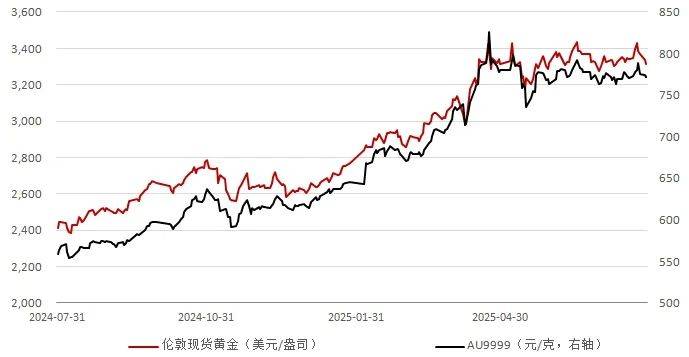
Group 1: International Gold Market - International gold price fluctuated and closed down at $3314.18 per ounce, with a high of $3345.35 and a low of $3301.47 during the trading day [1][9] - The COMEX gold futures closed at $3314.00 per ounce [9] - SPDR Gold ETF holdings stood at 956.23 tons [9][10] Group 2: Currency and Monetary Policy - The People's Bank of China conducted a 7-day reverse repurchase operation of 495.8 billion yuan, resulting in a net injection of 325.1 billion yuan after 170.7 billion yuan matured [2][10] - The onshore RMB closed at 7.1729 against the USD, down 50 basis points from the previous trading day, with the USD index rising by 1.02% to 98.6694 [15][2] Group 3: Macro Events and Trade Agreements - Trump announced that the U.S. will soon impose tariffs on pharmaceuticals, with global tariffs expected to be around 15-20% [2][17] - The EU and U.S. have established a general framework for a trade agreement, but specific details, including those related to alcoholic beverages, are still under negotiation [2][17] - The trade agreement includes a $750 billion energy purchase commitment and a $600 billion investment commitment from the EU, which may increase energy costs in Europe and accelerate capital outflow, negatively impacting the European economy [2][17] Group 4: Stock Market Performance - U.S. major stock indices showed mixed results, with the Dow down 0.14% at 44,837.56 points, S&P 500 up 0.02% at 6,389.77 points, and Nasdaq up 0.33% at 21,178.58 points [16] - Chinese A-shares saw gains, with the Shanghai Composite Index up 0.12% and the Shenzhen Component Index up 0.44% [16]

罗思义:美元低迷就是总统执政失败,特朗普能否打破魔咒?
Sou Hu Cai Jing· 2025-07-29 00:46
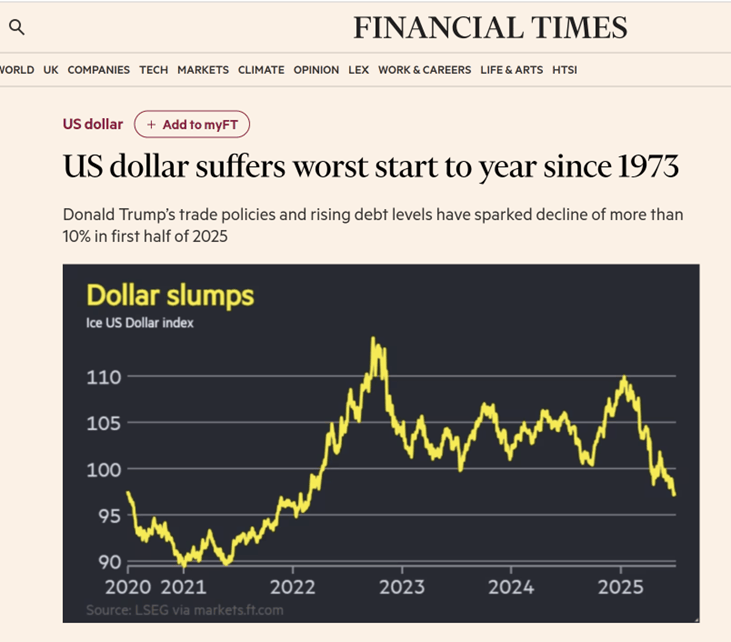
Group 1 - The core argument of the articles is that while Trump's tariff policies have led to some market volatility, the overall impact on the U.S. economy has been limited and within the normal range of economic fluctuations [1][3][4] - Analysts have differing views on the implications of Trump's policies, with some predicting significant economic turmoil while others argue that the changes are part of a normal economic cycle [3][4] - The success of Trump's economic policies hinges more on political factors rather than purely economic ones, as they aim to overturn decades of established trade policies [2][5] Group 2 - The analysis highlights that the S&P 500 index rose by 11.8% from April 1 to July 18, 2025, indicating a recovery and resilience in the market despite initial concerns [4] - The U.S. 10-year Treasury yield decreased from a peak of 4.61% on May 21 to 4.42% by July 18, suggesting a stabilization in the bond market [4] - The articles emphasize that while the tariff policies and a declining dollar may alter trade dynamics, they do not necessarily correlate with a significant downturn in U.S. economic growth [5][13] Group 3 - Trump's administration has seen the dollar experience its fastest decline since 1973, which is viewed as a strategic move to enhance U.S. competitiveness in global markets [6][10] - The combination of tariff measures and dollar depreciation has led to an estimated 25% increase in the average price of imported goods within six months [11][13] - The articles suggest that while the trade geography of the U.S. may change significantly, the overall economic slowdown is driven by different underlying economic forces [13]
宏观周报 (7月21日-27日):反内卷成为重要交易线索-20250727
Yin He Zheng Quan· 2025-07-27 08:06
Domestic Macro - Demand Side - As of July 24, 2023, the retail sales of passenger cars in China reached 978,000 units, a year-on-year increase of 9.0%, but a month-on-month decrease of 15.2%[2] - Subway passenger volume growth in July was 0.36% year-on-year and 4.31% month-on-month, indicating sustained travel demand[2] Domestic Macro - Production Side - By July 26, 2023, the average operating rate of blast furnaces decreased by 0.27 percentage points to 83.38%, while the operating rate of coke ovens fell by 0.77 percentage points to 73.11%[3] - The operating rate of semi-steel tires dropped by 3.25 percentage points to 73.8% year-on-year, reflecting the impact of anti-involution policies[3] Price Performance - As of July 25, 2023, the average wholesale price of pork increased by 0.35% week-on-week, while the average wholesale price of 28 monitored vegetables rose by 0.27%[4] - The price of eggs surged by 5.56% week-on-week due to seasonal demand from summer tourism and early Mid-Autumn Festival preparations[4] International Macro - The U.S. employment market remains stable, with initial jobless claims dropping to 217,000, alleviating concerns about rising unemployment rates[9] - The U.S. PMI for manufacturing in July was 49.5, below the expected 52.7, indicating a contraction in manufacturing activity[9] Policy and Market Trends - The yield on 30-year government bonds rose to 1.95%, while the yield on 10-year bonds reached 1.7%, indicating a significant adjustment in the bond market[1] - The Baltic Dry Index (BDI) averaged 1763.8 in July, reflecting a 5.3% month-on-month increase but a 7.8% year-on-year decline, indicating fluctuating shipping demand[2]
日本的骚操作连川普都惊呆了,原来日本的关税不是谈下来的
Sou Hu Cai Jing· 2025-07-26 15:55
Core Viewpoint - Japan has spent $550 billion to buy U.S. tariffs, resulting in a mere 15% reduction in tariffs, raising questions about the implications for global trade dynamics and U.S. economic policy [3][5][6] Group 1: Economic Implications - The transaction reflects a shift from traditional diplomatic negotiations to a cash-based approach in tariff discussions, potentially altering global trade rules [5][6] - If other countries follow Japan's lead and attempt to buy tariffs, it could transform the U.S. into a marketplace for tariffs, raising concerns about the future of international trade agreements [5][6][7] Group 2: Historical Context - This is not the first instance of Japan engaging in significant financial maneuvers to secure trade advantages; a similar situation occurred in 1985 with the Plaza Accord [3][6] - Japan's economic strength allows it to undertake such large expenditures, which may not be feasible for other nations lacking similar financial resources [6][7] Group 3: U.S. Trade Strategy - Trump's suggestion to allow other countries to purchase tariffs indicates a potential shift in U.S. trade strategy, emphasizing financial transactions over traditional negotiation methods [5][6] - The approach raises concerns about the sustainability of global economic order and the reliance on financial power in trade negotiations [6][7]
中国持续抛售美债,全球金融格局震荡,美国盟友态度动摇
Sou Hu Cai Jing· 2025-07-26 06:05
Group 1 - China has significantly reduced its holdings of US Treasury bonds, dropping from $1 trillion in 2022 to $756.3 billion by May 2024, marking the lowest level since 2009 [3][4] - The reduction in US Treasury holdings includes a sell-off of $173.2 billion in 2022, $50.8 billion in 2023, and $57.3 billion in 2024, indicating a trend of "liquidation" [3][4] - The shift in China's investment strategy is driven by concerns over the volatility of the US dollar and a desire to reduce dependency on it, while simultaneously increasing gold reserves to 2,296 tons by May 2024 [4][10] Group 2 - Other countries are also reducing their US Treasury holdings, with Saudi Arabia decreasing from $116 billion in 2016 to $80 billion in 2024, and Germany cutting $20 billion in the first quarter of 2024 [8][10] - The trend of "de-dollarization" is gaining momentum globally, with countries like Australia planning to reduce their US Treasury holdings from 60% to 50% over the next two years [8][10] - The global financial landscape is shifting, with non-dollar asset allocation rising to nearly 30% in 2024, more than doubling in five years, indicating a challenge to the dollar's dominance [12]

7.6万亿美元创新高!外资净增持中国股票101亿美元,扭转两年减持态势
Sou Hu Cai Jing· 2025-07-24 16:12
Group 1 - The foreign exchange market in China showed strong resilience and vitality in the first half of 2025, with cross-border income and expenditure reaching a historical high of 7.6 trillion USD, a year-on-year increase of 10.4% [1] - There was a net inflow of 127.3 billion USD in cross-border funds, with a significant quarter-on-quarter growth of 46% in the second quarter [1] - The foreign exchange reserves remained stable at 33,174 billion USD by the end of June, with the RMB accounting for 53% of cross-border receipts and payments [1] Group 2 - Foreign investment in RMB-denominated bonds has increased, with foreign holdings exceeding 600 billion USD, indicating strong international interest in the RMB bond market [3] - In the stock market, foreign net purchases of domestic stocks and funds reached 10.1 billion USD in the first half of the year, reversing a two-year trend of net selling [3] - Notably, the net increase in foreign holdings in May and June alone was 18.8 billion USD, reflecting a renewed confidence among international investors in the Chinese stock market [3] Group 3 - The stable development of the economic fundamentals has created a favorable macro environment for foreign investment, with several international investment banks upgrading China's asset ratings from neutral to overweight [4] - High-quality development of the financial market has provided a conducive policy environment for foreign investment, enhancing the convenience of foreign participation in China's financial markets [4] - China's financial market system is comprehensive and deep, with both bond and stock market capitalizations ranking second globally, offering diverse investment options for foreign investors [4]

上半年外资净增持境内股票和基金101亿美元 扭转过去两年总体净减持态势 外汇局:外资配置人民币资产仍有增长空间
Shang Hai Zheng Quan Bao· 2025-07-22 18:16
Group 1 - The core viewpoint of the articles is that China's foreign exchange market performed better than expected in the first half of the year, with stable foreign capital allocation in RMB assets and a positive outlook for future investment [1][3][6] - The foreign exchange market showed strong resilience and vitality, with five key features: steady increase in foreign-related income and expenditure, continued net inflow of cross-border funds, basic balance in supply and demand, active market trading, and stable foreign exchange reserves [1][6] - The RMB exchange rate remained stable, appreciating by 1.9% against the USD in the first half of the year, fluctuating between 7.15 and 7.35, which helped stabilize the macro economy and international payments [1][6] Group 2 - Foreign capital's allocation in RMB assets is expected to have sustainable growth potential, with foreign holdings of domestic RMB bonds exceeding $600 billion, and a net increase of $10.1 billion in domestic stocks and funds in the first half of the year [3][4] - The international balance of payments is maintaining basic equilibrium, with a steady increase in the current account surplus and a corresponding financial account deficit, indicating a self-balancing pattern [2][6] - Three factors are expected to support the continued stable operation of the foreign exchange market: robust economic fundamentals, steady progress in opening up to the outside world, and enhanced resilience of the foreign exchange market [6][7]