商贸零售

Search documents
华金证券:12月A股可能震荡偏强 科技成长、部分周期和消费板块相对占优
Sou Hu Cai Jing· 2025-12-03 06:21
行业配置方面,该机构预计,在日历效应及美联储降息周期叠加影响下,12月科技成长、部分周期和消 费可能相对占优,建议继续均衡配置:一是政策和产业趋势向上的电子(半导体、AI硬件)、通信 (AI硬件)、传媒(AI应用、游戏)、计算机(AI应用)、电新(储能、锂电)、创新药、机械设备 (机器人)等行业;二是可能补涨和基本面可能边际改善的消费(食品、商贸零售等)、大金融、军工 (商业航天)等行业。 华金证券发布研报称,12月A股可能震荡偏强,上行趋势不变。理由在于,12月政策和外部事件可能偏 积极,流动性可能进一步宽松,且经济和企业盈利可能延续弱修复趋势。 上证报中国证券网讯(记者 严晓菲)华金证券发布研报称,12月A股可能震荡偏强,上行趋势不变。理 由在于,12月政策和外部事件可能偏积极,流动性可能进一步宽松,且经济和企业盈利可能延续弱修复 趋势。 ...
16个行业获融资净买入,汽车行业净买入金额最多
Zheng Quan Shi Bao Wang· 2025-12-03 02:21
Summary of Key Points Core Viewpoint - As of December 2, the market's latest financing balance reached 24,689.03 billion yuan, showing a day-on-day increase of 21.94 billion yuan, with 16 industries experiencing an increase in financing balance, particularly the automotive sector which saw the largest increase of 9.53 billion yuan [1]. Industry Analysis - **Industries with Increased Financing Balance**: - Automotive: 1,191.25 billion yuan, increased by 9.53 billion yuan, growth of 0.81% [1] - Communication: 1,135.14 billion yuan, increased by 6.03 billion yuan, growth of 0.53% [1] - National Defense and Military Industry: 818.49 billion yuan, increased by 5.98 billion yuan, growth of 0.74% [1] - Computer: 1,789.87 billion yuan, increased by 3.90 billion yuan, growth of 0.22% [1] - Environmental Protection: 192.18 billion yuan, increased by 1.79 billion yuan, growth of 0.94% [1] - **Industries with Decreased Financing Balance**: - Non-banking Financial: 1,859.55 billion yuan, decreased by 3.55 billion yuan, decline of 0.19% [2] - Public Utilities: 516.79 billion yuan, decreased by 3.55 billion yuan, decline of 0.68% [2] - Retail: 271.60 billion yuan, decreased by 2.15 billion yuan, decline of 0.79% [2] - Textile and Apparel: 80.87 billion yuan, decreased by 0.64 billion yuan, decline of 0.79% [2] - **Highest Growth Rates**: - Environmental Protection industry had the highest growth rate at 0.94% [1] - Other notable growth rates include Automotive (0.81%), Coal (0.77%), and National Defense and Military Industry (0.74%) [1] - **Significant Declines**: - The Textile and Apparel, Retail, and Public Utilities sectors experienced the most significant declines in financing balance, with respective decreases of 0.79%, 0.79%, and 0.68% [1][2]
商社美护行业周报:六部门印发促消费实施方案,周大福、六福集团10-11月同店数据亮眼-20251202
Guoyuan Securities· 2025-12-02 09:11
Investment Rating - The industry maintains a "Recommended" rating, focusing on new consumption sectors such as beauty care, IP derivatives, and gold jewelry [5][27]. Core Insights - The report highlights a significant increase in retail performance, with major sectors like retail, social services, and beauty care showing positive growth rates of +3.45%, +3.92%, and +0.50% respectively during the week of November 24-28, 2025 [14][22]. - The implementation plan by six departments aims to enhance the adaptability of supply and demand in consumer goods, targeting the formation of three trillion-level consumption fields and ten hundred-billion-level consumption hotspots by 2027 [3][22]. - Key companies such as Chow Tai Fook and Luk Fook have reported impressive same-store sales growth, with Chow Tai Fook's same-store sales in mainland China increasing by 38.8% from October 1 to November 18, 2025 [4][22]. Summary by Sections Market Performance - The report indicates that the retail, social services, and beauty care sectors ranked 9th, 6th, and 26th among 31 primary industries, with the Shanghai Composite Index rising by 1.40% and the Shenzhen Component Index by 3.56% during the same period [14][18]. Key Industry Events and Information - The report discusses various industry developments, including the registration of a new medical device by Jinbo Bio in the Philippines and the performance of travel company Tongcheng Travel, which reported a revenue of 5.509 billion yuan in Q3 2025, up 10.4% year-on-year [3][22]. - The release of "Zootopia 2" on November 26, 2025, achieved a record box office of 228 million yuan on its first day, indicating strong demand for related merchandise [3][22]. Investment Recommendations - The report recommends focusing on companies such as Shangmei Co., Ltd., Juzhi Bio, Marubi Biotechnology, Runben Co., Ltd., Proya, Chao Hong Ji, and Furuida, which are positioned well within the beauty care and new consumption sectors [5][27].
A股市场大势研判:A股全天震荡拉升,沪指重返3900点
Dongguan Securities· 2025-12-02 02:36
Market Overview - The A-share market experienced a rally, with the Shanghai Composite Index returning above 3900 points, closing at 3914.01, up 0.65% [1] - The Shenzhen Component Index and the ChiNext Index also saw significant gains, closing at 13146.72 (up 1.25%) and 3092.50 (up 1.31%) respectively [1] Sector Performance - The top-performing sectors included non-ferrous metals (up 2.85%), communication (up 2.81%), and electronics (up 1.58%) [2] - Conversely, the weakest sectors were agriculture, forestry, animal husbandry, and fishery (down 0.43%) and environmental protection (down 0.23%) [2] Concept Indexes - Notable concept indexes that performed well included smart speakers (up 3.71%) and AI mobile phones (up 3.39%) [2] - Underperforming concepts included horse racing (down 0.92%) and digital watermarking (down 0.75%) [2] Economic Indicators - The manufacturing PMI for November was reported at 49.2%, a slight increase of 0.2 percentage points from the previous month, indicating a modest improvement but still below the expansion threshold [4] - The non-manufacturing business activity index fell to 49.5%, marking the first contraction in three years, primarily due to seasonal effects and diminishing impacts from policy measures [4] Market Outlook - The report suggests that the domestic economic fundamentals are expected to gradually improve under a backdrop of policy support, aiming for a growth target of around 5% for the year [5] - Key upcoming events include the political bureau meeting and the central economic work conference in December, which will set the policy direction for 2026 [5] - A balanced allocation strategy is recommended, focusing on sectors such as non-ferrous metals, new energy, technology growth, and dividend stocks [5]
中银晨会聚焦-20251202
Bank of China Securities· 2025-12-02 01:27
Core Insights - The manufacturing PMI index for November is at 49.2%, showing a slight month-on-month increase of 0.2 percentage points, indicating a minor recovery within the contraction zone [6][7] - The new orders index for November is also at 49.2%, with a month-on-month increase of 0.4 percentage points, while the new export orders index rose by 1.7 percentage points to 47.6%, likely driven by the upcoming holiday shopping season [6][7] - The production index stands at 50.0%, reflecting a month-on-month increase of 0.3 percentage points, indicating stability at the threshold level [6][7] Macroeconomic Overview - Manufacturing purchasing and inventory intentions are still in the contraction zone, suggesting a need for further improvement in procurement sentiment [6][7] - Fixed asset investment projects, particularly in infrastructure and affordable housing, are expected to gain momentum towards the end of the year and the beginning of the next [6][7] Market Performance - The Shanghai Composite Index closed at 3914.01, up by 0.65%, while the Shenzhen Component Index rose by 1.25% to 13146.72 [3] - The performance of various industry indices shows that non-ferrous metals and telecommunications sectors led with increases of 2.85% and 2.81%, respectively, while agriculture and forestry sectors saw declines [4] Sector Analysis - The manufacturing sector's price index showed a recovery in November, with the main raw material purchase price index rising by 1.1 percentage points to 53.6%, indicating a high level of activity [7] - The equipment manufacturing and raw materials industries are sensitive to downstream fixed asset investments, with some signs of demand recovery in November [8]




12月1日沪深两市强势个股与概念板块
2 1 Shi Ji Jing Ji Bao Dao· 2025-12-01 12:00
一、强势个股 截至12月1日收盘,上证综指上涨0.65%,收于3914.01点,深证成指上涨1.25%,收于13146.72点,创业 板指上涨1.31%,收于3092.5点。今日沪深两市A股共计75只涨停,综合当前连板数以及当日龙虎榜数 据,其中较为强势的前三只个股分别为:国晟科技(603778)、实达集团(600734)与梅雁吉祥 (600868)。今日强势个股前10位具体数据见下表: | 代码 | 隋称 | 连板数 | 换手率(%) | 成交额 | 龙虎特净买入额 | 最高价是否创一年来新高 | 所属行业 | | --- | --- | --- | --- | --- | --- | --- | --- | | 603778 | 国演科技 | 16天11预 | 26.61 | 21.52亿元 | 2288.46万元 | 是 | 建筑装饰 | | 600734 | 实达集团 | 8天6板 | 29.32 | 33.47亿元 | 3.3亿元 | 종 | 通信 | | 600868 | 梅雁古祥 | 4天3板 | 10.3 | 7.51亿元 | 8099.93万元 | 是 | 公用事业 | | 600981 | ...


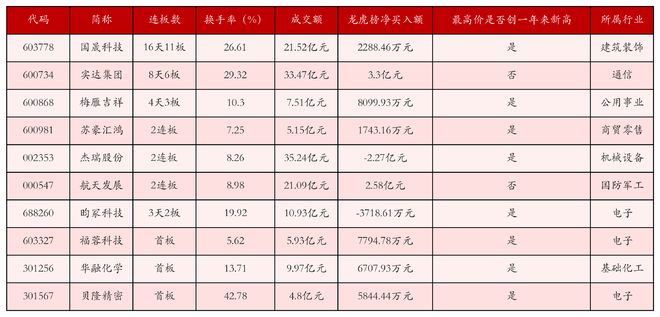
粤开市场日报-20251201
Yuekai Securities· 2025-12-01 07:54
Market Overview - The A-share market saw all major indices rise today, with the Shanghai Composite Index increasing by 0.65% to close at 3914.01 points, the Shenzhen Component Index rising by 1.25% to 13146.72 points, the STAR Market 50 Index up by 0.72% to 1336.76 points, and the ChiNext Index gaining 1.31% to 3092.50 points [1][14] - Overall, 3396 stocks rose while 1868 stocks fell, with a total trading volume of 18739 billion yuan, an increase of 2881 billion yuan compared to the previous trading day [1] Industry Performance - Among the Shenwan first-level industries, the top gainers included non-ferrous metals (up 2.85%), telecommunications (up 2.81%), electronics (up 1.58%), commercial retail (up 1.41%), and social services (up 1.35%). The only sectors that declined were agriculture, forestry, animal husbandry, and fishery (down 0.43%), environmental protection (down 0.23%), and real estate (down 0.06%) [1][14] Concept Sectors - The leading concept sectors with significant gains today included smart speakers, MCU chips, ice and snow tourism, photolithography machines, selected industrial metals, the Internet of Things, TWS headphones, GPUs, the SMIC industrial chain, rare earths, circuit boards, 6G, AI wearable devices, selected shipping, and AI mobile phones [2][11]
汇嘉时代精准切入即时零售 新疆商贸零售龙头本地化优势显著
Quan Jing Wang· 2025-12-01 05:41
Core Insights - The core viewpoint of the news is that Huijia Times has launched its first instant retail online supermarket, marking its entry into the instant retail sector and leveraging its local advantages to enhance market penetration [1][2]. Group 1: Company Strategy - Huijia Times has introduced its first instant retail online supermarket, Huijia Times Supermarket Zhongshan Road Store, which is available on major platforms like WeChat Mini Programs, Meituan Waimai, and Taobao Flash Purchase [1]. - The company aims to utilize its core stores to expand the instant retail model, enhancing its online shopping experience and integrating offline and online services [2]. - The supermarket's online platform has incorporated local adaptation advantages into its service radius, with different delivery ranges for various channels, ensuring efficient service delivery [3]. Group 2: Market Penetration Tactics - To quickly capture market share, Huijia Times has implemented attractive promotional strategies, including a free delivery threshold of 59 yuan and differentiated discounts for new and existing customers [4]. - The platform has launched over 3,000 SKUs, focusing on essential consumer goods like fresh produce and dairy products, ensuring high cost-performance ratios to meet daily purchasing needs [4]. - The multi-channel approach, utilizing WeChat Mini Programs, Meituan Waimai, and Taobao Flash Purchase, allows the company to leverage third-party traffic while building private domain traffic through its official platform [4]. Group 3: Industry Analysis - Industry analysis indicates that as competition in instant retail intensifies, regional retail companies will need to focus on local supply chain capabilities, fulfillment efficiency, and user operations [5]. - Huijia Times' move into instant retail not only reflects its digital transformation but also provides a reference path for other regional retail enterprises [5]. - Continued optimization of product structure, improvement of delivery times, and enhancement of membership operations could position Huijia Times as a leader in the local instant retail market [5].

今日沪指涨0.42% 有色金属行业涨幅最大
Zheng Quan Shi Bao Wang· 2025-12-01 04:35
证券时报·数据宝统计,截至上午收盘,今日沪指涨0.42%,A股成交量810.18亿股,成交金额12367.56 亿元,比上一个交易日增加26.14%。个股方面,3672只个股上涨,其中涨停66只,1592只个股下跌, 其中跌停5只。从申万行业来看,有色金属、通信、商贸零售等涨幅最大,涨幅分别为2.55%、2.51%、 1.46%;农林牧渔、银行、非银金融等跌幅最大,跌幅分别为0.39%、0.22%、0.21%。(数据宝) | 申万行业 | 行业涨跌(%) | 成交额(亿元) | 比上日(%) | 领涨(跌)股 | 涨跌幅(%) | | --- | --- | --- | --- | --- | --- | | 有色金属 | 2.55 | 934.05 | 83.34 | 亚太科技 | 10.06 | | 通信 | 2.51 | 981.99 | 34.40 | 广和通 | 20.01 | | 商贸零售 | 1.46 | 207.22 | 33.21 | 赫美集团 | 10.12 | | 社会服务 | 1.33 | 105.68 | 20.18 | 峨眉山A | 10.02 | | 国防军工 | 1.26 | ...



国信证券:2026年消费板块或迎来一定行情弹性 维持板块“优于大市”评级
智通财经网· 2025-12-01 03:31
Core Viewpoint - Guosen Securities maintains an "outperform" rating for the retail sector, anticipating potential market resilience in 2026 due to policy support and corporate improvements [1] 2025 Review - In the first nine months of 2025, China's retail sales reached 365.877 billion yuan, a year-on-year increase of 4.5%, with retail sales of non-automotive consumer goods growing by 4.9% [1] - Cosmetics sales increased by 3.9%, while gold and jewelry sales surged by 11.5% due to a low base last year and rising gold prices [1] - Cross-border e-commerce imports and exports amounted to approximately 2.06 trillion yuan, reflecting a 6.4% growth despite external tariff impacts [1] Structural Highlights - The consumption landscape in 2025 shows structural highlights in sectors like pets, trendy toys, personal care, and jewelry, driven by new consumer insights and product innovation [2] - The new consumption industry trends and the reversal expectations of traditional consumption are identified as two core themes, with initial positive market performance followed by a cooling phase [2] 2026 Outlook - New Market: Exploration of incremental growth opportunities in domestic markets and continued overseas expansion as a key strategy for Chinese brands [3] - New Demand: Insights into emerging consumer preferences will drive product innovation focused on emotional and practical value [3] - Platformization: In a competitive environment, companies need to develop platform mechanisms and explore new opportunities to ensure sustainable growth [3]