地产

Search documents
汽车下游充电服务扩张
Hua Tai Qi Huo· 2025-10-16 03:31
Report Summary 1. Industry Investment Rating There is no information about the industry investment rating in the provided content. 2. Core Viewpoints - The six - department plan aims to double the charging service capacity by the end of 2027, with 28 million charging facilities, over 300 million kilowatts of public charging capacity, and meeting the charging needs of over 80 million electric vehicles [1]. - In Q3 2025, the social financing scale increased strongly, with a cumulative increase of 30.09 trillion yuan, 4.42 trillion yuan more than the same period last year. As of the end of September, M2, RMB loans, and other financial data showed certain growth trends [1]. 3. Summary by Related Catalogs 3.1 Macro - economic and Policy - On October 15, six departments including the National Development and Reform Commission issued the "Three - year Doubling Action Plan for the Service Capacity of Electric Vehicle Charging Facilities (2025 - 2027)" [1]. - On October 15, the central bank released September financial data. As of the end of September 2025, the stock of social financing scale was 437.08 trillion yuan, a year - on - year increase of 8.7% [1]. 3.2 Upstream Industry - Non - ferrous metals: Copper and zinc prices continued to rise. On October 15, the spot price of copper was 85,410 yuan/ton, a year - on - year increase of 2.73%; the spot price of zinc was 22,000 yuan/ton, a year - on - year increase of 0.81% [2][35]. - Agriculture: The prices of eggs, palm oil, and corn declined. On October 15, the spot price of eggs was 5.9 yuan/kg, a year - on - year decrease of 6.79%; the spot price of palm oil was 9,362 yuan/ton, a year - on - year decrease of 2.46%; the spot price of corn was 2,185.7 yuan/ton, a year - on - year decrease of 2.30% [2][35]. 3.3 Mid - stream Industry - Chemical industry: The polyester start - up rate declined slightly, and the PTA start - up rate and other relevant data were also presented in the figures [2][3]. - Infrastructure: The asphalt start - up rate was at a three - year high [2]. 3.4 Downstream Industry - Real estate: The sales of commercial housing in second - and third - tier cities showed a slight recovery [2]. - Service industry: The number of domestic flights decreased slightly [2].
国信证券荀玉根:基本面或持续修复 科技股仍是市场主线
Zhong Guo Zheng Quan Bao· 2025-10-15 22:34
Group 1 - The core viewpoint is that the current economic improvement is expected to gradually spread across more industries, supported by macro policies and market sentiment, indicating potential for market growth [1] - The technology sector is identified as the main investment theme, driven by the AI wave, with historical examples showing significant profit growth in tech stocks during previous technological advancements [1] - The analysis highlights that from 2012 to 2015, the computer sector's net profit growth surged from 3% to 175%, and from 2019 to 2021, the electronics sector's net profit growth rebounded from -13% to 28% [1] Group 2 - The value sector is also noted for its investment potential, with expectations of a rotation in the market and potential for value stocks to catch up [2] - The real estate sector is highlighted as having low valuations after recent adjustments, with anticipated supportive policies likely to enhance recovery potential [2] - The brokerage sector is expected to benefit from increased market activity and financial innovation, leading to improved profitability [2] - The consumer sector, particularly the liquor industry, is seen as having high dividend yields and potential for growth due to the recovery of the stock market and increased consumer wealth [2]

国信证券荀玉根: 基本面或持续修复 科技股仍是市场主线
Zhong Guo Zheng Quan Bao· 2025-10-15 20:17
Core Viewpoint - The current economic fundamentals are showing signs of improvement, which is expected to gradually spread across more industries, supported by macro policies aimed at reducing competition and enhancing market sentiment [1] Group 1: Technology Sector - The technology sector is expected to remain the main focus of the market, driven by the AI wave that has opened up new growth opportunities across multiple industries since September 2024 [2] - Historical data shows significant profit growth in technology sectors during previous waves, such as the increase in net profit growth of the computer sector from 3% in Q1 2013 to 175% in Q1 2016 [2] - The outlook for the next year remains positive for the technology sector, particularly in AI applications [2] Group 2: Value Sector - The value sector is also seen as having investment potential, with expectations of a rotation in industries and potential for catch-up gains [2] - Three specific areas of focus within the value sector include real estate, brokerage firms, and consumer goods [3] Group 3: Real Estate Sector - The real estate sector has undergone significant adjustments and currently has low overall valuations, with expectations for more supportive policies to stabilize the market [3] - Low-valued real estate stocks are believed to have recovery potential [3] Group 4: Brokerage Sector - The brokerage sector is expected to benefit from a recovering market, with a noticeable increase in trading volume and a significant year-on-year rise in net profits [3] - Further market sentiment recovery could lead to increased trading volumes and enhanced profitability for brokerages [3] Group 5: Consumer Sector - The consumer sector, particularly the liquor industry, is highlighted for its potential, with the liquor index having declined for five consecutive years, leading to high dividend yields and improved cost-effectiveness [3] - The recovery in the stock market is anticipated to boost consumer spending, further supporting the upward movement of the consumer sector [3]
基本面或持续修复 科技股仍是市场主线
Zhong Guo Zheng Quan Bao· 2025-10-15 20:15
Group 1 - The core viewpoint is that the current economic improvement is expected to gradually expand across more industries, supported by macro policies and market sentiment, indicating potential for market growth [1] - The technology sector is identified as the main investment theme, driven by the AI wave, with historical examples showing significant profit growth in tech stocks during previous technological advancements [1] - The analysis highlights that from 2012 to 2015, the computer sector's net profit growth surged from 3% to 175%, and from 2019 to 2021, the electronics sector's net profit growth rebounded from -13% to 28% [1] Group 2 - The value sector is also noted for its investment potential, with expectations of a rotation in the market leading to opportunities for value stocks to catch up [2] - The real estate sector is highlighted as having low overall valuations after recent adjustments, with anticipated supportive policies expected to boost recovery [2] - The brokerage sector is expected to benefit from increased market activity and financial innovation, leading to a significant rise in net profits [2] - The consumer sector, particularly the liquor industry, is seen as having potential for growth due to high dividend yields and the positive impact of market recovery on consumer wealth [2]
国信证券首席策略分析师王开:长期看好科技成长板块 黄金仍具配置价值
Shang Hai Zheng Quan Bao· 2025-10-15 18:37
Core Viewpoint - The recent surge in the Shanghai Composite Index, surpassing 3900 points, indicates a significant increase in market activity, with a focus on the technology growth sector as the main theme of the current market cycle [1][2]. Industry Focus - The technology growth sector, particularly the AI computing industry chain, is expected to benefit from the global AI wave and domestic substitution, with upstream suppliers showing stronger logic than thematic stocks [1]. - Other technology sectors such as advanced manufacturing, new energy, and semiconductors may experience style rotation and periodic rebalancing within the growth sector [1]. - Low-valuation sectors like real estate, liquor, and brokerage are anticipated to benefit from improved policy environments and short-term capital drives in the fourth quarter [1]. Market Dynamics - The recent transitions in market leadership, such as Cambrian and Kweichow Moutai switching "king" titles, reflect a shift from traditional consumption to technology innovation-driven market characteristics [2]. - Investors are advised to adopt a balanced approach, seizing opportunities in both technology innovation and traditional sector valuation recovery [2]. Performance Metrics - The top four performing stocks in the computing sector and one in the electronics sector have contributed approximately 25% to the CSI 300 Index's gains this year, with the top 15 stocks accounting for half of the index's increase [3]. - The simultaneous rise of gold and the stock market indicates different underlying logics, with gold benefiting from global risk aversion and concerns over the Federal Reserve's independence, while the A-share market rises due to policy easing and industrial upgrades [3].
沪指重返3900点之际,逾70只基金十年仍亏钱、天治新消费混合亏53%
Sou Hu Cai Jing· 2025-10-15 09:55
Core Insights - The article highlights the significant performance disparity among public funds over the past decade, with some achieving returns exceeding 580% while others have lost over 55% [2][3] - The leading funds are primarily focused on technology and consumer sectors, while underperforming funds are heavily invested in traditional industries [2][6] - The importance of selecting the right funds is emphasized, as the difference in returns can exceed 600 percentage points for long-term investors [2] Performance Overview - As of October 14, 2023, 601 funds have achieved returns over 100% in the last ten years, with 42 funds exceeding 300% [3] - The top-performing fund, Huashang New Trend Preferred, has a return rate of 586.49%, followed by Huashang Advantage Industry A at 488.74% and Guotai Nasdaq 100 ETF at 487.37% [4][6] - Funds focused on technology and emerging industries, such as Dongwu Mobile Internet A and Xin'ao New Energy Industry A, have also shown strong performance, with returns exceeding 350% [6][7] Underperforming Funds - A total of 76 funds have recorded cumulative losses over the past decade, with 32 funds having returns below 20% [8] - The worst-performing fund, Tianzhi New Consumption, has a loss of 53.03%, while others like Fangzheng Fubon Innovation Power A and Morgan Consumption Pioneer have also seen significant declines [9][12] - Many underperforming funds are linked to sectors such as real estate, media, and traditional manufacturing, indicating a failure to adapt to structural market changes [12]


国泰海通:10月超配权益与黄金,标配债券
Ge Long Hui· 2025-10-15 03:57
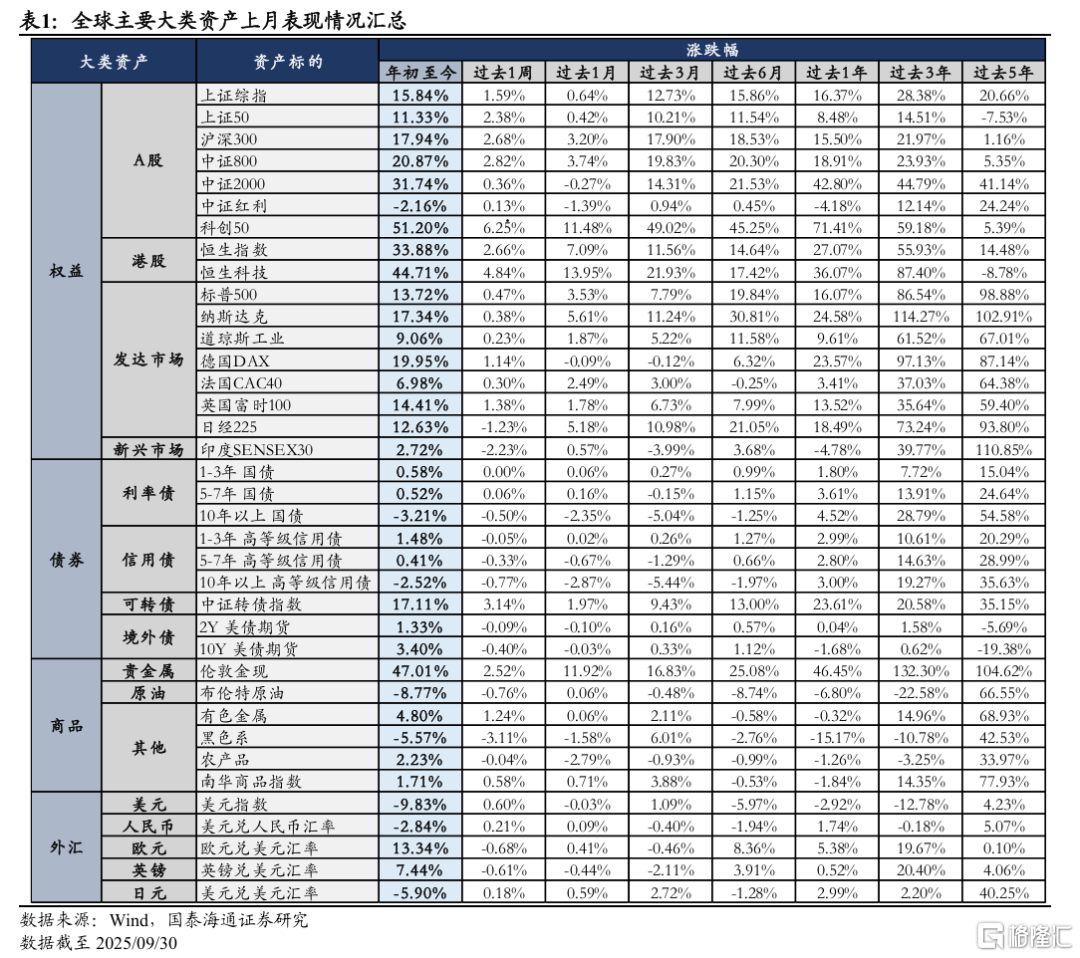
Core Viewpoint - The company has developed a "three-part" asset allocation framework consisting of Strategic Asset Allocation (SAA), Tactical Asset Allocation (TAA), and Major Event Review Adjustments to guide investment decisions. This framework aims to diversify macro risks, set long-term allocation benchmarks, and adjust based on short-term risk-return characteristics and significant events [1][10]. Group 1: Strategic Asset Allocation (SAA) - The SAA framework aims to mitigate macro risks by establishing a long-term allocation benchmark to ensure portfolio stability [1][10]. - The recommended asset allocation for October includes 41.25% in equities, 45% in bonds, and 13.75% in commodities, with specific allocations for A-shares, H-shares, and gold [1][2]. Group 2: Tactical Asset Allocation (TAA) - The TAA approach utilizes quantitative methods to identify assets with superior short-term risk-return characteristics, allowing for moderate adjustments to portfolio weights to enhance returns [1][10]. - The company remains optimistic about Chinese equities, suggesting an overweight position in A-shares and H-shares, while maintaining a neutral stance on bonds and a slightly optimistic view on commodities, particularly gold [2][3]. Group 3: Major Events Review - The company emphasizes the importance of subjective review of major events in conjunction with quantitative results to refine investment strategies, particularly in response to geopolitical uncertainties and market volatility [1][52]. - Recent events, such as the Chinese government's financial reforms and the U.S. Federal Reserve's interest rate adjustments, are expected to influence market dynamics positively, particularly for A-shares and gold [54]. Group 4: Performance Metrics - The performance of various asset classes has shown significant fluctuations, with notable increases in the Shanghai Composite Index and other Chinese indices over the past year, indicating a robust recovery in the equity market [6]. - The macro factor risk parity model has demonstrated effectiveness in enhancing returns while maintaining a balanced asset allocation, achieving an annualized return of 26.5% in 2025 with a Sharpe ratio of 2.59 [48][50].

万科A原总裁、CEO祝九胜已被采取刑事强制措施
Di Yi Cai Jing· 2025-10-14 11:22
祝九胜在1993年至2012年期间任职于中国建设银行股份有限公司深圳市分行,此后加入万科。2025年1 月,他已辞去万科董事、总裁、首席执行官等职务。 从多个信源获悉,万科A(000002.SZ)原总裁、CEO祝九胜已被采取刑事强制措施。 今年1月,媒体曾爆出祝九胜被带走调查的消息,当时他以更新朋友圈的方式对该消息作出回应。但多 位深圳地产业内人士表示,从那以后圈子里便极少听到他的消息。 ...

午评:沪指震荡涨0.21%,银行、酿酒等板块拉升,光伏产业链股活跃
Zheng Quan Shi Bao Wang· 2025-10-14 05:15
Core Viewpoint - The A-share market is experiencing fluctuations, with the ChiNext index dropping over 2% and the STAR 50 index nearly 3%, while the Shanghai Composite Index shows a slight increase of 0.21% [1] Market Performance - As of the midday close, the Shanghai Composite Index is at 3897.56 points, the Shenzhen Component Index has decreased by 1.02%, the ChiNext index has fallen by 2.24%, and the STAR 50 index has dropped by 2.84% [1] - The total trading volume across the Shanghai, Shenzhen, and North markets reached 1.6817 trillion yuan [1] Sector Analysis - The semiconductor sector is declining, while sectors such as insurance, coal, liquor, banking, oil, and real estate are seeing gains [1] - Gold concept stocks and the photovoltaic industry chain stocks are also active [1] Investment Strategy - Dongxing Securities indicates that the mid-term core trend of the A-share market remains unchanged, with limited impact from short-term external shocks [1] - The market is expected to maintain an upward trend as it consolidates around the 4000-point mark, with liquidity and the development of high-tech industries being the two core logical drivers [1] - The recommendation is to maintain confidence in the bull market and continue to favor the mid-term upward trend [1] Sector Allocation - The core position of the large technology sector is expected to remain stable, although short-term U.S.-China tensions may cause some disturbances for technology companies involved in overseas assets and supply chains [1] - Investors are advised to increase allocation to self-controlled sectors [1] - The cyclical sectors are still showing good prosperity and are suggested as one of the two core allocation lines, with a focus on military, pharmaceutical, and new energy industries [1] - High dividend yield stocks have become more attractive following a round of adjustments, making them a focus for conservative investors [1]
本次冲击或将小于“4·7行情”!把握黄金坑机会
Zheng Quan Shi Bao Wang· 2025-10-13 03:39
Group 1 - The traditional manufacturing sector in China is poised to benefit from the current geopolitical climate, as it can leverage its advantages to gain pricing power and move away from intense competition [2] - Recent export controls and licensing systems are aimed at protecting national interests and may help leading companies secure stable overseas market shares and better profitability [2] - The capital expenditure in traditional industries is showing signs of stabilization and recovery, providing a favorable environment for companies to improve their profit margins [2] Group 2 - External shocks leading to asset declines present a buying opportunity in the Chinese market, as the current trade risks are clearer compared to previous disruptions [3] - The demand for quality assets in China is surging, driven by the ongoing transformation of the economy and capital market reforms [3] - The focus remains on sectors that align with industrial development and stability, particularly in emerging technologies and cyclical finance [3] Group 3 - The market is expected to experience a short-term adjustment, but the overall resilience remains strong, with potential for new highs post-adjustment [5] - The current market conditions are more favorable than previous shocks, with investor sentiment and institutional support strengthening [5] - Key sectors to watch include military, semiconductors, and new consumption, which are positioned for marginal improvements [5] Group 4 - The core drivers of the current market rally remain unchanged, with a focus on medium to long-term policy expectations and liquidity trends [6] - Attention should be directed towards sectors with strong performance certainty, such as new productivity themes and large consumption [6] - Investment opportunities are identified in metals, agriculture, and energy sectors [6] Group 5 - The recent volatility in the technology sector is not expected to lead to significant long-term declines, as the market has learned from past experiences [7] - The focus should be on sectors that can benefit from domestic policies and self-sufficiency, including non-ferrous metals, banking, and agriculture [7] - Opportunities may arise from market corrections, particularly in sectors with strong growth potential [7] Group 6 - The mid-term outlook for A-shares remains optimistic despite external uncertainties, with a focus on traditional value sectors such as real estate and consumption [8] - The market is showing signs of a shift towards value-oriented investments, indicating a potential rebalancing of investment styles [8] - The gold market is expected to maintain a positive outlook, with no immediate signs of a peak [8] Group 7 - The current market environment is characterized by a lack of panic, suggesting that adjustments in global risk assets will be manageable [9] - The focus should be on domestic policies and the recovery of internal demand, which are expected to gain more attention in the market [9] - The recovery of manufacturing activities and investment acceleration are seen as key themes for future growth [9] Group 8 - The upcoming APEC summit is anticipated to be a significant event for potential shifts in the geopolitical landscape, impacting market sentiment [12] - The market is expected to respond positively to the stabilization of industry chains and economic resilience amid ongoing trade tensions [12] - Investment strategies should focus on sectors that align with anti-tariff measures and self-sufficiency, such as agriculture and military [12]