
软饮料

Search documents
黄金创4年来最大跌幅!白银跌8.17%,金店卖爆排长队
Sou Hu Cai Jing· 2025-10-22 03:27
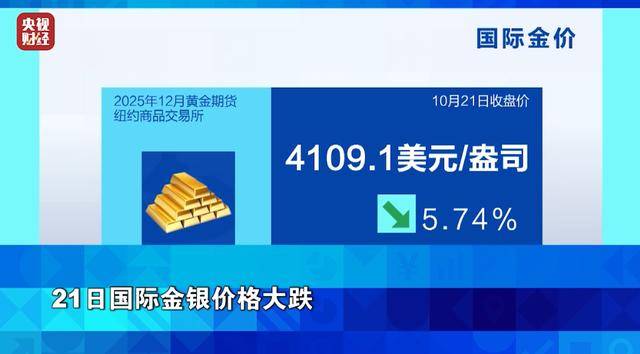
Group 1: Gold and Silver Market - International gold prices experienced a significant drop, with December gold futures closing at $4,109.1 per ounce, a decrease of 5.74% [3] - Silver prices also fell sharply, with December silver futures closing at $47.70 per ounce, down 7.16% [3] - The decline in gold prices was attributed to reduced market demand for safe-haven assets due to signs of easing global trade tensions and profit-taking ahead of the U.S. September CPI data [3] Group 2: Oil Market - International oil prices rose, with November light crude oil futures closing at $57.82 per barrel, an increase of 0.52% [6] - Brent crude oil futures for December delivery closed at $61.32 per barrel, up 0.51% [6] - The rise in oil prices was supported by a significant reduction in U.S. crude oil inventories, which fell by approximately 2.98 million barrels, exceeding expectations [6] Group 3: Company Earnings Reports - Coca-Cola reported a 30% year-over-year increase in net profit for Q3 2025, reaching $3.69 billion, driven by a 6% increase in product pricing [9] - Despite the positive earnings report, Coca-Cola's sales in North America and Latin America showed zero growth, indicating potential demand weakness in these key markets [9] - General Motors' adjusted EBIT fell by 18% year-over-year, but the results were better than analysts' concerns, leading to a 14.86% increase in GM's stock price following the earnings release [9] Group 4: European Stock Market - European stock indices collectively rose, driven by gains in military stocks, with the UK market up 0.25%, France up 0.64%, and Germany up 0.29% [11] - The CAC40 index in France reached a record closing high [11] Group 5: Gold Jewelry Demand - There was a surge in demand for gold jewelry, with reports of long queues at gold stores, indicating consumer enthusiasm despite falling gold prices [12][14] - The price of gold jewelry is closely tied to real-time gold prices, with significant increases noted in retail prices, such as a rise of 30 yuan per gram for Chow Tai Fook gold products [16]

金银遭遇重挫 疯狂走势接近尾声?
Hua Er Jie Jian Wen· 2025-10-22 02:35
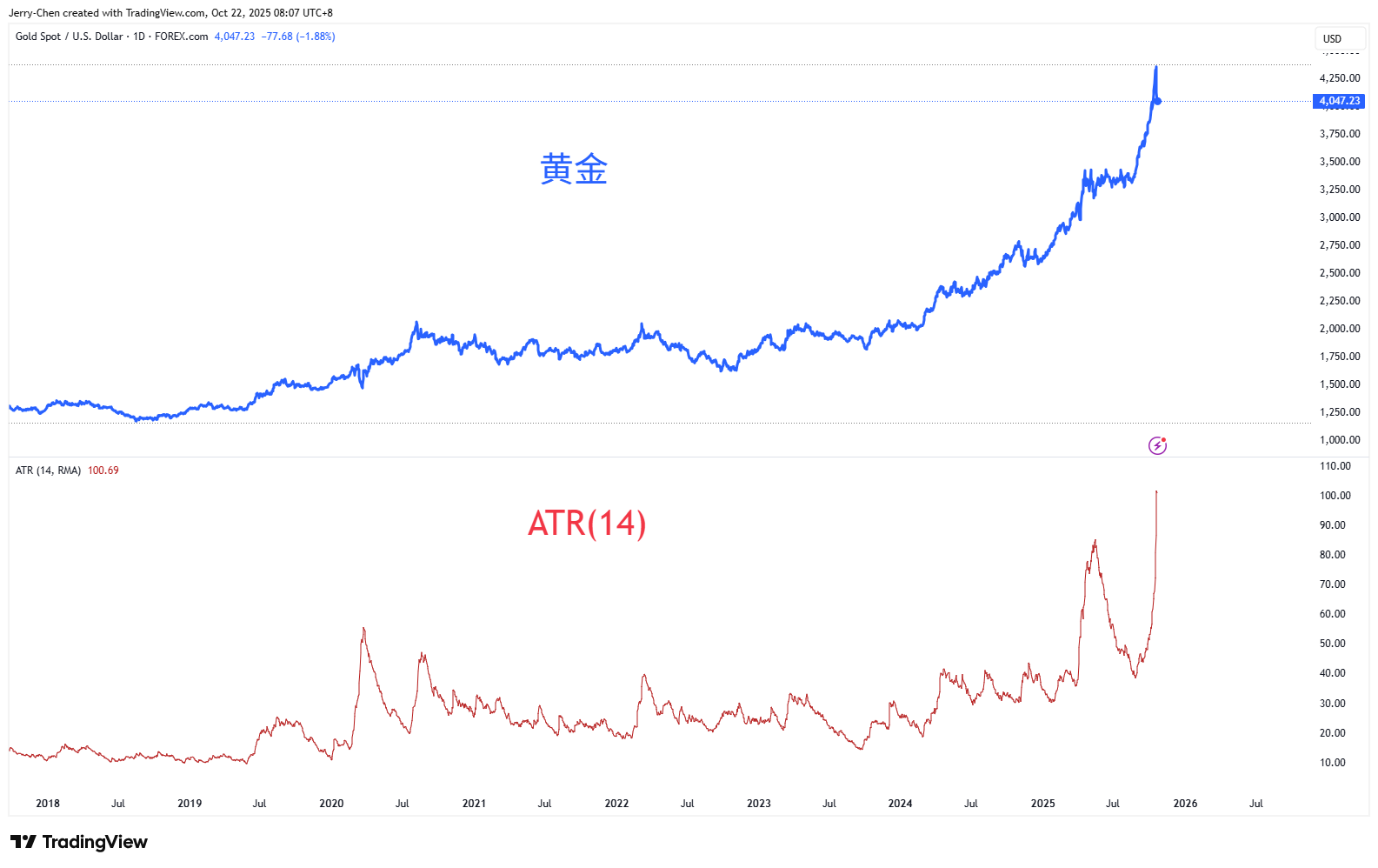
黄金白银周二经历史诗级暴跌,"高市交易"刺激美/日大幅上涨,美股涨跌不一。 现货黄金单日重挫5.3%,盘中一度跌破4100美元,最终收于4124美元,这是2020年8月11日以来的最大单日百分比跌幅。不过由于当前金价相较5年前已经 翻倍,因此周二近250美元的日内回撤幅度是当时的两倍还多。 除了黄金,近来顺风顺水的贵金属在周二集体遭遇滑铁卢。白银隔夜幅超7%,钯金和铂金的跌幅分别为5.8%和6.3%。 这是对近期疯狂行情的修正(获利了结),还是中期调整的信号? 黄金的衡量波动率的指标ATR(平均真实波幅)突破100美元。由于本周五有美国CPI数据公布,且目前多空双方势力更为均衡,因此黄金在本周剩余时间或 继续维持高波动。 但需要提醒的是,历史数据显示一旦ATR从峰值回落,黄金疯狂的涨势也将逐渐告一段落并转为震荡或下行走势。例如上次ATR在今年4月达到峰值,金价 在随后的5-8月进入横盘整理阶段。 另一个显示黄金可能遭遇阶段性调整的指标是金价和美国货币供应(M2)的比率。该数值达到自2011年以来的最高水平,这意味着相比于美国货币超发和 充裕的市场流动性,金价已经不再被低估。 与此同时,若把市值接近30万亿美元 ...
400亿救市无效?量化数据揭示市场真相
Sou Hu Cai Jing· 2025-10-22 02:10
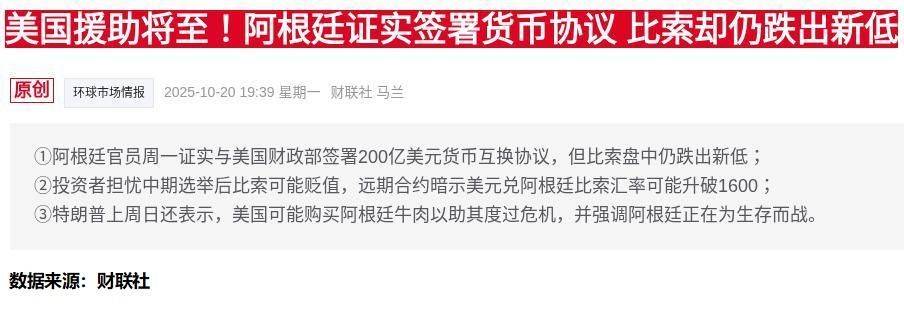
Group 1 - The core point of the article highlights the volatility in global financial markets, exemplified by the Argentine peso's dramatic decline despite significant U.S. government intervention [1][2] - The market's indifferent reaction to the U.S. rescue plan indicates a lack of confidence stemming from policy opacity, which is a parallel to the A-share market's behavior [2][5] - The A-share market has experienced a significant rise of over 1100 points, nearly 40%, since the new policy in September 2024, yet many investors still feel they are not profiting due to the nature of the rotation market [2][5] Group 2 - The traditional trading strategies have become outdated, replaced by an "ALL in" approach, leading to compressed cycles for market trends [5][8] - Retail investors face a dilemma of chasing hot stocks or missing out, emphasizing the importance of understanding current capital movements rather than speculating on future trends [8][10] - The article illustrates that stock price movements often mask the true intentions of large capital, with quantitative data systems providing insights into market behavior [10][12] Group 3 - The Argentine crisis reflects investor concerns over policy uncertainty, which is more impactful than the U.S. rescue plan, highlighting the importance of underlying market fundamentals [15] - The article suggests that in an era dominated by institutional investors, ordinary investors must upgrade their analytical tools to avoid losses [15][17] - Key recommendations include focusing on capital behavior, valuing quantitative data, maintaining independent thinking, and selecting appropriate analytical tools to understand market dynamics [17]
可口可乐2025年Q3营收125亿美元,上年同期118.54亿美元
Xin Lang Cai Jing· 2025-10-21 14:20
(来源:科创100ETF基金) 可口可乐2025年Q3营收125亿美元,上年同期118.54亿美元。预测全年资本支出大约为22亿美元,市场 预估21.7亿美元。 来源:市场资讯 ...

纳指轻微低开,通用汽车绩后涨超9%
Ge Long Hui· 2025-10-21 13:40
美股开盘,三大指数涨跌不一,纳指跌0.03%,标普500指数、道指涨0.03%。 通用汽车涨9.6%,Q3营收及调整后每股收益超预期,上调全年调整后息税前利润指引。 可口可乐涨3.3%,Q3业绩超预期,主要得益于期内产品价格组合上涨6%。 诺和诺德跌超1%,公司董事长Helge Lund、副董事长Henrik Poulsen以及其他五名独立董事将不上参加 连任选举。 (格隆汇) ...


可口可乐公司2025Q3营收124.55亿美元,超市场预期
Xin Lang Cai Jing· 2025-10-21 12:15
10月21日,可口可乐公司发布了2025年三季度财报,展现稳健的增长势头。财报显示,公司三季度营收 增长5%至124.55亿美元,超出市场预期的124.1亿美元;有机营收增长6%;净利润为36.83亿美元,增长 29%;每股收益(非公认会计准则)为0.82美元,增长6%,高于市场预期的0.78美元。 销量方面,全球单箱销量增长1%。可口可乐公司董事会主席兼首席执行官詹鲲杰(James Quincey)表 示,"我们有信心实现2025年的业绩目标,同时朝着更长远目标努力。" 来源:第一财经 ...
再上市找钱?东鹏饮料负债高企,被3200个经销商“掐住脖子”
Sou Hu Cai Jing· 2025-10-20 14:03
Core Viewpoint - Dongpeng Beverage has submitted a new listing application to the Hong Kong Stock Exchange after a previous attempt failed within six days, showcasing impressive growth metrics but facing potential challenges in sustaining this growth in a competitive market [3][15]. Group 1: Financial Performance - Dongpeng Beverage's revenue is projected to grow from 8.5 billion RMB in 2022 to over 15.8 billion RMB by 2024, with net profit increasing from 1.44 billion RMB to 3.33 billion RMB during the same period [3][4]. - In the first half of 2025, revenue reached 10.74 billion RMB, a year-on-year increase of 36.37%, but the growth rate has slightly declined compared to the same period in 2024 [3][4]. Group 2: Product Segmentation - The company's energy drink, Dongpeng Special Drink, remains the core product, accounting for 96.6% of revenue in 2022, which decreased to 77.9% in the first half of 2025, indicating a need for diversification [4][7]. - Other beverage products, such as sports drinks, have a much smaller market share, with revenue of 1.49 billion RMB in 2024, representing only 9.4% of total revenue [6][7]. Group 3: Distribution Channels - Dongpeng Beverage relies heavily on offline distribution channels, with 87.1% of revenue coming from distributors as of the first half of 2025, which poses risks related to dependence on these partners [7][9]. - The company has 3,200 distribution partners covering 4.2 million retail outlets, indicating a strong market presence but also a reliance on a single distribution model [7][9]. Group 4: Debt and Financial Structure - The company's debt levels are concerning, with a debt-to-asset ratio exceeding 50%, reaching 61.86% in the first half of 2025, indicating a reliance on debt financing [11][13]. - Short-term borrowings increased from 3.18 billion RMB in 2022 to 6.55 billion RMB in 2024, highlighting potential liquidity issues as current assets are insufficient to cover current liabilities [13][14]. Group 5: Market Position and Future Outlook - Dongpeng Beverage's growth story is challenged by increasing competition from established brands like Red Bull and the need for international expansion as domestic competition intensifies [15][16]. - The company stands at a critical juncture, where its reliance on a single product line and distribution model may hinder its long-term sustainability in the market [15][16].


欢乐家涨2.03%,成交额1018.44万元,主力资金净流出93.49万元
Xin Lang Cai Jing· 2025-10-20 01:54
Core Points - The stock price of Huanlejia increased by 2.03% on October 20, reaching 16.61 CNY per share, with a total market capitalization of 7.266 billion CNY [1] - The company has experienced a year-to-date stock price increase of 9.47%, but has seen a decline of 1.25% over the last five trading days and 18.98% over the last twenty days [1] - Huanlejia's main business includes the research, production, and sales of canned fruits, plant protein beverages, fruit juices, and lactic acid bacteria beverages, with revenue composition being 55.73% from beverages, 38.66% from canned goods, and 5.61% from other products [1] Financial Performance - For the first half of 2025, Huanlejia reported an operating income of 748 million CNY, a year-on-year decrease of 20.90%, and a net profit attributable to shareholders of 18.55 million CNY, down 77.50% year-on-year [2] - The company has distributed a total of 477 million CNY in dividends since its A-share listing, with 346 million CNY distributed over the past three years [3] Shareholder Information - As of September 19, the number of Huanlejia shareholders was 19,500, a decrease of 16.47% from the previous period, with an average of 19,828 circulating shares per shareholder, an increase of 19.72% [2] - The top ten circulating shareholders include Hong Kong Central Clearing Limited, which holds 353,000 shares, a decrease of 631,500 shares from the previous period [3]
1个农夫山泉≈23个华润饮料,怡宝“水战”输在哪?解开市值悬殊之谜
Mei Ri Jing Ji Xin Wen· 2025-10-17 13:36
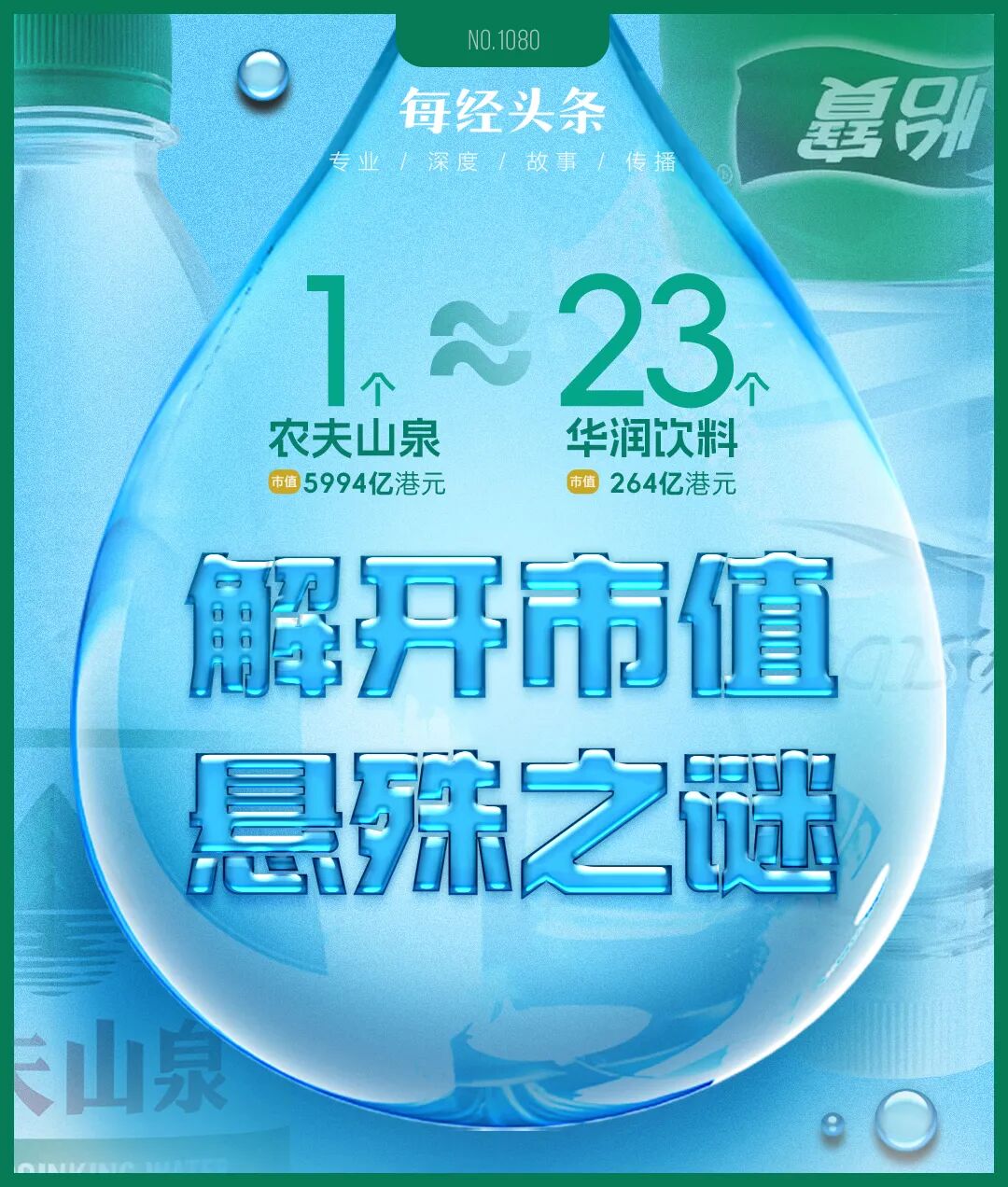
Group 1 - The article highlights the stark contrast in market valuation between two leading bottled water companies, Nongfu Spring and China Resources Beverage, despite their similar product offerings and pricing [2][3] - Nongfu Spring's market capitalization reached 599.4 billion HKD, while China Resources Beverage's market cap was only 26.4 billion HKD, indicating a significant disparity in investor perception [7] - Over the past three years, Nongfu Spring has maintained a gross margin close to 60%, while China Resources Beverage's gross margin has been around 40%, showcasing the profitability difference between the two companies [7][9] Group 2 - From January to October 2023, Nongfu Spring's market value increased by 217.6 billion HKD, while China Resources Beverage's decreased by 1.7 billion HKD, further emphasizing the valuation gap [7] - In the first half of 2025, Nongfu Spring reported revenue of 25.622 billion CNY and a net profit of 7.622 billion CNY, with bottled water revenue accounting for 36.9% of total revenue [7] - In contrast, China Resources Beverage's revenue was 6.206 billion CNY, with a net profit of only 0.805 billion CNY, and bottled water revenue making up 84.6% of its total revenue [7] Group 3 - The article discusses the competitive landscape in the bottled water market, noting that Nongfu Spring has successfully captured market share from China Resources Beverage, which has seen a decline in its market position [9][10] - Nongfu Spring has diversified its product offerings, with tea beverages contributing significantly to its revenue, while China Resources Beverage is still in the process of expanding its beverage portfolio [10][11] - The cost structure of bottled water production is highlighted, with Nongfu Spring benefiting from a fully self-sufficient production model, while China Resources Beverage relies on outsourcing, leading to higher costs and lower margins [15][19] Group 4 - The article emphasizes the importance of supply chain management in the bottled water industry, with companies increasingly focusing on building their own production facilities to reduce costs and improve margins [38] - Nongfu Spring has established multiple production bases and water sources, enhancing its operational efficiency, while China Resources Beverage is working to increase its self-production ratio [22][30] - The competitive advantage in the industry is shifting towards those who can effectively manage their supply chains and production capabilities, indicating a long-term strategic focus for both companies [38][39]
养元饮品10亿增资旗下私募,加码跨界投资布局
Huan Qiu Lao Hu Cai Jing· 2025-10-16 06:34
Core Viewpoint - Yangyuan Beverage has announced a capital increase of 1 billion yuan to the private equity fund Qianhong Investment, raising its total scale from 3 billion yuan to 4 billion yuan, and increasing its shareholding ratio to 99.925% [1][2] Group 1: Investment Details - The funds from the capital increase will be used entirely for new project investments by the private equity fund and will not be allocated to existing projects, including Changjiang Storage [2] - Qianhong Investment has made cumulative external investments of 2.954 billion yuan, with direct investments in companies across various sectors such as real estate, AI, new energy, and offline media [2] - A notable investment was made in Changjiang Storage's parent company, Changkong Group, with an additional 1.6 billion yuan, acquiring 0.99% of the shares, making Yangyuan Beverage the eighth largest shareholder [2] Group 2: Financial Performance - Yangyuan Beverage's revenue has declined from 8.144 billion yuan in 2018 to 6.058 billion yuan in 2024, with net profit dropping from 2.837 billion yuan to 1.722 billion yuan [3] - Revenue from walnut milk, the core product, has decreased by 5.86% to 5.373 billion yuan, with sales volume down by 4.71% to 565,300 tons [3] - In the first half of 2025, Yangyuan Beverage reported a revenue of 2.465 billion yuan, a year-on-year decline of 16.19%, and a net profit of 744 million yuan, down 27.76% year-on-year [3]
