债券业

Search documents
市场风险偏好下降 美国国债失守重要“心理防线”
智通财经网· 2025-10-16 22:18
Core Insights - The U.S. Treasury market is experiencing significant volatility, with the 10-year Treasury yield falling below the critical 4% level for the first time in 2025, closing at 3.976% [1] - The decline in the 10-year yield is seen as a signal of economic slowdown and increased risk aversion among investors, particularly in light of recent economic data and geopolitical tensions [1] - The Federal Reserve's intention to continue lowering interest rates to support the economy has reinforced expectations of a more accommodative monetary policy [1] Group 1 - The 10-year Treasury yield has dropped below 4%, marking a significant psychological threshold that has not been breached since April 4, when it briefly fell to 3.992% [1] - The recent economic data, including a contraction in service sector activity in New York and surrounding areas, has heightened concerns about economic slowdown [1] - The rise in long-term Treasury investments is attributed to increased risk from bank loan defaults and renewed tensions between the U.S. and China [1] Group 2 - Energy prices have decreased, contributing to a downward trend in inflation, with average gasoline prices in the U.S. falling approximately 4% over the past month [2] - The market is closely monitoring the upcoming Consumer Price Index (CPI) data, scheduled for release on October 24, which could influence the trajectory of Treasury yields [2] - The consensus among market participants is that the decline in Treasury yields is fundamentally linked to growing concerns over economic slowdown and expectations for policy easing [2]
存款搬家引关注,权威人士回应
第一财经· 2025-10-15 10:44
Core Viewpoint - The article discusses the phenomenon of "deposit migration," which is essentially a reallocation of residents' assets under the influence of interest rate mechanisms, as indicated by a market authority [3]. Group 1: Financial Statistics - In the first three quarters, the increase in RMB deposits reached 22.71 trillion yuan, with household deposits rising by 12.73 trillion yuan, non-financial enterprise deposits by 1.53 trillion yuan, fiscal deposits by 1.37 trillion yuan, and deposits from non-banking financial institutions by 4.81 trillion yuan [3]. - The growth rate of household deposits has slowed compared to previous highs, while non-bank deposits have maintained rapid growth [3]. Group 2: Deposit Migration - The term "deposit migration" refers to the phenomenon where residents convert their savings deposits in banks into other assets based on changes in asset return rates, reflecting a reallocation of their assets [3]. - Over the past 20 years, various asset types such as stocks, real estate, internet financial products, bank wealth management, and funds have served as destinations for the migration of household deposits, with these flows being dynamic and bidirectional based on market conditions [3]. Group 3: Market Dynamics - Experts suggest that deposit migration is a result of relative changes in yields across different financial markets rather than a cause. When expected yields on bonds and stocks rise, there is a tendency to increase holdings in these assets, leading to a corresponding reduction in other assets under budget constraints [4]. - Since 2023, the elasticity of the interest rate differential between deposit rates and other financial asset yields has increased, resulting in frequent occurrences of both "deposit migration" and "reflow" phenomena [4].


美联储正式服软,万亿美元或将涌入中国,下一个珍珠港事件或出现
Sou Hu Cai Jing· 2025-10-12 01:56
Core Viewpoint - The Federal Reserve's recent shift from aggressive interest rate hikes to rate cuts indicates a response to economic challenges, potentially leading to significant capital flows into China as investors seek more attractive returns [2][4][10]. Group 1: Federal Reserve Policy Changes - The Federal Reserve's policy has fluctuated from extensive asset purchases in 2021 to tightening measures, and now to a more accommodative stance with a 25 basis point rate cut in September 2023, reflecting concerns about economic strength [2][4]. - The Fed's balance sheet remains above $7 trillion, indicating a slow reduction in asset purchases while maintaining a low-interest-rate environment [4][10]. - Analysts suggest that continued rate cuts could weaken the US dollar, benefiting emerging markets, particularly China [4][10]. Group 2: Capital Flows to China - Goldman Sachs predicts that the Fed's rate cuts may prompt Chinese companies to sell $1 trillion in dollar assets and reinvest in renminbi, driven by changes in interest rate differentials [5][12]. - China's bond market is attracting foreign investment, with foreign institutions holding over 4 trillion renminbi in bonds, and significant trading activity recorded [5][10]. - The stability of Chinese government bond yields at around 2.5% compared to declining US Treasury yields makes Chinese assets more appealing to global investors [5][10]. Group 3: Global Currency Dynamics - Central banks are reportedly reducing their dollar reserves while increasing their holdings in renminbi, with 30% of bank leaders planning to increase renminbi allocations within two years [7][12]. - The weakening US dollar, which has dropped from a high of 114 to around 90, is expected to raise commodity prices, benefiting countries with strong currencies like China [7][10]. - The trend of increasing gold reserves among emerging markets, including China, is seen as a strategy to reduce reliance on the dollar and enhance financial security [7][12]. Group 4: Economic Context and Future Outlook - The US economy is projected to grow at around 2.5% in 2024, but consumer spending remains weak, leading to a cautious outlook on economic recovery [4][10]. - The ongoing US-China economic tensions, particularly in technology and supply chains, may influence capital flows and investment strategies [9][10]. - The potential for a "Pearl Harbor" event in the financial sector, such as a sudden devaluation of the dollar, is a concern for global markets, prompting countries to diversify their reserves [12][16].

跨境债券专辑丨自贸离岸债重启及商业银行应对措施研究
Xin Lang Cai Jing· 2025-10-09 23:07
Core Viewpoint - The People's Bank of China has announced the development of "Free Trade Offshore Bonds" as one of eight financial opening measures, indicating the resumption of this bond issuance after a hiatus of over a year [2][4]. Summary by Sections Development History and Characteristics of Free Trade Offshore Bonds - Free Trade Offshore Bonds were first introduced in 2016, aimed at enhancing the bond market and direct financing capabilities [3][4]. - The first issuance was by the Shanghai municipal government, totaling 3 billion yuan, and the market has since expanded to include various issuers and currencies [4][5]. - By 2023, 121 bonds were issued, amounting to a total of 82.354 billion yuan, but the market faced a pause due to policy tightening [4][5]. Opportunities for Commercial Banks - The resumption of Free Trade Offshore Bonds is expected to attract a more diverse and higher-quality range of issuers, particularly large domestic multinational companies and quality enterprises from Belt and Road Initiative countries [7]. - Funding sources for these bonds will broaden, with a focus on attracting more stable long-term investments from overseas institutions, enhancing market activity [8]. - Regulatory bodies have introduced supportive policies to create a favorable environment for the resumption of these bonds, facilitating easier cross-border transactions [9][10]. Challenges for Commercial Banks - Compliance risks remain a significant concern, particularly regarding foreign debt registration and the lack of clear policies for certain bond durations [11]. - Monitoring the use of funds raised through these bonds poses difficulties, as the flexibility in fund usage can complicate tracking and compliance [12]. - The need for thorough due diligence increases, especially with a more diverse range of issuers, which may complicate credit assessments and anti-money laundering efforts [13]. Recommendations for Commercial Banks - Banks should clarify their business positioning and focus on compliance and risk management while participating in the Free Trade Offshore Bonds market [14]. - Optimizing business processes and exploring various participation forms can enhance non-interest income and improve operational efficiency [15]. - Leveraging Free Trade Zone policies to enhance cross-border service capabilities is crucial for banks to effectively engage in this market [16]. - Strengthening risk management and compliance frameworks is essential to ensure adherence to regulations and effective monitoring of fund flows [17][18][19][20].
短期利率飙升至87%!阿根廷货币危机引发现金短缺
Hua Er Jie Jian Wen· 2025-10-09 00:14
Core Viewpoint - Argentina is facing a severe currency crisis, with efforts to defend the peso exacerbating cash shortages and pushing short-term interest rates to a historic high of 87% [1][2]. Group 1: Currency Crisis and Government Actions - The yield on local government Lecap bonds maturing on November 28 surged from 74% to 87%, a significant increase from 51% at the end of the previous week [1]. - The Argentine government has been selling dollars in the market for seven consecutive trading days, consuming at least $320 million [1]. - The government has re-implemented some foreign exchange controls and sold dollars in the futures market to prevent peso depreciation, but these efforts have highlighted the unsustainability of the current exchange rate [2]. Group 2: Political and Economic Context - President Javier Milei aims to avoid peso depreciation ahead of the midterm elections on October 26, as it would increase inflation [2]. - The upcoming elections involve half of the congressional seats, and Milei needs more support in both houses to advance his market-oriented economic reforms [2]. - Recent political setbacks, including a poor performance in local elections and corruption scandals, have intensified economic challenges for Milei's administration [2]. Group 3: Market Reactions and Investor Sentiment - The volatility in the bond market reflects investor skepticism regarding the current policy path, with significant fluctuations in bond prices [4]. - Following a strong rebound, the 2035 maturing bonds fell over 1 cent the next day, indicating market uncertainty [4]. - Investors are calling for currency liberalization, expressing a desire for the peso to float freely without intervention [5]. Group 4: International Support and Future Outlook - Despite U.S. promises of assistance, the situation has not improved significantly, with expectations of a new aid plan from the IMF [3]. - Current predictions suggest that the government may receive 34% to 37% of the votes in the upcoming elections, allowing Milei to continue governing through veto power and decrees [3].
每日债市速递 | 节前国债期货全线上涨
Wind万得· 2025-10-08 22:40
Group 1: Open Market Operations - The central bank conducted a 7-day reverse repurchase operation on September 30, with a fixed rate and a total of 242.2 billion yuan at an interest rate of 1.40%, with the same amount being bid and awarded [1] - On the same day, 276.1 billion yuan in reverse repos matured, resulting in a net withdrawal of 33.9 billion yuan [1] Group 2: Liquidity Conditions - On the last trading day of September, the interbank market liquidity remained stable, with overnight repo rates for deposit institutions rising over 7 basis points but still below 1.4%, which is considered a comfortable level for quarter-end [3] - The overnight financing rate in the U.S. was reported at 4.16% [3] Group 3: Interbank Certificates of Deposit - The latest transaction for one-year interbank certificates of deposit in the secondary market was around 1.675% [7] Group 4: Bond Market Overview - Major interest rate bonds in the interbank market saw a decline in yields across the board [8] - Government bond futures closed higher, with the 30-year main contract up by 0.1%, the 10-year contract up by 0.17%, the 5-year contract up by 0.11%, and the 2-year contract up by 0.04% [13] Group 5: Key News - The Shanghai Clearing House announced a full exemption of bond issuance registration fees from October 1, 2025, to September 30, 2026, and a 50% reduction in service fees for bond interest payment and redemption [14] - The interbank dealer association released a revised evaluation scheme for lead underwriters of non-financial corporate debt financing tools, emphasizing resource allocation to technology finance and inclusive finance [14] Group 6: Bond Defaults and Risks - Recent updates on bond defaults include the restructuring progress of Dongxu PPN001 and the slow debt restructuring of Sanbao Group [17] - A list of negative events in the bond market includes delayed ratings for several entities, indicating potential risks in the sector [17]

Fed policy will dominate market narrative when shutdown end, says Fed Watch Advisors' Ben Emons
Youtube· 2025-10-08 22:04
Group 1 - The Federal Reserve is experiencing a division among governors regarding the direction of interest rates, with a slim majority expecting two more cuts this year [1][3] - There is a lack of data due to the government shutdown, which is complicating the Fed's decision-making process [1][3] - The 10-year yield has remained relatively stable over the past 18 months, indicating a sideways trading pattern, which may suggest uncertainty in the market [4][5][6] Group 2 - The Japanese yen has been weakening significantly, leading to higher yields on Japanese Government Bonds (JGBs), which may impact the U.S. bond and equity markets [7][8] - The Bank of Japan faces pressure to raise rates due to high inflation, creating a complex relationship with global bond markets [8] - The Fed's balance sheet is at a critical level just below $3 trillion, raising concerns about the potential impact on the banking system if reserves become too low [10][11] Group 3 - The Fed's cautious stance may lead to a more dovish approach in future meetings, which could positively influence the stock market [12][13] - Faster rate cuts could push yields higher, reflecting increased stimulus in the economy, especially with the stock market reaching record highs [13]
10月债市怎么看?:10月债市投资策略
Hua Yuan Zheng Quan· 2025-09-28 14:08
Group 1 - The report indicates that the bond market experienced significant adjustments in September, influenced by strong stock market performance and institutional behaviors, particularly in long-term government bonds and capital bonds [1][2] - The bond market's performance diverged from the funding and economic fundamentals due to several factors, including a notable rise in the stock market, particularly in technology stocks, leading to expectations of economic recovery [1][2] - Institutional funds, such as pension funds, shifted significantly from the bond market to the stock market, exacerbated by regulatory impacts on public funds [1][2] Group 2 - The report highlights that the bond market's balance increased by 15.3 trillion yuan in the first eight months of 2025, with government bonds contributing 10.3 trillion yuan and financial bonds 2.7 trillion yuan [1][4] - Bank self-operated bond investments surged, with an increase of 11.4 trillion yuan, surpassing the total for the previous year, indicating a strong shift towards bond investments amid low credit demand [1][4] - The report notes that the overall bond investment balance of major banks increased by 21.4% year-on-year, while small and medium-sized banks also saw a significant increase of 17.8% [1][4] Group 3 - The report suggests that conditions for further policy interest rate cuts may be emerging, with the central bank indicating a balanced approach to monetary policy aimed at supporting the real economy while managing risks [1][2] - Recent economic data shows a decline in investment, consumption, and export growth rates, suggesting increasing downward pressure on the economy [1][6] - The report anticipates that the bond market's configuration value is prominent, with potential stabilization and a downward trend in bond yields, particularly for 10-year government bonds [1][2]
“闻到了2007年的味道”,大佬发警告
华尔街见闻· 2025-09-28 13:25
Core Viewpoint - The current financial market exhibits bubble signs reminiscent of the pre-2007 financial crisis, despite stricter bank regulations and increased capital buffers [1][4][11]. Group 1: Market Conditions - A significant resurgence in large leveraged buyout transactions is noted, with Wall Street banks preparing to arrange over $20 billion in merger debt financing, echoing the pre-crisis environment of 2007 [2][4]. - The risk premium for U.S. investment-grade corporate bonds recently hit a 27-year low, indicating overly optimistic risk pricing in the market [1][7]. - Early signs of economic slowdown are emerging, with the U.S. unemployment rate rising to its highest level since 2021 and consumer confidence dropping to a four-month low [1][16]. Group 2: Consumer Debt and Defaults - The rising auto loan default rates signal increasing financial pressure on consumers, with specific instances of bankruptcy among subprime auto lenders [5][11]. - The total U.S. investment-grade market has expanded from under $4 trillion in early 2015 to approximately $7.6 trillion, while the private credit market has grown to over $1.7 trillion [5][13]. Group 3: Investment Sentiment - Prominent market figures express concerns over current valuation levels, with JPMorgan CEO Jamie Dimon advising against purchasing credit products [8][11]. - Investment firms like DoubleLine Capital are reducing exposure to junk bonds due to valuations not reflecting inherent risks [9][11]. - The potential for significant market adjustments exists, as noted by various analysts, indicating that while a repeat of the 2007-2009 crisis is unlikely, substantial asset corrections may still occur [14][16].

资金大挪移!投资者狂买美国市政债券,美股单周“失血”200亿美元
Zhi Tong Cai Jing· 2025-09-23 06:33
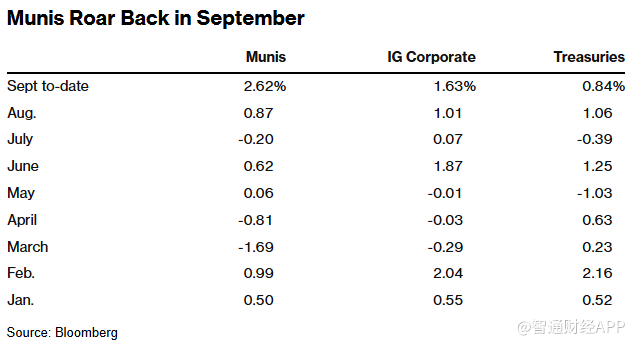
Group 1 - CreditSights reported that cash inflows into U.S. municipal bond funds reached the highest level since 2007, with approximately $2.4 billion in the week ending September 10, marking a 137-week high [1] - Exchange-traded funds (ETFs) also saw inflows of $2 billion, the highest in four weeks, while investors withdrew about $20 billion from U.S. equity funds during the same week [1] - The anticipation of the Federal Reserve restarting interest rate cuts has driven investors towards U.S. state and local government bonds, prompting a rebalancing of portfolios as stock prices hit historical highs [1] Group 2 - Municipal bonds returned 2.62% in September to date, outperforming investment-grade corporate bonds (1.63%) and Treasuries (0.84%) [2] - For most of the year, municipal bonds had underperformed compared to these asset classes due to record state and local government bond issuance and uncertainties surrounding tax-exempt bonds from the Trump administration's tax and spending proposals [2] Group 3 - A weak labor market report contributed to a strong rebound in municipal bonds, but an increase in bond issuance and a seasonal decrease in cash available for reinvestment may slow performance [3] - Approximately $16.3 billion in new bonds is expected to be issued in the next 30 days, which could impact market dynamics [3] - Tactical investors may pause or consider profit-taking, but the market is expected to perform well in October if bond issuance does not significantly increase [3]