
医药等

Search documents
资金跟踪系列之八:市场热度与波动率均上升,两融活跃度升至“924”高点
SINOLINK SECURITIES· 2025-08-25 13:27
Macro Liquidity - The US dollar index continued to decline, and the degree of "inversion" in the China-US interest rate spread has narrowed [1][15] - The nominal and real interest rates of 10Y US Treasury bonds both fell, indicating a rebound in inflation expectations [1][15] - Offshore dollar liquidity has tightened, while the domestic interbank funding situation is overall balanced, initially tightening and then loosening [1][15] Market Trading Activity - Market trading activity has continued to rise, with most industry trading heat above the 80th percentile [2][24] - The volatility of major indices has increased, while most industry volatilities remain below the 60th percentile [2][30] - Market liquidity indicators have slightly rebounded, but liquidity indicators across sectors remain below the 60th historical percentile [2][35] Institutional Research - The electronic, communication, computer, automotive, and pharmaceutical sectors have the highest research activity, with retail, non-ferrous metals, steel, electronics, and chemicals showing a month-on-month increase in research heat [3][42] Analyst Forecasts - Analysts have adjusted the net profit forecasts for the entire A-share market for 2025/2026, with increases for sectors such as steel, coal, media, and computers [4][49] - The proportion of stocks with upward revisions in net profit forecasts for 2025/2026 has increased [4][49] - The net profit forecasts for the Shanghai Stock Exchange 50 index for 2025/2026 have been raised [4][49] Northbound Trading Activity - Northbound trading activity has rebounded, but there has been overall net selling [5][31] - Based on the top 10 active stocks, the buy-sell ratio for electronic, computer, and non-bank sectors has increased [5][32] - For stocks with northbound holdings of less than 30 million shares, there were significant net purchases in media, non-ferrous metals, and communication sectors [5][33] Margin Financing Activity - Margin financing activity has risen to the highest level since September 2024, with net purchases primarily in electronic, computer, and communication sectors [6][35] - The proportion of margin financing in sectors such as home appliances, automotive, and utilities has increased significantly [6][38] - Margin financing has seen net purchases across various styles, including large, mid, and small-cap growth and value stocks [6][39] Hot Stocks on the Dragon and Tiger List - The trading activity on the Dragon and Tiger list has continued to rise, with real estate, media, and computer sectors showing relatively high trading volumes [7][41] Active Equity Fund Positions - Active equity funds have increased their positions, particularly in sectors like military, electric power, and TMT [8][45] - The correlation between active equity funds and large-cap growth/mid-small-cap value has increased [8][48] - New equity fund issuance has rebounded, with active funds seeing a decrease and passive funds seeing an increase in issuance [8][50]
上证180ETF指数基金(530280)自带杠铃策略,涨超0.7%
Xin Lang Cai Jing· 2025-08-13 02:13
Group 1 - The core viewpoint indicates that with the market stabilizing around 3600, a slow bull trend in the stock market is evident, and both dividend and technology assets are expected to yield excess returns in the long term, with a barbell strategy gaining attention [1] - The Shanghai 180 Index employs a barbell strategy consisting of 90% dividend and 10% technology assets, making it a good choice for equity market allocation, benefiting from both stable dividends and the growth of technology [1] - As of August 13, 2025, the Shanghai 180 Index has increased by 0.42%, with notable gains in constituent stocks such as Luoyang Molybdenum (up 3.55%) and Zijin Mining (up 3.40%) [1] Group 2 - The Shanghai 180 ETF closely tracks the Shanghai 180 Index, which selects 180 securities with large market capitalization and good liquidity from the Shanghai stock market, reflecting the overall performance of core listed companies [2] - As of July 31, 2025, the top ten weighted stocks in the Shanghai 180 Index account for 25.4% of the index, including major companies like Kweichow Moutai and China Ping An [2] - The Shanghai 180 ETF has various connection funds available for investment, enhancing accessibility for investors [2]
2.07亿资金抢筹东信和平,机构狂买东杰智能丨龙虎榜
2 1 Shi Ji Jing Ji Bao Dao· 2025-08-05 14:00
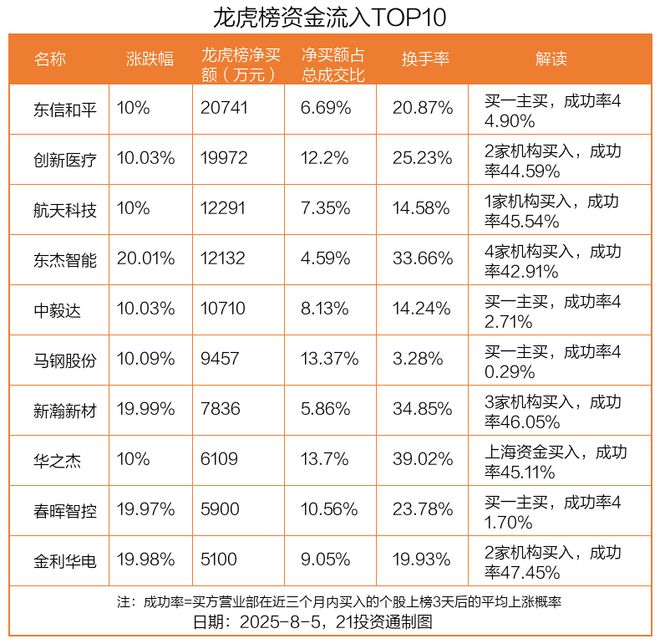
Market Overview - On August 5, the Shanghai Composite Index rose by 0.96%, the Shenzhen Component Index increased by 0.59%, and the ChiNext Index gained 0.39% [1] - A total of 48 stocks appeared on the "Dragon and Tiger List" due to significant trading activity, with the highest net inflow of funds recorded for Dongxin HePing (002017.SZ) at 207 million yuan [1][4] Stock Performance - Dongxin HePing saw a net buying amount of 207.41 million yuan, accounting for 6.69% of its total trading volume, and closed with a 10% increase and a turnover rate of 20.87% [2][4] - The stock with the highest net outflow was Shanhe Intelligent (002097.SZ), which experienced a net selling of 335 million yuan, representing 5.63% of its total trading volume, and closed up by 9.99% with a turnover rate of 34.24% [4][6] Institutional Activity - Institutions participated in 27 stocks on the Dragon and Tiger List, with a total net buying of 118 million yuan, net buying 12 stocks and net selling 15 stocks [6][12] - The stock with the highest institutional net buying was Dongjie Intelligent (300486.SZ), which closed up by 20.01% with a turnover rate of 33.66% [7] Northbound Capital - Northbound funds participated in 14 stocks on the Dragon and Tiger List, with a total net buying of 101 million yuan [10] - The highest net buying by northbound funds was also for Dongxin HePing, amounting to 93.36 million yuan, while the highest net selling was for Shanhe Intelligent at 110 million yuan [10][12] Joint Activity of Institutions and Northbound Funds - Both institutions and northbound funds jointly net bought stocks such as Aerospace Science and Technology and Yutian Guanjia, while they jointly net sold stocks including Guizhou Bailin and Shanhe Intelligent [12][14] - Discrepancies were noted in stocks like Longyang Electronics and Chenxin Pharmaceuticals, where institutions sold while northbound funds bought [12]


大盘冲高回落,关注A500ETF易方达(159361)、沪深300ETF易方达(510310)等产品后续走势
Mei Ri Jing Ji Xin Wen· 2025-07-29 11:06
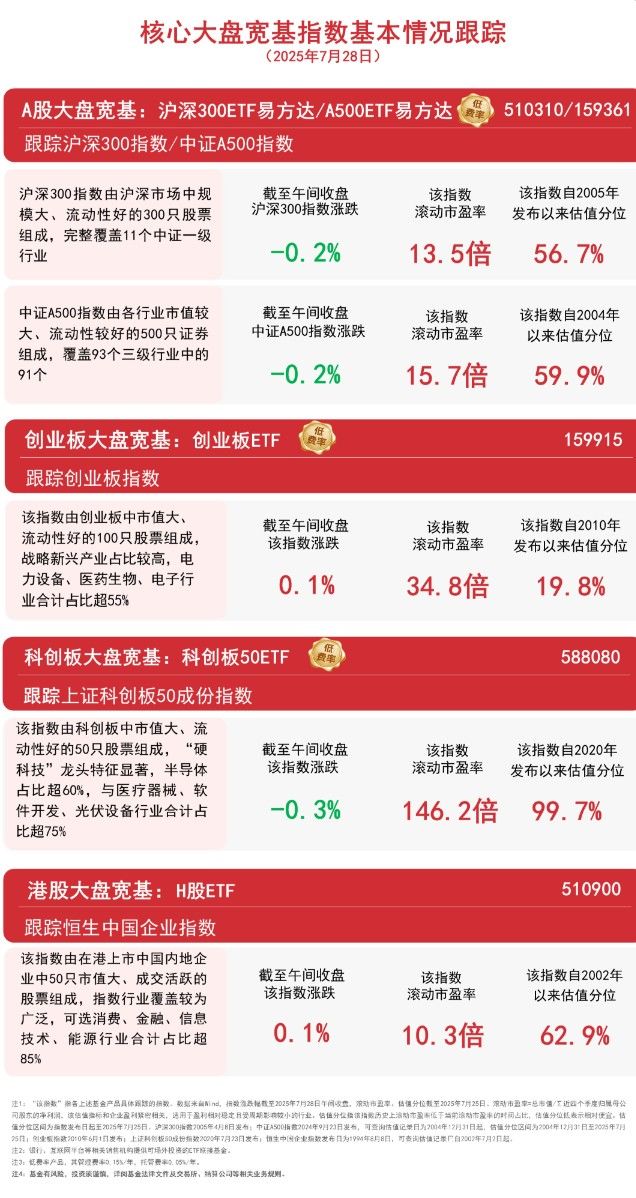
Market Overview - A-shares experienced a rise followed by a pullback in the morning session, with sectors such as PCB, film and television, and PEEK materials showing gains, while coal and steel sectors adjusted [1] - The Hong Kong stock market fluctuated, with the pharmaceutical sector rising against the trend [1] Index Performance - The CSI 300 Index fell by 0.2% at midday, with a rolling P/E ratio of 13.5 times, placing it in the 56.7% valuation percentile since its inception in 2005 [2] - The CSI A500 Index also decreased by 0.2%, with a rolling P/E ratio of 15.7 times, ranking in the 59.9% valuation percentile since its launch in 2004 [2] - The ChiNext Index saw a slight increase of 0.1%, with a rolling P/E ratio of 34.8 times, which is in the 19.8% valuation percentile since its establishment in 2010 [2] - The STAR Market 50 Index declined by 0.3%, with a notably high rolling P/E ratio of 146.2 times, placing it in the 99.7% valuation percentile since its introduction in 2020 [2] Sector Analysis - The A-share market's strategic emerging industries, including electric equipment, pharmaceuticals, and electronics, account for over 55% of the ChiNext Index [2] - The Hong Kong market's H-share Index covers a wide range of industries, with consumer discretionary, financials, information technology, and energy sectors making up over 85% of its composition [4]
“反内卷”:三重目标下如何去产能、提物价
Soochow Securities· 2025-07-28 06:02
Group 1: Capacity Reduction Strategy - The "anti-involution" price governance aims for three goals: short-term regulation of price wars, medium-term capacity reduction, and long-term price recovery, particularly PPI[1] - Capacity reduction can be categorized into two types: shutdown and production limitation, and policy-guided capacity reduction[1] - The current trend favors policy-guided capacity reduction over shutdowns, as the demand side lacks strong stimulus policies[1] Group 2: Price Recovery Expectations - PPI is expected to take 11-12 months to turn positive, potentially reaching around 1.9% by September 2026 under neutral assumptions[1] - Three scenarios for PPI recovery are outlined: optimistic (3.86%), neutral (1.92%), and pessimistic (0.9%) by September 2026, depending on the strength of supply-side capacity reduction[3] - The GDP deflator's recovery is more challenging than PPI due to the service sector's larger weight, with the second industry experiencing a -3.06% deflation in Q2 2024[3] Group 3: Market Clearing Mechanism - The market clearing mechanism is essential for addressing capacity surplus, requiring timely price adjustments and responsive supply behavior[22] - Current obstacles include government subsidies allowing firms to sell below cost, leading to persistent losses and market inefficiencies[24] - Previous efforts to clear "zombie enterprises" in coal and steel sectors have shown significant results, with 115 million tons of capacity addressed[24]
2025年全国消费品工业座谈会在陕西西安召开
news flash· 2025-07-17 12:21
Group 1 - The conference emphasized the importance of the consumer goods industry as a traditional advantage and a vital livelihood sector, serving as the material foundation to meet the growing needs of the people for a better life [2] - The consumer goods industry is expected to play a foundational role in economic growth, supporting the advancement of new industrialization and the construction of a manufacturing powerhouse [2] - The industry will focus on enhancing the resilience and competitiveness of key industrial chains and supply chains while promoting the transformation and upgrading of traditional industries [1][2] Group 2 - The conference called for a systematic planning of the consumer goods industry development strategy and the continuous improvement of the policy support system for industry development [2] - There will be a strong push for the integration of technological and industrial innovation, particularly in sectors such as textiles, light industry, food, and pharmaceuticals [2] - Measures will be taken to boost consumption and expand domestic demand, enhancing the adaptability of supply and demand in the consumer goods sector [2]
A500ETF嘉实(159351)盘中涨近1%,成分股哈投股份、包钢股份、药明康德纷纷10cm涨停
Xin Lang Cai Jing· 2025-07-11 03:06
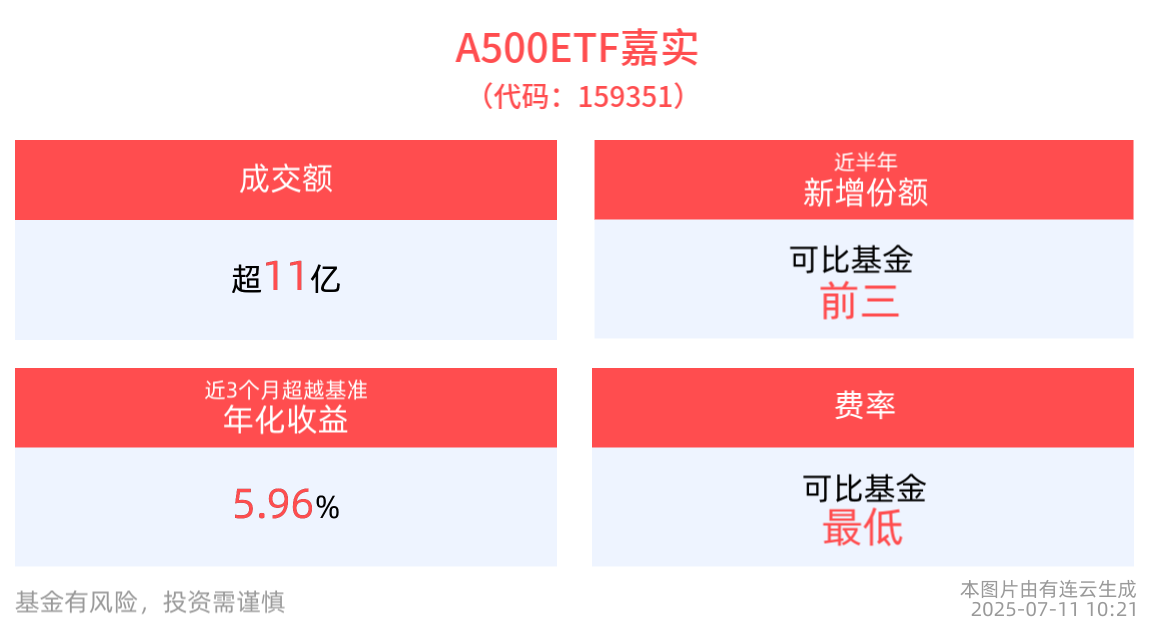
Group 1: A500ETF Performance - A500ETF Jiashi has a turnover rate of 7.59% with a transaction volume of 1.107 billion yuan, and the average daily transaction volume over the past month is 3.051 billion yuan [3] - The latest scale of A500ETF Jiashi reached 14.38 billion yuan, with a significant increase of 909 million shares over the past six months [3] - As of July 10, 2025, A500ETF Jiashi's net value has increased by 8.82% over the past six months, with the highest monthly return since inception being 3.55% and the longest consecutive monthly increase being 2 months [3] Group 2: Index and Market Analysis - Pacific Securities notes that the Shanghai Composite Index has successfully broken through 3,500 points, but the current trading volume and volatility are not comparable to the market conditions in late September last year, indicating a more oscillatory upward trend [4] - Multiple indices have broken through their oscillation ranges, but the options volatility remains low, with trading volume around 1.5 trillion yuan, which is inconsistent with the previous year's simultaneous increase in volume and volatility [4] - According to Caixin Securities, the A-share market is currently in a continuation phase of the upward trend since the 9.24 market, showing a wide oscillation pattern, with upcoming policy announcements expected to be crucial for breaking out of this range [4] Group 3: Top Weighted Stocks - The top ten weighted stocks in the CSI A500 Index include Kweichow Moutai, CATL, Ping An Insurance, China Merchants Bank, Industrial Bank, Yangtze Power, Midea Group, Zijin Mining, BYD, and Dongfang Fortune, collectively accounting for 20.67% of the index [3] - The individual stock performances include Kweichow Moutai up by 0.88%, Ping An Insurance up by 2.17%, and BYD up by 1.27%, among others [6] - Investors without stock accounts can access the A500ETF Jiashi linked fund (022454) for exposure to the top 500 A-share companies [6]

[7月3日]指数估值数据(A股继续上涨;月薪宝创新高,再平衡的机会来了么;红利估值表更新;指数日报更新)
银行螺丝钉· 2025-07-03 13:47
Core Viewpoint - The overall market is experiencing an upward trend, with various sectors showing positive performance, particularly in technology and healthcare, while the Hong Kong stock market is showing mixed results [1][4]. Market Performance - The overall market has risen, closing at 4.9 stars, with large, mid, and small-cap stocks all experiencing similar gains [1][2]. - Growth style stocks are performing strongly, while value style stocks show slight fluctuations [3]. Sector Analysis - Technology, ChiNext, and pharmaceutical biotechnology sectors have seen significant increases [4]. - The Hong Kong stock market experienced a slight decline after a previous rise, with its dividend index continuing to increase [4]. Investment Strategies - The "Yuexinbao" investment strategy has reached a historical high, with plans to adjust the stock-bond ratio [6][7]. - The "Yuexinbao" and similar strategies benefit from declining deposit rates, leading to higher returns in 2023 compared to previous years [8]. Return Sources - Returns are derived from three main components: 1. **Equity Portion**: Focused on value style stocks, contributing stable returns through dividends and long-term price appreciation [9][11]. 2. **Bond Portion**: Emphasizes short to medium-term bonds due to current low yields in long-term bonds [12]. 3. **Rebalancing**: Adjusting the portfolio to maintain target allocations, which can enhance returns during market fluctuations [13][18]. Historical Performance - A rebalancing opportunity occurred in February 2024, where the "Yuexinbao" strategy saw a significant recovery, with stock assets increasing by approximately 30% from February to June [19][21]. Dividend Index Valuation - The current valuation of various dividend indices indicates some are still undervalued, but they are approaching normal valuation levels [29].
[7月2日]指数估值数据(红利指数强势;主动基金表现好坏跟什么有关呢)
银行螺丝钉· 2025-07-02 13:58
Core Viewpoint - The article discusses the current market trends, emphasizing the performance of different investment strategies and the importance of selecting fundamentally strong companies for long-term investment success [8][28]. Market Overview - The market experienced slight declines today, with minimal volatility, maintaining a rating of 4.9 stars [1]. - Large-cap stocks like the CSI 300 showed little fluctuation, while small-cap stocks faced more significant declines [2]. - Value style investments overall saw an increase, with dividend and value indices performing strongly [3][4]. Investment Strategy Performance - In the first half of the year, both active selection and index enhancement strategies outperformed the broader market indices, with active selection rising by 5% while the CSI 300 remained flat [8]. - Active selection strategies have shown a historical tendency to outperform the market approximately 60% of the time, indicating a cyclical nature of performance [9]. Stock Selection Criteria - The active selection strategy focuses on choosing stocks with strong profitability, measured by Return on Equity (ROE) [12][15]. - Companies are categorized based on their ROE into three indices: loss-making stocks (negative ROE), marginally profitable stocks (positive but below market average), and quality stocks (positive and above market average) [18]. - Historical data indicates that strong profitability leads to better long-term returns, despite occasional surges in loss-making stocks during specific market conditions [19][25]. Market Dynamics - There have been instances of speculative trading in loss-making stocks, notably in 2014-2015 and projected for late 2024, which can lead to short-term underperformance for quality-focused strategies [19][21]. - Such speculative trends are typically short-lived, reinforcing the notion that long-term stock performance is driven by underlying company profitability [22][24]. Long-term Investment Philosophy - The company advocates for a long-term investment approach, prioritizing companies with solid earnings over engaging in short-term speculative trading [28]. - A quote from Graham highlights the distinction between short-term market fluctuations and long-term value realization, emphasizing the importance of company fundamentals [30][31]. New Features and Tools - A new feature in the "Today Stars" app allows users to access core data and real-time valuations of mainstream ETFs, aiding in identifying undervalued investment opportunities [32][34].
平安中证A50ETF基金经理钱晶:中证A50指数——沪深300增强的优质选择
Quan Jing Wang· 2025-06-26 09:00
Group 1 - The core viewpoint of the news is the introduction of the China Securities A50 Index ETF and its enhanced strategy, which provides investors with a new perspective on capturing investment opportunities in core A-share assets [1][2] - The China Securities A50 Index is composed of 50 constituent stocks selected from 98 sub-industries based on free float market capitalization, ensuring representation from each secondary industry [1] - The constituent stocks of the A50 Index account for 17.72% of total market revenue and 16.13% of net profit attributable to shareholders, highlighting the concentration effect of leading companies in the A-share market [1] Group 2 - Over the past 11 years, the A50 Index has outperformed the CSI 300 Index in 8 out of those years, with only 3 years of underperformance, indicating its strong historical performance [2] - The A50 Index has a strategic allocation that is overweight in food and beverage and power equipment sectors, while being underweight in the banking sector, which helps mitigate exposure risk in banking [2] - The A50 Index is characterized by its focus on leading companies in specific industries, balanced industry structure, and strong profit growth capabilities, making it a representative of high-quality assets in the A-share market [2] Group 3 - Ping An Fund has a total of 28 ETF products covering broad-based indices, industry thematic indices, strategy indices, and bond indices, indicating a comprehensive approach to ETF offerings [3] - The fund's broad-based ETFs cover large, medium, and small market capitalizations, while thematic ETFs span various sectors including upstream cycles, midstream manufacturing, downstream consumption, TMT, and pharmaceuticals [3] - The bond ETFs include corporate bond ETFs, national development bond ETFs, and active national treasury bond ETFs, catering to different scenarios in the bond market [3]