资源品

Search documents
A股关键时刻!八大券商最新研判!
天天基金网· 2025-11-20 08:38
Core Viewpoint - The article discusses the optimistic outlook for China's economy and A-share market in 2026, highlighting the potential for high-quality development and the importance of sectors such as technology, cyclical industries, and manufacturing [3][5][11]. Economic Outlook - Multiple institutions predict that China's economy will maintain resilience and enter a new phase of high-quality development in 2026, marking the beginning of the "15th Five-Year Plan" [5]. - Macro policies are expected to shift from extraordinary counter-cyclical adjustments to a more normalized approach, focusing on technological self-reliance and the cultivation of new productive forces [5]. - External demand is anticipated to remain robust, while internal demand will rely on fiscal efforts to stimulate investment in human capital and consumer supply [5]. A-share Market Trends - The A-share market has been on a rising trend since 2025, with active trading observed. There are differing opinions on whether this upward trend will continue in 2026, with some institutions expecting a comprehensive market rally while others foresee a slowdown in growth [7][8]. - By mid-2026, it is expected that the "policy bottom, market bottom, and economic bottom" will successively appear, potentially triggering a comprehensive market rally [8]. - The overall sentiment is that the A-share market's upward momentum is far from over, with expectations that it may challenge levels not seen in the past decade [8]. Sector Focus - Key sectors to watch in 2026 include technology, cyclical industries, and manufacturing, with specific attention to areas such as AI, robotics, energy storage, photovoltaics, pharmaceuticals, and military industries [11]. - Institutions suggest that resource products may emerge as a new mainline direction following technology, driven by global monetary easing, supply-demand gaps, and domestic inventory replenishment [11]. - The TMT (Technology, Media, and Telecommunications) and advanced manufacturing sectors are expected to remain central to market dynamics, with potential for significant growth [11]. Capital Flow Insights - Residents are identified as the most significant source of funds in the A-share market, with current trends resembling those seen in 2015. High-risk preference funds have entered the market rapidly, while medium-risk preference funds may represent the next incremental growth phase [9].






10月外贸数据点评:出口动能减弱,结构韧性仍存
LIANCHU SECURITIES· 2025-11-11 12:15
Export Performance - In October, China's exports decreased by 1.1% year-on-year, a significant drop of 9.4 percentage points from the previous month, and below the Wind consensus expectation of 3.1%[1] - The export decline is attributed to a high base effect and weakening external demand, with the new export orders PMI falling to 45.9, down nearly 2 percentage points from last month[1] - Exports to the EU, Japan, and South Korea showed significant declines, with exports to Japan down 5.7% and to South Korea down 13.0%[2][3] Product Categories - Labor-intensive products saw a sharp decline, with exports of bags, textiles, and footwear down by 25.7%, 16.0%, and 21.0% respectively, collectively dragging down exports by approximately 2.1 percentage points[3][4] - High-tech products, however, supported export growth, with integrated circuits and automobiles growing by 26.9% and 34.0% respectively, contributing 5.1 percentage points to overall export performance[4][5] Import Trends - Imports grew by only 1.0% year-on-year in October, a decrease of 6.4 percentage points from the previous month, indicating a clear structural divergence[5] - Agricultural imports remained resilient, with a 7.0% increase, particularly driven by a 11.4% rise in soybean imports due to increased procurement from Brazil[5][6] - Energy and machinery imports faced declines, with coal and crude oil imports down by 27.5% and 0.3% respectively, reflecting ongoing price pressures[5][6] Market Outlook - Despite the short-term pressures on exports, structural resilience remains, particularly from non-US markets like ASEAN and Africa, which continue to support export growth[6] - The easing of US-China trade tensions may provide a temporary boost to exports, while high base effects and order depletion could pose challenges in the fourth quarter[6][7] Risk Factors - Potential risks include unexpected changes in overseas policies and slower-than-expected global economic recovery, which could further impact export performance[7][8]
期指:或震荡上行
Xin Lang Cai Jing· 2025-11-10 01:20
Core Insights - The market index is experiencing continued fluctuations at relatively high levels, with investors focusing on fundamental improvements and economic conditions following the third-quarter reports [1] - The technology sector is undergoing a structural correction, with market trends expanding towards upstream resource industries [1] - Recent CPI and PPI data for October have shown a rebound, influenced by low base effects and positive impacts from "anti-involution" measures [1] - The narrative of "re-inflation" is expected to alleviate pressure from high valuations, as price levels align with corporate profits and inventory cycles [1] - The upcoming release of monetary credit and real economy data is anticipated, with preliminary October PMI and export figures indicating a marginal economic slowdown [1] - Expectations for policy easing ahead of the December Political Bureau meeting are likely to enhance market risk appetite [1] - Current market disturbances are primarily driven by concerns over excessive AI capital expenditures overseas, though overall risks remain localized rather than systemic [1] - The market is likely to continue a pattern of oscillation and gradual upward movement [1]

机构研究周报:市场风格有望再平衡,货币政策或加快放松
Wind万得· 2025-11-09 22:31
Core Viewpoints - The market style is expected to rebalance in November, potentially returning to a "dumbbell" structure, as liquidity remains relatively loose and external factors like the Fed's interest rate expectations may fluctuate [1][22]. Economic Data - China's October exports fell by 1.1% year-on-year, below the expected 3% growth, while imports grew by 1%. The trade surplus was $90.07 billion, slightly down from the previous month's $90.45 billion. For the first ten months of 2025, total trade value reached $520.46 billion, a 2.7% year-on-year increase [3][4]. - The decline in exports is attributed to a high base from the previous year and a slowing global economy, compounded by increased tariffs from the U.S. [3]. Equity Market Insights - Morgan Asset Management indicates that the global macro environment remains favorable for risk assets, supported by healthy consumer balance sheets, expectations of gradual monetary easing from the Fed, and ongoing fiscal stimulus [5]. - CITIC Securities suggests that resource products may become a new investment focus due to global monetary easing and supply-demand gaps, highlighting strategic resources like rare earths and lithium as having long-term investment value [6]. - China Europe Fund emphasizes the importance of cyclical stocks and technology resonance, suggesting that the market's current valuation recovery is nearly complete, with future growth driven by earnings [7]. Industry Research - CITIC Securities highlights that 2026 will be a critical year for the recovery of real estate companies' balance sheets, with a potential bottoming out of profits. The residential market shows signs of stabilization, and companies with quality investment properties are expected to perform well [11]. - Guotai Junan Securities notes that the liquor industry is undergoing a period of accelerated adjustment, with inventory clearing expected to lead to a rebound in stock prices [12]. - Penghua Fund anticipates that the domestic economy will seek balance between policy support and structural optimization over the next two to three years, favoring high-quality dividend assets [13]. Macro and Fixed Income - Huatai Securities recommends a focus on short-term credit bonds for defensive strategies, as overall credit demand is weakening [18]. - CICC predicts that monetary policy will accelerate easing due to ongoing export pressures, with expectations for rate cuts and reserve requirement ratio reductions [19]. - Bosera Fund indicates that domestic financial policies are favorable for the bond market, enhancing supply-demand dynamics [20].

私募仓位年内首次突破80%大关
Shang Hai Zheng Quan Bao· 2025-11-07 19:10
Core Insights - The private equity market is experiencing a significant increase in positions, with the stock private equity position index reaching 80.16% as of October 31, marking a new high for the year [1][2] - The rise in positions reflects a positive shift in market expectations, with a notable increase from a low of 73.93% in August [2] - The majority of private equity firms are fully invested, with 63.21% in a full position, indicating strong confidence in market conditions [2] Position Distribution - As of October 31, 80.07% of large private equity firms (over 100 billion) maintained positions above 80%, while those managing between 50 billion and 100 billion reached 85.02% [2] - Smaller private equity firms are also increasing their positions, with most categories exceeding the 80% threshold [2] Market Consensus - There is a consensus among private equity firms that a structural market trend will continue, leading to a preference for high positions [3] - Firms anticipate a potential market correction in November but believe it will serve as a buildup for the next market rally [3] Investment Focus - Private equity firms are focusing on two main sectors: technology and cyclical industries [4] - The technology sector is driven by the AI revolution and advancements in the semiconductor industry, while cyclical industries are shifting towards quality improvement and international market expansion [4] Portfolio Strategy - Current portfolio strategies emphasize a combination of core (high-quality blue-chip) and satellite (innovative growth) investments [5] - Core investments focus on undervalued quality companies across various sectors, while satellite investments target high-growth areas such as AI computing and biotechnology [5]
中信证券:港股市场风偏或上行
Xin Lang Cai Jing· 2025-10-31 00:35
Core Viewpoint - The current rise in the US stock market is primarily driven by corporate fundamentals, with improved US-China relations expected to significantly reduce potential disruptions from additional risk factors [1] Group 1: US Stock Market - The US stock market still possesses significant allocation value under the backdrop of relatively eased US-China relations and overall ample liquidity in the US [1] - Recommended sectors for investment in the US market include technology, manufacturing benefiting from re-industrialization and policy support, midstream and upstream resource products, and the nuclear power industry [1] Group 2: Hong Kong Stock Market - The risk appetite in the Hong Kong stock market may increase, with a focus on raw materials, sectors benefiting from exports to the US, and industries that may gain from the appreciation of the Renminbi, such as aviation and paper manufacturing [1]
中信证券:港股风偏上行,美股仍具配置价值
Ge Long Hui A P P· 2025-10-31 00:33
Core Viewpoint - The current rise in the US stock market is primarily driven by corporate fundamentals, with a potential reduction in risk factors due to the easing of US-China relations [1] Group 1: US Stock Market - The easing of US-China relations is expected to significantly lower potential disturbances from additional risk factors [1] - The overall liquidity in the US remains relatively abundant, indicating that the US stock market still holds significant allocation value [1] - Recommended sectors for investment include technology, manufacturing benefiting from re-industrialization and policy support, midstream and upstream resource products, and the nuclear power industry [1] Group 2: Hong Kong Stock Market - The risk appetite in the Hong Kong stock market may increase, with a focus on raw materials and sectors benefiting from exports to the US [1] - Sectors that may benefit from the appreciation of the Renminbi include aviation and paper manufacturing [1]
资金透视:交易型资金小幅降温
HTSC· 2025-10-21 02:53
Core Insights - The market is experiencing a slight cooling of trading funds, with indicators of market profitability and sentiment returning to historical mid-levels, suggesting that the market correction may be sufficient [2] - Trading funds are still active, but retail and margin financing funds have shifted to net outflows, indicating a slowdown in the inflow rate of margin financing [2][3] - There is a rebound in the willingness of allocation funds to "buy the dip," with public fund positions showing signs of recovery for the first time since mid-August [4] Trading Funds Activity - The number of investors participating in trading has marginally decreased to levels seen in early September, with retail funds showing a net outflow of 13.7 billion [3][10] - The inflow rate of margin financing has significantly slowed, with a net outflow of 12.8 billion last week, marking the lowest trading activity since September 2025 [3][16] - The number of private equity fund registrations has rebounded to 270, returning to mid-August issuance levels [3] Allocation Funds Behavior - Public fund positions have shown a recovery for the first time since mid-August, with funds adopting a "barbell" strategy by increasing allocations in defensive sectors like finance while also betting on consumer sectors [4][30] - Active allocation foreign capital saw a net inflow of 7.8 billion during the last reporting period, marking a new high for 2025 [4] Northbound Capital Analysis - Northbound capital has slightly reduced its holdings in A-shares, with technology sectors being the main focus for increased investment, particularly in electronics and power equipment [5] - In the consumer sector, funds have reduced holdings in liquor and pharmaceuticals, while increasing investments in pig farming [5] Fund Flow Overview - Retail funds experienced a net outflow of 13.7 billion, with net inflows observed in banking, non-bank financials, and metals, while outflows were noted in computing and basic chemicals [6][10] - Margin financing funds saw a net outflow of 12.8 billion, with inflows into non-bank financials and basic chemicals, while outflows occurred in electronics and communications [6][16] - Public funds have seen a rebound in both new issuance and existing fund positions, with an increase in equity allocations [6][30] ETF Activity - Last week, stock ETFs saw a net inflow of 19 billion, while broad-based ETFs experienced a net outflow of 18.8 billion, with significant inflows in sectors like metals and banking [40][41] - The average trading volume of ETFs has increased to 200 billion since mid-July, compared to 100 billion in the first half of 2025 [40] Private Equity Trends - The number of private equity fund registrations has increased, indicating a stable market environment despite recent adjustments [52][57] - The average position of subjective long-only private equity funds has risen to 78%, with a significant proportion of managers planning to increase their positions [52]
上银基金:静待高估值板块业绩验证,中长期坚定看好A股
Xin Lang Ji Jin· 2025-10-10 08:47
Market Performance - The A-share market experienced a decline, with the Wind All A index dropping by 1.64%, the Shanghai Composite Index falling by 0.94% to below 3900 points, the Shenzhen Component Index decreasing by 2.7%, and the ChiNext Index declining by 4.55%, marking the second-highest drop of the year [1] Market Dynamics - Recent market conditions showed ample liquidity and a sustained increase in risk appetite, with the "margin trading" balance rising. Growth sectors such as AI, semiconductors, and robotics attracted significant investor interest, leading to rapid valuation increases. However, major companies in the electronics and communications sectors have seen their stock prices reflect optimistic expectations, prompting some brokerages to lower the "margin trading" calculation rates for leading companies to mitigate risks [1] Sector Outlook - The outlook for the market suggests that sectors like electronics and communications, which have seen substantial gains, will require time to realize performance and digest high valuations. Conversely, dividend-paying assets with lower crowding and valuations are becoming increasingly attractive [2] - In the medium to long term, the global context of "asset scarcity" continues, with expectations of Federal Reserve interest rate cuts and a temporary easing of geopolitical tensions in the Middle East, maintaining the trend of "patient capital" flowing into the stock market. Additionally, ongoing "anti-involution" policies are expected to improve corporate earnings, providing support for the market [2] Investment Opportunities - The company remains optimistic about the equity market and suggests focusing on three key opportunities: 1. AI-related industries, with increasing domestic support policies and expected growth in capital expenditure for computing power, particularly in domestic computing chains and consumer electronics [2] 2. The enhancement of Chinese brand competitiveness, transitioning from "cheap goods" to "good, cheap, and profitable" products, with potential in sectors like automotive, innovative pharmaceuticals, and military trade [2] 3. Resource commodities such as copper, precious metals, and minor metals, which possess genuine scarcity and inflation resistance, along with stable cash flow and long-term investment value [2]
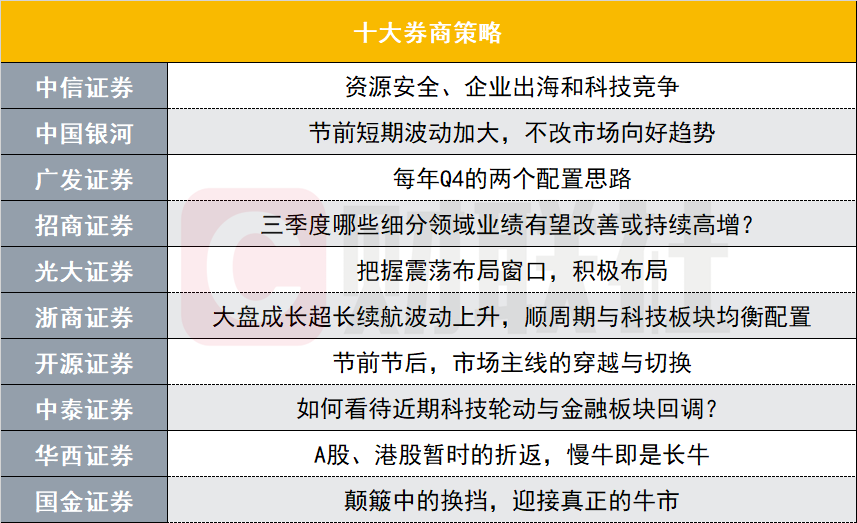
长假将至持币还是持股?十大券商策略来了
Feng Huang Wang· 2025-09-28 22:37
Core Viewpoint - The A-share market is experiencing narrow fluctuations as the National Day and Mid-Autumn Festival holidays approach, leading to increased market divergence. Some brokerages interpret the recent sideways movement of the index as a "gear shift" within a bull market [1] Group 1: Market Strategies - CITIC Securities emphasizes resource security, corporate globalization, and technological competition as key structural market themes, highlighting limited directions for speculation [3] - China Galaxy notes that short-term volatility before the holiday does not alter the overall positive market trend, with structural opportunities remaining prominent, particularly in the technology sector [4][5] - GF Securities identifies two key strategies for Q4: focusing on low-valuation blue chips and sectors with historical upward trends during this period [7][8] Group 2: Sector Insights - CITIC Securities points out that the resource sector is driven by insufficient investment in traditional resources amid high global interest rates, leading to supply constraints [3] - China Galaxy suggests that the new productivity theme will gain traction as China increasingly prioritizes technological self-reliance, with significant implications for the technology sector [4] - 招商证券 forecasts improvements in specific sectors such as high-end manufacturing, AI industry chain, and certain resource products due to policy support and low base effects [13][14] Group 3: Investment Opportunities - Guangfa Securities highlights the potential for cyclical industries to outperform in Q4, with over 65% historical probability of gains in these sectors [8][9] - Open Source Securities recommends focusing on technology sectors, particularly those with high growth potential, while also considering lower valuation opportunities in other sectors [20] - Huaxi Securities indicates that the current market conditions support a slow bull market, with a focus on technology and high-quality growth sectors [30] Group 4: Economic and Policy Context - The Federal Reserve's recent interest rate cuts are expected to support global liquidity, which may positively impact the A-share market [32] - The implementation of supply-side "anti-involution" policies is showing early signs of effectiveness, with industrial profits rebounding and PPI declines moderating [33] - The overall liquidity environment remains favorable, with increasing retail participation in the market and a shift towards passive investment products [34]