
金融保险

Search documents
激活消费潜能 构筑高质量发展新格局
Zhong Guo Zheng Quan Bao· 2025-10-22 20:16
Core Viewpoint - The Chinese government emphasizes the importance of boosting consumption as a long-term strategic choice for economic security, industrial upgrading, and improving people's livelihoods, especially in the context of a complex global environment [1] Group 1: Consumption as Economic Driver - Consumption is identified as the most fundamental and stable pillar of economic growth, providing solid support for long-term development [1] - The current structural issues in China include insufficient consumption and low industrial prices, necessitating a shift from investment and export-driven growth to a consumption-driven model [1][2] - The transformation towards a strong domestic consumption market is crucial for enhancing economic quality and resilience against external shocks [1] Group 2: Structural Upgrades in Consumption - Chinese consumer behavior is shifting from quantity to quality, with increasing demand for high-quality goods and services, particularly in sectors like culture, tourism, education, and healthcare [2] - This structural upgrade in consumption is driving supply-side responses, prompting companies to innovate in technology, business models, and resource allocation towards high-value sectors [2][3] - The goal of boosting consumption is to improve the actual living standards of families, reflecting a country's economic development and social progress [2] Group 3: Potential of the Chinese Consumption Market - China's consumption market has significant growth potential, supported by a large population base, despite challenges like an aging population [3][4] - The current consumption as a percentage of GDP is around 40%, which is lower than that of major developed countries, indicating room for optimization [3] - Service consumption in China is also lagging behind, with only 46.1% of per capita consumption in 2024 being service-related, compared to higher levels in Japan and the U.S. [3] Group 4: Systematic Solutions for Consumption Activation - The core issues in the consumption market stem from both demand and supply constraints, necessitating a comprehensive approach to stimulate consumption [5] - Strategies include stabilizing and increasing household income, improving the consumption environment, and enhancing the quality of supply [6][7] - Infrastructure investment is crucial for creating a favorable consumption environment, promoting a cycle of "infrastructure boosting consumption" [8]
华为联合中国太保共创金融保险业智能化新范式
Xin Lang Cai Jing· 2025-09-28 10:36
Core Insights - The insurance industry is undergoing a profound transformation through deep integration with cutting-edge technology [1] - The collaboration between Huawei and China Pacific Insurance aims to enhance operational efficiency and decision-making accuracy in key areas such as sales and claims [1] - This partnership represents not only a technological upgrade but also a practical implementation of strategic pathways for digital transformation in the financial insurance sector [1] Group 1 - The "Pacific Insurance Financial Industry Lighthouse" initiative brings multiple positive effects, providing high-performance computing support for China Pacific Insurance's business system [1] - The use of large model technology significantly improves operational efficiency and decision-making accuracy in critical processes [1] - The successful collaboration between Pacific Insurance Technology and Huawei validates the feasible model of "independent innovation + scenario application" [1] Group 2 - The partnership offers advanced concepts and practical frameworks for the digital transformation of the domestic financial insurance industry [1]

供应链+制造业+金融 中国信保支持我国自主品牌纯电客车出口埃塞俄比亚
Zhong Guo Jin Rong Xin Xi Wang· 2025-09-18 13:51
Core Insights - The delivery of 28 electric buses to Ethiopia, backed by China Export & Credit Insurance Corporation, highlights the growing demand for green transportation in the country as a new member of the BRICS [1] - The project showcases the collaboration between Xiamen Jianfa Light Industry Co., Ltd. and a leading domestic bus manufacturer, emphasizing resource sharing and complementary advantages in promoting high-quality Chinese manufacturing abroad [1] - The initiative aligns with Xiamen's status as one of the first cities in China to innovate and apply supply chain solutions, enhancing the local economy and supporting the development of a modern transportation system in Ethiopia [1] Company Insights - Xiamen Jianfa Light Industry Co., Ltd. has integrated resources effectively to meet market demands, focusing on customized production and a comprehensive service system from design to training and parts supply [1] - The company is leveraging its strengths in supply chain management to facilitate the export of domestically produced electric buses, contributing to the global green transportation movement [1] Industry Insights - The project is part of a broader trend in Ethiopia, where there is an increasing emphasis on upgrading public transportation facilities and adopting green vehicles [1] - China Export & Credit Insurance Corporation has developed a tailored risk protection plan for the export project, fostering a collaborative ecosystem of "supply chain + manufacturing + finance" to ensure smooth operations and market expansion [1]
百日千万招聘专项行动推出现代服务等专场招聘
Ren Min Ri Bao· 2025-09-10 22:13
Group 1 - The "Hundred Days of Millions of Recruitment" initiative is being launched from September 8 to 14, focusing on four online recruitment events in the intelligent driving, financial insurance, modern services, and electric power industries, with over 83,000 employers participating and a recruitment demand exceeding 577,000 positions [1] - The intelligent driving sector will feature over 40 employers offering positions such as autonomous driving algorithm engineers, data mining engineers, and hardware testing engineers, with a recruitment demand exceeding 1,000 positions [1] - The financial insurance sector will have over 60 employers providing roles like risk strategy analysts, financial risk control specialists, asset management consultants, and financial advisors, also with a recruitment demand exceeding 1,000 positions [1] Group 2 - The modern services sector will involve 83,000 employers offering positions such as maintenance engineers, administrative management, customer managers, and new media operations, with a recruitment demand of 574,000 positions [1] - The electric power sector will include over 90 employers offering roles such as electrical engineers, surveying engineers, equipment engineers, and centralized control operators, with a recruitment demand of 1,800 positions [1] - Employers and job seekers can participate in the recruitment activities through platforms like the China Public Recruitment Network, the National Talent Network, and the Employment Online Special Action main venue page [1]
【环球财经】巴西二季度GDP增长0.4% 为连续第16个季度增长
Xin Hua Cai Jing· 2025-09-04 05:38
Economic Overview - Brazil's GDP grew by 0.4% in Q2 2025, marking the 16th consecutive quarter of positive growth and the highest level since the series began in 1996, with a total economic output of 3.2 trillion reais [1] - The growth rate in Q2 was lower than the 1.3% recorded in Q1, indicating a moderate slowdown, but still exceeded market expectations of 0.3%. Year-on-year, the economy grew by 2.2% [1] Sector Performance - The services sector grew by 0.6%, reaching a historical high and serving as the main driver of overall economic growth, particularly in financial services, information and communication, and transportation and storage [1] - The industrial sector saw a 0.5% increase, primarily driven by mining, especially in oil and gas extraction, although manufacturing, electricity, and construction experienced slight declines [1] - Agriculture experienced a minor decline of 0.1% quarter-on-quarter but showed a significant year-on-year growth of 10.1%, benefiting from strong soybean and corn harvests earlier in the year [1] Demand Side Analysis - Government consumption decreased by 0.6%, while household consumption increased by 0.5%. Investment fell by 2.2%, mainly due to weaknesses in construction and capital goods production [1] - On the external front, exports grew by 0.7%, while imports declined by 2.9% [1] Industry Insights - The manufacturing and construction sectors, closely tied to credit, are under significant pressure, while the resilience of the services sector and household consumption plays a crucial supporting role [2]
汽车之家再次易主 18亿美元“卖身”海尔后将走向何处?
经济观察报· 2025-09-01 11:24
Core Viewpoint - The recent acquisition of Autohome by Haier Group's Katai Chi Holdings marks a significant shift in ownership, raising questions about the future direction and value of the platform, especially given its current performance decline [2][5]. Group 1: Acquisition Details - Haier Group announced the completion of a strategic investment in Autohome, acquiring approximately 43.0% of its shares for about $1.8 billion, thus becoming the controlling shareholder [2]. - Following the acquisition, Ping An Insurance retains a 5.1% stake in Autohome and one board seat, indicating a shift from being the major shareholder [2]. - The acquisition has been under scrutiny, particularly regarding Haier's intentions in the automotive sector, with the company denying plans to manufacture vehicles and instead focusing on automotive aftermarket services [2][3]. Group 2: Business Performance and Challenges - Autohome has experienced a significant decline in revenue and profit, with a reported net income of RMB 1.758 billion in Q2 2025, down 6.14% year-on-year, and a net profit of RMB 415.7 million, down 20.79% [5]. - The traditional media advertising revenue has plummeted by 35.46%, now accounting for only 16.24% of total revenue, due to reduced advertising budgets from automotive brands, particularly in the fuel vehicle segment [5]. - The company is facing challenges in its lead generation services due to the rise of direct sales models in the electric vehicle sector and increased competition within the industry [5]. Group 3: Strategic Direction - The new CEO of Autohome, appointed in February, has indicated a strategic shift towards transforming the company from a vertical media platform to an automotive ecosystem platform, in collaboration with Haier and Ping An [5][6]. - Katai Chi is expected to leverage Autohome's online platform to expand its offline service offerings, while also providing offline experiences for Autohome users [6]. - The future of Autohome's ability to capitalize on its traffic value remains uncertain, especially after multiple ownership changes [6].





汽车之家正式易主
Sou Hu Cai Jing· 2025-08-28 05:34
Group 1 - Haier Group's subsidiary, Katai Chi Holdings, has completed the strategic acquisition of a 43.0% stake in Autohome from Ping An's Yunchen Capital for approximately $1.8 billion, becoming the controlling shareholder of Autohome [2][4] - Ping An Property & Casualty will retain a 5.1% stake in Autohome through Yunchen Capital and maintain one board seat [2] - Following the acquisition, Autohome announced a management restructuring, with CEO Wu Tao resigning and Yang Song appointed as the new CEO [2] Group 2 - Yang Song, the new CEO of Autohome, assured employees that there would be no layoffs or changes to job stability and compensation as a result of the acquisition, and that business operations would continue normally [2] - The strategic focus post-acquisition will shift from being an automotive vertical media platform to an automotive ecosystem platform in collaboration with Haier and Ping An [2] - Autohome reported a net revenue of RMB 1.758 billion for Q2 2025, a decrease from RMB 1.873 billion in the same period of 2024, with a net profit of RMB 415.7 million compared to RMB 524.8 million in 2024 [3]

晚间公告丨8月27日这些公告有看头
Di Yi Cai Jing· 2025-08-27 10:46
Mergers and Acquisitions - Huayu Automotive plans to acquire 49% stake in SAIC Qingtao for 206 million yuan [2] - Debang Lighting intends to gain control of Jiali Co. by acquiring at least 51% of its shares, expected to constitute a major asset restructuring [3] Financial Performance - Honghe Technology reported a net profit of 87.3751 million yuan for the first half of 2025, a year-on-year increase of 10,587.74% [4] - China Pacific Insurance achieved a net profit of 26.53 billion yuan in the first half of 2025, up 16.9% year-on-year [5] - Juhua Co. reported a net profit of 2.051 billion yuan, reflecting a 146.97% increase year-on-year [6] - Transsion Holdings experienced a net profit decline of 57.48%, reporting 1.213 billion yuan for the first half of 2025 [7] - China Life Insurance's net profit reached 40.931 billion yuan, a 6.9% increase year-on-year [8] - Shandong Gold reported a net profit of 2.808 billion yuan, up 102.98% year-on-year, and plans to distribute a cash dividend of 1.8 yuan per 10 shares [9] - China Aluminum's net profit was 7.071 billion yuan, a slight increase of 0.81% year-on-year [10] Shareholding Changes - Hehui Optoelectronics announced that Shanghai Integrated Circuit Industry Investment Fund plans to reduce its stake by up to 2% [12] - Cambridge Technology's controlling shareholder reduced its stake by 1.8 million shares through block trading [13]




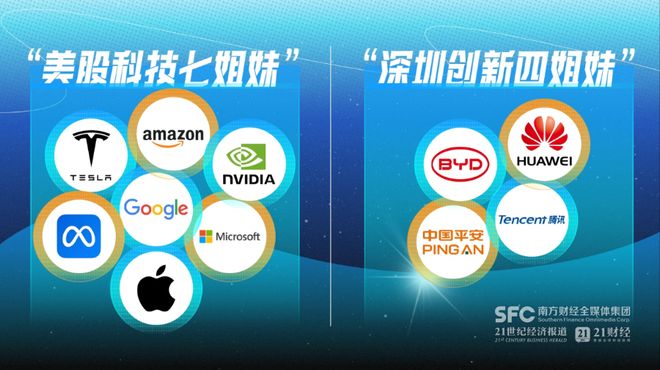
深圳创新“四姐妹”,凭什么是这四家企业?
2 1 Shi Ji Jing Ji Bao Dao· 2025-08-20 04:14
Core Viewpoint - The article highlights the emergence of Shenzhen as a global innovation hub, showcasing four major companies—Huawei, BYD, Tencent, and China Ping An—as representatives of China's innovative capabilities and their significant contributions to the economy and technology landscape [4][5][18]. Group 1: Shenzhen's Innovation Landscape - Shenzhen has transformed from a small fishing village to a prominent "innovation city" over the past 45 years, giving rise to influential tech companies [4][5]. - The "Shenzhen Innovation Four Sisters" (Huawei, BYD, Tencent, and China Ping An) each have a market value exceeding 1 trillion yuan and annual revenues surpassing 600 billion yuan [5]. - These companies collectively hold over 50,000 valid patents, supported by a research workforce of approximately 300,000 and R&D investments of 300 billion yuan [5][9]. Group 2: Talent and Workforce - Shenzhen boasts over 4 million skilled workers and more than 25,000 high-tech enterprises, with the "Four Sisters" employing a significant portion of the talent [9]. - BYD leads with 122,000 engineers, followed by Huawei with 113,000, and Tencent has a high technical talent ratio of 73% [9]. - China Ping An has invested 18 billion yuan in R&D, employing 21,000 tech developers and 3,000 scientists, with over 10% of its workforce holding master's or doctoral degrees [11][13]. Group 3: Technological Advancements - China Ping An is recognized for its AI-driven revenue growth, being the only financial insurance company included in Goldman Sachs' new AI investment framework [16]. - The company has developed advanced AI technologies, achieving high accuracy in various applications, including medical diagnostics and insurance underwriting [14][16]. - Huawei has successfully developed its own full-stack chips and the Harmony operating system, while BYD has reduced electric vehicle costs below Tesla's by 15% [18]. Group 4: Strategic Innovation Approaches - The "Four Sisters" have established flexible innovation mechanisms internally, allowing departments to operate autonomously while maintaining strategic alignment [20]. - Externally, they engage in collaborations and investments to acquire technological and market resources, exemplified by Ping An's differentiated service strategy in the financial sector [20][22]. - The companies are also exploring innovative business models, such as Ping An's "home-based elderly care" service, integrating various service modules to enhance customer experience [22].


沪指盘中突破3700点,A50ETF(159601)涨超1.8%,聚焦核心资产一键布局机会
Mei Ri Jing Ji Xin Wen· 2025-08-14 09:24
Group 1 - The A-share market has reached new heights, with the Shanghai Composite Index breaking through 3700 points for the first time since December 2021, indicating a significant upward trend [1] - The MSCI China A50 Connect Index rose over 1.8% during the session, with most constituent stocks experiencing gains, highlighting strong performance among leading assets [1] - Minsheng Securities notes that the current A-share market demonstrates improved "cost-performance" compared to historical levels, characterized by lower volatility and better sector rotation, which enhances investor confidence [1] Group 2 - The A-share market has outperformed economic growth for four consecutive quarters as of Q2, marking the first time since the second half of 2021 that the stock market has consistently outpaced economic expansion [1] - There is an expectation that the A-share market will outperform the US stock market, reflecting a commitment to enhancing the attractiveness of the domestic capital market amid various pressures faced this year [1] - The A50 ETF closely tracks the MSCI China A50 Connect Index, providing a balanced exposure to core leading assets in the A-share market, making it a preferred choice for both domestic and foreign investors [2]