基础化工

Search documents
活跃周期在途,但短线情绪过热或暗含局部波动风险
Huajin Securities· 2026-01-18 09:45
Group 1 - The new stock market is currently active, but short-term sentiment may be overheated, indicating potential local volatility risks [1][12] - Since the beginning of the year, the new stock sector has shown strong performance for two consecutive trading weeks, with a favorable atmosphere for buying [2][12] - The average increase of new stocks listed since 2025 is approximately 3.1%, with about 70.7% of new stocks showing positive returns [6][26] Group 2 - The average issuance price-to-earnings ratio for new stocks in January is 19.6X, slightly down from the previous month [13][15] - The average first-day closing price-to-earnings ratio for new stocks in January is 52.2X, down from 69.9X in the previous month [15][16] - The first-day average increase for new stocks in January is 138.8%, compared to 205.6% in the previous month, indicating a temporary decline in trading enthusiasm [16][24] Group 3 - Upcoming new stocks include Aisheren, Hengyun Chang, and Guoliang New Materials, with expected issuance price-to-earnings ratios of 44.1X for the new stocks [4][30] - The new stock issuance remains constrained, but the active funding environment suggests continued profit opportunities in new stock subscriptions [30][31] - Specific stocks recommended for attention include Tongyu New Materials, Fengbei Biological, and Hengkang New Materials, which are expected to show significant activity [39][40]
基本面选股组合月报:安全边际组合2025年实现21.34%超额收益-20260117
Minsheng Securities· 2026-01-17 15:13
- The "Competitive Advantage Portfolio" utilizes a competitive barrier analysis framework to categorize industries into four types: "Barrier Shield," "Highly Competitive," "Steady Progress," and "Seeking Breakthrough." The strategy focuses on identifying "sole leading" companies in "Barrier Shield" industries and "cooperative win-win" companies in industries without clear leaders. For non-"Barrier Shield" industries, it targets "efficient operation" companies that perform well even in competitive environments[11][12] - The "Margin of Safety Portfolio" emphasizes the internal factors of a company, focusing on creating entry barriers to ensure unique market positions and sustainable profitability. It calculates the intrinsic value of a company based on its profitability, selecting the top 50 stocks with the highest margin of safety from a pool of stocks with comprehensive competitive advantages. The portfolio is adjusted on May 1, September 1, and November 1 each year[17][19] - The "Dividend Low Volatility Adjusted Portfolio" aims to avoid the "high dividend trap" by considering the sustainability of company earnings and long-term value. It uses dividend yield predictions and negative screening to exclude stocks with extreme price performance or abnormal debt ratios[23] - The "AEG Valuation Potential Portfolio" uses the AEG_EP factor to select the top 100 stocks, then narrows it down to the top 50 stocks with high dividend reinvestment ratios. This strategy invests in companies whose growth potential is not yet fully recognized by the market. The AEG model calculates abnormal earnings growth as follows: $$ \begin{array}{c} A E G=Y_{t}-N_{t}=(E_{t}+r*D P S_{t-1})-(1+r)*E_{t-1} \\ \frac{V_{0}}{E_{1}}=\frac{1}{r}+\frac{1}{r}*\frac{\left(\frac{A E G_{2}}{1+r}+\frac{A E G_{3}}{(1+r)^{2}}+\frac{A E G_{4}}{(1+r)^{3}}+\cdots\right)}{E_{1}} \end{array} $$ where \(E_1\) is the first period's earnings and \(V_0\) is the current market value[28][29][31] - The "Cash Cow Portfolio" uses the CFOR analysis system to evaluate a company's profitability and cash generation efficiency. It focuses on the stability of free cash profit ratio, operating asset return rate, net profit margin, and total asset turnover rate, selecting high-quality stocks from the CSI 800 index[34][35][36] - The "Distressed Reversal Portfolio" captures short-term valuation fluctuations by utilizing inventory cycles to depict company reversals, considering accelerated recovery and undervaluation. It constructs a top 50 portfolio based on valuation improvement[41][43] Model Backtest Results - Competitive Advantage Portfolio: Annualized return since 2019 is 19.84%, Sharpe ratio 0.93, IR 0.09, maximum drawdown -19.32%, Calmar ratio 1.03[16] - Margin of Safety Portfolio: Annualized return since 2019 is 23.16%, Sharpe ratio 1.15, IR 0.16, maximum drawdown -16.89%, Calmar ratio 1.37[21] - Dividend Low Volatility Adjusted Portfolio: Annualized return since 2019 is 16.87%, Sharpe ratio 1.00, IR 0.17, maximum drawdown -21.61%, Calmar ratio 0.78[24] - AEG Valuation Potential Portfolio: Annualized return since 2019 is 25.36%, Sharpe ratio 1.16, IR 0.15, maximum drawdown -24.02%, Calmar ratio 1.06[33] - CSI 800 Cash Cow Portfolio: Annualized return since 2019 is 13.42%, Sharpe ratio 0.67, IR 0.09, maximum drawdown -19.80%, Calmar ratio 0.68[39] - Distressed Reversal Portfolio: Annualized return since 2019 is 24.53%, Sharpe ratio 0.99, IR 0.15, maximum drawdown -33.73%, Calmar ratio 0.73[43]
A股市场运行周报第76期:市场修斜率,慢牛更可期,两法可应对-20260117
ZHESHANG SECURITIES· 2026-01-17 11:40
Core Insights - The market experienced a surge followed by a pullback, with a general trend of "small strength and large weakness" observed. The major indices began to correct their upward slope, indicating a potential short-term consolidation after the spring rally initiated in mid-December last year. However, this correction does not alter the overall "systematic slow bull" nature of the market [1][4][55] - The report suggests that the technology growth sector is expected to outperform, and recommends two strategies for market participation: one is to balance mid-term positions in sectors with high prosperity and reasonable price levels, specifically in the "two electric and non-mechanical" sectors (electronics, new energy, chemicals, non-bank financials, machinery) to adopt an "offensive instead of defensive" approach; the second is to consider the relatively lower positions in the market, such as the CSI 1000 and National CSI 2000, to capture relative returns [1][5][56] Weekly Market Overview - The market saw a significant increase in trading volume followed by a decline, with the major indices showing a "small strength and large weakness" pattern. The Shanghai Composite, SSE 50, and CSI 300 indices fell by 0.45%, 1.74%, and 0.57% respectively, while growth indices like CSI 500, CSI 1000, and National CSI 2000 rose by 2.18%, 1.27%, and 1.31% respectively [2][12][54] - The technology sector is gaining momentum, with TMT sectors (Technology, Media, Telecommunications) showing strong performance, while other styles are generally weakening. The computer, electronics, media, and communication sectors rose by 3.82%, 3.77%, 2.04%, and 1.42% respectively [2][14][54] Market Sentiment and Fund Flows - The average daily trading volume in the Shanghai and Shenzhen markets increased to 3.43 trillion yuan, indicating heightened market activity. However, the financing buy-in ratio decreased to 10.85% [20][26] - The total margin financing balance rose significantly to 2.71 trillion yuan, with a notable inflow of funds into the margin financing sector, while stock ETFs experienced a net outflow of 675 million yuan [26][31] Market Attribution - Key events influencing the market included the increase in financing margin ratios by the Shanghai and Shenzhen stock exchanges, announcements from multiple listed companies urging rational decision-making, and a meeting by the China Securities Regulatory Commission emphasizing market stability [3][50][54]
业绩行情逐步发酵!预告披露率已突破5%,“预喜”股扎堆板块盘点,这些标的高增领跑
Xin Lang Cai Jing· 2026-01-16 09:45
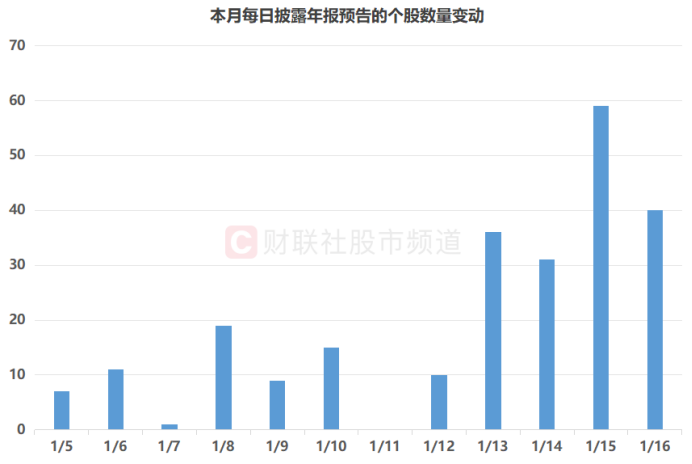
Core Viewpoint - The A-share market is experiencing an increase in performance announcements as the deadline for annual report forecasts approaches, with over 280 companies having disclosed their 2025 annual report forecasts by January 16, representing nearly 5.2% of the total market [1]. Group 1: Performance Forecasts - Nearly half of the disclosed companies have positive performance forecasts for 2025, with around 140 companies (47.6%) expecting an increase, slight increase, turnaround, or continued profit [3]. - The breakdown of positive forecasts includes 26.9% expecting an increase, 14.7% a slight increase, 5.6% a turnaround, and 0.3% continued profit [3]. - Conversely, about half of the companies are expected to incur losses in 2025, with 19.6% continuing losses, 10.5% first-time losses, 8.7% reduced losses, 4.9% increased losses, and 4.5% reduced forecasts [3]. Group 2: Industry Distribution - The sectors with the highest number of companies expecting positive performance include basic chemicals, electronics, automotive, pharmaceutical biology, and machinery, accounting for nearly 56.6% of the positive forecast companies [3]. - In terms of loss forecasts, the sectors with the highest concentration of expected losses are electronics, electrical equipment, construction decoration, machinery, and pharmaceutical biology [4]. Group 3: Individual Company Performance - Among the disclosed forecasts, 11 companies are expected to have a net profit (lower limit) exceeding 5 billion yuan, with Zijin Mining leading at 51 billion yuan [8]. - Other notable companies with significant profit forecasts include Luoyang Molybdenum, Luxshare Precision, WuXi AppTec, Muyuan Foods, and Baofeng Energy, all exceeding 10 billion yuan [8]. - A total of 48 companies are expected to see their profit growth double, with Kewen Biological, Zhongtai Shares, SAIC Motor, and Bawei Storage among the top performers [8]. Group 4: Turnaround Companies - There are 16 companies expected to turn around from losses, with Kewen Biological leading with a projected profit growth of over 10 times [10]. - Other companies with significant turnaround forecasts include Zhongtai Shares, Huazheng New Materials, and Haowu Shares, all showing growth rates above 2 times [10]. - The sectors with the most turnaround companies include machinery, basic chemicals, agriculture, automotive, and others [10].





研究所日报-20260116
Yintai Securities· 2026-01-16 05:17
Report Summary 1. Industry Investment Rating - Not provided in the given content. 2. Core Views - The central bank has rolled out a "combination punch" to support high - quality economic development, focusing on private SMEs and technological innovation. There is still room for reserve requirement ratio cuts and interest rate cuts, with favorable conditions for further loosening of monetary policy [2][3]. 3. Key Points by Category Central Bank Policies - The central bank has lowered the rediscount and relending rates by 0.25 percentage points. It has increased the relending quota for agriculture and small businesses by 500 billion yuan, set up a 1 - trillion - yuan relending quota for private enterprises, and increased the quota for technological innovation and transformation relending by 400 billion yuan. It has also expanded the scope of the carbon emission reduction support tool and reduced the minimum down - payment ratio for commercial housing loans to 30% [2]. - Central bank deputy governor Zou Lan stated that there is still room for reserve requirement ratio cuts and interest rate cuts. Conditions for further loosening monetary policy are relatively sufficient, and loose monetary policy is needed to support positive fiscal policies, consumption boost, and investment stabilization [3]. Stock Market Performance On January 15, 2026 - A - share indices showed mixed performance. The Shanghai Composite Index fell 0.33%, the Shenzhen Component Index rose 0.41%, and the total trading volume of the two markets was 2,905.496 billion yuan, a decrease of 1,035.893 billion yuan from the previous trading day. The ChiNext Index rose 0.56%, and the STAR 50 Index fell 0.46% [4]. - Internationally, South Korean, Dutch, and US stocks led the gains, while the Hang Seng Tech Index, Saudi All - Share Index, and Nikkei 225 led the losses. European major stock indices also showed mixed performance [4]. - The 10 - year China Treasury bond yield was 1.8483%, with a change of - 0.14BP. The average daily prices of inter - bank R001 and R007 were 1.4154% and 1.5497% respectively [4]. - In terms of sectors, electronics, basic chemicals, and non - ferrous metals led the gains, while the comprehensive, national defense and military industry, and media sectors led the losses [4]. On January 8, 2026 - The Shanghai Composite Index fell slightly by 0.07%, and the Shenzhen Component Index fell 0.51%. The total trading volume of the two markets was 2,800.265 billion yuan, a decrease of 538.76 billion yuan from the previous trading day. The ChiNext Index fell 0.82%, and the STAR 50 Index rose 0.82% [7]. - US stocks showed mixed performance, and European stocks also had mixed results. The Nikkei 225, Dutch AEX, Hang Seng Index, and Hang Seng Tech Index had relatively large declines [8]. - The 10 - year China Treasury bond yield was 1.8828%, with a change of - 1.6BP. The average daily prices of inter - bank R001 and R007 were 1.3424% and 1.5261% respectively [9]. - In terms of sectors, national defense and military industry, media, building decoration, and real estate led the gains, while non - bank finance, non - ferrous metals, communications, and banks led the losses [10]. Interest Rates and Exchange Rates - The 10 - year US Treasury bond yield was 1.848, with a change of - 0.14BP. DR007 was 1.502, with a change of - 6.44BP. The US dollar against the offshore RMB was 6.9631, with a change of - 0.12%. The US dollar index was 99.34, with a change of 0.27% [20]. A - Share Market Overview - The total A - share market capitalization was 114.37 trillion yuan, an increase of 5.62 trillion yuan compared to the beginning of the year. The cumulative trading volume this year was 28.53 trillion yuan, with an average daily trading volume of 31,698.37 billion yuan. The PE(TTM) was 23.34x, and the PB(MRQ) was 6.23x. The margin trading balance decreased by 24,885.74 billion yuan compared to a month ago, and the short - selling balance decreased by 170.96 billion yuan [24]. - Different A - share indices had different performance, with details on their closing prices, trading volumes, daily and weekly changes, and the number of rising and falling stocks [24]. - The latest trading volume was 29,385 billion yuan, and the latest turnover rate was 4.98%. The margin trading balance was 26,806 billion yuan as of January 14, 2026 [25][26]. Industry Performance - The top three sectors in terms of daily increase were electronics, basic chemicals, and non - ferrous metals. The top three sectors in terms of daily net capital inflow were electronics, banks, and basic chemicals. The top three sectors in terms of late - session net capital inflow were electronics, machinery, and national defense and military industry [28][30]. - The top three themes in terms of daily increase were advanced packaging, cobalt mines, and lithography machines [30].
“反内卷”优化供给,有机硅、PTA等子行业迎修复机遇,聚焦石化ETF(159731)配置价值
Mei Ri Jing Ji Xin Wen· 2026-01-16 05:14
Group 1 - The core viewpoint of the article highlights the performance of the Petrochemical ETF (159731), which has seen a decline of 0.52% as of January 16, with notable gains from stocks like Bluestar Technology, Tongcheng New Materials, and Jinfat Technology [1] - The Petrochemical ETF has experienced net inflows for 8 out of the last 10 trading days, totaling 176 million yuan, with its latest share count reaching 449 million and a total scale of 431 million yuan, both marking new highs since its inception [1] - According to Industrial Securities, the "anti-involution" trend is optimizing supply order, and certain sub-industries are expected to recover, particularly in organic silicon, PTA, polyester filament, caprolactam, spandex, soda ash, PVC, glyphosate, and urea [1] Group 2 - Several sub-industries within the chemical sector, such as organic silicon, PTA, and caprolactam, are gradually initiating industry self-discipline to seek profit recovery, with expectations for improved performance following price control and production reduction measures [1] - Other sub-industries experiencing price and margin fluctuations at the bottom are also anticipated to see profit improvements driven by potential industry self-discipline and supply-demand recovery [1] - The Petrochemical ETF and its linked funds closely track the CSI Petrochemical Industry Index, with the basic chemical industry accounting for 59.23% and the oil and petrochemical industry for 32.60%, indicating a potential upward trend in industry prosperity due to the "anti-involution" catalyst [1]
化工板块迎盘整!政策利好密集释放,机构:化工盈利有望触底回升
Xin Lang Cai Jing· 2026-01-16 02:50
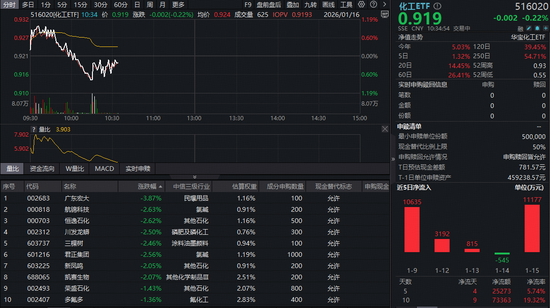
Group 1 - The chemical sector is experiencing fluctuations, with the chemical ETF (516020) showing a slight decline of 0.22% as of the report time [1][5] - Key stocks in the sector, including Guangdong Hongda, fell over 3%, while several others like Hanjin Technology and Hengyi Petrochemical dropped more than 2%, negatively impacting the sector's performance [1][5] - Recent regulatory developments include the approval of the "People's Republic of China Hazardous Chemicals Safety Law," effective from May 1, 2026, marking a new phase in hazardous materials management [7] Group 2 - The Ministry of Industry and Information Technology and six other departments have issued a "Work Plan for Stable Growth in the Petrochemical and Chemical Industry (2025-2026)," emphasizing a transition towards green and high-end development [7] - Shanghai Securities anticipates a recovery in the chemical industry, with supply growth expected to slow and a replenishment cycle beginning [7] - Huafu Securities notes that after a downturn in profitability and valuation in 2025, the industry is poised for a rebound in 2026, entering a new phase of supply-demand rebalancing [7] Group 3 - The chemical ETF (516020) tracks the CSI sub-sector chemical industry index, with nearly 50% of its holdings in large-cap leading stocks like Wanhua Chemical and Salt Lake Industry, providing investment opportunities [2][8] - The remaining 50% of the ETF's holdings are diversified across leading stocks in sub-sectors such as phosphate fertilizer, fluorine chemicals, and nitrogen fertilizers [2][8] - Investors can also access the chemical ETF through linked funds (Class A 012537/Class C 012538) for more efficient exposure to the sector [2][8]


华泰期货:央行“组合拳” 助力市场回升
Xin Lang Cai Jing· 2026-01-16 02:38
Core Viewpoint - The central bank has introduced a significant policy package aimed at supporting high-quality economic development, which includes various measures to enhance liquidity and support specific sectors [1][6]. Monetary Policy - The central bank has lowered the re-lending and rediscount rates by 0.25 percentage points [1][6]. - The quota for re-lending to support agriculture and small enterprises has been increased by 500 billion yuan, with a total quota of 1 trillion yuan specifically for private enterprises [1][6]. - The re-lending quota for technological innovation and technical transformation has been increased by 400 billion yuan, with an expanded support scope [1][6]. - The minimum down payment ratio for commercial property loans has been reduced to 30% [1][6]. - The central bank indicated that there is still room for further rate cuts and reserve requirement ratio reductions this year [1][6]. Market Performance - The A-share market showed mixed performance, with the Shanghai Composite Index down 0.33% at 4112.60 points, while the ChiNext Index rose 0.56% [1][6]. - Sector performance varied, with electronics, basic chemicals, and non-ferrous metals leading gains, while defense, media, and computer sectors experienced declines [1][6]. - The trading volume in the Shanghai and Shenzhen markets decreased to 2.9 trillion yuan [1][6]. - In the U.S., major stock indices saw slight increases, with the Dow Jones up 0.6% at 49,442.44 points [1][6]. Strategy - The central bank's policy measures are expected to enhance market liquidity and strengthen the growth drivers for the technology sector within the equity market [3][8]. - The overall monetary policy remains accommodative, with the continuous release of liquidity expected to positively impact the equity market, providing upward momentum for stock indices [3][8]. - It is recommended to buy on dips for IC and IM contracts [3][8].

华泰证券今日早参-20260116
HTSC· 2026-01-16 02:04
Macro Insights - The central bank has announced a series of targeted monetary easing measures, including structural interest rate cuts and expanded relending quotas, indicating a clear intention to support high-quality economic development in 2026 [2][3] - December's new RMB loans and social financing slightly exceeded market expectations but showed a year-on-year decrease, reflecting a divergence in financing demand between infrastructure and real estate sectors [2][3] Power Equipment and New Energy - The State Grid Corporation plans to invest 4 trillion yuan during the 14th Five-Year Plan period, a 40% increase compared to the previous plan, which is expected to benefit power grid equipment companies significantly [4][5] - The demand for ultra-high voltage construction remains high, and investments in cross-province transmission channels and reinforcement of weak grids in the western regions are expected to continue growing [4] Fixed Income and Credit - The recent financial data indicates a strong start to credit in 2026, with the central bank's proactive monetary policy tools being a key factor [3] - The adjustment of the minimum margin ratio for margin trading from 80% to 100% reflects a regulatory approach to guide the market towards a healthier long-term trend [5] Oil and Chemicals - The ongoing tensions in Iran may disrupt the supply of energy and chemical products, leading to increased volatility in oil prices, with WTI and Brent crude oil prices rising by 6.5% and 7.6% respectively since the beginning of the month [6] - Iran's status as a major supplier of urea and methanol means that prolonged conflict could lead to localized shortages in these chemicals [6] Technology Sector - Insights from CES 2026 highlight three main investment themes: the ongoing demand for computing chips and data center infrastructure driven by AI, the rise of robotics, and advancements in smart hardware technologies [7] - The preference for investment is shifting towards storage, semiconductor equipment, and indices like the Philadelphia Semiconductor Index and Nasdaq [7] Key Companies - Si Yuan Electric (002028 CH) reported a revenue of 21.205 billion yuan for 2025, a year-on-year increase of 37.18%, and a net profit of 3.163 billion yuan, exceeding previous expectations [8] - Shengnong Development (002299 CH) anticipates a net profit of 1.37-1.43 billion yuan for 2025, reflecting a year-on-year growth of 89.2%-97.4%, despite challenges in the fourth quarter due to falling chicken prices [9]
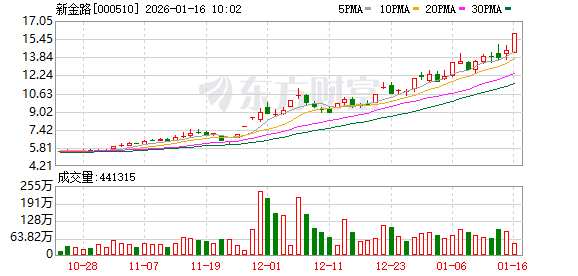
新金路涨8.79%,股价创历史新高
Zheng Quan Shi Bao Wang· 2026-01-16 02:02
新金路股价创出历史新高,截至9:41,该股上涨8.79%,股价报15.72元,成交量2323.86万股,成交金额 3.50亿元,换手率3.83%,该股最新A股总市值达101.95亿元,该股A股流通市值95.37亿元。 (文章来源:证券时报网) 证券时报·数据宝统计显示,新金路所属的基础化工行业,目前整体涨幅为0.55%,行业内,目前股价上 涨的有189只,涨幅居前的有星华新材、天晟新材、华谊集团等,涨幅分别为15.63%、12.10%、 10.01%。股价下跌的有227只,跌幅居前的有神剑股份、七彩化学、金牛化工等,跌幅分别为9.99%、 9.40%、6.93%。 公司发布的三季报数据显示,前三季度公司共实现营业收入12.60亿元,同比下降16.82%,实现净利 润-7849.45万元,同比下降129.38%,基本每股收益为-0.1210元。(数据宝) ...