
传媒

Search documents
收盘丨沪指涨0.85%重返4100点,煤炭股掀涨停潮
Di Yi Cai Jing· 2026-02-04 07:16
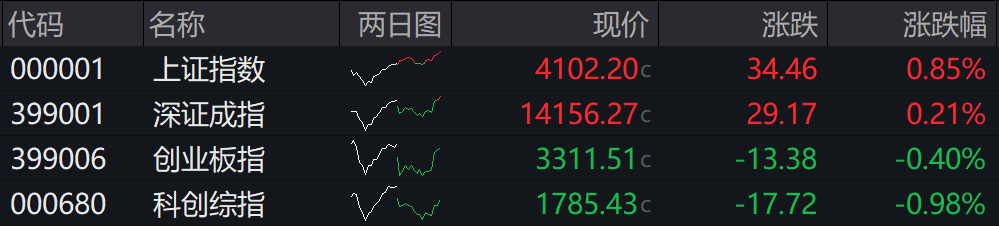
沪深两市成交额2.48万亿,较上一个交易日缩量633亿。 2月4日,A股三大指数分化,沪指震荡上行。截至收盘,沪指涨0.85%,深成指涨0.21%,创业板指跌0.4%,科创综指跌0.98%。 | 代码 | 名称 | 涨幅量 | 现价 | | --- | --- | --- | --- | | 000517 | 荣安地产 | +10.27% | 2.04 | | 600683 | 京投发展 | +10.09% | 6.00 | | 000560 | 我爱我家 | +10.06% | 3.61 | | 600325 | 华发股份 | +9.95% | 4.42 | | 000838 | 财信发展 | +9.92% | 2.66 | | 000042 | 中洲控股 | +7.91% | 9.00 | | 601155 | 新城控股 | +7.62% | 18.08 | | 600791 | 京能量化 | +7.60% | 6.51 | | 001979 | 招商蛇口 | +7.31% | 10.87 | | 600649 | 城投控股 | +6.94% | 5.55 | | 600463 | 空港股份 | +6.7 ...




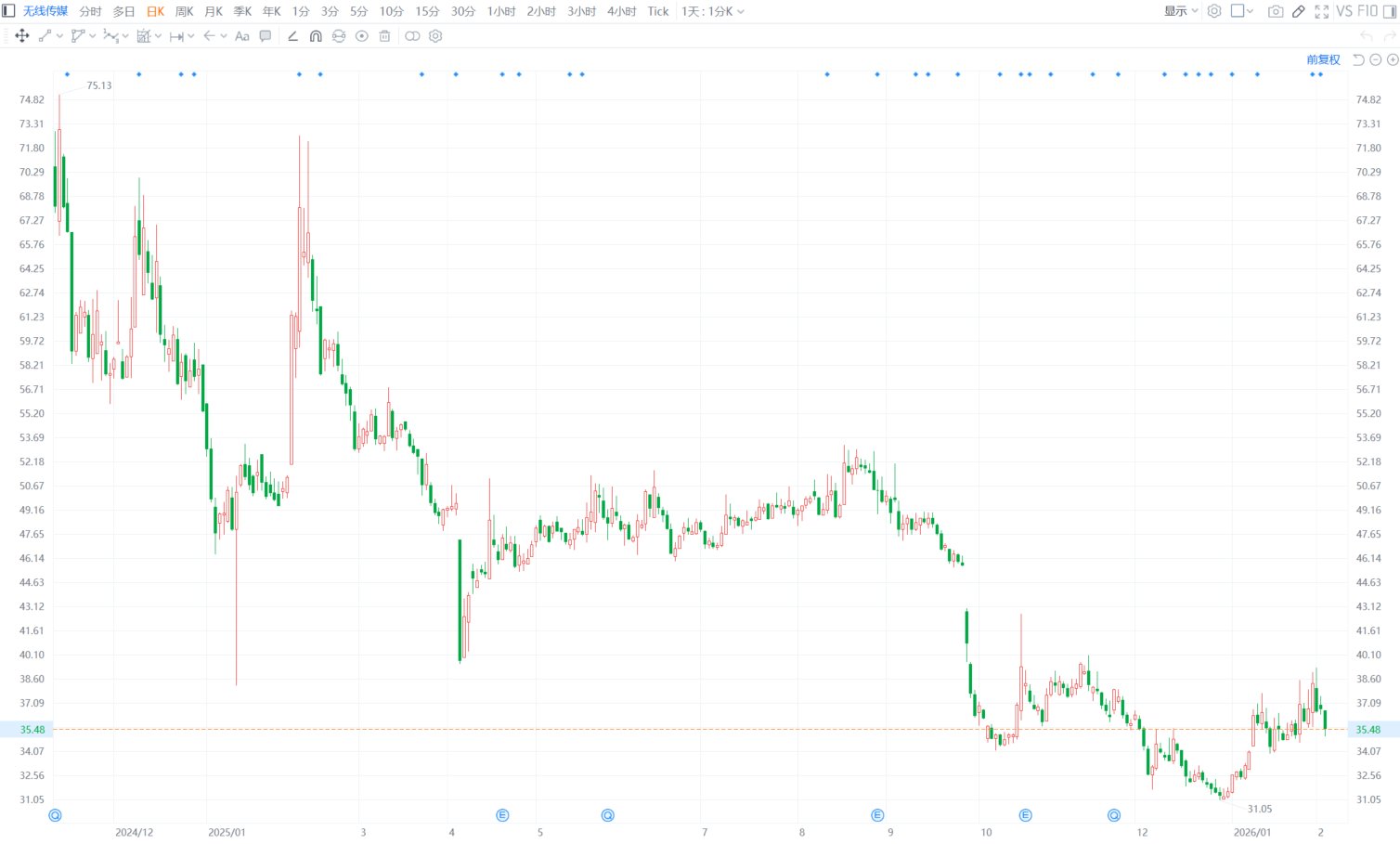
A股异动丨无线传媒跌逾4% 文盛基金及一致行动人和旅投基金分别完成减持4%和0.7%
Ge Long Hui A P P· 2026-02-04 06:54
Group 1 - The core point of the article is that Wireless Media (301551.SZ) experienced a decline of 4.57%, closing at 35.05 yuan due to significant share reductions by major shareholders [1] - Wensheng Fund and its concerted parties reduced their holdings by a total of 15.9999 million shares, representing 4% of the total share capital, through block trades and centralized bidding from December 16, 2025, to January 30, 2026 [1] - Lvtou Fund also reduced its holdings by 2.8165 million shares, accounting for 0.7% of the total share capital, between December 16, 2025, and December 26, 2025 [1]
央行加量续作3个月期买断式逆回购,A500ETF基金(512050)午后回升,昨日获得超3.6亿元资金净流入
Mei Ri Jing Ji Xin Wen· 2026-02-04 06:12
Group 1 - A500ETF fund (512050) experienced a low opening and fluctuated, with a narrowing decline of 0.244% by 13:53. Notable stocks in the portfolio included JinkoSolar, CIMC Group, TCL Technology, and China Eastern Airlines, all reaching a 10% limit up. The ETF saw a net inflow of over 360 million yuan yesterday [1] - The People's Bank of China announced an 800 billion yuan reverse repurchase operation on February 4, aimed at maintaining ample liquidity in the banking system. This operation will result in a net injection of 100 billion yuan after accounting for 700 billion yuan in reverse repos maturing this month [1] - Analysts believe that February is a month with concentrated credit issuance, and the demand for liquidity is increasing due to cash withdrawal factors before the Spring Festival. The central bank has been injecting medium- and short-term liquidity into the market through reverse repos and medium-term lending facilities (MLF) to ensure stable financial market operations at the year's end [1] Group 2 - Dongfang Caifu Securities indicated that the spring market is not over, and structural adjustments are needed. It is suggested to focus on sectors that have not fully realized their potential gains since the spring rally, such as electronics, communications, and non-bank financials [2] - Key industry directions to focus on include electronics, insurance, media, machinery, communications, and chemicals. Thematic areas of interest include robotics, autonomous driving, and AI applications [2]
2月资产配置展望:金银大幅波动后怎么看?
East Money Securities· 2026-02-04 05:32
Group 1: Strategy Overview - The report indicates that after significant fluctuations in gold and silver prices, the market is influenced by geopolitical uncertainties and the strong dollar, which may lead to a bearish outlook for gold prices in the short term [11][12][10] - The report suggests that high-risk investors with insufficient positions may consider participating in gold and silver trading to adjust their holdings, while long-term asset allocation should reduce gold's proportion due to uncertainties surrounding inflation control and strong dollar policies [11][12][10] Group 2: Market Performance in January - In January, precious metals continued to show strong performance, driven by geopolitical uncertainties and increased demand for safe-haven assets, with COMEX silver rising by 131.61% and COMEX gold increasing by 26.44% from November 2025 to January 28, 2026 [13][14] - The report highlights a structural recovery in the domestic stock market, with the Shanghai Composite Index rising by 4.6% in January, while the performance of financial and consumer sectors was relatively weak [15][19] Group 3: Commodity Market Insights - The report notes that the commodity market is characterized by increased geopolitical disturbances and rising risk premiums for physical assets, with industrial metals supported by recovering manufacturing activity and structural demand from AI and renewable energy sectors [29][30] - Oil prices are influenced by geopolitical factors, particularly the situation in Iran, with expectations of oversupply in the medium term as global supply is projected to increase significantly [35][36] Group 4: Bond Market Analysis - The bond market is expected to maintain a narrow range of fluctuations, with the 10-year government bond yield projected to oscillate between 1.8% and 1.9% due to policy support and market expectations [28][21] - The report indicates that the defensive attributes of the bond market have weakened, reflecting a shift in investor preference towards equities and commodities amid rising risk appetite [16][21]
国泰海通证券1月基金表现回顾:重配有色、传媒等相关行业和个股的基金表现较优
GUOTAI HAITONG SECURITIES· 2026-02-04 05:17
重配有色、传媒等相关行业和个股的基金表现较优 国泰海通证券 1 月基金表现回顾 [Table_Authors] 庄梓恺(分析师) 本报告导读: 2026 年 1 月,A 股上涨,债市上涨,美股上涨,油价金价均上涨。基金方面,部分 重配有色、传媒等相关行业和个股的基金表现较优。 投资要点: [Table_Summary] 2026 年 1 月资本市场回顾 股票市场:A 股上涨,有色金属、传媒和石油石化行业表现较优。 2026 年 1 月,A 股上涨。2026 年开年以来,A 股市场热点赛道相继 发酵,在去年中国经济完成全年目标的背景下,A 股市场景气度保 持向上,1 月全月依然延续了慢牛上涨行情。从结构性机会来看,首 先,全球局势紧张加剧全球矿产供给不确定性,全月有色金属行业 表现靠前;其次,AI 大模型公司智谱、MiniMax 相继在港股上市, 以 AI 应用为代表的传媒行业表现出色;此外,国际能源署上调 2026 年全球原油需求增长预期,将需求增幅从此前的 86 万桶/日调整为 93 万桶/日,叠加地缘政治因素,石油石化板块本月走强。 2026 年 1 月基金业绩回顾 基金评价 /[Table_Date] ...
重要!一边是“煤飞色舞”,一边是“科技退潮”,发生了什么?
Sou Hu Cai Jing· 2026-02-04 04:54
Core Viewpoint - The A-share market is experiencing a classic structural market scenario driven by policy guidance, capital preferences, and market sentiment, with a clear divergence between sectors [1] Market Overview - The Shanghai Composite Index closed flat at 4067.67 points, while the Shenzhen Component Index fell by 0.92%, the ChiNext Index dropped by 1.74%, and the STAR 50 Index plummeted by 2.44%, indicating a "strong Shanghai, weak Shenzhen" pattern [1] - Total trading volume reached 1.62 trillion yuan, showing a slight increase, reflecting significant divergence between bulls and bears at current levels [1] Sector Performance - The gainers were predominantly traditional cyclical and stable growth sectors: coal (+6.32%), transportation (+2.34%), real estate (+1.76%), and building materials (+1.75%) [1] - The decliners were entirely from the technology growth sector: media (-3.70%), telecommunications (-3.19%), computers (-2.61%), and electronics (-2.32%) [1] Driving Factors of Market Divergence - **Policy Catalysts**: The central government's focus on "energy security" and "modern industrial construction" has boosted the coal sector, while local governments' commitment to growth has positively impacted the real estate and transportation sectors [2] - **Capital Flows**: There is a clear trend of "risk aversion" and "seeking stability," with new and existing funds moving towards high dividend, stable performance sectors benefiting from policy support, such as coal [2] - **External Market Influence**: The decline of the Hang Seng Tech Index by 2.29% has affected A-shares, particularly in the TMT sector, due to global concerns over AI technology disrupting traditional business models [3] Coal Sector Insights - The rise of the coal sector is not merely a rebound from oversold conditions; it reflects a strategic shift towards being a "stabilizer" and "modern industrial foundation" under the "energy security" framework, potentially leading to a revaluation of the sector [3] - The coal sector's low valuation and high cash flow characteristics make it a preferred defensive allocation in an uncertain market, with today's surge reflecting market premium on this "certainty" [3] Future Market Outlook - The current divergence in the market is unlikely to end quickly, with a shift from a broad-based "beta market" to a focus on individual stocks and niche sectors, indicating an "alpha market" approach [3] Investment Opportunities - Two areas to focus on include sectors driven by "policy bottom" and "dividend yield," such as energy and core infrastructure operators, which offer good safety margins [4] - Additionally, sectors with confirmed industry trends and recent policy details, like aerospace and hydrogen energy, may emerge as leading growth stocks [4]
蜜雪冰城的雪王经济学:主题乐园或成方向
2 1 Shi Ji Jing Ji Bao Dao· 2026-02-04 03:54
Core Insights - Mixue Ice City is diversifying its business model, with the "Snow King" IP being a significant focus for expansion and engagement [1][3][4] Group 1: Recruitment and Theme Park Development - Mixue Ice City has recently posted job openings related to a "Theme Park Project," indicating plans to develop a comprehensive experience around the "Snow King" IP [1] - The job roles include positions such as park performance coordinator, content writer, project manager, and product coordinator, with salaries ranging from 10,000 to 24,000 yuan per month [1] Group 2: Expansion and Flagship Stores - The company has been expanding its flagship stores across cities like Hangzhou, Jinan, and Guangzhou, featuring limited edition drinks and merchandise related to the "Snow King" [2] - The flagship store in Zhengzhou has shown strong customer attraction, with a peak daily footfall of 46,000 and a maximum daily revenue exceeding 350,000 yuan [2] Group 3: Brand and Marketing Efficiency - The "Snow King" IP has become a core competitive advantage for Mixue Ice City, significantly reducing marketing expenses, with brand promotion costs accounting for only 0.9% of revenue in the first three quarters of 2024 [3] - The operational costs associated with the "Snow King" IP are low, and its popularity has been driven by the company's extensive store network rather than heavy promotional spending [3] Group 4: Future Investments - Approximately 7% (2.3 billion HKD) of the funds raised will be allocated to further develop the brand IP and enhance consumer recognition of the "Snow King" [5] - The recruitment for the theme park project may be a strategic move to capitalize on the economic potential of the "Snow King" [6]

太空光伏概念,大爆发
财联社· 2026-02-04 03:43
Market Overview - The A-share market experienced a volatile decline, with the Shanghai Composite Index turning negative and the ChiNext Index dropping over 2% during the session [1] - The total trading volume in the Shanghai and Shenzhen markets reached 1.62 trillion yuan, an increase of 116 billion yuan compared to the previous trading day [1] Sector Performance - The space photovoltaic concept saw a significant surge, with Zhonglai Co. hitting the daily limit up of 20% and Guosheng Technology achieving two consecutive limit-ups [3] - The coal sector rebounded collectively, with Yanzhou Coal, China Coal Energy, and Shanxi Black Cat all reaching the daily limit up [3] - The airport and shipping sectors strengthened, with China Eastern Airlines and Huaxia Airlines also hitting the daily limit up [3] - The real estate sector was active, with Rong'an Real Estate and Caixin Development reaching the daily limit up [3] - The hydrogen energy concept experienced a rapid rise, with Beijing Capital and Zhiyuan New Energy hitting the daily limit up [3] Declining Sectors - The precious metals sector opened high but fell back, with Zhaojin Mining and Sichuan Gold experiencing significant declines [3] - The AI application sector saw a collective downturn, with Yili Media hitting the daily limit down [3] Closing Summary - By the end of the trading session, the Shenzhen Component Index fell by 0.92%, and the ChiNext Index dropped by 1.74% [3]





1月A股新开户数超490万户
Jin Rong Shi Bao· 2026-02-04 03:19
A股股票与基金开户量激增,是市场行情向好的直接体现与有力印证。 刚刚过去的1月,A股三大指数悉数收涨,上证指数、深证成指、创业板指分别上涨3.76%、5.03%、4.47%,科创综指则大幅收涨近12%。市场整体呈 现"小盘成长占优,大盘价值承压"的结构性分化格局,有色金属与科技两大主线交替领涨。 《金融时报》记者2月3日从上交所获悉,2026年1月,A股新开户数491.58万户,刷新2024年11月以来的单月开户纪录,环比增长89.3%,同比增长 213.1%。同月,基金新开户54.63万户,环比增长123.8%,同比增长168.7%。 | 日期 | 总数 | A股 | B股 | 基金 | | --- | --- | --- | --- | --- | | 2026.01 | 546.27 | 491.58 | 0.05 | 54.63 | 展望后市,国泰海通证券策略团队认为,A股市场有望逐步企稳。一是国内政策重心正转向内需主导,并作为首要任务,有望提振中国经济前景与资产回 报;二是中国证监会近期再次强调"全力巩固资本市场稳中向好势头"。 博时基金宏观团队表示,近期ETF资金流出、海外波动加大,对A股市场形成 ...

AI应用若大涨,有何不同? 如何演绎
2026-02-04 02:27
Summary of Conference Call on AI Applications Industry Overview - The discussion primarily revolves around the **AI applications sector**, particularly in the context of the **media and internet industries** in both the Hong Kong and A-share markets. The call highlights the performance of AI applications since the emergence of ChatGPT in 2023, noting that the sector has been a leader among various industries this year [1][2]. Core Insights and Arguments 1. **Seasonal Market Trends**: - The call identifies two key seasonal trends influencing market behavior around the Lunar New Year: - The first is the **Spring Rally** and **Year-End Market Dynamics**, where companies engage in strategic planning and forecasting, leading to a consensus that drives market sentiment [2]. - The second is the timing of annual and quarterly reports, which creates a gap where companies make projections without concrete data, heightening market emotions [2]. 2. **Macro-Economic Context**: - The discussion emphasizes a **fourfold resonance** in the macroeconomic environment since 2020, encompassing political, monetary, technological, and demographic factors. This backdrop significantly influences market themes and sentiments, suggesting that AI is not merely a technological revolution but part of a broader societal transformation [3][5]. 3. **Differences Between AI and Internet Technologies**: - The call outlines six fundamental differences between AI and traditional internet technologies, arguing that AI's impact is more profound and transformative, akin to historical revolutions such as the Industrial Revolution and the Age of Exploration [5][6]. 4. **Investment Focus and Timing**: - The analysis suggests that from 2023 to 2025, the focus will shift towards **entrepreneurial companies** in the AI space, with established giants like BAT (Baidu, Alibaba, Tencent) becoming more relevant from 2026 onwards as they adapt to the evolving landscape [7][8]. 5. **Market Sentiment and Performance**: - The call notes that the performance of AI applications is closely tied to the number and scale of listed companies, as well as the timing of significant events and earnings reports. The consensus around themes can lead to rapid market movements, as seen in the publishing and gaming sectors [9][10]. 6. **Sector-Specific Insights**: - The discussion categorizes AI applications into two main directions: **applications** and **content**, with applications further divided into online platforms and real-world hardware implementations. The call emphasizes the importance of understanding these distinctions for investment strategies [12][13]. 7. **Key Market Catalysts**: - The call identifies **advertising and e-commerce** as the two primary sectors likely to see significant growth and application of AI technologies, with market sizes reaching trillions [16]. Additional Important Points - **Hong Kong vs. A-Share Markets**: The volatility of the Hong Kong market compared to the A-share market is noted, with the former experiencing more dramatic fluctuations [18]. - **User Acquisition Strategies**: The competition among BAT companies for user acquisition through innovative AI applications is highlighted, particularly in the context of the "red envelope war" [19][21]. - **Long-Term Outlook**: The call suggests that while 2026 may see significant advancements in AI applications, the real impact and earnings realization may not fully materialize until 2027 [16][29]. Conclusion - The conference call provides a comprehensive overview of the current state and future outlook of AI applications within the media and internet sectors, emphasizing the importance of macroeconomic factors, seasonal trends, and the evolving competitive landscape among major players. Investors are encouraged to focus on the demand side of AI applications and the potential for innovative use cases across various industries [14][15][25].