工业母机

Search documents
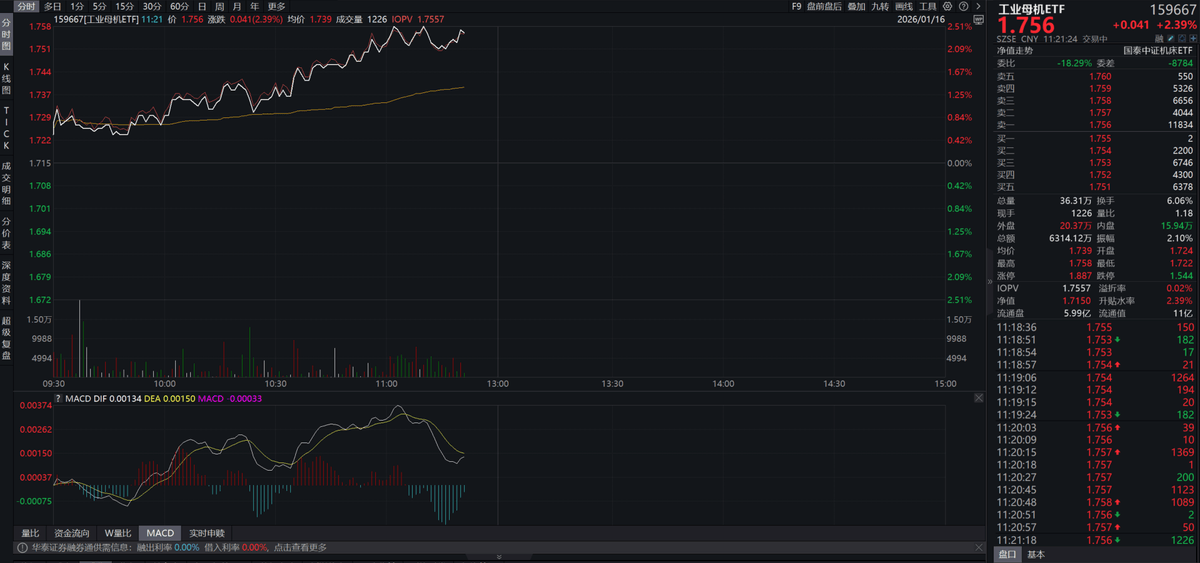
人形机器人、PCB需求双轮驱动,工业母机ETF(159667)大涨2%
Mei Ri Jing Ji Xin Wen· 2026-01-16 06:24
Group 1 - The core viewpoint highlights the positive catalysts in humanoid robots and PCB equipment sectors, which are closely related to the industrial mother machine industry, with the Industrial Mother Machine ETF (159667) expected to benefit significantly from these developments [1][9]. - The Industrial Mother Machine ETF tracks an index where the combined weight of robot and PCB equipment-related stocks is approximately 58%, indicating a strong potential for growth in these areas [9]. - On January 16, the Industrial Mother Machine ETF (159667) surged over 2%, reflecting market optimism regarding the catalysts in these sectors [1]. Group 2 - Humanoid robots are gaining attention, with Tesla's Optimus V3 expected to start mass production in 2026, showcasing advanced design and functionality [3]. - The humanoid robot sector has seen increased activity since July 2025, with significant events and developments, although a temporary pullback occurred due to external factors [3]. - Key future developments to watch include Tesla's humanoid robot progress and the listing of Yushu Technology [3]. Group 3 - The demand for PCBs is expected to rise significantly due to the rapid development of AI infrastructure, with AI servers requiring PCBs that can be 5 to 7 times more valuable than traditional servers [6]. - The global server and data storage market is projected to grow by 45.5% year-on-year in 2024, with continued double-digit growth expected in the coming years [6]. - Domestic PCB manufacturers are in the early stages of expansion, which is likely to drive demand for equipment and materials, leading to a simultaneous increase in both volume and price [6]. Group 4 - The machine tool industry in China is characterized by a "large but not strong" dynamic, with high-end sectors still reliant on imports, indicating significant room for domestic substitution [9]. - The CNC rate for metal processing machine tools in China has rebounded to approximately 40% in 2023, but there remains substantial growth potential compared to developed countries where the rate exceeds 70% [9].


战新产业增加值占比大幅提升!地方国企“十五五”发展目标定了
Xin Lang Cai Jing· 2026-01-16 03:31
Group 1 - The core objective of the "14th Five-Year Plan" for local state-owned enterprises (SOEs) is to significantly enhance technological self-reliance, achieve rapid breakthroughs in key core technologies, and steadily increase the number of leading technology enterprises [1] - The focus for 2026 includes improving quality and efficiency, enhancing growth quality, and exploring growth potential while ensuring smooth economic circulation [1] - A total of 500 billion yuan in new policy financial tools has been fully allocated, supporting over 2,300 projects with a total investment of approximately 7 trillion yuan [1] Group 2 - The emphasis on stabilizing growth includes promoting major project implementation in urban renewal, affordable housing, and new infrastructure such as smart logistics and 5G IoT to stimulate consumption [2] - The State-owned Assets Supervision and Administration Commission (SASAC) aims to strengthen the role of SOEs in technological innovation, optimize the layout of state-owned capital, and enhance traditional industries while developing emerging pillar industries [2][3] - Key areas for SOE reform this year include deepening the "three systems" reform, improving innovation mechanisms, and establishing a regulatory model that balances state asset security with development vitality [3]

21专访丨浙商宏观首席林成炜:黄金上涨仍有支撑 长期看好A股
2 1 Shi Ji Jing Ji Bao Dao· 2026-01-15 23:32
Group 1 - The core view is that the trend of residents moving savings from deposits to diversified assets like equities, gold, and insurance will continue into 2026, supported by improving fundamentals and declining deposit rates [1][18] - The A-share market is expected to experience a main upward trend driven by liquidity and risk appetite recovery, with a focus on indices like the CSI 2000, STAR 50, and ChiNext [4][21] - The bond market is anticipated to see a downward trend in interest rates, with the 10-year government bond yield expected to reach around 1.5% [5][22] Group 2 - The RMB/USD exchange rate is projected to peak at around 6.8 in the first half of 2026, with an average around 7 for the year [7][23] - The outlook for commodities includes a bullish stance on precious and non-ferrous metals, while maintaining a bearish view on crude oil, targeting $50 per barrel for WTI [8][24] - The GDP growth target for 2026 is set at approximately 4.8%, with quarterly expectations of 5.1%, 4.8%, 4.6%, and 4.7% [10][26] Group 3 - The fiscal policy for 2026 is expected to be more proactive, with a deficit rate projected between 4.0% and 4.2%, corresponding to a deficit scale of approximately 5.89 trillion to 6.19 trillion yuan [11][27] - The monetary policy is anticipated to be moderately loose, with potential for 50 basis points of reserve requirement ratio cuts and 10 basis points of interest rate cuts throughout the year [12][28] - The demand for financing in 2026 is expected to improve, with new credit estimated at 17.6 trillion yuan, reflecting a year-end growth rate of 6.5% [15][30] Group 4 - Key investment opportunities in 2026 are expected to focus on core technology breakthroughs, integration of technology and industry, and the transformation of manufacturing towards high-end, intelligent, and green practices [16][31] - The investment landscape will likely benefit from policies supporting infrastructure and high-end manufacturing, with a focus on projects that enhance economic stability [11][30]

专访浙商宏观首席林成炜:2026年A股仍处于慢牛行情
2 1 Shi Ji Jing Ji Bao Dao· 2026-01-15 11:17
Group 1 - The core view is that the trend of residents moving savings from deposits to diversified assets like equities, gold, and insurance will continue into 2026, supported by improved fundamentals and declining deposit rates [1][6] - A-shares are expected to experience a main upward trend driven by liquidity and risk appetite, with a focus on technology growth sectors such as integrated circuits and advanced materials [1][6] - The long-term upward trend in gold prices is supported by two main factors: the ongoing devaluation of the dollar and the increasing demand for gold by central banks to mitigate risks [1][8] Group 2 - In 2026, the A-share market is anticipated to show a structural market characterized by low volatility dividends and technology growth, with key indices like the ChiNext and STAR Market expected to perform well [6] - The bond market is projected to experience a downward trend in interest rates, with the 10-year government bond yield expected to reach around 1.5% [7] - The RMB/USD exchange rate is expected to fluctuate around 7, with a potential high of 6.8 in the first half of 2026 [7] Group 3 - The overall outlook for commodities is bullish on precious and non-ferrous metals while bearish on crude oil, with a target price of $50 per barrel for WTI crude [9] - The 2026 GDP growth target is set at around 4.8%, with industrial growth policies expected to support this target [10][11] - The fiscal deficit is projected to be between 4.0% and 4.2%, with a total deficit scale of approximately 5.89 trillion to 6.19 trillion yuan [11] Group 4 - The expected new credit scale for 2026 is around 17.6 trillion yuan, with a year-end growth rate of 6.5%, while social financing is projected to increase by approximately 36.2 trillion yuan [16] - The real estate market is expected to maintain a strict control on new projects due to high inventory levels, with potential policy adjustments in major cities [18] - Key investment opportunities in 2026 are anticipated in technology and green industries, particularly in areas like artificial intelligence and renewable energy [19][20]


在发展中固安全 在安全中谋发展(学习贯彻党的二十届四中全会精神)
Ren Min Ri Bao· 2026-01-14 23:03
Group 1 - The concept of coordinating development and security is a fundamental principle emphasized by Xi Jinping, highlighting the need for a balance between economic growth and national security [1][2][3] - The integration of development and security is seen as a significant innovation in economic and national security theories, moving beyond traditional dichotomies [4][5] - The relationship between development and security is characterized as a dialectical unity, where development is the foundation of security, and security is a prerequisite for development [3][6] Group 2 - The practical implementation of the coordinated development and security concept has led to significant advancements in China's economic strength and technological self-reliance, enhancing national security [8][9] - China's GDP reached 134.9 trillion yuan in 2024, with a growth rate of 5.0%, contributing approximately 30% to global economic growth [9] - The manufacturing sector remains robust, with a global share of nearly 30%, and significant advancements in research and development, particularly in critical technology areas [9][10] Group 3 - The construction of a new security framework is essential for supporting high-quality development, with a focus on systemic restructuring of national security mechanisms [12][18] - The emphasis on food and energy security has been strengthened, with grain production stabilizing at over 1.3 trillion jin annually and energy self-sufficiency maintained above 80% [10][11] - The resilience and competitiveness of supply chains have been enhanced to effectively counter external pressures, particularly in key industries like integrated circuits and advanced materials [11][16] Group 4 - The strategic focus on technological self-reliance is critical for national security, with an emphasis on overcoming "choke point" issues in key technology sectors [17][19] - The establishment of a comprehensive national security system is aimed at ensuring political stability and economic health, addressing risks in various sectors including finance and real estate [19][20] - The ongoing development of a modern industrial system is crucial for maintaining national security, with a focus on enhancing domestic capabilities and reducing reliance on imports [16][17]
2026开年市场洞察
Sou Hu Cai Jing· 2026-01-14 02:11
Group 1 - The core viewpoint is that the A-share market in 2026 is likely to be driven by a dual engine of "consumption recovery" and "technology self-reliance" [5] - The national fiscal work conference has set the tone for 2026, emphasizing "strongly boosting consumption" and committing to "continue arranging funds to support the replacement of consumer goods" [4] - Short-term investment focus should be on sectors directly benefiting from subsidies, such as major appliances, new energy vehicles, and smart home industries [4] Group 2 - The current market shows no significant risk points, with a neutral to warm risk preference expected to be maintained [7] - The resilience of the Chinese economy has been demonstrated through the pressure test of tariff conflicts in 2025, leading to a significant reduction in concerns about future tariff and trade-related risks [7] - The cyclical industries, such as non-ferrous metals and chemicals, are expected to benefit from economic recovery and supply-side improvements, presenting promising profit recovery potential [7]

鉴往知来的产业脉络与机遇航图:“十五五”规划:循迹探新
Dongguan Securities· 2026-01-13 09:46
Group 1 - The "15th Five-Year Plan" emphasizes a transition from scale expansion to connotative development, focusing on high-quality growth and systemic integration [12][25] - The plan aims to establish a modern industrial system, highlighting the importance of the real economy and technological self-reliance [12][30] - Key areas of focus include technological innovation, expanding domestic demand, and building a robust security framework for industries and supply chains [12][30] Group 2 - The "15th Five-Year Plan" is positioned as a critical period for consolidating the foundation for achieving socialist modernization by 2035 [25][26] - Compared to the "14th Five-Year Plan," the "15th Five-Year Plan" places greater emphasis on quality and resilience in development, reflecting a cautious approach to international environments [25][28] - The plan outlines specific goals for economic growth, including a significant increase in the resident consumption rate and enhancing the role of domestic demand in driving economic growth [30][33] Group 3 - The capital market is expected to benefit from the policy catalysis effect of the "15th Five-Year Plan," with historical data indicating that planning periods often coincide with market uptrends [12][29] - Investment themes are centered around technological self-reliance, modernization of the industrial system, and sectors that boost domestic demand [12][30] - The manufacturing sector is anticipated to receive support from policy, funding, and fundamental improvements, particularly in advanced manufacturing [30][31]
AI、高股息、新质生产力:2026开年市场如何走?|投向预言家
Sou Hu Cai Jing· 2026-01-13 08:47
Group 1 - The core viewpoint for 2026 A-shares is likely to be driven by a dual engine of "consumption recovery" and "technological self-reliance" [4] - The national fiscal work conference has set the tone for 2026, emphasizing "strongly boosting consumption" and committing to "continue arranging funds to support the replacement of consumer goods" [3] - Short-term focus should be on sectors directly benefiting from policies, such as major appliances, new energy vehicles, and smart home industries, which are the primary targets for subsidies [3] Group 2 - Mid-term investments should target "hard technology" sectors like semiconductors, industrial mother machines, and AI hardware, as the conference highlighted increased investment in technology and key manufacturing industry actions [3] - Long-term attention should be given to areas related to employment services, vocational training, and urban renewal, which are crucial for improving consumer capacity [3] - The market's risk appetite is expected to remain neutral to warm, with a significant reduction in concerns over potential tariff and trade-related risks, supported by positive government statements from both China and the U.S. regarding economic performance in 2026 [5] Group 3 - Structural opportunities are anticipated to expand further in 2026, with cyclical industries like non-ferrous metals and chemicals expected to benefit from economic recovery and supply-side improvements [5] - The ongoing AI wave and the demand for self-reliance in technology remain core investment themes [5] - The difficulty of stock selection is expected to increase in 2026, necessitating in-depth research to seize stock picking and timing opportunities [5]

八部门发文:2027年我国人工智能产业规模稳居世界前列
Yang Zi Wan Bao Wang· 2026-01-12 11:11
Core Viewpoint - The integration of artificial intelligence (AI) with the real economy is accelerating, significantly transforming manufacturing production models and economic forms. The Chinese government has issued a joint implementation opinion aimed at enhancing AI capabilities in the manufacturing sector by 2027 [1]. Group 1: Implementation Goals - By 2027, key AI technologies in China are expected to achieve secure and reliable supply, with the industry scale and empowerment level remaining among the world's top [1]. - The plan aims to promote the deep application of 3-5 general large models in manufacturing, launch 1,000 high-level industrial intelligent entities, create 100 high-quality data sets in industrial fields, and promote 500 typical application scenarios [2]. - The initiative includes cultivating 2-3 globally influential leading enterprises and a number of specialized small and medium-sized enterprises, as well as establishing a global leading open-source ecosystem [1][2]. Group 2: Focus Areas for Development - The opinion emphasizes accelerating the empowerment of key manufacturing sectors such as raw materials, equipment manufacturing, consumer goods, electronic information, and software services [2]. - It highlights the importance of intelligent auxiliary design, software code assistance, and drug research and development to create personalized, low-cost, and efficient new research and design models [2]. - The plan encourages leading enterprises and state-owned enterprises to pioneer the application of industrial intelligent entities and explore new models of AI empowerment in manufacturing [2]. Group 3: Technological Advancements - The initiative calls for the acceleration of intelligent equipment iterations, including the application of intelligent entities in industrial mother machines and robots, and the development of new-generation AI numerical control systems [2]. - It aims to promote the integration of AI technologies into the research, manufacturing, and operation of major technical equipment such as large aircraft and ships, as well as the development of intelligent low-altitude equipment like drones [2]. - The plan also includes testing and safety evaluations for smart connected vehicles equipped with autonomous driving functions [2]. Group 4: Ethical and Transparency Measures - The opinion requires enhancing AI transparency and explainability through measures such as the identification of generated synthetic content [3]. - It emphasizes the implementation of ethical management services for AI technology and the strengthening of industry self-regulation to improve enterprises' ability to prevent ethical risks associated with AI [3].
2026首周行情利好,躁动的资本能走多远?
Sou Hu Cai Jing· 2026-01-11 14:03
Group 1 - Global stock markets, commodities, and credit markets have shown strong performance in the first trading week of 2026, with the S&P 500 index rising 1.6% to reach a historical high and the Russell 2000 small-cap index surging 4.6% [2] - The A-share market has also performed exceptionally well, with the Shanghai Composite Index breaking through 4100 points and achieving a "16 consecutive days of gains," with a single-day trading volume reaching 3.15 trillion yuan, marking the fifth highest in history [2][5] - The commodities market has seen significant movements, with oil experiencing its largest single-day increase since October of the previous year, silver rising 10% over the week, and gold nearing historical highs [2] Group 2 - Short-term liquidity is identified as a key factor driving asset prices, with the Federal Reserve's balance sheet expansion and fiscal account releases potentially bringing about approximately $600 billion in liquidity in the first quarter [3] - The market sentiment has shifted from defensive assets to cyclical stocks and high-risk varieties, supported by policies from the Trump administration [3] Group 3 - There is a noted disconnect between current optimistic sentiment and the underlying fundamentals, raising concerns about potential market volatility due to future expectation adjustments [4] - The A-share market's performance is characterized by a broad-based rally, with over 3900 stocks rising, indicating a healthier market structure compared to previous years [18] Group 4 - The significant increase in trading volume and financing balance suggests that new capital, particularly leveraged funds, is actively positioning for a new economic cycle rather than engaging in speculative behavior at market peaks [19][20] - The market is undergoing a healthy rotation of funds, with outflows concentrated in previously high-performing sectors while inflows are directed towards emerging sectors like media and home appliances [21][22] Group 5 - The current market environment is seen as a historical resonance point between "stock optimization" and "new capital entry," with domestic institutions actively reallocating assets while new capital is being attracted to the market [23] - The upcoming period is expected to maintain a favorable environment for bullish sentiment, supported by a friendly monetary environment and expectations of policy support ahead of important domestic meetings [26] Group 6 - Post-Spring Festival, the market is anticipated to transition into a highly structured value discovery process rather than a broad-based bull market, focusing on sectors that resonate with "global nominal growth" [27][28] - Key sectors include high-end manufacturing that can capture overseas capital expenditure needs, as well as traditional industries undergoing necessary adjustments that may present unexpected investment opportunities [30][32]