
燃气轮机

Search documents
订单与股价齐飞!AI引爆需求,这个传统板块成了“香馍馍”
券商中国· 2026-02-15 08:18
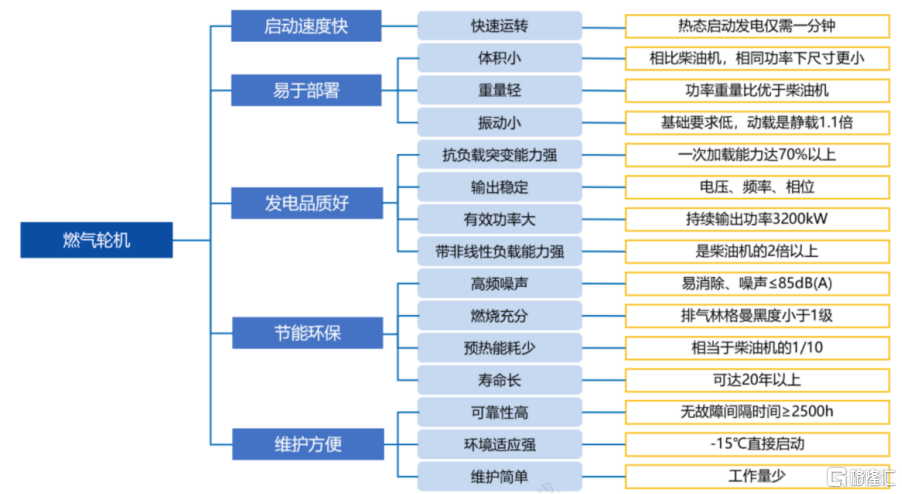
Core Viewpoint - The gas turbine industry is experiencing significant growth driven by the increasing power demand from AI applications, particularly in the North American market [2][6]. Group 1: Market Demand and Growth - The global demand for gas turbines is expected to rise, with a forecasted additional requirement of 31GW of power for AI data centers in the U.S. over the next five years [6]. - The electricity consumption of global data centers is projected to increase from 415TWh in 2024 to 945TWh by 2030, with the U.S. accounting for 45% of this demand [6]. - The North American market is focusing on traditional power generation equipment such as gas turbines, gas internal combustion engines, and diesel generators to meet the surging electricity needs [2]. Group 2: Company Performance - Companies like Jerry Holdings and Yingliu Technology have seen their stock prices soar, with Jerry Holdings' stock increasing by 96% in 2025 and an additional 38.94% in the first two months of this year [5]. - Yingliu Technology's stock has risen over 50% this year, while Dongfang Electric's stock has increased by more than 30% [5]. - Jerry Holdings has secured four contracts in North America since November 2025, with a total contract value of approximately 34 billion yuan [5]. Group 3: Advantages of Gas Turbines - Gas turbines are favored for their quick startup, easy deployment, stable power generation, energy efficiency, low maintenance, and cost-effectiveness, making them an optimal choice for AI data center power supply [7]. - The efficiency of gas turbine combined cycles can exceed 60%, and they have the lowest cost per kilowatt-hour [7]. Group 4: Future Projections - The global gas turbine sales are expected to increase, with the number of MW orders projected to rise from 58GW in 2024 to 71GW in 2025, and the number of units ordered expected to grow from 471 to 964 [8]. - Major manufacturers like GE, Siemens, and Mitsubishi Heavy Industries have their order deliveries scheduled until 2029, indicating strong future demand [7].




AI 算力倒逼电力革命,节后这个方向不容错过
3 6 Ke· 2026-02-13 09:49
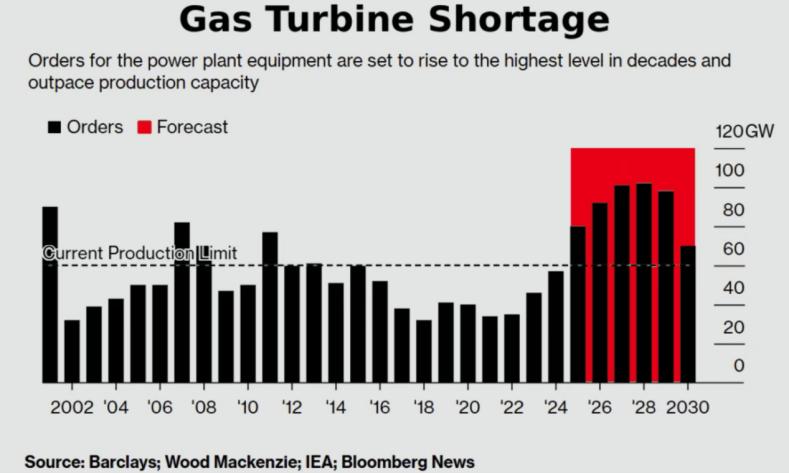
Core Viewpoint - The increasing power consumption of AI data centers is creating a significant demand for gas turbines, which are becoming the preferred solution for addressing power supply gaps in the industry [1][2]. Group 1: Demand and Supply Dynamics - The gas turbine sector is experiencing a robust uptrend driven by four key factors: explosive demand, rigid supply constraints, technological barriers, and overseas market transmission [2]. - AI data centers' electricity consumption has surged from 50MW to as high as 1GW, with projections indicating that by 2030, AI data centers will account for 16% of total U.S. electricity consumption, necessitating an additional 104-130GW of power generation capacity [2]. - The aging U.S. power grid, with an average lifespan exceeding 35 years, is unable to meet the rising electricity demand, while alternative energy sources like nuclear and renewables face long construction timelines and stability issues [2]. Group 2: Gas Turbine Market Characteristics - Gas turbines are favored for their quick startup, short construction cycles, economic efficiency, and high reliability, making them the standard power supply solution for AI data centers [3]. - The global gas turbine market is dominated by three major players—Mitsubishi Heavy Industries, Siemens Energy, and GE Vernova—who collectively hold a 76.3% market share, with future global orders expected to reach 100GW per year against a current manufacturing capacity of approximately 60GW, indicating a significant supply-demand gap [3][7]. - Orders for popular gas turbine models are currently scheduled for delivery between 2028 and 2030, highlighting the extended lead times in the industry [3]. Group 3: Industry Growth and Opportunities - Major overseas players are experiencing a surge in orders, with GE Vernova reporting a 46% year-on-year increase in gas turbine orders, and Siemens Energy's gas service business seeing a 42% increase in new orders [7]. - The supply chain for gas turbines is complex, with critical components like high-temperature blades facing long production cycles of 3-5 years, creating bottlenecks in supply [8]. - Domestic companies are positioned to benefit from the overflow of orders as international firms shift production to China, leveraging a complete high-end manufacturing supply chain and technological advancements [8]. Group 4: Investment Focus Areas - Future investments should focus on three main areas: overseas demand transmission, technological barriers, and domestic substitution [9]. - Companies with strong overseas integration capabilities and local service advantages are prioritized for short-term performance, while core component suppliers are seen as long-term stable investments due to their critical role in the gas turbine value chain [9][10]. - Domestic pioneers in gas turbine technology are expected to gain traction as the industry moves towards greater localization, particularly in heavy-duty turbines and supporting materials [10]. Conclusion - The surge in AI computing demand is reshaping the global energy supply landscape, with gas turbines emerging as the optimal short-term power solution, leading to a period of significant growth in the industry [11]. - The ongoing verification of industry data and the increasing demand for gas turbines suggest a favorable outlook for the sector, with a focus on overseas demand, technological barriers, and domestic substitution as key investment themes [11].


AI 算力倒逼电力革命,节后这个方向不容错过!
Sou Hu Cai Jing· 2026-02-13 09:18
Core Viewpoint - The increasing power consumption of AI data centers is creating a significant demand for gas turbines, which are becoming the preferred solution for addressing power supply shortages in the industry [1][2]. Group 1: Demand and Supply Dynamics - The gas turbine sector is experiencing a strong upward trend driven by four key factors: explosive demand, rigid supply constraints, technological barriers, and overseas market conditions [2]. - AI data centers' electricity consumption has surged from 50MW to as high as 1GW, with projections indicating that by 2030, AI data centers will account for 16% of the total electricity consumption in the U.S., necessitating an additional 104-130GW of power generation capacity [2]. - The aging U.S. power grid infrastructure, with an average lifespan exceeding 35 years, is unable to meet the rising electricity demand, while alternative energy sources like nuclear and renewables face long construction timelines and stability issues [2]. Group 2: Market Structure and Competition - The global gas turbine market is dominated by three major players: Mitsubishi Heavy Industries, Siemens Energy, and GE Vernova, which collectively hold a 76.3% market share [4]. - The global order for gas turbines is expected to reach 100GW per year, while current manufacturing capacity is only about 60GW, indicating a significant supply-demand gap [4]. - Popular gas turbine models currently have order backlogs extending to 2028-2030, with delivery cycles of 3-5 years [5]. Group 3: Industry Growth and Opportunities - Major companies like GE Vernova and Siemens Energy are reporting substantial increases in gas turbine orders, with GEV's new orders up 46% and Siemens Energy's gas service orders increasing by 42% year-on-year [8]. - The supply chain for gas turbines is complex, with critical components like high-temperature blades facing long production cycles of 3-5 years, creating bottlenecks in expansion [8]. - Domestic companies are positioned to benefit from the overflow of orders as international leaders shift production to China, leveraging a robust high-end manufacturing supply chain [9]. Group 4: Investment Focus Areas - Investment strategies should focus on three main areas: overseas demand transmission, technological barriers, and domestic substitution [10]. - Key investment targets include companies with strong overseas integration capabilities, core component suppliers, and domestic pioneers in technology breakthroughs [10][11]. - The gas turbine industry is entering a "golden development period" characterized by rising demand and prices, driven by the explosion of AI computing needs [11].
AI 算力倒逼电力革命,节后这个方向不容错过!
格隆汇APP· 2026-02-13 08:17
Core Viewpoint - The article discusses the rising demand for gas turbines driven by the explosion of AI computing power, highlighting a significant shift in the energy supply landscape and the emergence of a golden development period for the gas turbine industry [4][16]. Group 1: Industry Demand and Supply Dynamics - AI data centers' power consumption has surged from 50MW to as high as 1GW, creating a substantial electricity supply gap that gas turbines are well-positioned to fill [4][7]. - The demand for electricity from AI data centers is expected to grow exponentially, with projections indicating that by 2030, AI data centers will account for 16% of total U.S. electricity consumption, necessitating an additional 104-130GW of power generation capacity [7]. - The global gas turbine market is characterized by an oligopolistic structure, with three major players—Mitsubishi Heavy Industries, Siemens Energy, and GE Vernova—holding a combined market share of 76.3% [8]. Group 2: Market Trends and Order Backlogs - Current global gas turbine orders are backlogged until 2028-2030, with delivery cycles ranging from 3 to 5 years, indicating strong demand and supply constraints [9]. - Major companies like GEV and Siemens Energy have reported significant increases in new gas turbine orders, with GEV's orders up 46% and Siemens Energy's gas service orders increasing by 42% year-over-year [12]. Group 3: Supply Chain and Technological Barriers - The gas turbine supply chain is complex, with critical components like high-temperature blades facing production bottlenecks due to long expansion cycles and cautious capital expenditure from leading manufacturers [12][13]. - The article emphasizes the importance of technological barriers in the gas turbine industry, which create high entry barriers for smaller firms and allow leading companies to maintain profitability amid rising demand [13]. Group 4: Investment Opportunities and Strategic Focus - Future investment strategies should focus on three main themes: overseas demand transmission, technological barriers, and domestic substitution, with an emphasis on identifying core companies that can leverage these trends [14][15]. - Key areas for investment include leading companies with integrated capabilities, core component suppliers, and domestic pioneers in gas turbine technology, particularly in heavy-duty turbines and supporting materials [15]. Conclusion - The surge in AI computing demand is reshaping the global energy supply landscape, with gas turbines emerging as the optimal short-term power solution, leading to a period of simultaneous volume and price increases in the industry [16].

未知机构:国金机械应流股份涨停点评叶片是燃机产业链核心瓶颈环节公司未来成长空间巨大-20260213
未知机构· 2026-02-13 02:00
Company and Industry Summary Company: 应流股份 (Yingliu Co., Ltd.) Key Points - 应流股份 is positioned in the critical bottleneck of the gas turbine industry, specifically in turbine blade production, which is essential for overall turbine capacity [1] - Recent financial reports from major gas turbine manufacturers (GEV, Mitsubishi, Siemens Energy) indicate that new orders for gas turbines exceeded expectations, but delivery has been constrained due to tight capacity, leading to an increase in backlogged orders [1] - Siemens and GEV have extended their backlog coverage to 4.8 years, highlighting the demand for turbine blades [1] - Elon Musk's statement emphasizes that turbine blades are the most constrained component in the gas turbine supply chain, reinforcing the importance of 应流股份 in this sector [1] - 应流股份 has established a strong foundation for growth, having invested heavily in R&D and capacity since 2015, and has already validated its products with leading gas turbine manufacturers [1][2] - The company is expected to see a significant increase in new orders, projecting over 2 billion in new orders for gas turbine blades in 2025, with a year-on-year growth rate exceeding 70% [5] - As of the end of 2025, 应流股份 anticipates a backlog of 1.8 billion in gas turbine orders, indicating a sustained upward trend in orders and revenue over the next 3-5 years [5] - The global market for gas turbine blades is valued at 50 billion, while 应流股份's revenue from gas turbine blades is projected to be less than 1 billion in 2025, indicating substantial growth potential [5] - Compared to HWM, the global leader in turbine blades with over 8 billion in revenue and a market cap of 92.8 billion, 应流股份 currently holds only 1% market share but is expected to increase this to 10% [5] - 应流股份's current market valuation is significantly lower than HWM, with a projected PE ratio of less than 30 times for 2028, suggesting ample room for growth [5] Additional Insights - The company has met three critical conditions for success: timing, prior investment in capacity and R&D, and established relationships with major industry players [2][3][4] - The combination of these factors creates a unique competitive barrier for 应流股份 during the industry's growth phase [4] - Other companies to watch in this sector include 万泽股份, 杰瑞股份, 海联讯, 东方电气, and 崇德科技 [6]
探底回升,持仓还是持币到了最后时刻
Ge Long Hui· 2026-02-12 20:41
Market Overview - The three major indices collectively rose by midday, with the Shanghai Composite Index up 0.12%, the Shenzhen Component Index up 0.81%, and the ChiNext Index up 1.18%. Over 2,700 stocks in the two markets increased, with a total trading volume of 1.33 trillion yuan [1]. Sector Performance - The film and cinema sector experienced a significant decline, dropping 3.05% by midday, with stocks like Huayi Brothers, Hengdian Film, and Bona Film hitting the daily limit down. Other sectors such as grain economy, tax refund stores, community group buying, gaming, short drama interactive games, broadcasting, tourism concepts, and hotel tourism also followed suit with declines exceeding 1% [3]. - The electric grid equipment sector showed strong performance, with companies like Siyi Electric and Sifang Co. reaching new highs, and several stocks including Wangbian Electric, Shun Sodium, and Senyuan Electric hitting the daily limit up. The non-ferrous metals sector was also active, with Xianglu Tungsten gaining three boards in five days and Zhangyuan Tungsten achieving two consecutive boards [3]. - The CPO concept saw renewed strength, with Tianfu Communication rising over 10% to set a new historical high. The gas turbine sector experienced a surge, with Yingliu Co. and Changbao Co. hitting the daily limit up [3]. Price Movements - On February 12, Zhipu announced a structural adjustment to the pricing system of the GLM Coding Plan, with an overall price increase of over 30%. By 2025, China's transformer export value is expected to reach a record 64.6 billion yuan, marking a nearly 36% increase from the previous year [3]. - The price of praseodymium and neodymium oxide continues to rise, reaching 800,000 yuan per ton, with a week-on-week increase of 9.9% and a month-on-month increase of 28.8% [3].

逻辑清晰的液冷和燃机
傅里叶的猫· 2026-02-12 15:58
Group 1: Liquid Cooling and Gas Turbines - Vertiv reported better-than-expected earnings, particularly in orders, indicating a strong year for liquid cooling technology [1] - Domestic liquid cooling companies saw significant stock price increases, with leading company Inveca hitting the daily limit [2] - Siemens Energy's earnings also exceeded expectations, with a record backlog of €146 billion in orders, driven by high demand for gas turbines and grid technology [3] Group 2: Autonomous Driving - The U.S. House Energy and Commerce Committee held a hearing to ease regulations on autonomous vehicle deployment, highlighting concerns about competition with China [4] - The passage of the Autonomous Driving Bill by the U.S. House Energy and Commerce Committee marks a significant step towards accelerating autonomous driving deployment across the U.S. [4] - In China, the Ministry of Industry and Information Technology is soliciting public opinions on new mandatory national standards for autonomous driving systems, indicating a proactive approach to regulation [7] Group 3: Industry Insights and Updates - The Knowledge Star platform has upgraded its daily reports to include summaries of news from major international media and insights from analysts across various industries, including memory, autonomous driving, and liquid cooling [8]

豪迈科技股价创新高,受益于燃气轮机行业景气度提升
Jing Ji Guan Cha Wang· 2026-02-12 10:56
Core Viewpoint - The stock price of Haomai Technology reached a historical high due to the improving sentiment in the gas turbine industry and the company's strong fundamentals [1] Industry Policy and Environment - The construction boom of AI data centers in the U.S. has led to a surge in electricity demand, making gas turbines a key power solution. As of January 2026, the installed natural gas power generation capacity under construction in the U.S. exceeded 29 GW, more than doubling within a year, with planned capacity reaching 159 GW [2] - Supply chain bottlenecks are evident, with GE Vernova reporting an approximately 80% increase in gas turbine contracts for 2025, and Siemens Energy expecting to sell nearly 200 units in the U.S. that year, with delivery times extending from 3.5 years to 5 years [2] - Haomai Technology, as a core supplier to giants like GE and Siemens, benefits directly from this supply-demand gap, with full order books supporting performance [2] Performance and Operating Conditions - In the first three quarters of 2025, the company reported revenue of 8.076 billion yuan, a year-on-year increase of 26.89%, and a net profit attributable to shareholders of 1.788 billion yuan, up 26.21% [3] - The third quarter net profit was 592 million yuan, reflecting a year-on-year growth of 29.49% [3] - The business structure has been optimized, with the tire mold business benefiting from the recovery of Chinese tire companies' overseas factories, and the CNC machine tool business seeing a 145% year-on-year revenue increase in the first half of 2025 [3] - The gross margin for the first three quarters was 33.99%, and the net margin was 22.15%, with the expense ratio decreasing by 1.44 percentage points to 8.18% [3] Financial and Technical Aspects - On February 12, the net inflow of main funds was 321,400 yuan, with the stock price rising 16.87% over the past five days [4] - Institutional investors are optimistic, with Guotou Securities giving a "Buy-A" rating on February 10 and a target price of 95.84 yuan. Four institutions have issued buy ratings in the past 90 days, with an average target price of 97.0 yuan [4] - The machinery equipment sector saw a net inflow of 6.904 billion yuan on the same day, with an industry increase of 1.45%, amplifying individual stock gains [4] Company Fundamentals - The management team is stable, with founder Zhang Gongyun frequently increasing his holdings, and core executives having long tenures, fostering a culture of innovation that enhances per capita revenue [5] - The current price-to-earnings ratio is 33.09 times, which, while higher than the specialized equipment industry average of 29.59 times, is lower than the company's historical level of 37.47 times, with performance growth supporting the valuation [5]

港股收盘(02.12) | 恒指收跌0.86% 科网股拖累大市走低 大模型“双雄”齐创新高
智通财经网· 2026-02-12 08:45
Market Overview - The Hong Kong stock market declined today, influenced by technology stocks, with the Hang Seng Index closing down 0.86% at 27,032.54 points, marking the end of a three-day rally [1] - The Hang Seng Technology Index fell 1.65% to 5,408.98 points, indicating a weak performance in the tech sector [1] Blue-Chip Stocks Performance - Zijin Mining (02899) led blue-chip gains, rising 3.45% to HKD 45.02, contributing 14.47 points to the Hang Seng Index, following a target price increase by Citigroup of over 30% for both A-shares and H-shares [2] - WuXi AppTec (02359) and Sun Hung Kai Properties (00016) also saw gains of 2.91% and 2.85%, respectively, while Budweiser APAC (01876) and Trip.com Group (09961) faced declines of 5.21% and 3.9% [2] Sector Highlights - The technology sector faced pressure, with Tencent and Alibaba dropping over 2% and nearly 1%, respectively [3][6] - The AI model sector saw significant gains, with Zhizhu (02513) rising 28.68% and MINIMAX-WP (00100) increasing over 14% [3] - The chip sector experienced a notable rise, with Tianzhi Zhixin (09903) and Zhaoyi Innovation (03986) surging over 20% [4] Notable Company Developments - Zhizhu confirmed the launch of its new model GLM-5, which has seen a price increase of at least 30% for subscription packages, while existing subscribers will maintain their current rates [4] - Micron Technology's stock rose significantly in the U.S. market, with a target price increase to USD 450 by Morgan Stanley, reflecting strong demand driven by AI applications [5] Emerging Trends - The gas turbine sector is gaining traction due to a surge in electricity demand in North America, with companies like Harbin Electric (01133) and Dongfang Electric (01072) seeing substantial stock increases [6] - The North American electricity shortage is expected to create investment opportunities across various technologies, including gas turbines and energy storage [6] Company-Specific News - Budweiser APAC reported a revenue decline of 7.7% to USD 5.764 billion for the year ending December 31, 2025, with a significant drop in net profit by 32.6% [9] - China National Heavy Duty Truck (03808) achieved record high exports of over 16,000 heavy trucks in January, marking a 22.5% year-on-year increase in total vehicle sales for 2025 [8]
燃气轮机专题汇报:供给变革、需求共振与核心环节国产化机遇
2026-02-11 15:40
Summary of Conference Call on Gas Turbine Industry Industry Overview - The conference focused on the gas turbine industry, particularly in the context of North America's electricity shortage and the increasing demand for power generation technologies [2][4]. Key Points and Arguments 1. **Global Demand and Supply Dynamics**: - In 2022, the global demand for gas turbines was 40 GW, increasing to 44 GW in 2023 and projected to reach 58 GW in 2024. By 2025, new orders are expected to be around 85 GW, with a long-term demand forecast exceeding 200 GW by 2030 [3][4]. - Current supply is constrained, with only 57 GW available against a demand of 87 GW for new orders in 2025, leading to a significant supply-demand gap [3][4]. 2. **Technological Adjustments**: - The industry is experiencing a dynamic adjustment in technology paths due to supply chain constraints and regional demand imbalances. Gas turbines remain the primary technology, but there is a shift towards other technologies as well [4][5]. 3. **Investment Opportunities**: - The investment focus should be on segments with the tightest supply constraints, such as gas turbine hot-end components and large-bore engines. There is also potential in domestic and export replacements, as well as companies that are well-positioned within global supply chains [7][12]. 4. **Service Market Growth**: - The global gas turbine service market is projected to grow from $38 billion in 2023 to approximately $87 billion by 2033, indicating a significant compound annual growth rate [8]. 5. **Gas Internal Combustion Engines**: - Gas internal combustion engines, particularly medium-speed engines, are gaining traction due to their cost-effectiveness and shorter delivery times compared to gas turbines. The cost per kilowatt-hour for medium-speed engines is competitive, making them attractive for specific applications [9][10]. 6. **Diesel Generators**: - Diesel generators are recognized as essential backup power sources, especially in data centers. The demand for diesel generators is expected to grow significantly, with a projected market size increase from over $11 billion in 2025 to approximately $16.5 billion by 2029 [10][11]. Additional Important Insights - **Market Concentration**: - The gas turbine market is highly concentrated, with a few key players dominating the supply chain. This concentration leads to rigid supply constraints, particularly in the production of critical components like hot-end blades [6][7]. - **Company Recommendations**: - Key companies highlighted include: - **Jereh**: Strong performance in gas turbine manufacturing and global supply chain advantages [12]. - **Inflow**: Focused on hot-end components with strong order visibility and partnerships with major global players [13]. - **Haomai**: A leading supplier of cold-end components with stable growth prospects [14]. - **Dongfang Electric**: A major domestic player with a significant market share and potential for valuation appreciation [15]. - **LianDe**: Positioned well across multiple segments with a focus on efficiency and cost reduction [16]. This summary encapsulates the critical insights and projections discussed during the conference call, providing a comprehensive overview of the gas turbine industry and its investment landscape.
